


Ancient Site Sparks Heated Political Debate about India's Past

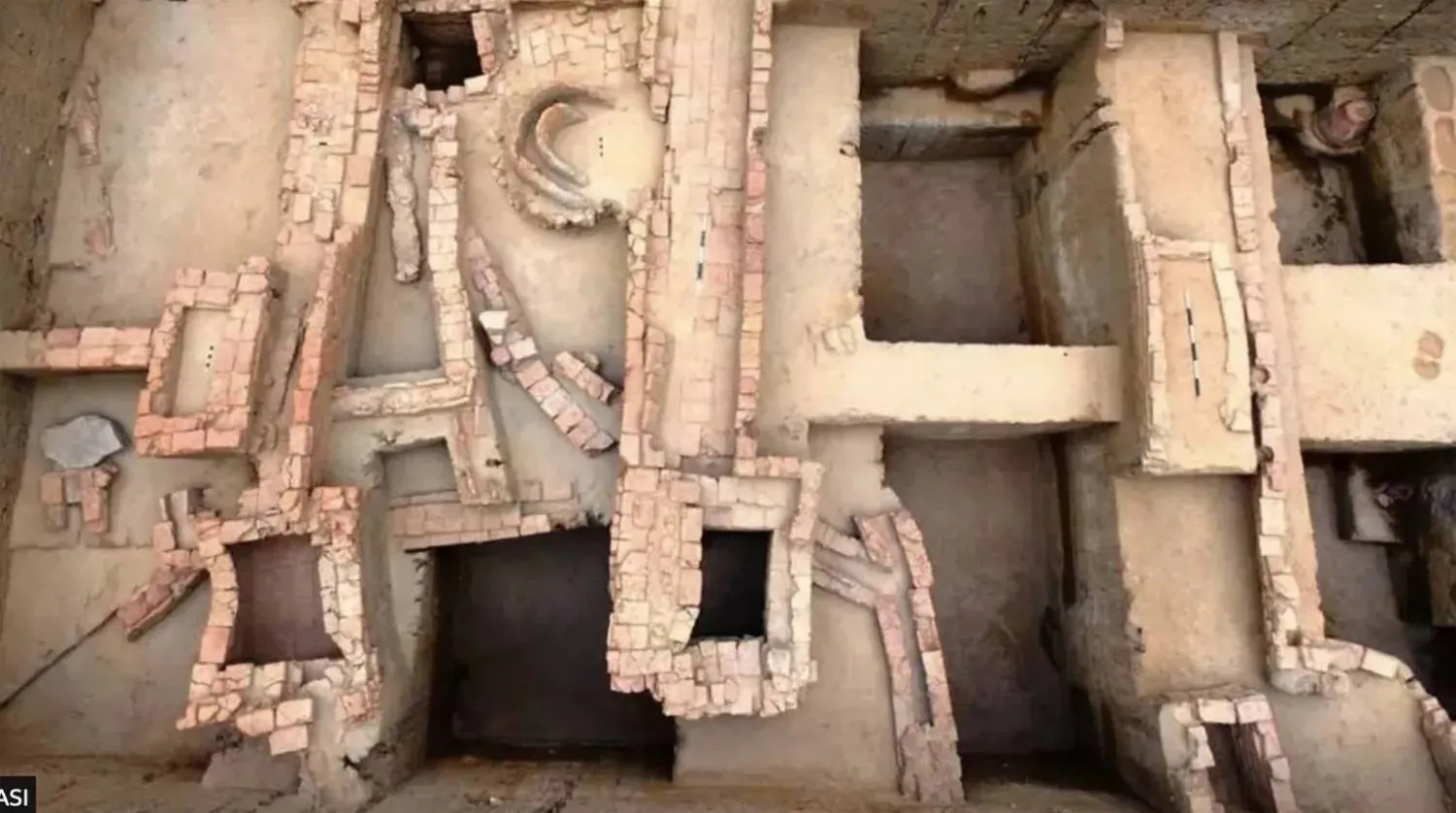
A view of an excavated site in Keeladi. (Archaeological Survey of India)
TT

Ancient Site Sparks Heated Political Debate about India's Past

A view of an excavated site in Keeladi. (Archaeological Survey of India)

The Keeladi village in India's southern Tamil Nadu state has unearthed archeological finds that have sparked a political and historical debate.

Amid coconut groves, a series of 15ft (4.5m) deep trenches reveal ancient artifacts buried in layers of soil - fragments of terracotta pots, and traces of long-lost brick structures, BBC reported on Monday.

Experts from the Tamil Nadu State Department of Archaeology estimate the artifacts to be 2,000 to 2,500 years old, with the oldest dating back to around 580 BCE. They say these findings challenge and reshape existing narratives about early civilization in the Indian subcontinent.

With politicians, historians, and epigraphists weighing in, Keeladi has moved beyond archaeology, becoming a symbol of state pride and identity amid competing historical narratives.

Yet history enthusiasts say it remains one of modern India's most compelling and accessible discoveries - offering a rare opportunity to deepen understanding of a shared past.

Keeladi, a village 12km (7 miles) from Madurai on the banks of the Vaigai river, was one of 100 sites shortlisted for excavation by Archaeological Survey of India (ASI) archaeologist Amarnath Ramakrishnan in 2013.

He selected a 100-acre site there because of its proximity to ancient Madurai and the earlier discovery of red-and-black pottery ware by a schoolteacher in 1975.

Ajay Kumar, leading the state archaeology team at Keeladi, said the key finds are elaborate brick structures and water systems - evidence of a 2,500-year-old urban settlement.

“This was a literate, urban society where people had separate spaces for habitation, burial practices and industrial work,” Kumar said, noting it's the first large, well-defined ancient urban settlement found in southern India.

William Daniel, a teacher from neighboring Kerala, said the discoveries made him feel proud about his heritage.

“It gives people from the south [of India] something to feel proud about, that our civilization is just as ancient and important as the one in the north [of India],” he said.

The politics surrounding Keeladi reflects a deep-rooted north-south divide - underscoring how understanding the present requires grappling with the past.

India's first major civilization, the Indus Valley, emerged in the north and central regions between 3300 and 1300 BCE. After its decline, a second urban phase, the Vedic period, rose in the Gangetic plains, lasting until the 6th Century BCE.

This phase saw major cities, powerful kingdoms and the rise of Vedic culture - a foundation for Hinduism. As a result, urbanization in ancient India is often viewed as a northern phenomenon, with a dominant narrative that the northern Aryans "civilized" the Dravidian south.

This is especially evident in the mainstream understanding of the spread of literacy.

It is believed that the Ashokan Brahmi script - found on Mauryan king Ashoka's rock edicts in northern and central India, dating back to the 3rd Century BCE - is the predecessor of most scripts in South and Southeast Asia.

Epigraphists like Iravatham Mahadevan and Y Subbarayalu have long held the view that the Tamil Brahmi script - the Tamil language spoken in Tamil Nadu and written in the Brahmi script - was an offshoot of the Ashokan Brahmi script.

But now, archaeologists from the Tamil Nadu state department say that the excavations at Keeladi are challenging this narrative.

“We have found graffiti in the Tamil Brahmi script dating back to the 6th Century BCE, which shows that it is older than the Ashokan Brahmi script. We believe that both scripts developed independently and, perhaps, emerged from the Indus Valley script,” Kumar said.

Epigraphist S Rajavelu, former professor of marine archaeology at the Tamil University, agrees with Kumar and said other excavation sites in the state too have unearthed graffiti in the Tamil Brahmi script dating back to the 5th and 4th Century BCE.

But some experts say that more research and evidence are needed to conclusively prove the antiquity of the Tamil Brahmi script.



New Rome Metro Stations Showcase Ancient Treasures After Years of Delays

People examine artifacts on display during the inauguration of the Colosseo Fori Imperiali stop on Metro Line C in Rome, Italy, 16 December 2025. (EPA)
TT

New Rome Metro Stations Showcase Ancient Treasures After Years of Delays

People examine artifacts on display during the inauguration of the Colosseo Fori Imperiali stop on Metro Line C in Rome, Italy, 16 December 2025. (EPA)

After years of delays and spiraling costs, Rome inaugurated two new metro stations on Tuesday, including one by the Colosseum, showcasing archaeological discoveries that might become tourist attractions in their own right.

The driverless Metro C line now stretches from the Italian capital's eastern suburbs to Porta Metronia and the Colosseum, extending its reach into the historic city center.

Future plans will take it even deeper under Rome's baroque heart, beneath the river Tiber and onto the Vatican, though the next stop at Piazza Venezia is not expected to open before 2032.

Excavations for the new stations revealed remarkable finds, which slowed work as archaeologists painstakingly preserved layers of ancient Rome they hadn't known were there.

At Porta Metronia, drilling rigs uncovered a military barracks dating back 2,000 years, as well as a residential house, complete with frescoed rooms and mosaics, which are preserved in a museum within the station.

During the Colosseum excavations, workers discovered 28 ancient wells and hundreds of everyday artifacts, including hairpins, oil lamps, irrigation pipes, knives, and statues, many of which are on show.

"These two stations will travel around the world," Transport Minister Matteo Salvini said on Tuesday, predicting they would soon flood social media.

"Beyond serving commuters and Romans, anyone who comes here from Italy or from abroad will stop in these stations. They might take the metro even if they don't need it, just to enjoy the ride," he added.

LONG DELAYS, COST HIKES

Rome's Metro C was meant to link the city's two main Basilicas by the year 2000. Instead, the line only reached the imposing San Giovanni Basilica in 2018, and the Vatican station near St. Peter's Basilica won't be ready for at least another decade.

The initial plan to build 24 stations to the Colosseum was priced at 2.23 billion euros ($2.63 billion), but costs have surged past 3 billion euros, and the entire line could exceed 6 billion by the time the final seven stations are completed.

Engineers say Rome is among the most challenging cities in the world for metro construction, due to buried archaeological sites that require safeguarding and concerns that vibrations could damage the heritage above ground.

At the next stop, at Piazza Venezia, a construction team is digging an 85-meter deep (280 feet) ring around the site which will be filled with reinforced concrete to protect the six underground floors of the station that are being dug out.

Rome Mayor Roberto Gualtieri said it was worth the effort.

"Without these major works, we would never have discovered the barracks at Porta Metronia, we would never have found these wells, and today we would have known far less about our extraordinary past," he said.

Metro C is intended to carry 600,000 passengers a day, easing Rome's notorious traffic and speeding tourists between major landmarks. At present it carries 41,000 daily, but the new openings should see numbers climb.


New Discoveries Bridge Chronological Gap between Nabataean, Early Islamic Periods in AlUla’s Wadi al-Qura

The study presents, for the first time, detailed evidence documenting a historical phase in Wadi al-Qura (modern-day AlUla) spanning the 3rd to 7th centuries CE. (SPA)
TT

New Discoveries Bridge Chronological Gap between Nabataean, Early Islamic Periods in AlUla’s Wadi al-Qura

The study presents, for the first time, detailed evidence documenting a historical phase in Wadi al-Qura (modern-day AlUla) spanning the 3rd to 7th centuries CE. (SPA)

A joint research team from the Saudi Arabia’s Royal Commission for AlUla (RCU) and the French National Centre for Scientific Research (CNRS) published a new peer-reviewed paper in “Arabian Archaeology and Epigraphy, one of the leading international journals dedicated to Arabian Peninsula and Middle Eastern archaeology.

The study presents, for the first time, detailed evidence documenting a historical phase in Wadi al-Qura (modern-day AlUla) spanning the 3rd to 7th centuries CE.

An RCU statement said the research focuses on a period long regarded as a knowledge gap between the end of the Nabataean era and the beginning of the early Islamic period in northwest Arabia, a time traditionally assumed to have witnessed a widespread decline in settled occupation across sites such as Tayma, Khaybar, and Hegra.

Building on fieldwork from the Dadan Archaeological Project, a collaboration between RCU, CNRS, and AFALULA, the study compiles findings from three consecutive excavation seasons (2021–2023) at an archaeological mound located within the boundaries of the Dadan site, less than one kilometer south of ancient Dadan.

Excavations uncovered a substantial structure built in the late 3rd or early 4th century CE and occupied continuously until the first half of the 7th century CE. This discovery provides the first integrated archaeological evidence of sustained settlement in the region from the early 5th to the early 7th century CE.

The findings reveal a clear architectural and cultural sequence, featuring a network of organized rooms and courtyards, a central square equipped with a well, basin, and water channels, as well as evidence of agricultural practices, crop storage, food production, and craft activities, indicating a stable, structured community.

The study adopts a multidisciplinary approach, incorporating ceramic and lithic analysis, archaeobotany, zooarchaeology, and geoarchaeology. Together, these methods offer new insights into diet, agriculture, and the oasis environment during this extended period.

Collectively, the results challenge long-held assumptions about the history of Wadi al-Qura. Rather than experiencing a complete interruption in settlement between the 4th and 6th centuries CE, the region appears to have hosted a continuous, well-organized community with advanced architectural planning and internal water-management systems, illustrating social and economic continuity up to the eve of the Islamic era.

Commenting on the study, Vice President of Culture within RCU’s Tourism Sector Dr. Abdulrahman AlSuhaibani, who is also a principal contributor to the research, said that "these findings reveal an important chapter in the history of Wadi al-Qura and show that AlUla was part of a vibrant settlement network in the centuries preceding the rise of Islam.”

“This research enriches our understanding of local communities in northwest Arabia and further reinforces AlUla’s position as a place of enduring cultural continuity,” he added.

This achievement reflects RCU’s commitment to advancing world-class archaeological research and building international partnerships with leading scientific institutions.

It supports the ongoing rediscovery of AlUla’s heritage and strengthens its role as a global reference for the study of Arabian history, aligning with Saudi Vision 2030 objectives to boost cultural tourism, grow the knowledge economy, and protect natural and cultural heritage.


King Salman Global Academy for Arabic Language Launches Framework on Multilingualism at UNESCO

The UNESCO logo is seen during the 39th session of the General Conference at the UNESCO headquarters in Paris, Saturday, Nov. 4, 2017. (AP)
TT

King Salman Global Academy for Arabic Language Launches Framework on Multilingualism at UNESCO

The UNESCO logo is seen during the 39th session of the General Conference at the UNESCO headquarters in Paris, Saturday, Nov. 4, 2017. (AP)

Saudi Arabia's King Salman Global Academy for the Arabic Language (KSGAAL) launched its Framework on Multilingualism Framework at the UN Educational, Scientific, and Cultural Organization (UNESCO) headquarters in Paris, reported the Saudi Press Agency on Monday.

The launch took place during a symposium titled “Multilingualism in International Organizations.”

The event was attended by senior UNESCO officials, ambassadors of the Arab Group, experts from international organizations, participating delegations, and specialists in language policy.

The initiative is part of the academy's activities marking World Arabic Language Day.

KSGAAL Secretary-General Dr. Abdullah Al-Washmi said the launch of the framework represents a practical step reflecting the academy’s commitment to promoting multilingualism within international institutions and contributing to the development of linguistic work environments.

He expressed his gratitude for the continued support by Minister of Culture and academy Board Chairman Prince Bader bin Abdullah bin Farhan, underlining Saudi Arabia's dedication to supporting the Arabic language and its sciences and strengthening its global presence.

The framework aims to support UNESCO’s policies in empowering official languages within its institutional work in line with the objectives of the Human Capability Development Program, one of the Kingdom’s Vision 2030 programs, and within the academy's international initiatives, particularly those associated with World Arabic Language Day, he added.

It also aims to meet the linguistic needs of the Arab Group, boost institutional practices that contribute to developing the linguistic landscape, and expand Arab participation in UNESCO’s programs and activities.

The first session of the symposium was dedicated to presenting the framework, outlining its main components, and highlighting its role in supporting multilingualism and strengthening the presence of the Arabic language within the organization’s institutional and digital environments.

The framework is the result of joint efforts between the academy and the Saudi delegation to UNESCO.

The launch of the framework falls within the academy’s broader efforts to bolster the presence of the Arabic language in international organizations, support joint initiatives aimed at developing linguistic practices, and unify Arab efforts in the field of international language planning, helping consolidate the status of Arabic at both the international and institutional levels.