
Art in Mind… Wry Reflections that Blend Art and Reality

A London exhibition by eight artists blends paintings and photography.

"The Price of Bananas". (Asharq Al-Awsat)
TT

Art in Mind… Wry Reflections that Blend Art and Reality

"The Price of Bananas". (Asharq Al-Awsat)

In the Brick Lane area of East London, a mischievous creative spirit reigns, expressing itself through graffiti on every wall, door, and window. Words and slogans mingle with imaginary or even realistic drawings. Here, creativity is vibrant and boundless, making the area attractive to young and old alike. The streets are crowded, and the bagel shops for which the area is famous attract passers-by, while the scattered art galleries offer visitors a place to consume sandwiches and to chat.

Amid this buzz, a group exhibition is currently being held at the Brick Lane Gallery, featuring artists who lack notoriety, but make up for it in talent and creativity. The exhibition showcases eight artists, whose works range from landscape painting to photography and portraits. Some of the works appear amateurish, but others exude strong artistic talent and distinctive style.

The show explores the different ways artists express visions that blend abstract nature, landscapes, and dreamlike fantasies. It explores the works of artist Shelley Hordiyuk, who chose to display her canvases without frames to evoke the idea of liberation from constraint. Her paintings, entitled "Drawn by the Light", depict a world of trees and branches. She chooses to depict her trees from the perspective of a person standing beneath a web of branches. She chooses a uniform color background for each painting. One has a green background, where the trees appear almost devoid of leaves, and then there is a painting with a yellow background mixed with brown patches, reflecting warmth.
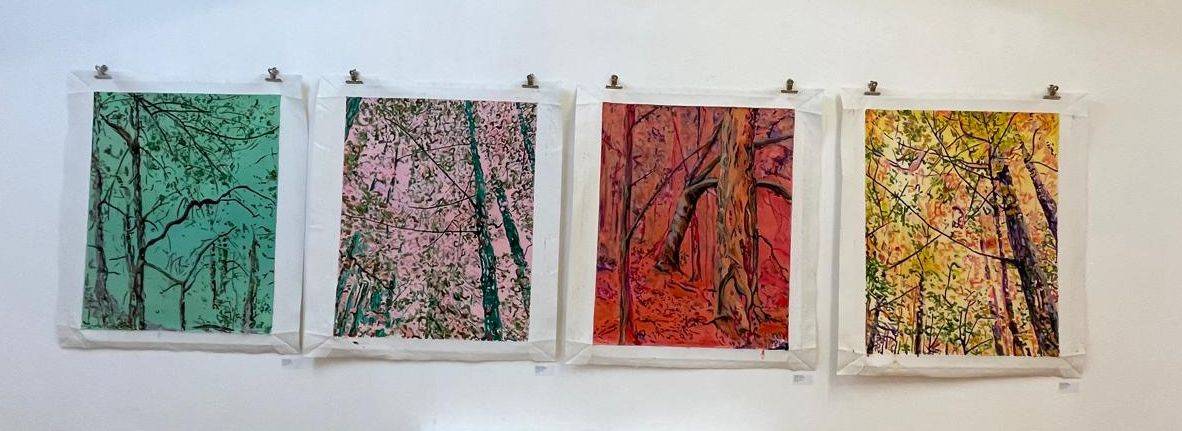
"Drawn by the Light" paintings by Shelley Hordiyuk. (Asharq Al-Awsat)

She says of her paintings, "I feel a love for the impossible tree or the sky painted in unrealistic colors. I also like to exaggerate these colors and lines, to take shapes from reality and gradually transform them into abstract pictures."

On a separate wall, the paintings of English artist Bryn Haworth are distinguished by their calm, confident brushstrokes and vivid colors. They also have an air of mystery that prompted visitors to ask the artist what they meant. One of them explained, "I sense a sarcastic tone in the paintings. They appear serious and traditional, but the artist has a distinct sense of humor that provokes discussion about what he depicts."

In an introduction to his work, Haworth discusses two paintings entitled "Remoaner Lisa" and "Something Rotten." The first takes Leonardo da Vinci’s smiling Mona Lisa, removing her smile and transforming it into a sulky pout. Behind her, instead of a Tuscan landscape, he depicts the reality of Britain after its separation from the European Union (Brexit). Behind the Mona Lisa, we see the Eurostar train tunnel, its entrance closed, and the white cliffs of Dover with the word "Goodbye" written over them, a reference to a cover from the pro-Brexit newspaper The Sun.

The painting combines seriousness with bitter irony. It was first presented in Paris as part of an exhibition on the stance of British artists towards Brexit. Haworth explains that he was keen for the Mona Lisa to resemble former Prime Minister David Cameron, whom many blame for the Brexit referendum.
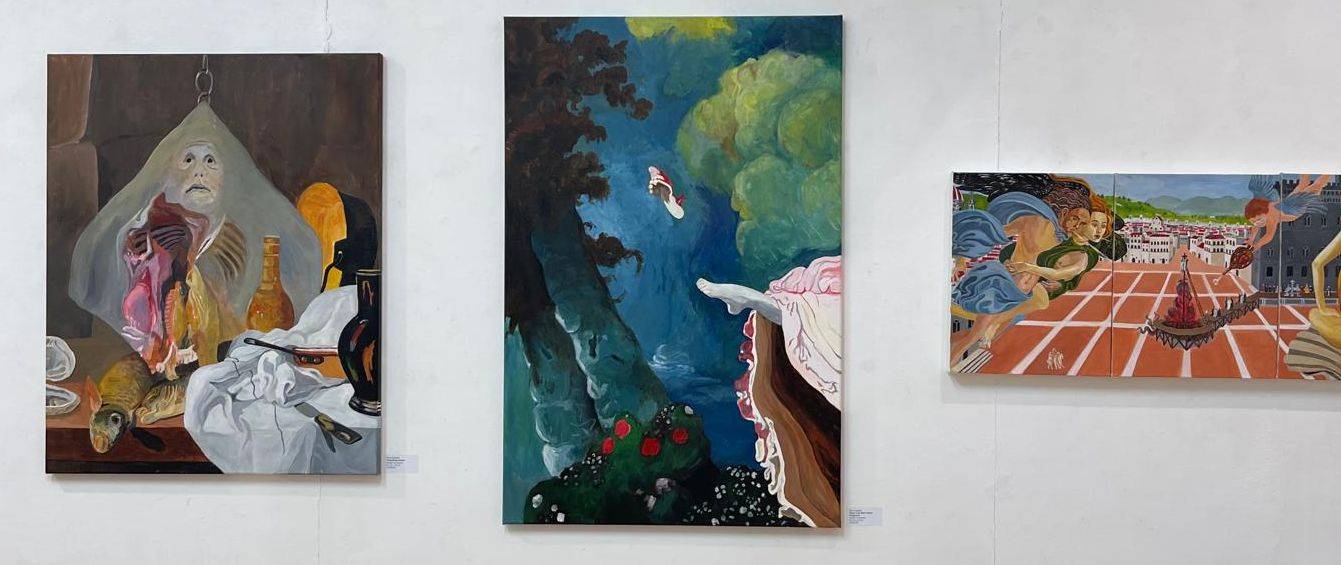
Art by Bryn Haworth. (Asharq Al-Awsat)

The political dimension extends to another painting inspired by the French artist Chardin's painting "Ray." In it, a ray fish hangs above a kitchen table, but it appears grey, as if mold has begun to invade it. The artist used the features of former Prime Minister Boris Johnson to express the confusion that characterized his term in office during the COVID-19 pandemic.

The two paintings are the beginning of a parodic series the artist is working on, creating an alternative to the portraits that line the main stairway in 10 Downing Street.

From da Vinci and Chardin, the third piece is based on Renaissance artist, Sandro Botticelli, and his iconic work, "The Birth of Venus." In the original, the goddess emerges from the depths of the sea, radiant with breathtaking beauty, standing on a shell. Here, we see her as reimagined by Haworth, sitting on her shell as she watches a scene unfold near the Uffizi Museum where she resides. It’s a scene from Italian history: the trial of the extremist priest, Girolamo Savonarola. From her position above the scene, Venus witnesses the brutal end of a period of religious extremism to which Botticelli himself fell victim, to the point that he burned several of his paintings in the so-called bonfire of the vanities – a pivotal moment in the history of art.
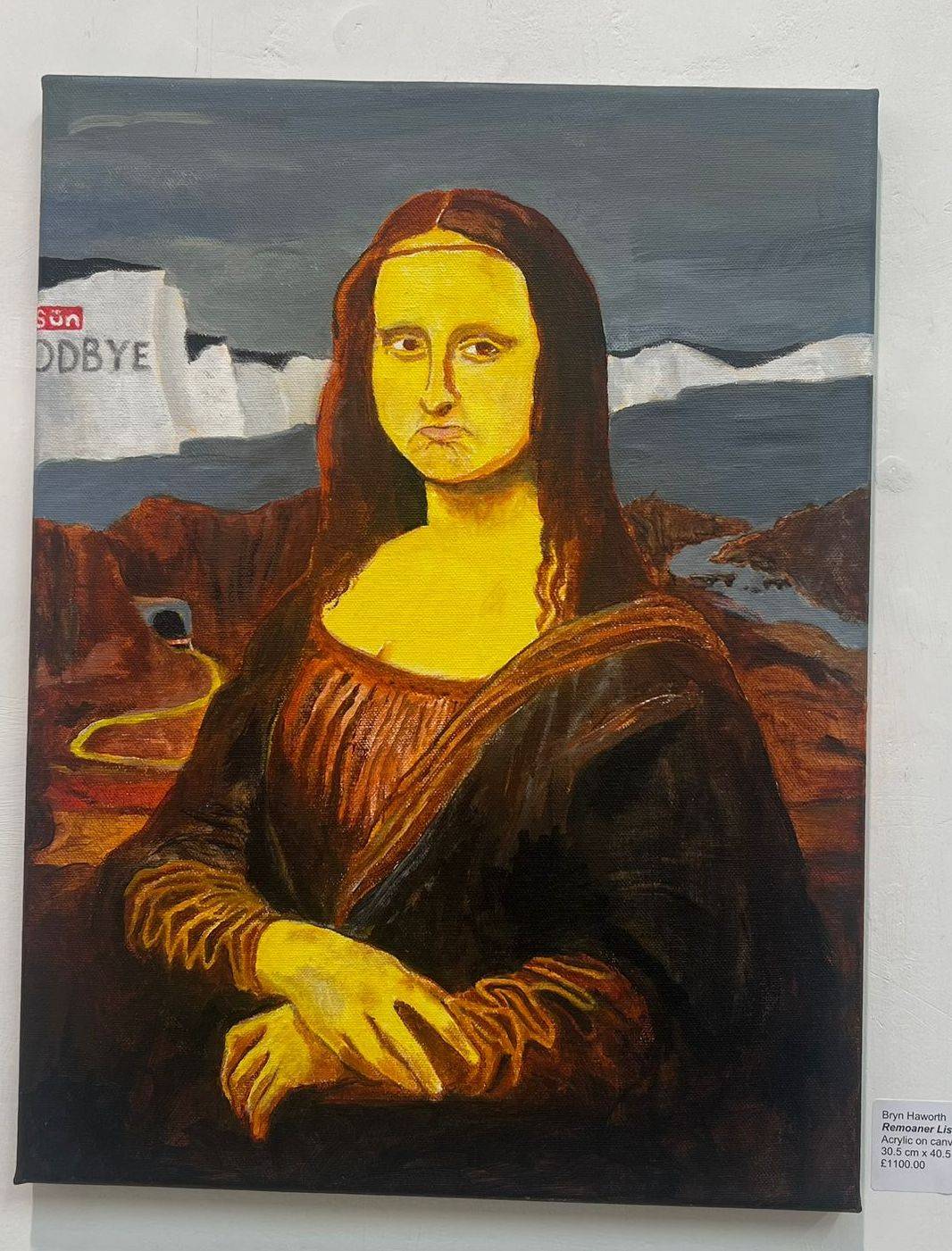
The "Remoaner Lisa" by Bryn Haworth. (Asharq Al-Awsat)

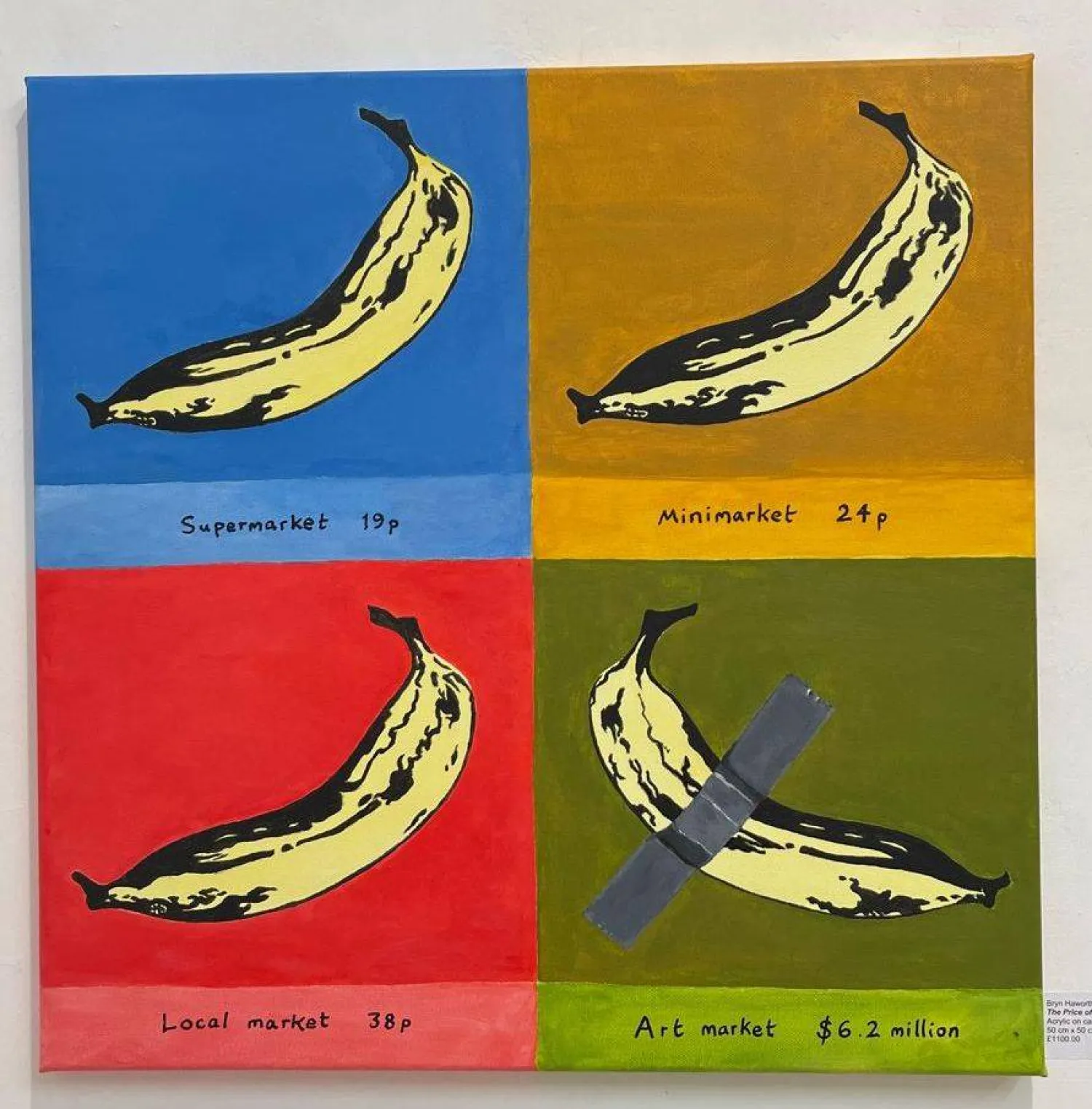
"The Price of Bananas" is a tongue-in-cheek commentary on the art market and on the sale of "Comedian" in particular. Created by Italian artist Maurizio Cattelan, this was a real banana attached to the gallery wall by duct tape, which sold for more than $6 million at auction. Haworth’s version borrows from Andy Warhol in its depiction of four bananas against colorful backgrounds. However, he chooses to place the current price from various local markets under each banana, ending with the art market. The work attracts visitors with its ironic touch and its colorful brilliance.

In a nearby corner, Russian photographer of Turkish origin, Daniel Buyukotsun, displays a number of photographs entitled "Street Layers", a black-and-white series in which the photographer experiments with layering different scenes on top of each other without resorting to digital technology. He superimposes a shot of one London street over a view of vehicles from a different street. Buildings, pedestrians, and vehicles blend within a single frame, giving the image an experimental feel, but also representing an emotional record of the capital’s streets.
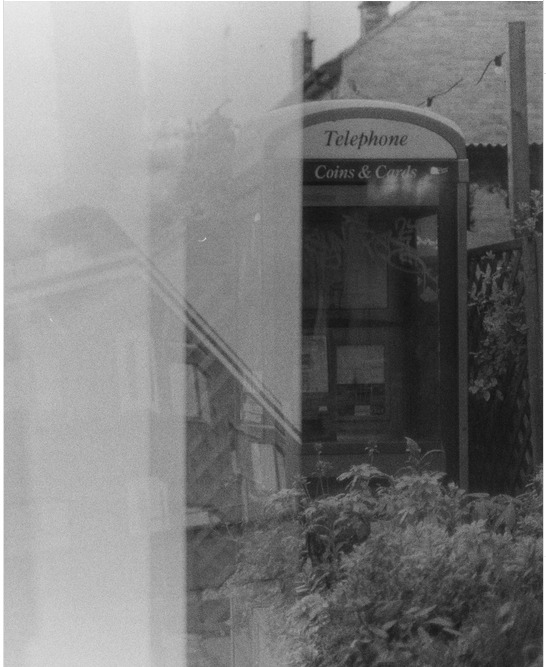
A work by Daniel Buyukotsun. (Asharq Al-Awsat)

Buyukotsun notes that he deliberately created one sequence of shots, but in other images the arrangement of layers was accidental: "My aim is not to record city life as it is, but to explore how life can feel within those layers."

It's the kind of feeling the visitor to Brick Lane will instantly recognize, a combination of urban reality with flights of the imagination.


*"Art In Mind" exhibition at Brick Lane Gallery, London runs until 25 August.


Saudi Heritage Commission Announces Discovery of 20 Rock Engravings in Soudah Peaks Project

The newly identified sites feature inscriptions and rock carvings estimated to be between 4,000 and 5,000 years old. (SPA)
TT

Saudi Heritage Commission Announces Discovery of 20 Rock Engravings in Soudah Peaks Project

The newly identified sites feature inscriptions and rock carvings estimated to be between 4,000 and 5,000 years old. (SPA)

Saudi Arabia’s Heritage Commission, in collaboration with Soudah Development, a Public Investment Fund company, announced on Tuesday the discovery of 20 ancient rock art sites within the Soudah Peaks area.

Spanning more than 636.5 square kilometers across Soudah and parts of Rijal Almaa, the project area is now recognized as home to some of the region’s oldest cultural landmarks. The newly identified sites feature inscriptions and rock carvings estimated to be between 4,000 and 5,000 years old, offering valuable insights into the region’s rich history.

The findings include Thamudic inscriptions, along with vivid depictions of ibex, hyenas, and ostriches, as well as scenes of hunters, dancers, palm trees, and weapons, reflecting the environmental and social practices of the ancient communities that once inhabited the area.

The survey forms part of a memorandum of understanding signed between the Heritage Commission and Soudah Development. Conducted in four scientific phases, the initiative began with data collection and site analysis, concluding with the documentation and classification of high-value archaeological sites in preparation for future development and preservation efforts.

Soudah Development remains committed to protecting and promoting the natural and cultural heritage of the project area. The company continues to work towards creating an integrated cultural and tourism experience that reflects the authenticity and historical richness of the region, in line with its vision to transform Soudah Peaks into a premier luxury mountain destination rooted in heritage.


Ancient Rome Meets Modern Technology as Tourists Visit Restored, Frescoed Home via Livestream Tours

 Colosseum Archeological Park guide Valentina uses a head-mounted device to livestream a guided tour for the press of the newly-restored underground House of Griffins, dated between the II and I century B.C., on the Palatine Hill next to the Colosseum, in Rome, Tuesday, Jan. 13, 2026. (AP)
Colosseum Archeological Park guide Valentina uses a head-mounted device to livestream a guided tour for the press of the newly-restored underground House of Griffins, dated between the II and I century B.C., on the Palatine Hill next to the Colosseum, in Rome, Tuesday, Jan. 13, 2026. (AP)
TT

Ancient Rome Meets Modern Technology as Tourists Visit Restored, Frescoed Home via Livestream Tours

 Colosseum Archeological Park guide Valentina uses a head-mounted device to livestream a guided tour for the press of the newly-restored underground House of Griffins, dated between the II and I century B.C., on the Palatine Hill next to the Colosseum, in Rome, Tuesday, Jan. 13, 2026. (AP)
Colosseum Archeological Park guide Valentina uses a head-mounted device to livestream a guided tour for the press of the newly-restored underground House of Griffins, dated between the II and I century B.C., on the Palatine Hill next to the Colosseum, in Rome, Tuesday, Jan. 13, 2026. (AP)

One of the best-preserved ancient Roman homes on the Palatine Hill is opening to the public for the first time, albeit via a livestreamed tour of its hard-to-reach underground frescoes and mosaics.

The House of the Griffins was first discovered during the excavations in the early 20th century of the Palatine Hill, the verdant hill that rises up from the Roman Forum and dominates views of central Rome today with its striking red brick ruins.

The hill, located just off the Colosseum, was the site of temples and homes of leading citizens during Rome’s Republican era, which is traditionally dated from 509 B.C. to 27 B.C. It became the aristocratic quarter during the Roman Empire that followed, when new palaces were built on top of the older homes.

The House of the Griffins is one of those earlier Republican-era homes, and was hidden to the world underground after the Emperor Domitian built his palace on top of it in the first century A.D.

Now for the first time, the general public can virtually visit the House of the Griffins and its newly restored frescoes, including the decoration that gives the home its name: An arched lunette fresco featuring two griffins — the half-eagle, half-lion mythological creatures.

Visitors won’t actually walk through the home’s intimate rooms, which are only accessible via a perilously steep staircase underground. Rather, visitors above ground will watch as a tour guide wearing a head-mounted smartphone descends into the domus and walks through its rooms, livestreaming the visit and narration.

The live, virtual tour serves multiple purposes: It allows visitors to “see” a domus that, because of its underground location, would otherwise be off-limits. And by limiting the number of people in its rooms, the livestreaming protects the delicate frescoes from too much humidity and carbon dioxide.

Project chief Federica Rinaldi said archaeologists don’t know much about the family who lived there, but said they were clearly well-off. The level of decoration recalls some of the elegant homes of the era in Pompeii: The frescoes feature richly colored faux marble designs, and floor mosaics of three-dimensional cubes.

“Its location at the highest point of the hill, its distribution over several levels that take advantage of the slopes of the Palatine Hill itself, and its preservation make it today an almost textbook reference," she said. “It was certainly a domus of the highest standard.”

Starting on March 3, the livestreamed tours will be held weekly, on Tuesdays, with one in Italian and one in English, though more are foreseen. Groups are limited to a dozen people and require reservations, as well as an additional ticket beyond the typical Colosseum-Palatine Hill entrance fee.

The restoration of the House of the Griffins is one of 10 projects funded by the European Union in the archaeological park and is part of an effort to spread tourists out beyond the must-see Colosseum and Forum, which often get overwhelmed with visitors.

“It’s a great occasion to value the full territory of the park,” said the head of the park, Simone Quilici.


Sudan Recovers 570 Artifacts Looted During War

Artifacts that were recovered after being looted from the National Museum in Khartoum during the country's long-running war, are displayed during an official ceremony in Port Sudan on January 13, 2026. (AFP)
TT

Sudan Recovers 570 Artifacts Looted During War

Artifacts that were recovered after being looted from the National Museum in Khartoum during the country's long-running war, are displayed during an official ceremony in Port Sudan on January 13, 2026. (AFP)

Sudanese authorities displayed ancient figurines, ornate vases and scarab-shaped amulets at a ceremony Tuesday in Port Sudan celebrating the recovery of more than 570 antiquities stolen from the national museum during the country's long-running war.

The artifacts, arranged on large tables under heavy security, were recovered after months of investigation and brought to the wartime capital of Port Sudan.

The National Museum in Khartoum, which housed some of Sudan's most important archaeological collections, was looted and badly damaged after the paramilitary Rapid Support Forces (RSF) seized the capital in the early days of its war with the army, its former ally.

At the time, satellite images showed trucks carrying artifacts west, towards the vast region of Darfur -- now completely under RSF control.

Since then, Sudanese authorities have worked with UNESCO and Interpol to track down the stolen items.

Authorities did not detail on Tuesday exactly how the artifacts were recovered.

"Sudan heritage is not only of national importance, it is a treasure of humanity," said UNESCO's representative in Sudan, Ahmed Junaid, referring to international efforts to combat illicit trafficking of cultural property.

"Many people do not know the value of the objects displayed on the tables, but they reflect the identity of the nation and its history," said Sudan's finance minister Gibril Ibrahim.

Khalid Aleisir, minister of information and culture, announced a "financial reward" for anyone returning antiquities to the authorities, without specifying an amount.

Officials estimate that the recovered items account for about 30 percent of the objects looted from the museum.

Still missing are the contents of the so-called "gold room", the museum's most valuable collection, which included ancient jewellery and 24-carat gold pieces, some nearly 8,000 years old.