


The Volunteers Battling to Save Romania's Cultural Treasures

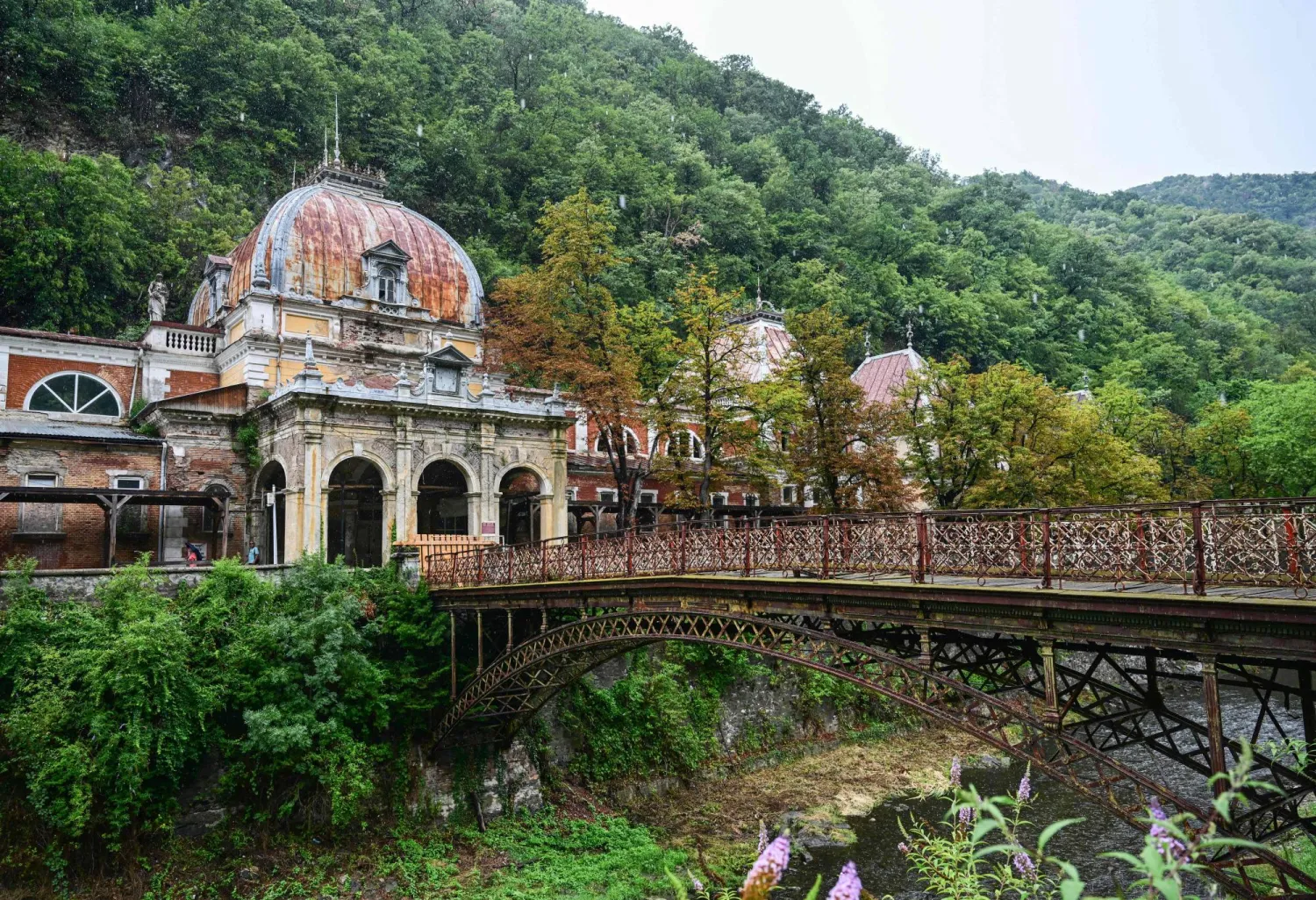
Exterior view of Neptune Imperial Baths building and the wrought iron bridge that is closed for access- in Baile Herculane on July 29, 2025. (Photo by Daniel MIHAILESCU / AFP)
TT

The Volunteers Battling to Save Romania's Cultural Treasures

Exterior view of Neptune Imperial Baths building and the wrought iron bridge that is closed for access- in Baile Herculane on July 29, 2025. (Photo by Daniel MIHAILESCU / AFP)

Graffiti covers the crumbling walls of the main thermal baths in one of Europe's oldest spa towns.

But after decades of neglect, a group of young architects is working to restore the picturesque Romanian resort that once attracted emperors, AFP reported.

"Someone once said that if you drink water from the spring from Herculane, you never leave," said 31-year-old architect Oana Chirila.

"I was struck by the beauty of the place," she said of the town in the southwest of the country, surrounded by mountains and crossed by a river.

"And at the same time shocked by its condition," she said of the decrepit state of the old thermal baths.

She first stumbled upon Baile Herculane eight years ago, purely by chance, she said.
Her group's restoration efforts here are just one of several recent civil society initiatives launched to protect some of Romania's historic monuments.

An estimated 800 of them are in an advanced state of decay or in danger of crumbling altogether. Some of those are already considered to represent a danger to the public.

The neglect is the result of Romania's chaotic transition from Communism to democracy, which was marked by opaque privatizations, often resulting in interminable legal battles and investigations by anti-corruption prosecutors.

Built in 1886, the Neptune Imperial Baths attracted illustrious clients in its heyday, with its warm sulphur treatments.

They included Austria's Emperor Franz Joseph and his wife Elisabeth, popularly known as Sisi. Franz Joseph described the town as Europe's "most beautiful spa resort".

Now the baths are closed, their interior walls covered in graffiti, rubble on the floor and rain leaking in.

Despite the decay, tourists still frequently stop to marvel at and photograph the long, rusty facade, some trying to peek inside through the broken windows.

For the moment, Chirila and her team of volunteers are confined to doing conservation work on the baths' outer structure.

They could not restore the building until legal disputes between the authorities and the private owners are solved, she explained, adding: "There's always this fear that it might collapse."

"Most of the historical monuments are in their current state –- meaning constant decay –- because they are legally blocked," preventing any use of public or European funds for their restoration.

For the moment then, along one side of the riverbank, people take dips in three basins with sulphur water -- dubbed "little bathtubs" by Chirila.

It was her team that refurbished the basins and built the changing booths and wooden pavilions, one of a number of projects they have undertaken in the town.

When AFP met her, about a dozen students were helping out with the renovation of a path through the woods.

In recent years, Baile Herculane, a town of 3,800, has seen a steady rise in tourists, say local officials.

Some 160,000 tourists came in 2024 -- up from 90,000 in 2020 -- many for spa treatments, but also for the hiking and climbing.

"The resort has changed," Aura Zidarita, 50, a doctor, told AFP. She remained hopeful it could once again become a "pearl of Europe".

Initiatives such as Chirila's have multiplied in recent years, according to Stefan Balici, president of the Romanian Order of Architects.

They represent "a lesson in how citizens' initiatives can intervene in heritage preservation", in a country with little record of investing in the restoration of its monuments.

In 2019, young architects got involved in another spa resort, Baile Govora.

Chirila admitted she sometimes feared her work on the Imperial Baths is like "putting a bandage on a patient in sepsis".

But Balici had no doubt of its value. Without her intervention, he said, the building would be "a pile of rubble" by now.

Chirila said she also drew hope from those like herself who believed in investing in the country's heritage.

"Herculane ended up like this because of corruption," she said.

"But we hope that thanks to good people it will heal."



'Talking Drum' Looted by France in 1916 Back in Ivory Coast

A crate containing the Djidji Ayokwe drum, at the airport in Abidjan, Ivory Coast. (Photo by Issouf SANOGO / AFP)
TT

'Talking Drum' Looted by France in 1916 Back in Ivory Coast

A crate containing the Djidji Ayokwe drum, at the airport in Abidjan, Ivory Coast. (Photo by Issouf SANOGO / AFP)

The Djidji Ayokwe "talking drum", which was looted by French colonial troops in 1916 and taken to France, arrived back in Ivory Coast Friday, in the latest repatriation of stolen artifacts.

The wooden drum, more than three meters (10 feet) long and weighing 430 kilos (950 pounds), was used by the Ebrie tribe to transmit messages.

It was officially handed over on February 20 after France's parliament approved removing the artifact from the national museum collections to enable its return.

Ivory Coast had asked in late 2018 for the return of the Djidji Ayokwe among 148 works of art taken during the colonial period.

It arrived aboard a specially chartered plane at Ivory Coast's main city Abidjan and remained inside a huge wooden crate stamped "fragile", AFP journalists saw.

"It's an historic day and I feel deep emotion," Culture Minister Francoise Remarck said, welcoming its arrival at the airport, where the Ebrie community also sang and played drums.

"We are living a moment of justice and remembrance," the minister added.

French President Emmanuel Macron promised in 2021 to send the drum and other artifacts back home to the west African country.

It is one of hundreds of objects France is preparing to send back to Africa, with the efforts set to be accelerated by the passing of a new law to authorize mass repatriations.

"We are happy and relieved to know that this sacred piece of our culture is back on its native land," Aboussou Guy Georges Mobio, an Ebrie village chief, told AFP.

The drum will initially be held in a "safe space" to allow it to acclimatize, the culture minister said.

It is due to go on display at the Museum of Civilizations in Abidjan which has been specially renovated.

The "talking drum" was used by the Ebrie community to warn of danger, mobilize for war or call villagers to ceremonies.

It was seized by colonial authorities in 1916 before being shipped to France in 1929 and exhibited in Paris.

Senegal and Benin have also asked for the repatriation of their treasures.

In late 2020, the French parliament adopted a law providing for the permanent return to Benin of 26 artifacts from the royal treasures of Dahomey.

The return of cultural artifacts taken from ex-colonies in Africa and elsewhere has become a sensitive issue, with museums, institutions and collectors in Europe and the United States facing pressure to give them back.


Red Sea Fund Launches Second Round to Support Film Projects in Production Stage

File photo of the fifth day of the Red Sea International Film Festival - SPA
TT

Red Sea Fund Launches Second Round to Support Film Projects in Production Stage

File photo of the fifth day of the Red Sea International Film Festival - SPA

The Red Sea Fund, affiliated with the Red Sea Film Foundation, announced the opening of applications to support film projects in the production stage within the second round of this year’s support program, which will continue until March 21, as part of its efforts to enhance the cinema industry and empower innovators in the region, SPA reported.

The round aims to support promising cinematic voices from the Kingdom and the Arab world, as well as filmmakers from Africa and Asia, through financial grants that help complete film projects and present their creative narratives globally, with a special focus on projects ready to enter production and begin filming.


Prince Mohammed bin Salman Project Restores Historic Al-Jami' Mosque in Tabuk Region

The renovation utilized modern technologies to restore the mosque's original identity - SPA
TT

Prince Mohammed bin Salman Project Restores Historic Al-Jami' Mosque in Tabuk Region

The renovation utilized modern technologies to restore the mosque's original identity - SPA

The Prince Mohammed bin Salman Project for the Development of Historical Mosques has completed the restoration of Al-Jami' Mosque in Duba, Tabuk Region, as part of its mission to preserve the Kingdom's architectural heritage under Vision 2030.

As one of Duba’s oldest landmarks, the mosque is deeply intertwined with the city’s maritime history, traditionally serving as a central meeting point for sailors. Throughout its history, the mosque underwent several construction phases, including significant contributions by King Abdulaziz and King Fahd, before its selection for the current national development project, SPA reported.

The renovation utilized modern technologies to restore the mosque's original identity, increasing its area to 972.23 square meters and its capacity to 779 worshippers. The architectural style is inspired by traditional Red Sea heritage, incorporating natural materials like stone, mud, and wood for intricate mashrabiyas.

Executed by specialized Saudi firms, the project balances traditional standards with sustainability to rehabilitate the site for worship while highlighting its cultural significance. By restoring such landmarks, the project ensures the preservation of the Kingdom’s diverse architectural and social memory for future generations.