


Matcha Madness Leaves Japan’s Tea Ceremony Pros Skeptical 

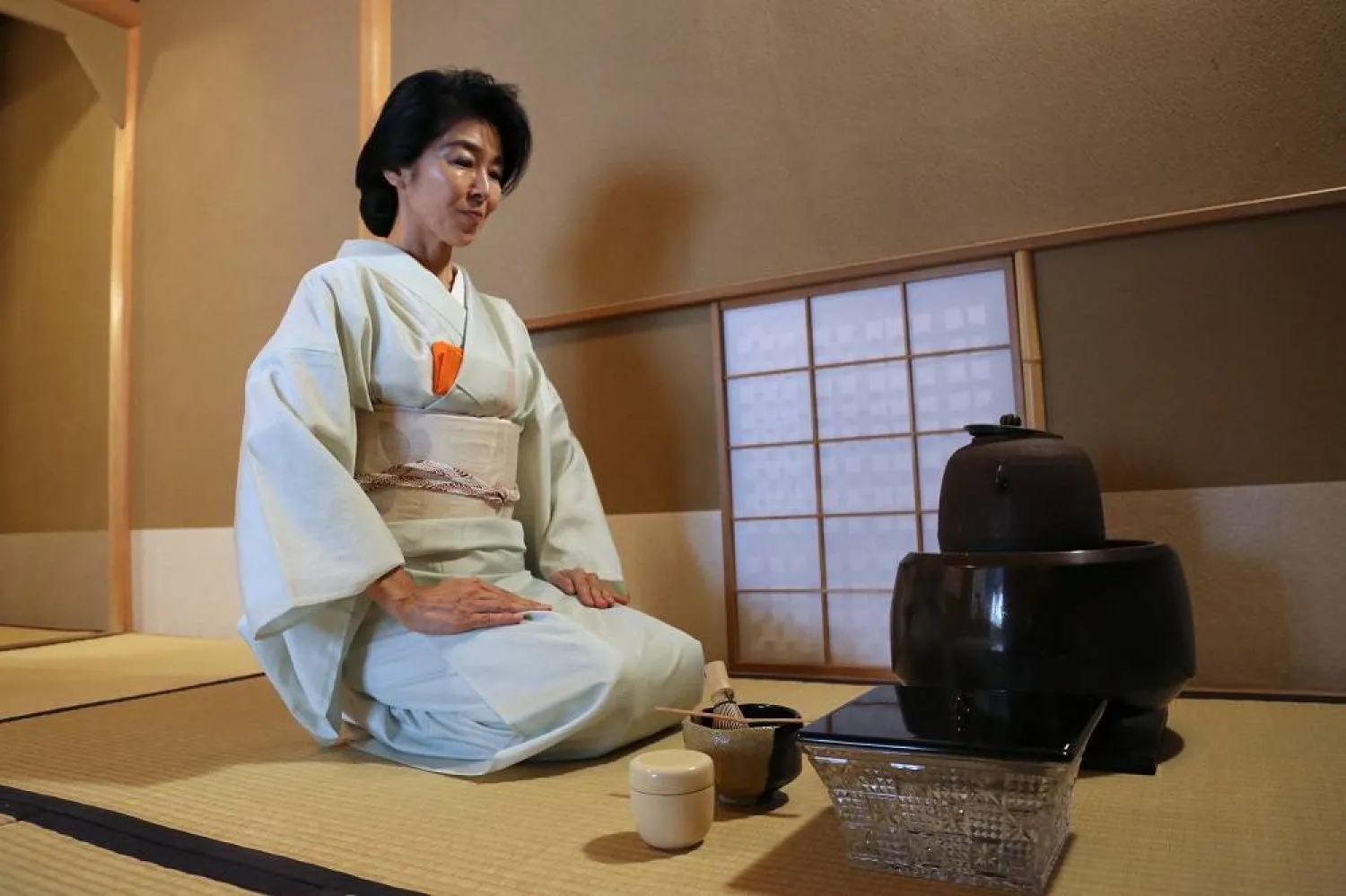
Tea ceremony master Keiko Kaneko demonstrates the tea ceremony at her tea house in Tokyo, Aug. 8, 2025. (AP) 
TT

Matcha Madness Leaves Japan’s Tea Ceremony Pros Skeptical 

Tea ceremony master Keiko Kaneko demonstrates the tea ceremony at her tea house in Tokyo, Aug. 8, 2025. (AP) 

Clad in an elegant kimono of pale green, tea ceremony instructor Keiko Kaneko uses a tiny wooden spoon to place a speck of matcha into a porcelain bowl.

She froths up the special powdered Japanese green tea with a bamboo whisk after pouring hot water with a ladle from a pot simmering over hot coal.

Her solemn, dance-like movements celebrate a Zenlike transient moment, solitude broken up by the ritualistic sharing of a drink.

No wonder Kaneko and others serious about “sado,” or “the way of tea,” are a bit taken aback by how matcha is suddenly popping up in all sorts of things, from lattes and ice cream to cakes and chocolate.

No one knows for sure who started the global matcha boom, which has been going on for several years. But it's clear that harvests, especially of fine-grade matcha, can't keep up with demand.

A booming market

Matcha is a type of tea that's grown in shade, steamed and then ground into a very fine powder. It's processed differently from regular green tea, with the best matcha ground using stone mills, and switching from one to the other takes time. No farmer wants to switch and then find that matcha fever has died.

The Japanese agricultural ministry has been working to boost tea growth, offering help for farmers with new machines, special soil, financial aid and counseling to try to coax tea growers to switch to matcha from regular green “sencha” tea.

“We don’t want this to end up just a fad, but instead make matcha a standard as a flavor and Japanese global brand,” said Tomoyuki Kawai, who works at the tea section of the agricultural ministry.

Production of “tencha,” the kind of tea used for matcha, nearly tripled from 1,452 tons in 2008, to 4,176 tons in 2023, according to government data.

Japan's tea exports have more than doubled over the last decade, with the US now accounting for about a third. Much of that growth is of matcha, according to Japanese government data. The concern is that with labor shortages as aging farmers leave their fields, the matcha crunch may worsen in coming years.

Other countries, including China and some Southeast Asian countries, also are producing matcha, so Japan is racing to establish its branding as the origin of the tea.

An art form turned into a global fun drink

Tea ceremony practitioners aren’t angered by the craze, just perplexed. They hope it will lead to people taking an interest in sado, whose followers have been steadily declining. But they aren’t counting on it.

The tea ceremony is “reminding us to cherish every encounter as unique and unrepeatable,” said Kaneko, who is a licensed instructor.

She pointed to the special small entrance to her tea house. Noble samurai had to stoop to enter, leaving their swords behind them. The message: when partaking of tea, everyone is equal.

The purity and stillness of the ceremony are a world apart from the hectic and mundane, and from the craze for matcha that's brewing outside the tea house.

The Matcha Crème Frappuccino is standard fare at the Starbucks coffee outlets everywhere. While matcha, a special ingredient traditionally used in the tea ceremony, isn’t meant to be drunk in great quantities at once like regular tea or juices, it’s suddenly being consumed like other fruit and flavors.

Matcha drinks have become popular at cafes from Melbourne to Los Angeles. Various cookbooks offer matcha recipes, and foreign tourists to Japan are taking home tins and bags of matcha as souvenirs.

It's a modern take on traditions perfected by the 16th century Buddhist monk Sen no Rikyu in Kyoto, who helped shape the traditions of tea ceremony and of “wabi-sabi,” the rustic, imperfect but pure and nature-oriented aesthetic often seen as synonymous with high-class Japanese culture.

Matcha's future

Minoru Handa, the third-generation chief of suburban tea store Tokyo Handa-en, which sells green and brown tea as well as matcha, says the appeal of matcha is in its versatility. Unlike tea leaves, the powder can be easily mixed into just about anything.

“The health boom and the interest in Japanese culture have added to the momentum,” he said, stirring a machine that was roasting brown tea, sending a pungent aroma through the streets.

“It’s safe and healthy so there’s practically no reason it won’t sell,” said Handa.

His business, which dates back to 1815, has a longtime relationship with growers in Kagoshima, southwestern Japan, and has a steady supply of matcha. To guard against hoarders, he limits purchases at his store to one can per customer.

Handa, who has exhibited his prize-winning tea in the US and Europe, expects that growers will increase the supply and shrugs off the hullabaloo over the matcha shortage.

But Anna Poian, co-director and founder of the Global Japanese Tea Association, thinks lower-grade matcha should be used for things like lattes, since one has to put in quite a lot of fine-grade matcha to be able to taste it.

“It’s a bit of a shame. It’s a bit of a waste,” she said.

The best matcha should be reserved for the real thing, she said in an interview from Madrid.

“It is a very delicate, complex tea that is produced with the idea to be drunk only with water,” she said.


Saudi Arabia: Ship of Tolerance Initiative Promotes Cultural Dialogue in Jeddah

The Royal Institute of Traditional Arts (Wrth) will offer traditional craft workshops throughout Ramadan. SPA
TT

Saudi Arabia: Ship of Tolerance Initiative Promotes Cultural Dialogue in Jeddah

The Royal Institute of Traditional Arts (Wrth) will offer traditional craft workshops throughout Ramadan. SPA

The Saudi Ministry of Culture, in collaboration with the "Lenobadir" volunteer and community partnership program and the Athr Foundation, has launched the Ship of Tolerance initiative in Historic Jeddah during Ramadan.

The initiative aims to enhance shared human values through arts, and promote tolerance and coexistence among children and families. It provides an educational and cultural experience aligned with the area’s unique character as a UNESCO World Heritage site.

As part of this global art project, children will create artworks that represent acceptance and dialogue.

The Royal Institute of Traditional Arts (Wrth) will offer traditional craft workshops throughout Ramadan, linking the initiative's values with local heritage and enriching visitors' connection to the region's identity.

This effort supports cultural programs with educational and social dimensions in Historic Jeddah, activating local sites for experiences that combine art, crafts, and community participation. It aligns with the National Strategy for Culture under Saudi Vision 2030, focusing on heritage preservation and expanding culture's impact on daily life.


Oscar Contender ‘Hamnet’ Boosts Tourism at Shakespeare Heritage Sites 

A view of Shakespeare’s Birthplace, William Shakespeare's childhood home, in Stratford-upon-Avon, Britain, February 9, 2026. (Reuters)
TT

Oscar Contender ‘Hamnet’ Boosts Tourism at Shakespeare Heritage Sites 

A view of Shakespeare’s Birthplace, William Shakespeare's childhood home, in Stratford-upon-Avon, Britain, February 9, 2026. (Reuters)

On a cloudy winter's day, visitors stream into what was once William Shakespeare's childhood home in Stratford-upon-Avon and the nearby Anne Hathaway's cottage, family residence of the bard's wife.

Hathaway's cottage is one of the settings for the BAFTA and Oscar best film contender "Hamnet", and the movie's success is drawing a new wave of tourists to Shakespeare sites in the town in central England.

Shakespeare's Birthplace is the house the young William once lived in and where his father worked as a glove maker, while Hathaway's cottage is where he would have visited his future wife early in their relationship.

Typically, around 250,000 visitors, from the UK, Europe, the United States, China and elsewhere, walk through the locations each year, according to the Shakespeare Birthplace Trust. ‌The charity looks after ‌Shakespeare heritage sites, which also include Shakespeare's New Place, the site of ‌the ⁠Stratford home where the ⁠bard died in 1616.

Visitors are flocking in this year thanks to "Hamnet", the film based on Maggie O'Farrell's 2020 novel, which gives a fictional account of the relationship between Shakespeare and Hathaway, also known as Agnes, and the death of their 11-year-old son Hamnet in 1596.

"Visitor numbers have increased by about 15 to 20% across all sites since the film was released back in January. I think that will only continue as we go throughout the year," Richard Patterson, chief operating officer for the Shakespeare Birthplace Trust, said.

"They particularly want ⁠to look (at) Anne Hathaway's cottage and the specifics around how the family ‌engaged in the spaces and the landscape in and around ‌the cottage... you can see why he would have been inspired."

NEW ACCESS TO SHAKESPEARE

"Hamnet" has 11 nominations at ‌Sunday's British BAFTA awards, including best film and leading actress for Jessie Buckley, who plays Agnes. It ‌also has eight Oscar nominations, with Buckley seen as the frontrunner to win best actress.

"Hamnet" is set in Stratford-upon-Avon and London although it was not filmed in Stratford.

It sees Paul Mescal's young Shakespeare fall for Agnes while teaching Latin to pay off his father's debts. The drama, seen mainly through Agnes' eyes, focuses on their ‌life together and grief over Hamnet's death, leading Shakespeare to write "Hamlet".

"Shakespeare... is notoriously enigmatic. He writes about humanity, about feeling, about emotion, about conflict, ⁠but where do we understand ⁠who he is in that story?" said Charlotte Scott, a professor of Shakespeare studies and interim director of collections, learning and research at the Shakespeare Birthplace Trust.

"And that's driven people creative and otherwise for hundreds and hundreds of years. Where is Shakespeare's heart? And this is what the film I think has so beautifully opened up."

Little is known about how the couple met. Shakespeare was 18 and Hathaway 26 when they married in 1582. Daughter Susanna arrived in 1583 and twins Judith and Hamnet in 1585.

The film acknowledges the names Hamnet and Hamlet were interchangeable back then. While grief is a dominant theme, audiences also see Shakespeare in love and as a father.

"A lot of people will see this film not necessarily having... had any kind of relationship with Shakespeare," Scott said.

"So people will come to this film, I hope, and find a new way of accessing Shakespeare that is about creativity, that is about understanding storytelling as a constant process of regeneration, but also crucially, looking at it from that kind of emotive angle."


Culture Ministry Continues Preparations in Historic Jeddah to Welcome Visitors during Ramadan 

Historic Jeddah has emerged as a leading cultural tourism destination during Ramadan. (SPA)
TT

Culture Ministry Continues Preparations in Historic Jeddah to Welcome Visitors during Ramadan 

Historic Jeddah has emerged as a leading cultural tourism destination during Ramadan. (SPA)

The Saudi Ministry of Culture is continuing its efforts to revitalize Historic Jeddah in preparation for welcoming visitors during the holy month of Ramadan, offering cultural programs, events, and heritage experiences that reflect the authenticity of the past.

The district has emerged as a leading cultural tourism destination at this time of year as part of the “The Heart of Ramadan” campaign launched by the Saudi Tourism Authority.

Visitors are provided the opportunity to explore the district’s attractions, including archaeological sites located within the geographical boundaries of the UNESCO World Heritage-listed area, which represent a central component of the Kingdom’s urban and cultural heritage.

The area also features museums that serve as gateways to understanding the city’s rich heritage and cultural development, in addition to traditional markets that narrate historical stories through locally made products and Ramadan specialties that reflect authentic traditions.

These initiatives are part of the ministry’s ongoing efforts to revitalize Historic Jeddah in line with the objectives of Saudi Vision 2030 and aiming to transform it into a vibrant hub for arts, culture, and the creative economy, while preserving its tangible and intangible heritage.
