


Wealthy Ancient Roman's Tomb Discovered in Albania

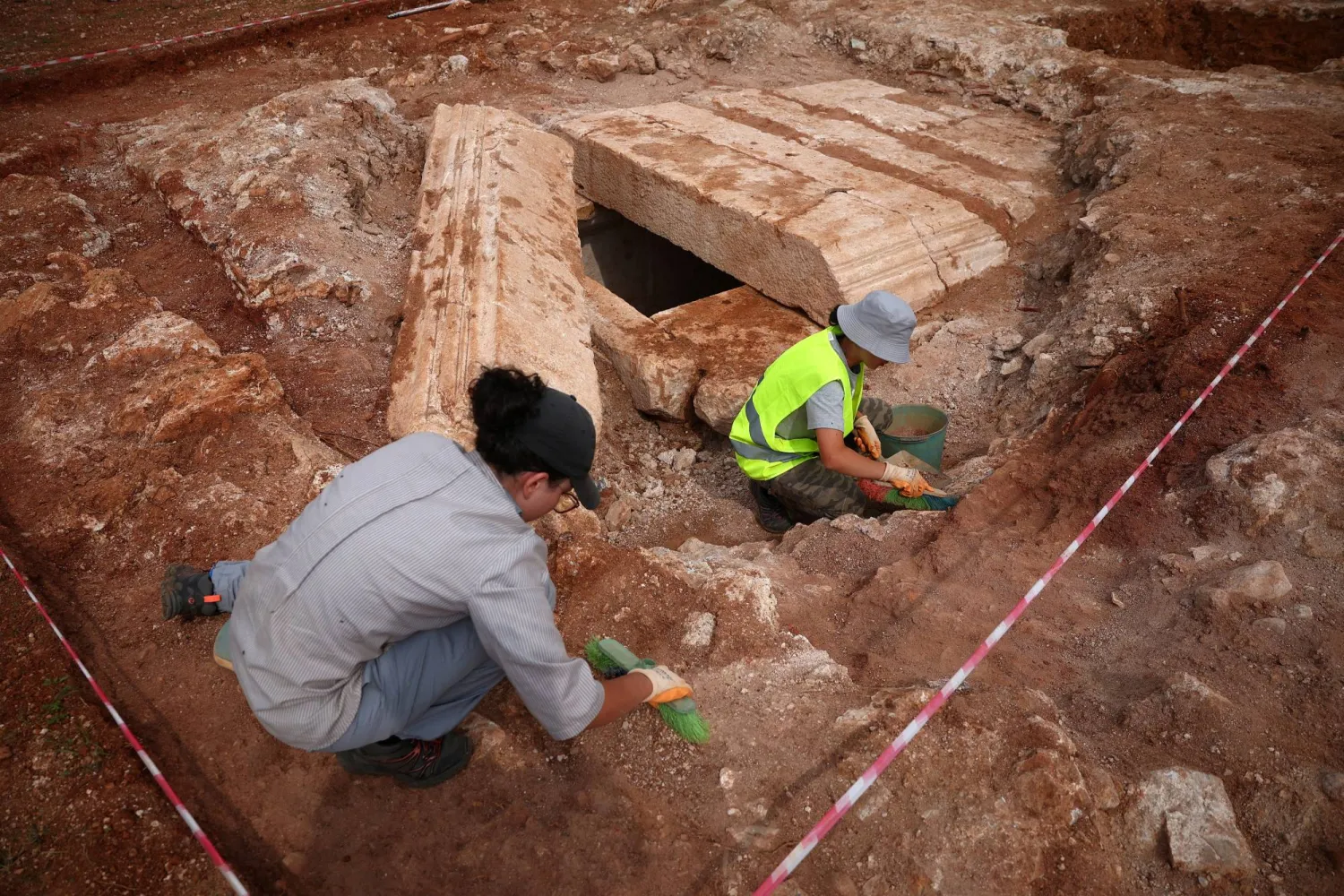
Archaeologists work on Albania's first discovered monumental tomb, which they suggest may be a mausoleum, dated to the Roman period III–IV century AD, in Strikcan, Albania, September 4, 2025. REUTERS/Florion Goga
TT

Wealthy Ancient Roman's Tomb Discovered in Albania

Archaeologists work on Albania's first discovered monumental tomb, which they suggest may be a mausoleum, dated to the Roman period III–IV century AD, in Strikcan, Albania, September 4, 2025. REUTERS/Florion Goga

Archaeologists in Albania have discovered a large Roman burial chamber dating from the third to fourth century AD, the first of its kind found in the Balkan country that was once part of the Roman Empire. Tipped off by locals who had noticed some unusual stones on a plateau near the North Macedonia border, staff from the Institute of Archaeology began excavating in early August and found the underground structure whose large limestone slabs were inscribed with Greek lettering.

"The inscription tells us that the person buried here was named Gelliano, a name typical of the Roman period. We are uncertain about the identity of the second individual, but it is likely a family member," said Erikson Nikolli, the project's lead archaeologist.

The tomb, which measures nine meters by six meters (29 ft by 19 ft), is the first discovery in Albania of what the experts believe to be a wealthy person's resting place, grander than other burial sites found in the area.

Local authorities in Albania, where tourism is booming, are already planning to develop the site into a tourist attraction, while residents flocked to the area upon hearing the news of the discovery.

Last week, Nikolli's team used brushes to reveal the intricately carved edges of the tomb's white roof stone and walls.

"We also uncovered a piece of fabric embroidered with gold thread, which confirms our belief that we are dealing with a member of the upper class."

Other findings include glass plates and knives.

Nikolli said that the tomb had been looted at least twice – once in antiquity and later when heavy machinery was used to move a massive rock on top of the chamber.

He explained that the occupant’s name was inscribed in Greek letters but carried a Latin meaning, while a second inscription indicates that the tomb was dedicated to the god Jupiter.

Experts have yet to decipher additional inscriptions on stones found nearby, which are believed to have belonged to another monument now surrounded by cornfields and a quarry.



Red Sea Fund Launches Second Round to Support Film Projects in Production Stage

File photo of the fifth day of the Red Sea International Film Festival - SPA
TT

Red Sea Fund Launches Second Round to Support Film Projects in Production Stage

File photo of the fifth day of the Red Sea International Film Festival - SPA

The Red Sea Fund, affiliated with the Red Sea Film Foundation, announced the opening of applications to support film projects in the production stage within the second round of this year’s support program, which will continue until March 21, as part of its efforts to enhance the cinema industry and empower innovators in the region, SPA reported.

The round aims to support promising cinematic voices from the Kingdom and the Arab world, as well as filmmakers from Africa and Asia, through financial grants that help complete film projects and present their creative narratives globally, with a special focus on projects ready to enter production and begin filming.


Prince Mohammed bin Salman Project Restores Historic Al-Jami' Mosque in Tabuk Region

The renovation utilized modern technologies to restore the mosque's original identity - SPA
TT

Prince Mohammed bin Salman Project Restores Historic Al-Jami' Mosque in Tabuk Region

The renovation utilized modern technologies to restore the mosque's original identity - SPA

The Prince Mohammed bin Salman Project for the Development of Historical Mosques has completed the restoration of Al-Jami' Mosque in Duba, Tabuk Region, as part of its mission to preserve the Kingdom's architectural heritage under Vision 2030.

As one of Duba’s oldest landmarks, the mosque is deeply intertwined with the city’s maritime history, traditionally serving as a central meeting point for sailors. Throughout its history, the mosque underwent several construction phases, including significant contributions by King Abdulaziz and King Fahd, before its selection for the current national development project, SPA reported.

The renovation utilized modern technologies to restore the mosque's original identity, increasing its area to 972.23 square meters and its capacity to 779 worshippers. The architectural style is inspired by traditional Red Sea heritage, incorporating natural materials like stone, mud, and wood for intricate mashrabiyas.

Executed by specialized Saudi firms, the project balances traditional standards with sustainability to rehabilitate the site for worship while highlighting its cultural significance. By restoring such landmarks, the project ensures the preservation of the Kingdom’s diverse architectural and social memory for future generations.


Leading Portraiture Competition Celebrates Saudi Heritage Through Art

Throughout its history, the award has emphasized themes rooted in Saudi heritage and national initiatives - SPA
TT

Leading Portraiture Competition Celebrates Saudi Heritage Through Art

Throughout its history, the award has emphasized themes rooted in Saudi heritage and national initiatives - SPA

The Dia Aziz Dia Award for Portrait, hosted by the Saudi Arabian Society for Culture and Arts in Jeddah, is a leading platform for portraiture and the only competition of its kind in the Middle East. It fosters national identity through contemporary art, connecting veteran and emerging artists.

Throughout its history, the award has emphasized themes rooted in Saudi heritage and national initiatives, including Saudi women, the Arabian horse, the Saudi Green Initiative, and King Abdulaziz.

These themes highlight art's role in reflecting social transformations and contributing to the cultural goals of Saudi Vision 2030, SPA reported.

The current ninth edition, with a theme focused on King Salman, invited artists to depict the leadership and humanity of the Custodian of the Two Holy Mosques. This edition attracted significant participation, with 787 submissions from 42 cities, including international entries.

Of these, 61 works were shortlisted for the final competition, with prizes totaling SAR170,000 awarded to three main winners and seven incentive recipients.