
Sotheby’s Strikes Alliance with Ascendant Art Fair in Manhattan

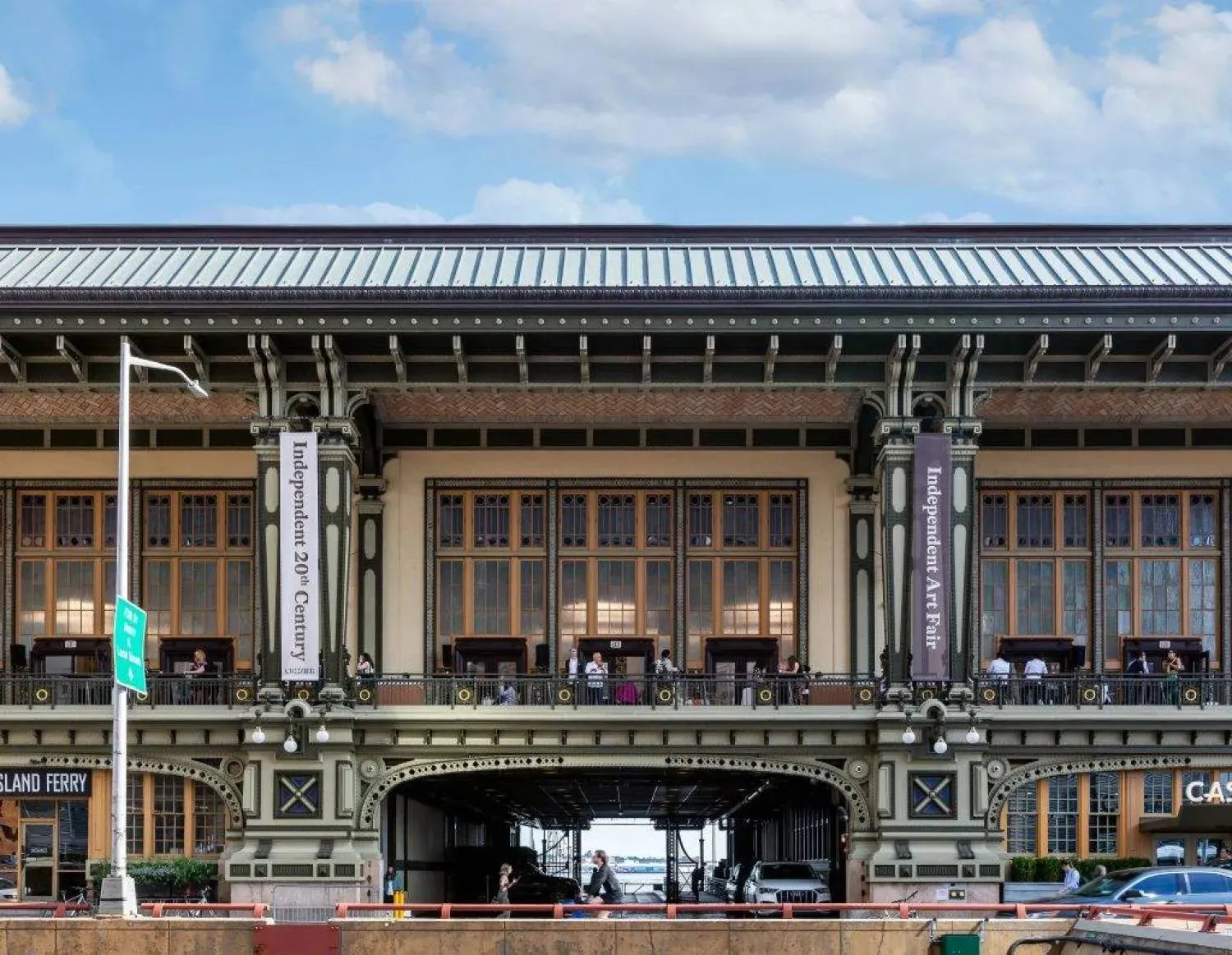
The Independent 20th Century art fair has been held in the Battery Maritime Building in Manhattan. (The New York Times)
TT

Sotheby’s Strikes Alliance with Ascendant Art Fair in Manhattan

The Independent 20th Century art fair has been held in the Battery Maritime Building in Manhattan. (The New York Times)

Sotheby’s and Independent announced on Monday that they have entered into a multiyear commitment that will bring Independent 20th Century art fair — focused on art made between 1900 and 2000 — to the Breuer building in Manhattan starting in 2026.

The agreement represents a first-of-its-kind partnership between notable players in the auction and art fair sectors. It is also an indication of how differently Sotheby’s New York headquarters may approach public programming after the company officially takes up residence in the Modernist landmark at 945 Madison Avenue this November.

“When we acquired the Breuer, we knew it would open a whole world of possibilities, but we didn’t know what they were,” Charles Stewart, Sotheby’s chief executive, said in a group interview on Sept. 3. “This is one of those possibilities that’s come about because of this architectural icon.”

Independent 20th Century will debut at the Breuer from Sept. 24 to 27, 2026, with more than 50 exhibiting galleries — a 50% increase in size compared to the four editions of the fair staged at Casa Cipriani inside the Battery Maritime Building.

Although Sotheby’s and Independent declined to disclose further terms of the deal, both companies confirmed that other prospects under discussion include additional programming and exhibitions.

“None of us at this table are interested in a landlord-tenant relationship; we’re interested in going beyond what fairs can be,” Elizabeth Dee, Independent’s founder and creative director, said during the interview with Stewart; Independent’s chief operating officer, Sofie Scheerlinck; and the gallerist Alma Luxembourg, who is also a member of Independent 20th Century’s founding committee.

“We got in a room, started talking about all the things that are working and not working in culture, and we’re all aligned in terms of how to work together to move forward and innovate,” Dee said.

Although its effect on Sotheby’s bottom line will be minimal, the pact has tangible value to the company. Madeline Lissner, Sotheby’s global head of fine art, said working with Independent will help position the company as “more than an auction house,” and the Breuer as a cultural hub that attracts attention “for moments that are not just selling-focused,” as the company is also seeking to do with its new locations in Hong Kong and Paris.

The financial ups and downs of Sotheby’s and Patrick Drahi, the French-Israeli telecom billionaire who acquired the auction house in a take-private deal in 2019, have received particular attention amid the art market’s larger struggles.

Sotheby’s reported $2.2 billion in auction sales in the first half of 2025, a decrease of 4% compared to the same period a year earlier. Its $4.6 billion in auction sales in 2024 represented a year-over-year decline of 28%.

Sotheby’s sold a stake of between 25% and 30% to ADQ, Abu Dhabi’s sovereign wealth fund, last fall, in a deal valued at $1 billion.

The auction house then trimmed its work force by around 4%, it said Sunday.

A slew of contemporary galleries have permanently closed since that time, while four art fairs have canceled or postponed forthcoming editions.

An alliance between an auction house and an art fair — and by extension, the galleries who show there — has been a long time coming. Ever since the 1973 evening auction of contemporary artworks owned by the New York taxi magnates Robert and Ethel Scull, at what was then Sotheby Parke Bernet, auction houses and galleries have operated less and less as occupants of distinct sectors of the art trade than as competitors whose specialties increasingly overlap in shared territory.

The best known example is the two-part evening auction in 2008 at Sotheby’s London in which Damien Hirst bypassed his galleries to sell more than $200 million worth of his new art directly to buyers.

But the door swung in the opposite direction, too.

In 2020, for instance, the late real estate tycoon Donald Marron’s collection of Modern and postwar artworks, estimated to be worth $450 million, was sold jointly by Acquavella Galleries, Gagosian and Pace Gallery rather than an auction house.

These milestone events were natural outgrowths of longer-running processes, as major auction houses built up robust private-sales departments, and public auction prices increasingly influenced the demand for new works by the same artists in galleries.

Independent offers two annual fairs by invitation; the second, a larger contemporary fair simply called Independent, is held in New York each May. It will also double its square footage by moving to Pier 36, an event venue at 299 South Street.

Compared with Art Basel, a storied competitor in Switzerland that typically includes about 300 galleries, there were 82 exhibitors at the most recent edition of Independent in May 2025, and the company employs only eight full-time staff members.

On the other side, partnering with Sotheby’s could unlock the resources of a multinational corporation that draws Modern art buyers who typically acquire at auction. But will the fair have to trade in some of the autonomy that has underwritten Independent’s success?

“Sotheby’s will not have any curatorial voice within our exhibition,” Dee said when asked. “Why would we, after 17 years, not want to pursue a curatorial vision in the Breuer building?” She added, “Why would we want to become a part of the monoculture we’re fighting against?”

Conceived as the first custom-designed site for the Whitney Museum of American Art in 1966, the Breuer temporarily hosted exhibitions by the Metropolitan Museum of Art, 2016-20, and the Frick Collection, 2021-24.

Sotheby’s only stewards works of art for, at most, a few months at a time and all in the service of passing them on to new owners at the highest prices the market will bear.

Both Sotheby’s and Independent believe this distinguished setting matters to how buyers see and value works of art.

Under the architecture firm Herzog & de Meuron, in partnership with PBDW Architects, parts of the Breuer’s interiors are being remodeled to function largely as permanent exhibition spaces, a boon for Independent’s galleries and a sharp counterpoint to the cubicle format of the average art fair.

The venue change will also lower exhibiting galleries’ costs by an average of 25% compared with Independent 20th Century’s most recent edition, Scheerlinck said.

Dee cautions that doubling the fairs’ footprints will not mean doubling its exhibitor capacity. Doing so would improve the organization’s margins but would cut against its quality-over-quantity ethos.

“If it were a pure numbers game, we would stuff the Breuer and we would stuff Pier 36, but we’re not going to,” Scheerlinck said, “while being very mindful of course that everyone has to survive.”

Joe Nahmad, the founder of Nahmad Contemporary gallery, who is also on Independent 20th Century’s founding committee, said that “what excites me about this new wave on the Upper East Side is how architecture and world-class exhibitions will be coming together to make the historic feel contemporary.”

Whether the experience will “spark passion in a new generation of collectors,” as Nahmad predicted, is still to be seen.

*The New York Times


Saudi Arabia: Ship of Tolerance Initiative Promotes Cultural Dialogue in Jeddah

The Royal Institute of Traditional Arts (Wrth) will offer traditional craft workshops throughout Ramadan. SPA
TT

Saudi Arabia: Ship of Tolerance Initiative Promotes Cultural Dialogue in Jeddah

The Royal Institute of Traditional Arts (Wrth) will offer traditional craft workshops throughout Ramadan. SPA

The Saudi Ministry of Culture, in collaboration with the "Lenobadir" volunteer and community partnership program and the Athr Foundation, has launched the Ship of Tolerance initiative in Historic Jeddah during Ramadan.

The initiative aims to enhance shared human values through arts, and promote tolerance and coexistence among children and families. It provides an educational and cultural experience aligned with the area’s unique character as a UNESCO World Heritage site.

As part of this global art project, children will create artworks that represent acceptance and dialogue.

The Royal Institute of Traditional Arts (Wrth) will offer traditional craft workshops throughout Ramadan, linking the initiative's values with local heritage and enriching visitors' connection to the region's identity.

This effort supports cultural programs with educational and social dimensions in Historic Jeddah, activating local sites for experiences that combine art, crafts, and community participation. It aligns with the National Strategy for Culture under Saudi Vision 2030, focusing on heritage preservation and expanding culture's impact on daily life.


Oscar Contender ‘Hamnet’ Boosts Tourism at Shakespeare Heritage Sites 

A view of Shakespeare’s Birthplace, William Shakespeare's childhood home, in Stratford-upon-Avon, Britain, February 9, 2026. (Reuters)
TT

Oscar Contender ‘Hamnet’ Boosts Tourism at Shakespeare Heritage Sites 

A view of Shakespeare’s Birthplace, William Shakespeare's childhood home, in Stratford-upon-Avon, Britain, February 9, 2026. (Reuters)

On a cloudy winter's day, visitors stream into what was once William Shakespeare's childhood home in Stratford-upon-Avon and the nearby Anne Hathaway's cottage, family residence of the bard's wife.

Hathaway's cottage is one of the settings for the BAFTA and Oscar best film contender "Hamnet", and the movie's success is drawing a new wave of tourists to Shakespeare sites in the town in central England.

Shakespeare's Birthplace is the house the young William once lived in and where his father worked as a glove maker, while Hathaway's cottage is where he would have visited his future wife early in their relationship.

Typically, around 250,000 visitors, from the UK, Europe, the United States, China and elsewhere, walk through the locations each year, according to the Shakespeare Birthplace Trust. ‌The charity looks after ‌Shakespeare heritage sites, which also include Shakespeare's New Place, the site of ‌the ⁠Stratford home where the ⁠bard died in 1616.

Visitors are flocking in this year thanks to "Hamnet", the film based on Maggie O'Farrell's 2020 novel, which gives a fictional account of the relationship between Shakespeare and Hathaway, also known as Agnes, and the death of their 11-year-old son Hamnet in 1596.

"Visitor numbers have increased by about 15 to 20% across all sites since the film was released back in January. I think that will only continue as we go throughout the year," Richard Patterson, chief operating officer for the Shakespeare Birthplace Trust, said.

"They particularly want ⁠to look (at) Anne Hathaway's cottage and the specifics around how the family ‌engaged in the spaces and the landscape in and around ‌the cottage... you can see why he would have been inspired."

NEW ACCESS TO SHAKESPEARE

"Hamnet" has 11 nominations at ‌Sunday's British BAFTA awards, including best film and leading actress for Jessie Buckley, who plays Agnes. It ‌also has eight Oscar nominations, with Buckley seen as the frontrunner to win best actress.

"Hamnet" is set in Stratford-upon-Avon and London although it was not filmed in Stratford.

It sees Paul Mescal's young Shakespeare fall for Agnes while teaching Latin to pay off his father's debts. The drama, seen mainly through Agnes' eyes, focuses on their ‌life together and grief over Hamnet's death, leading Shakespeare to write "Hamlet".

"Shakespeare... is notoriously enigmatic. He writes about humanity, about feeling, about emotion, about conflict, ⁠but where do we understand ⁠who he is in that story?" said Charlotte Scott, a professor of Shakespeare studies and interim director of collections, learning and research at the Shakespeare Birthplace Trust.

"And that's driven people creative and otherwise for hundreds and hundreds of years. Where is Shakespeare's heart? And this is what the film I think has so beautifully opened up."

Little is known about how the couple met. Shakespeare was 18 and Hathaway 26 when they married in 1582. Daughter Susanna arrived in 1583 and twins Judith and Hamnet in 1585.

The film acknowledges the names Hamnet and Hamlet were interchangeable back then. While grief is a dominant theme, audiences also see Shakespeare in love and as a father.

"A lot of people will see this film not necessarily having... had any kind of relationship with Shakespeare," Scott said.

"So people will come to this film, I hope, and find a new way of accessing Shakespeare that is about creativity, that is about understanding storytelling as a constant process of regeneration, but also crucially, looking at it from that kind of emotive angle."


Culture Ministry Continues Preparations in Historic Jeddah to Welcome Visitors during Ramadan 

Historic Jeddah has emerged as a leading cultural tourism destination during Ramadan. (SPA)
TT

Culture Ministry Continues Preparations in Historic Jeddah to Welcome Visitors during Ramadan 

Historic Jeddah has emerged as a leading cultural tourism destination during Ramadan. (SPA)

The Saudi Ministry of Culture is continuing its efforts to revitalize Historic Jeddah in preparation for welcoming visitors during the holy month of Ramadan, offering cultural programs, events, and heritage experiences that reflect the authenticity of the past.

The district has emerged as a leading cultural tourism destination at this time of year as part of the “The Heart of Ramadan” campaign launched by the Saudi Tourism Authority.

Visitors are provided the opportunity to explore the district’s attractions, including archaeological sites located within the geographical boundaries of the UNESCO World Heritage-listed area, which represent a central component of the Kingdom’s urban and cultural heritage.

The area also features museums that serve as gateways to understanding the city’s rich heritage and cultural development, in addition to traditional markets that narrate historical stories through locally made products and Ramadan specialties that reflect authentic traditions.

These initiatives are part of the ministry’s ongoing efforts to revitalize Historic Jeddah in line with the objectives of Saudi Vision 2030 and aiming to transform it into a vibrant hub for arts, culture, and the creative economy, while preserving its tangible and intangible heritage.