Greece, Egypt Reach Deal on Ancient Mount Sinai Monastery Future, Greek PM Says

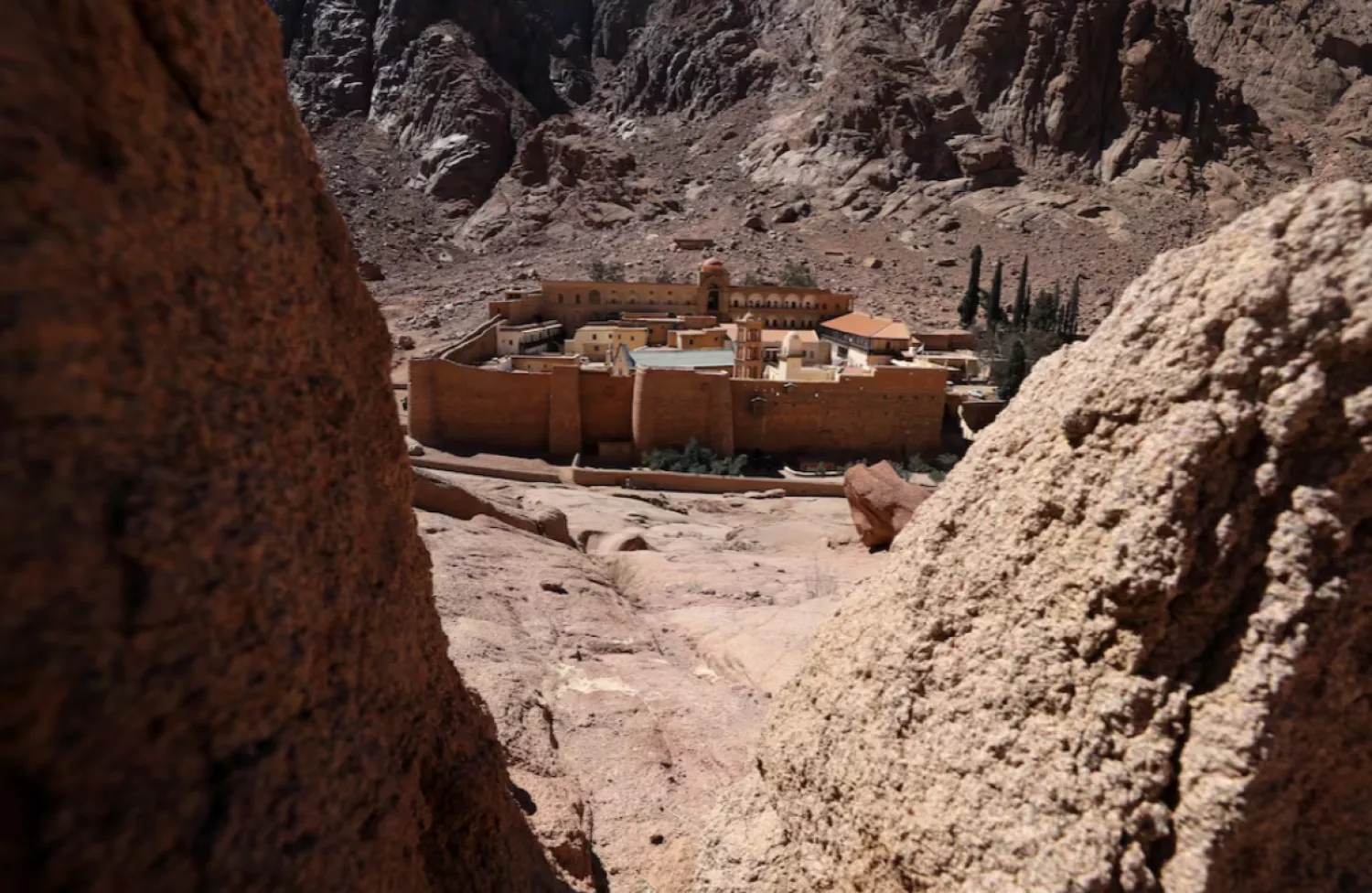
A general view of St. Catherine's Monastery in South Sinai, Egypt, March 7, 2019. Picture taken March 7, 2019. REUTERS/Mohamed Abd El Ghany/File Photo
TT

Greece, Egypt Reach Deal on Ancient Mount Sinai Monastery Future, Greek PM Says

A general view of St. Catherine's Monastery in South Sinai, Egypt, March 7, 2019. Picture taken March 7, 2019. REUTERS/Mohamed Abd El Ghany/File Photo

Greece said on Thursday it had agreed with Egypt on the future of St Catherine's Monastery at the foot of Egypt's Mount Sinai, one of the world's oldest sites of Christian worship whose status had led to a diplomatic spat between the two countries.

Athens had expressed concern about plans by Egypt to develop a tourism project around the site, where by Biblical tradition Moses received the Ten Commandments. The UNESCO World Heritage Site is still houses Greek Orthodox monks, according to Reuters.

Earlier this year, an Egyptian court ruling ordered the monks to vacate several plots of land and worship facilities that monks have used for centuries, on the grounds that they were illegally sequestered.

But after negotiations, Greece and Egypt have finalized an out of court deal that will be signed by the leadership of the monastery and the Egyptian authorities, according to Greek Prime Minister Kyriakos Mitsotakis and diplomats.

"It guarantees the character of the monastery in perpetuity," Mitsotakis said during a speech in parliament.

"Any conversion of the monastery as well as of the other places of worship is prohibited."

A senior Greek foreign ministry official said that the deal will be signed in the coming weeks.

The St Catherine's Monastery, at the foot of Mount Sinai, was founded in the 6th century and is the oldest Christian monastery still in use for its original function, says UNESCO.

Its library is one of the most extensive worldwide, containing some of the world's earliest Christian manuscripts.


Saudi Handicrafts Week Welcomes China as Guest of Honor

China's expanded presence reflects its cultural significance, with its pavilion showcasing a wide range of traditional Chinese handicrafts - SPA
TT

Saudi Handicrafts Week Welcomes China as Guest of Honor

China's expanded presence reflects its cultural significance, with its pavilion showcasing a wide range of traditional Chinese handicrafts - SPA

The third edition of the Saudi International Handicrafts Week (Banan) is a prominent cultural platform celebrating handicrafts locally and internationally, aligning with a broader strategy to revive traditional crafts, present them in a contemporary form reflecting the Kingdom’s cultural identity, and support the growing creative economy, SPA reported.

The exhibition, organized as part of the Year of Handicrafts 2025, reaffirms efforts to highlight this sector, empower its practitioners, and provide a space for artisans from across the Kingdom and the world to exchange experiences and diverse expertise.

This year, Banan features extensive international participation, showcasing artistic heritage and craft-making traditions from Oman, Kuwait, Bahrain, the UAE, Qatar, Syria, Jordan, Yemen, Tunisia, Morocco, Türkiye, Uzbekistan, Pakistan, Japan, Thailand, Indonesia, Korea, the Maldives, Bulgaria, the UK, France, Italy, Spain, Greece, Georgia, Austria, Hungary, Albania, Finland, Croatia, Colombia, Cuba, Peru, Chile, Mexico, the US, Australia, Nigeria, Comoros, and China, this edition's guest of honor.

China's expanded presence reflects its cultural significance, with its pavilion showcasing a wide range of traditional Chinese handicrafts and offering visitors a distinctive artistic experience.

This international diversity allows visitors to explore multiple schools of craftsmanship, discover models that blend heritage with innovation, and create new opportunities for cultural interaction and knowledge exchange among artisans.


Saudi Exports Launches Saudi Craft Sub-brand to Boost Handicrafts

Saudi Exports Launches Saudi Craft Sub-brand to Boost Handicrafts
TT

Saudi Exports Launches Saudi Craft Sub-brand to Boost Handicrafts

Saudi Exports Launches Saudi Craft Sub-brand to Boost Handicrafts

The Saudi Export Development Authority (Saudi Exports), represented by the Made in Saudi Program and in cooperation with the Heritage Commission, launched the "Saudi Craft" sub-brand—derived from the "Saudi Made" national identity—during the Saudi International Handicrafts Week (Banan), which is held under the patronage of Minister of Culture Prince Bader bin Abdullah bin Farhan.

This launch comes as part of efforts to support and empower Saudi handicrafts, highlight their economic and cultural value, and strengthen their presence in local and global markets, SPA reported.

It builds on the ongoing integration between the industry and culture ecosystems to develop national creative industries, in line with the declaration of 2025 as the Year of Handicrafts, aiming to empower artisans, open new horizons for their products to reach broader markets, boost the national economy, and reinforce Saudi cultural identity.

The authority affirmed that the Saudi Craft identity is one of the key components supporting the national industrial identity. It seeks to document Saudi handicrafts and showcase them as national products defined by creativity, authenticity, and quality under the Saudi Made identity umbrella.

The new identity also reflects a commitment to building an integrated system for promoting Saudi handicrafts locally and internationally, in cooperation with the Heritage Commission, which plays a central role in preserving handicraft heritage and empowering practitioners through training and qualification programs, as well as raising public awareness of the sector as one of the pillars of the Kingdom’s intangible cultural heritage.


Gazans Begin to Restore Historic Fort Damaged in War

Work has begun to rehabilitate the Pasha's Palace Museum a former fort turned heritage site housing 40,000 artifacts representing the succession of civilizations in Gaza © Omar AL-QATTAA / AFP
TT

Gazans Begin to Restore Historic Fort Damaged in War

Work has begun to rehabilitate the Pasha's Palace Museum a former fort turned heritage site housing 40,000 artifacts representing the succession of civilizations in Gaza © Omar AL-QATTAA / AFP

One bucket at a time, Palestinian workers cleared sand and crumbling mortar from the remains of an former medieval fortress turned museum in Gaza City, damaged by two years of fighting between Israel and Hamas.

A dozen workers in high visibility jackets worked by hand to excavate the bombarded buildings that remain of the Pasha Palace Museum -- which reputedly once housed Napoleon Bonaparte during a one-night stay in Gaza -- stacking stones to be reused in one pile, and rubble to be discarded in another.

Overhead, an Israeli surveillance drone buzzed loudly while the team toiled in silence.

"The Pasha Palace Museum is one of the most important sites destroyed during the recent war on Gaza City," Hamouda al-Dahdar, the cultural heritage expert in charge of the restoration works, told AFP, adding that more than 70 percent of the palace's buildings were destroyed.

As of October 2025, the UN's cultural heritage agency, UNESCO, had identified damage at 114 sites since the start of the war in Gaza on October 7, 2023, including the Pasha Palace.

Other damaged sites include the Saint Hilarion Monastery complex -- one of the oldest Christian monasteries in the Middle East -- and Gaza City's Omari Mosque.

Issam Juha, director of the Center for Cultural Heritage Preservation, the nonprofit organization in the Israeli-occupied West Bank who is helping coordinate the castle's restoration at a distance, said the main issue was getting materials into Gaza.

"There are no more materials and we are only managing debris, collecting stones, sorting these stones, and have minimal intervention for the consolidation," Juha told AFP.

Israel imposed severe restrictions on the Gaza Strip at the start of the war, causing shortages of everything including food and medicine.

After a US-brokered ceasefire deal came into effect in October, aid trucks began flowing in greater numbers, but each item crossing into Gaza must be approved by strict Israeli vetting, humanitarian organizations say.

Juha said the ceasefire had allowed workers to resume their excavations.

Before, he said, it was unsafe for them to work and "people were threatened by drones that were scanning the place and shooting".

Juha said that at least 226 heritage and cultural sites were damaged during the war, arguing his number was higher than UNESCO's because his teams in Gaza were able to access more areas.

Juha's organization is loosely affiliated with the Ramallah-based Palestinian Authority's ministry of antiquities, he said.

"Our cultural heritage is the identity and memory of the Palestinian people," Dahdar said in Gaza City.

"Before the war, the Pasha's Palace contained more than 17,000 artefacts, but unfortunately all of them disappeared after the invasion of the Old City of Gaza," he said.

He added that his team had since recovered 20 important artefacts dating back to the Roman, Byzantine and Islamic eras.

Gaza's history stretches back thousands of years, making the tiny Palestinian territory a treasure trove of archaeological artefacts from past civilizations including Canaanites, Egyptians, Persians and Greeks.

"We are... salvaging the archaeological stones in preparation for future restoration work, as well as rescuing and extracting any artefacts that were on display inside the Pasha Palace," Dahdar said.

As the pile of excavated rubble already several metres high grew, one craftsman carefully restored a piece of stonework bearing a cross mounted with an Islamic crescent.

Another delicately brushed the dust off stonework bearing Islamic calligraphy.

"We are not talking about just an old building, but rather we are dealing with buildings dating back to different eras," said Dahdar.