


Historic Libraries Bring Modern Comfort to Book Lovers and History Buffs in New England

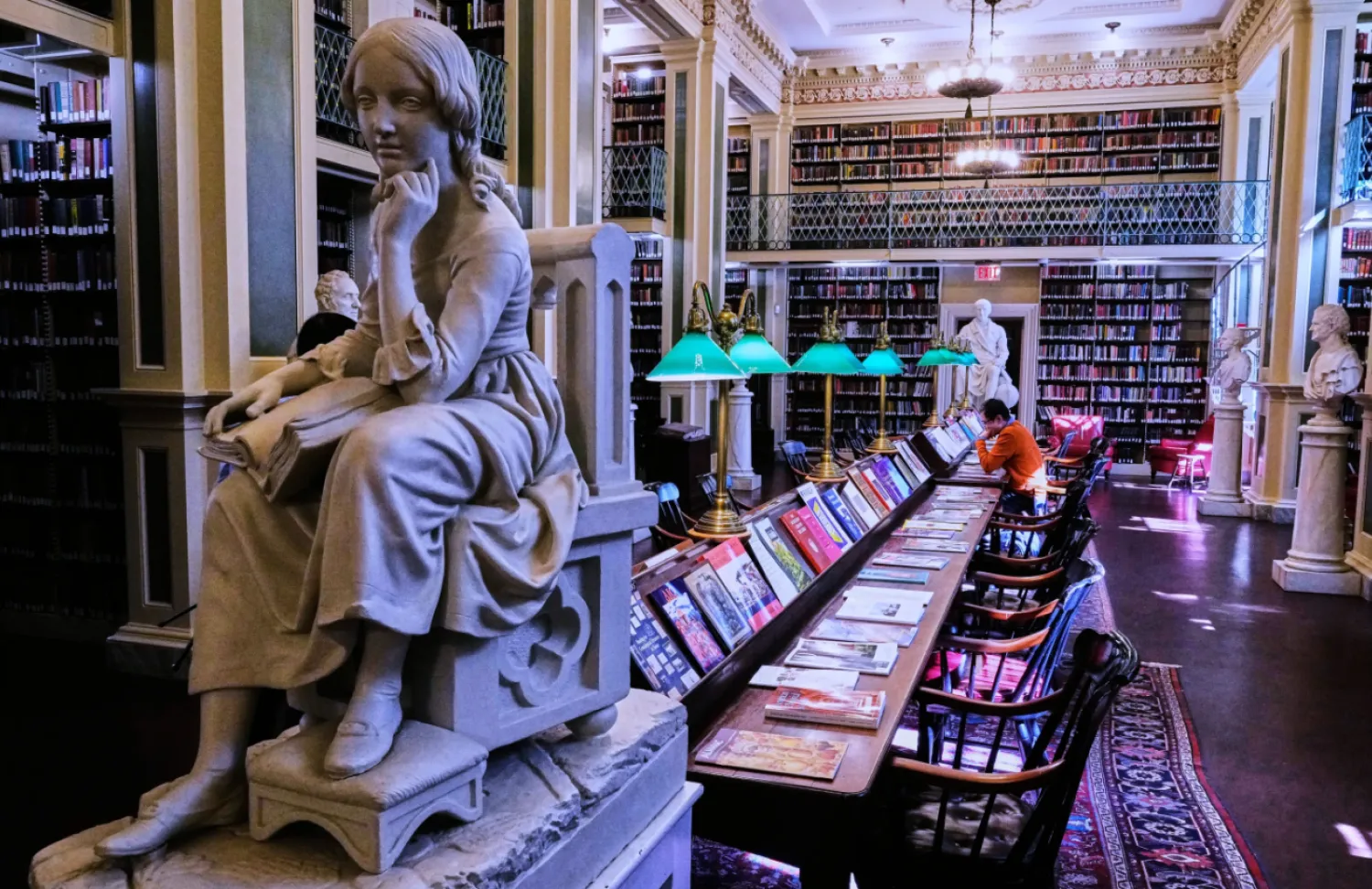
Little Nell, left, a sculpture of the character from Charles Dickens's "The Old Curiosity Shop", is displayed at the Boston Athenaeum, Thursday, Oct. 9, 2025, in Boston. (AP Photo/Charles Krupa)
TT

Historic Libraries Bring Modern Comfort to Book Lovers and History Buffs in New England

Little Nell, left, a sculpture of the character from Charles Dickens's "The Old Curiosity Shop", is displayed at the Boston Athenaeum, Thursday, Oct. 9, 2025, in Boston. (AP Photo/Charles Krupa)

When David Arsenault takes down a worn, leather-bound 19th-century book from the winding shelves of the Boston Athenaeum, he feels a sense of awe — like he’s handling an artifact in a museum.

Many of the half a million books that line the library's seemingly endless maze of reading room shelves and stacks were printed before his great-great-grandparents were born. Among fraying copies of Charles Dickens novels, Civil War-era biographies and town genealogies, everything has a history and a heartbeat, The AP news reported.

“It almost feels like you shouldn’t be able to take the books out of the building, it feels so special,” said Arsenault, who visits the institution adjacent to Boston Common a few times a week. “You do feel like, and in a lot of ways, you are, in a museum — but it’s a museum you get to not feel like you’re a visitor in all the time, but really a part of.”

The more than 200-year-old institution is one of only about 20 member-supported private libraries in the US dating back to the 18th- and 19th-centuries. Called athenaeums, a Greek word meaning “temple of Athena,” the concept predates the traditional public library most Americans recognize today. The institutions were built by merchants, doctors, writers, lawyers and ministers who wanted to not only create institutions for reading — then an expensive and difficult-to-access hobby — but also space to explore culture and debate.

Many of these athenaeums still play a vibrant role in their communities.

Patrons gather to play games, join discussions on James Joyce, or even research family history. Others visit to explore some of the nation’s most prized artifacts, such as the largest collection from George Washington ’s personal library at Mount Vernon at the Boston Athenaeum.

In addition to conservation work, institutions acquire and uplift the work of more modern creatives who may have been overlooked. The Boston Athenaeum recently co-debuted an exhibit by painter Allan Rohan Crite, who died in 2007 and used his canvas to depict the joy of Black life in the city.

One thing binds all athenaeums together: books and people who love them.

“The whole institution is built around housing the books,” said Matt Burriesci, executive director of Providence Athenaeum in Rhode Island. “The people who come to this institution really appreciate just holding a book in their hands and reading it the old-fashioned way.”

Book lover's dream Built to mimic an imposing Greek temple, staffers at the Providence Athenaeum often talk about the joy of watching people enter for the first time.

Visitors must climb a series of cold, granite steps. Only then are they met with a thick wooden door that ushers them into a warm world filled with cozy reading nooks, hidden desks to leave secret messages to fellow patrons, and almost every square inch bursting with books.

“It’s the actual time capsule of people’s reading habits over 200 years,” Burriesci said, while pointing to a first-edition of Little Women, where the pages and spine proudly showcase years of being well read.

Many athenaeums are designed to pay tribute to Greek influence and their namesake, the goddess of wisdom. In Boston, a city once dubbed “the Athens of America,” visitors to the athenaeum are greeted by a nearly 7-foot-tall (2.1-meter-tall) bronze statue of Athena Giustiniani.

The building is as much an art museum as it is a library.

“So many libraries were built to be functional — this library was built to inspire,” said John Buchtel, the Boston Athenaeum’s curator of rare books and head of special collections.

The 12-level building includes five gallery floors where ornate busts of writers and historical figures decorate reading rooms with wooden tables overlooked by book-lined pathways reachable by spiral and hidden staircases.

Natural light shines in from large windows where guests can look down to see one of Boston's most historic cemeteries where figures like Paul Revere, Samuel Adams, and John Hancock are buried.

“We’re able to leave many of these things out for people to peruse, and I think people can often get curious about something and just follow their curiosity into things that they didn’t even know that they were going to be fascinated by,” said Boston Athenaeum executive director Leah Rosovsky.

A safe haven When athenaeums were founded, they were exclusive spaces that only people with education and money could access.

Some are now free. Most are open to the public for day passes and tours. Memberships to the Boston Athenaeum can range from $17 to $42 a month per person, depending on whether the patron is under 40 or is sharing the membership with family members.

Charlie Grantham, a wedding photographer and aspiring novelist, said she first visited during one of the institution’s annual community days, where the public can explore for free. She said she was surprised by how accessible it was and describes the space as “Boston’s best kept secret — an oasis in the middle of the city.”

“It’s just so peaceful. Even if I’m still working... doing things I’m stressed out about at home, when I’m here, there’s like a stillness about it and things feel more manageable, things feel enjoyable here,” she said.

Some people visit every day to work remotely, read or socialize, said Salem Athenaeum executive director Jean Marie Procious.

“We do have a loneliness crisis,” she said. “And we want to encourage people to come and see us as a space to meet up with others and a safe environment that you’re not expected to buy a drink or buy a meal.”



Czech ‘Arks’ Help Preserve Ukraine’s Cultural Heritage

A photo taken in Prague's National Museum shows a 3D scanner in the Archa III (Ark Project) truck on March 24, 2026 in Prague, Czech Republic. (AFP)
TT

Czech ‘Arks’ Help Preserve Ukraine’s Cultural Heritage

A photo taken in Prague's National Museum shows a 3D scanner in the Archa III (Ark Project) truck on March 24, 2026 in Prague, Czech Republic. (AFP)

The National Museum in Prague on Tuesday unveiled a van containing a 3D scanning device that will soon travel to war-ravaged Ukraine to help preserve its cultural artifacts.

The Archa (Ark) III is a Volkswagen van comprising a studio equipped with a robot and three cameras to create precise models of endangered historic items in Ukraine, which has been battling a full-scale Russian invasion since 2022.

"Archa III is a unique mobile digitization device enabling us to create high-quality 3D images of endangered artifacts and collection items out in the field," National Museum director Michal Lukes told reporters.

He added the scanners could handle both tiny objects and more sizeable items even inside museums.

"In this way, we can create precise digital copies of items that can then serve for documentation and research purposes, but also for restoration, potential reconstruction, or the production of copies," he added.

Museum staff will drive the van to Kyiv in early April and hand it over to Ukrainian partners under the project carried out in cooperation with the foundation of Czech billionaire Karel Komarek.

It follows an Archa I container equipped to conserve and restore books and an Archa II van digitizing two-dimensional items, which Prague sent to Ukraine earlier.

The foundation, which worked on the first two "Arks" with other institutions, said they have so far handled almost 40,000 pages of documents, such as historic newspapers retrieved from the Regional Scientific Library in Kherson.

"The van comprises an autonomous robotic system designed for photogrammetry and 3D output," said the museum's IT director Martin Soucek.

Speed is crucial, and the robot moving along three axes can generate thousands of high-quality photographs within minutes.

"It then uses the photographs to create a hyper-realistic model with high detail, a so-called digital twin," Soucek added.

The project also involves expert training and a website on which the scanned artifacts will be exhibited.

Vitalii Usatyi, the charge d'affaires at the Ukrainian embassy in Prague, hailed the van for being able to work across Ukraine, "including regions exposed to risks related to the Russian aggression".

"This is crucial for preserving cultural heritage," he added.

A recent UNESCO report said that 523 cultural sites had been verified as damaged as of March 11, including 153 religious sites, 273 buildings of historical or artistic interest, 39 museums, 33 monuments, 20 libraries, four archaeological sites and one archive.


In Lebanon’s Tyre, Ancient Site Threatened by Israeli Bombs

This photograph taken on March 23, 2026, shows smoke as it rises from the site of an Israeli air strike at the background of the archaeological site of the ruins of the Phoenician Port in the southern Lebanese city of Tyre. (AFP)
TT

In Lebanon’s Tyre, Ancient Site Threatened by Israeli Bombs

This photograph taken on March 23, 2026, shows smoke as it rises from the site of an Israeli air strike at the background of the archaeological site of the ruins of the Phoenician Port in the southern Lebanese city of Tyre. (AFP)

At an archaeological site in southern Lebanon's Tyre, small signs bearing a blue and white emblem provide a symbolic shield, meant to protect the ancient ruins from bombardment.

One of the oldest cities on the Mediterranean coast, Tyre is located around 20 kilometers (12 miles) from the Israeli border, and has been the target of several strikes since Lebanon was drawn into the Middle East war by Hezbollah's March 2 rocket attack on Israel.

The Al-Bass site is centered on a necropolis that dates back three millennia to Tyre's time as a major Phoenician city and was still in use until the Arab conquests of the 7h Century.

An organization linked to UNESCO, the United Nations' cultural heritage agency, launched the signs initiative near the site, part of a push that covers more than 30 locations across the country.

It is a reminder that the 1954 Hague Convention obliges warring parties to protect cultural property.

On March 6, an Israeli strike hit just a few meters away, killing eight people according to Lebanon's health ministry.

The target, a family home, is now a pile of rubble.

"They were our neighbors... They thought that being close to an archaeological site protected them, that because this is a World Heritage site it would not be struck," said Nader Saqlawi, director of archaeological excavations in the south for Lebanon's culture ministry.

Museum employees place Enhanced Protection Emblems, a special symbol used under international humanitarian law to protect critical sites during armed conflict, at the archaeological site of the Roman hippodrome in the southern Lebanese city of Tyre, on March 23, 2026. (AFP)

- Human remains -

The team from the ministry that came to inspect possible damage to the monuments found human remains -- "a hand and pieces of flesh" -- on the roof of the site's museum, which is still under construction, he said.

The museum suffered damage, its windows were blown out, but the explosion did not reach the necropolis nor the Roman-era triumphal arch, aqueducts and hippodrome that are also part of the site.

In antiquity, the city of Tyre was at various times Phoenician, Persian, Hellenistic, Roman and Byzantine.

While many of its inhabitants have fled the latest war, others remain alongside the city's precious relics.

Lebanese Culture Minister Ghassan Salame condemned what he called Israel's aggression.

"The archaeological sites do not contain any military or security presence. Therefore, this argument cannot be used to justify their bombing," he said.

There was no immediate comment in response to AFP's request from the Israeli army, which usually says it is targeting Hezbollah sites or operatives with its attacks.

"Lebanon is full of archaeological riches... and the Beirut depots do not have the capacity to accommodate all these threatened objects," said David Sassine, an expert at the International Alliance for the Protection of Heritage.

This photograph taken on March 23, 2026, shows boxes filled with fragments of ancient pottery collected after an Israeli strike near the archaeological site of the Roman hippodrome in the southern Lebanese city of Tyre. (AFP)

- 'No one cares' -

There is also no guarantee that the objects would be safer in the capital, which is itself regularly bombed by Israel, and transporting the items from the south of the country, even under military escort, "remains risky", Sassine said.

During the previous Israel-Hezbollah conflict in 2024, gold coins, millennia-old amphorae and valuable sarcophagi were transferred to Beirut, where they have remained.

Tyre was heavily damaged by Israeli strikes during that war, while much of the population evacuated at the time.

Closer to the border, the citadel in the village of Shamaa was also partly destroyed by the Israeli military.

Saqlawi of the culture ministry said he believed attacks on historic sites were intentional.

"The Israelis know everything. They know your shoe size... and they know very well this is an archaeological site," he said.

Mustapha Najdi, a guard at the archaeological sites, was at the Al-Bass site when the March 6 strike hit.

"I heard a very violent impact. I fled and alerted the authorities," he said.

"No one cares about us," Najdi lamented, calling on "everyone who can to exert pressure to stop this barbarity".

"This civilization represents history, represents us all, Lebanese and non-Lebanese."


India’s Historic Haveli Homes Caught Between Revival and Ruin

 This photograph taken on February 2, 2026 shows a hospitality staff arranging tableware at the Dharampura Haveli, an 18th-century haveli-turned-heritage hotel in the old quarters of Delhi. (AFP)
This photograph taken on February 2, 2026 shows a hospitality staff arranging tableware at the Dharampura Haveli, an 18th-century haveli-turned-heritage hotel in the old quarters of Delhi. (AFP)
TT

India’s Historic Haveli Homes Caught Between Revival and Ruin

 This photograph taken on February 2, 2026 shows a hospitality staff arranging tableware at the Dharampura Haveli, an 18th-century haveli-turned-heritage hotel in the old quarters of Delhi. (AFP)
This photograph taken on February 2, 2026 shows a hospitality staff arranging tableware at the Dharampura Haveli, an 18th-century haveli-turned-heritage hotel in the old quarters of Delhi. (AFP)

Once the grand residences of Mughal-era nobility, the Indian capital's haveli homes now stand at a fragile crossroads -- a handful lovingly restored but many more sliding quietly into ruin.

Across Old Delhi -- the 17th century walled city founded as the Mughal capital Shahjahanabad -- cracked facades, shuttered gateways and sagging balconies tell the story of a heritage under siege from neglect, inheritance battles and relentless urban pressure.

Only a few restored pockets provide a glimpse of what once was -- airy courtyards, carved sandstone pillars and homes built around a deeply social way of life.

Inside one restored mansion that now houses a cultural center, sunlight filters through stained glass onto carved sandstone arches, the air infused with freshly polished wood and rosewater.

Musicians tune their instruments in a frescoed courtyard, where nobles may once have entertained guests, offering a rare peek into Old Delhi's rich architectural past.

But outside in the narrow lanes of Old Delhi's Chandni Chowk district, the contrast is stark.

Many havelis are abandoned or on the verge of collapsing, their carved facades fading beneath peeling paint.

The contrast reflects two futures -- one of careful restoration and the other of gradual decay.

- 'Who will pay?' -

The Kathika Cultural Centre's founder Atul Khanna said his initiative hoped to create an immersive cultural space inside a restored structure.

But he admitted that conservation in Old Delhi remains a huge challenge.

Many havelis are split among multiple heirs, with no single stakeholder willing or able to invest in costly upkeep.

"When there are multiple ownerships, that becomes a challenge," he said.

"If the haveli is decaying, who is going to spend the money?"

Khanna also blamed bureaucratic hurdles for discouraging restoration.

"There should be some kind of a single window for anyone who is working with heritage," he said, arguing that easing red tape would be more effective than offering subsidies for restoration.

Another prominent restoration is the 18th century Haveli Dharampura, now converted into a heritage hotel.

"Restoration in Old Delhi is still isolated unless there is sustained support and awareness," said Vidyun Goel, whose family owns the property.

Residents say family disputes and the push to convert properties into shops or apartments have led to rapid decline.

In nearby Roshanpura, only a scattering of old homes still stand. Among them, the century-old Mathur ki Haveli is a rare example of a lived-in heritage home.

- Showpiece projects -

"We are in love with this house," said Ashok Mathur, a fourth-generation resident who continues to live in the ancestral property despite mounting challenges.

Wooden ceilings are deteriorating, floors are wearing thin and doors require constant repair, he said, walking through rooms that bear only traces of intricate craftsmanship.

Still, he said he has never considered leaving -- although he can only imagine the social world that once defined haveli life.

"There is no community left," Mathur, 56, said. "We are living in a cocoon."

Conservationist K. T. Ravindran said that while Old Delhi is economically vibrant, its havelis suffer from unclear titles and multiple claimants.

"Often buildings that look intact from outside conceal deeper damage," he said, noting that the condition was worse in the inner lanes hidden from public view.

Ravindran said revival was still possible, but only through neighborhood-level regeneration rather than isolated showpiece projects.

Oral historian Sohail Hashmi said each haveli once formed part of "a larger social ecosystem of neighborhoods, crafts and traditions", with architecture and community deeply intertwined.

As Khanna put it, the loss goes beyond architecture.

"When you lose a haveli, you are not only losing the structure," he said.

"Every element in it is a piece of art."