

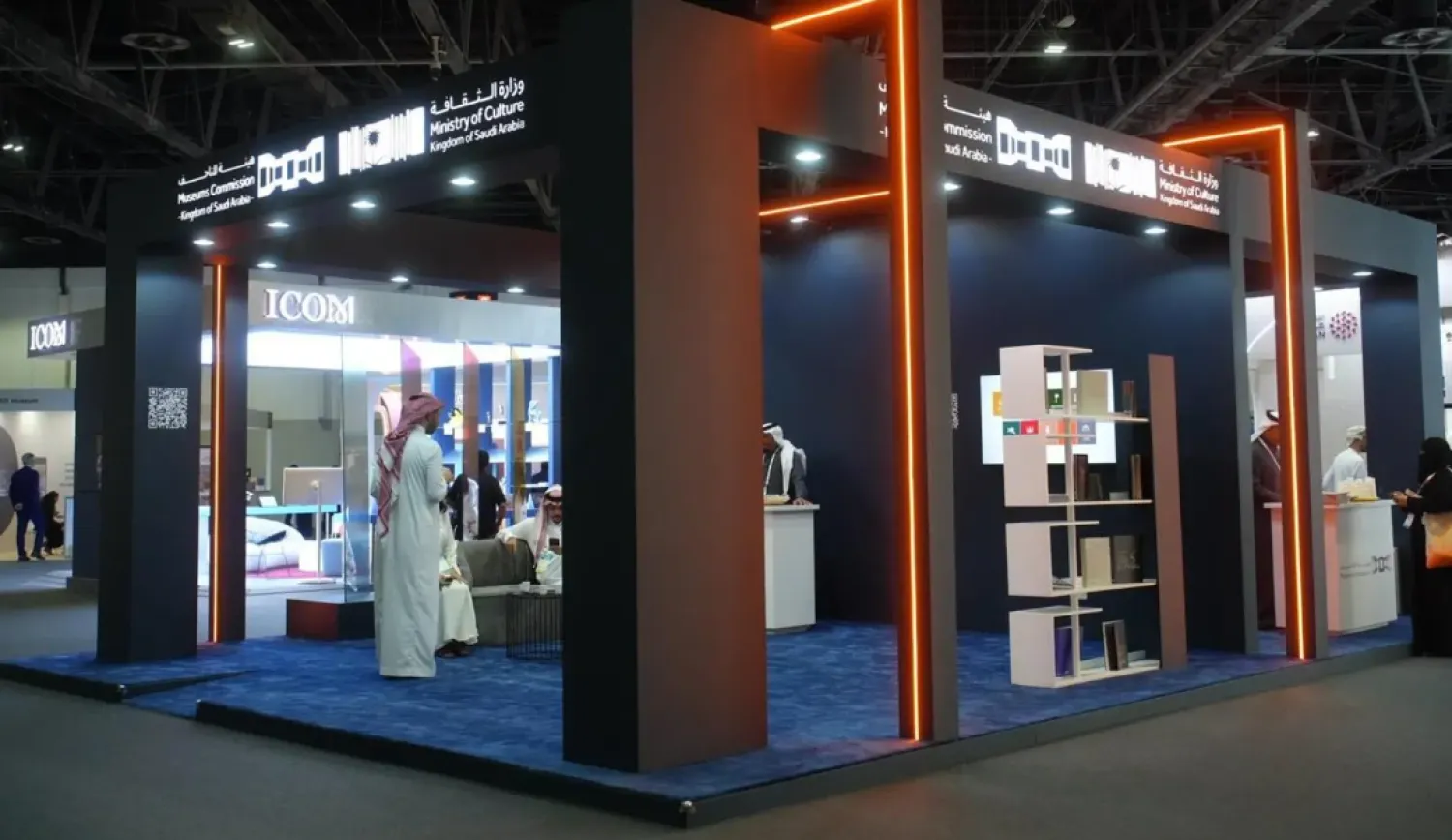

Saudi Museums Commission Inaugurates Pavilion at ICOM Dubai 2025

The commission affirmed that its participation in ICOM Dubai represents an opportunity to showcase Saudi Arabia’s experience in building an integrated museum sector - SPA
TT

Saudi Museums Commission Inaugurates Pavilion at ICOM Dubai 2025

The commission affirmed that its participation in ICOM Dubai represents an opportunity to showcase Saudi Arabia’s experience in building an integrated museum sector - SPA

The Museums Commission participated today in the 27th General Conference of the International Council of Museums (ICOM), being held in Dubai from November 11 to 17, 2025.


The conference, themed "The Future of Museums in Rapidly Changing Communities," has drawn a diverse group of museum experts and institutions from across the globe, according to a press release issued by the commission on Wednesday.

On the first day of the conference, the Museums Commission unveiled its pavilion, showcasing the Kingdom's efforts to develop its national and regional museum ecosystem. The exhibit highlights the commission's key initiatives and projects aligned with Saudi Vision 2030, as part of its mission to transform museums into vibrant community hubs that enhance cultural communication and revitalize values of identity and heritage.

The pavilion features interactive and visual displays highlighting the transformation of the museum sector in Saudi Arabia. These displays showcase the diversity of exhibited experiences, the adoption of modern technologies in presentation and documentation, and programs that empower national talent in conservation, research, design, and the overall museum experience.

The release added that the commission’s representatives will also participate in various conference panels and sessions. These speakers will highlight the evolution of Saudi Arabia's museum landscape over the past decade and discuss the crucial role museums play in documenting social and cultural shifts. They will also explore how these institutions are strengthening the Kingdom's presence on the global cultural landscape.

This participation reinforces the Museums Commission's presence in international forums and reaffirms its commitment to fostering professional dialogue within the global museum community. It also underscores the importance of exchanging expertise in areas of museum management, exhibition development strategies, and the adoption of digital solutions that keep pace with the rapid changes in modern communities.

The commission affirmed that its participation in ICOM Dubai represents an opportunity to showcase Saudi Arabia’s experience in building an integrated museum sector that contributes to preserving national memory and safeguarding tangible and intangible heritage. Additionally, it allows the commission to explore the future of museums as open spaces for dialogue, creativity, and education.

The ICOM conference is considered one of the world's most influential events in the museum sector, bringing together distinguished experts, cultural leaders, and museum professionals to discuss the opportunities and challenges facing cultural institutions amidst rapid technological and social transformations. This underscores the Kingdom's growing stature and leadership role on the global cultural landscape.



Red Sea Museum Showcases Jeddah's Black Coral Prayer-Bead Making Heritage

The gallery also features a wall displaying shells, molluscs and pieces of coral from the Red Sea - SPA
TT

Red Sea Museum Showcases Jeddah's Black Coral Prayer-Bead Making Heritage

The gallery also features a wall displaying shells, molluscs and pieces of coral from the Red Sea - SPA

The Red Sea Museum represents a valuable addition to Jeddah's cultural and tourism landscape, offering an educational experience that brings the history of the Red Sea to life and highlights Saudi Arabia’s rich civilization and cultural heritage associated with navigation, trade and Hajj.

As one of Saudi Arabia’s prominent cultural and educational destinations, the museum presents art exhibitions and cultural and educational programs that explore the history and civilization heritage of the Red Sea and document its connection with navigation, trade and human life through experiences that bring together visual arts, architecture, cinema and storytelling, SPA reported.

The Red Sea Museum showcases the craft of prayer-bead making. An identification label accompanying a set of prayer beads made from black coral on display at the museum bears the name of craftsman Ahmed Al-Halabi, who made the beads in Jeddah. The beads tell part of his family's history, as it is one of the oldest families known for this craft in the city.

The gallery also features a wall displaying shells, molluscs and pieces of coral from the Red Sea.

Visitors can observe coral in its natural form before seeing how the craftsman shaped black coral into beads, threaded them together to make a string of prayer beads, and designed them to pass smoothly between the fingers.


Landmark Bus Tours, Folk Arts, and Stargazing Draw Crowds to 'Wasm Hail' Cultural Festival

The program features traditional camel processions, folk arts, stage and musical performances, handicraft stalls, exhibition pavilions, and classic car displays - SPA
TT

Landmark Bus Tours, Folk Arts, and Stargazing Draw Crowds to 'Wasm Hail' Cultural Festival

The program features traditional camel processions, folk arts, stage and musical performances, handicraft stalls, exhibition pavilions, and classic car displays - SPA

The Wasm Hail events at Al-Qishlah Palace in Hail have welcomed thousands of residents and tourists from within the region and beyond to enjoy a diverse array of experiences blending heritage, culture, and entertainment.

The program features traditional camel processions, folk arts, stage and musical performances, handicraft stalls, exhibition pavilions, and classic car displays. A dedicated tourist bus service also offers guided tours of landmarks, SPA reported.

Adding an educational dimension, the festival includes an astronomical experience enabling visitors to observe the moon and planets through optical telescopes and safely view the sun via specialized solar telescopes, highlighting Hail's diverse cultural and tourism assets.


A Long-Buried Ancient Library in Rome Opens to the Public After Restoration

 Marble archaeological remains from the western library of Trajan's Forum, which archaeologists believe may have housed the ancient Bibliotheca Ulpia, one of ancient Rome's most important libraries, are displayed during a press preview of the restored site in Rome, Thursday, Nov. 19, 2026. (AP)
Marble archaeological remains from the western library of Trajan's Forum, which archaeologists believe may have housed the ancient Bibliotheca Ulpia, one of ancient Rome's most important libraries, are displayed during a press preview of the restored site in Rome, Thursday, Nov. 19, 2026. (AP)
TT

A Long-Buried Ancient Library in Rome Opens to the Public After Restoration

 Marble archaeological remains from the western library of Trajan's Forum, which archaeologists believe may have housed the ancient Bibliotheca Ulpia, one of ancient Rome's most important libraries, are displayed during a press preview of the restored site in Rome, Thursday, Nov. 19, 2026. (AP)
Marble archaeological remains from the western library of Trajan's Forum, which archaeologists believe may have housed the ancient Bibliotheca Ulpia, one of ancient Rome's most important libraries, are displayed during a press preview of the restored site in Rome, Thursday, Nov. 19, 2026. (AP)

The famed Alexandria Library in Egypt may have been lost, but another of the ancient world's repositories for texts has been restored in Rome and is reopening to the public this week.

The ruins of the Ulpia library are located in Emperor Trajan’s Forum, just next to the iconic column that celebrates his victorious campaigns against the Dacians and the Roman conquest of what is modern-day Romania. It remained inaccessible for almost a century.

“After the Alexandria Library of Egypt, after the Library of Pergamon in Asia Minor, this one in the Trajan’s Forum was certainly one of the most important, given both the number of ‘volumina,’ as books were called in ancient times, and the quantity of documents," Claudio Parisi Presicce, an archaeologist and Rome's superintendent for cultural heritage, said in an interview with The Associated Press.

The place was in a state of ruin when discovered in 1932 during clearing works by Benito Mussolini's government for the road that became the famous Via dei Fori Imperiali. Later, it was covered in concrete and used as a storage room for some of the countless pieces from Trajan's Forum, the last and greatest of the imperial fora, built in 112 AD.

But the niches in its walls were evidently spots to set cabinets for scrolls, signaling that this was one of the two, two-story buildings comprising the Ulpia library referenced in ancient texts, Presicce said.

Archaeologists from Rome's superintendency for cultural heritage identify it as the Ulpia library's western building, which ancient texts indicate stored Greek-language scrolls.

The new permanent exhibition offers visitors an idea of the space as it used to be, featuring the remains of some of the library’s rich marble decorations — white for the walls, and different colors for its floor and columns. Immersive videomapping is also projected on its walls, showing the history of the library and its discovery. Instead of scroll-filled cabinets, spread throughout the space today are broken Corinthian columns and pieces of sculptures.

The library was a fundamental part of the Forum, and a place that for centuries attracted citizens from all over Rome with its vast collection of edicts and documents.

“The libraries were used by both common citizens, those who could afford a certain cultural level and a better education than those from the lower classes, but also by magistrates who needed access to older documents, or needed to check the norms that regulated the life of the community,” he said.

Restoration started in 2025, and lasted about a year. The 1.75-million-euro cost ($1.92 million) came from the European Union’s pandemic recovery funds — just one of many restoration projects Rome is carrying out across the city with EU money.

It will initially be opened to visitors only on Fridays, Saturdays and Sundays. Visits are scheduled every 40 minutes, 20 people at a time.

The library's eastern building remains buried beneath an 18th-century church, on the other side of Trajan's Forum, and stored Latin-language scrolls. There are no plans for its excavation.