


Rebooted Harlem Museum Celebrates Rise of Black Art

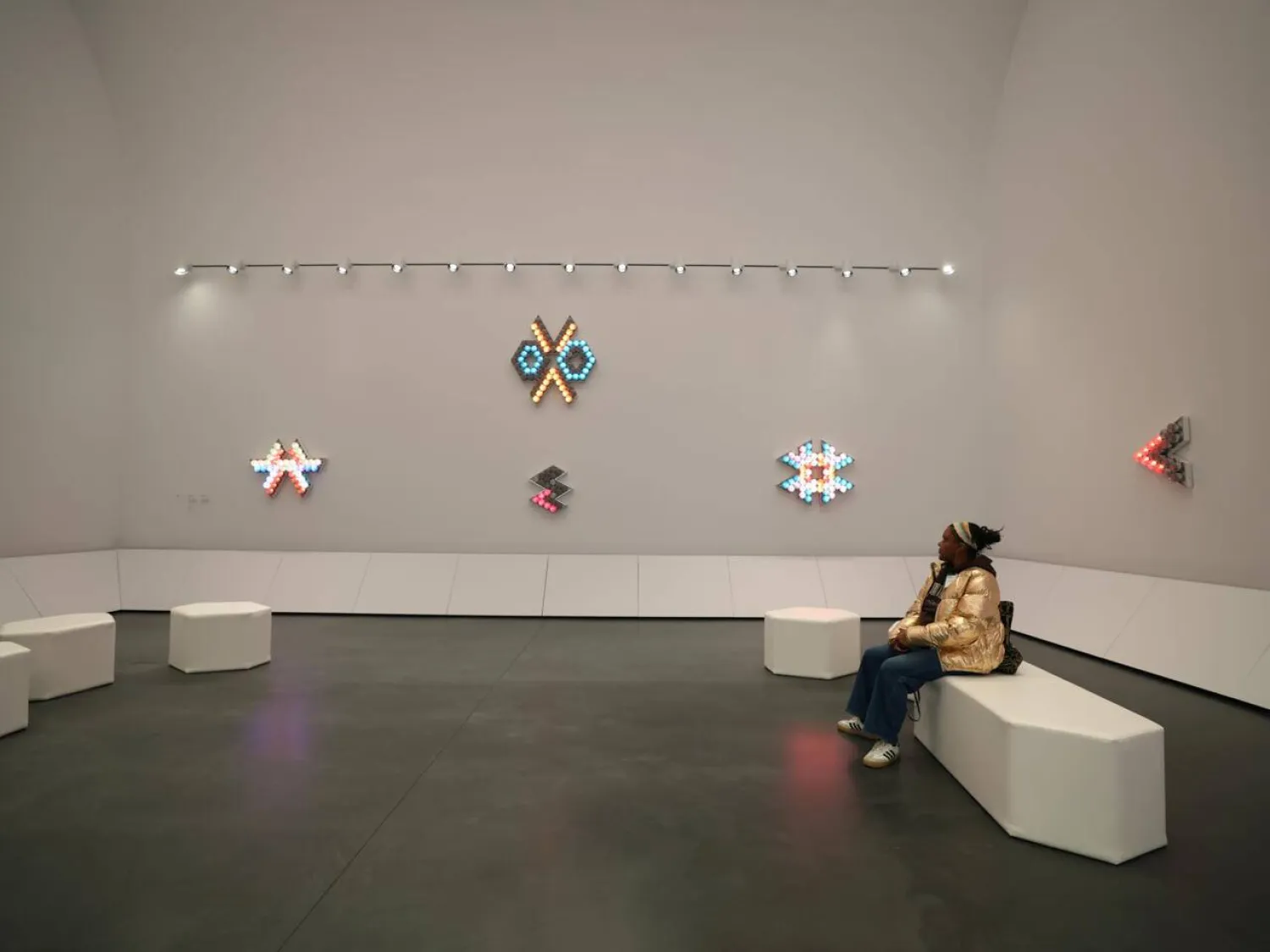
To mark its reopening, the Studio Museum is mounting a retrospective on Ton Lloyd, whose works were shown in the museum's 1968 inaugural show. TIMOTHY A. CLARY / AFP
TT

Rebooted Harlem Museum Celebrates Rise of Black Art

To mark its reopening, the Studio Museum is mounting a retrospective on Ton Lloyd, whose works were shown in the museum's 1968 inaugural show. TIMOTHY A. CLARY / AFP

As the Studio Museum reopens this weekend in its gleaming new building, New York's premier institution for Black art finds itself looking back and looking forward at the same time.

Colorful signs featuring permanent works have sprouted near the museum's home in Harlem, a center point in Black life and imagination in America for more than a century, AFP said.

The museum, closed for the more than seven-year project, has commissioned new works to commemorate the reboot, which features expanded studios for the institution's artists-in-residence program.

But the 57-year-old museum is also hearkening back to its roots with a retrospective of the late Tom Lloyd, whose electronically programmed wall sculptures anticipated today's digital age.

Some of the same pieces were hung in the museum's inaugural 1968 show back when works by artists of African descent were mostly absent from New York's leading museums.

Today's art scene is very different.

Rashid Johnson, Amy Sherald and others are regularly showcased in shows at the Guggenheim, Whitney and other nameplate New York museums, which have also hosted retrospectives belatedly recognizing Black movements.

"In the time of the museum's life, we have seen this incredible trajectory and some of that is a result of the work that the museum did in its establishment and its early years," said Studio Museum director Thelma Golden, who oversaw a more than $300 million drive to finance a teardown and newbuild project that cements the museum's ties to Harlem.

"The aperture opens, but even with that, we still believe deeply in the work that continues to need to be done."

'Truly current work'

The museum's history is laid out in photos of the 1968 groundbreaking, and there are posters of jazz nights, "Uptown Friday" gatherings, high school programs and of shows such as a retrospective of James Van Der Zee, a famed photographer during the Harlem Renaissance.

The founders' ambitions included creating a place distinct from New York establishments like the Museum of Modern Art.

The Studio Museum will present "truly current work," founders wrote in 1966. The work "could turn out to be a flash in the pan or could conceivably begin an entire new school or new direction in art."

Backers also sought to redefine Harlem, "which is all too often equated with slums, violence and other evils," and to deepen the commitment of supporters -- some white -- to "make New York City a united city rather than one which is currently divided by an invisible Berlin wall."

Key turning points included 1981, when the Studio Museum broke ground at its current address at 144 West 125th Street.

Another shift came after Golden joined in 2000, when the mission statement was expanded beyond US-born creators to artists of African descent "locally, nationally and internationally."

Signature works

That broadened scope is boldly expressed on the building's exterior with a red, black and green flag by David Hammons inspired by the Pan-African flag of the 1920s associated with activist Marcus Garvey.

Another signature work is Houston Conwill's "The Joyful Mysteries," containing statements by seven prominent Black Americans written for future generations. The time capsules will be opened in September 2034, 50 years after their creation.

The new edifice itself nods to Harlem's architectural vernacular, with a mass of geometries in gray concrete and glass. The building has received rapturous reviews, and this weekend offers the public a first look.

Golden described the site as aiming to "redefine what a museum can be in its space and content."

She credited her predecessors, not all of whom lived to see Black art achieve mainstream acceptance.

"I am well aware that they did not get to see the fruits of the labor," Golden told AFP. "The inheritance I have from them is that they believed so deeply that that belief carries from '68 to this moment."



'Talking Drum' Looted by France in 1916 Back in Ivory Coast

A crate containing the Djidji Ayokwe drum, at the airport in Abidjan, Ivory Coast. (Photo by Issouf SANOGO / AFP)
TT

'Talking Drum' Looted by France in 1916 Back in Ivory Coast

A crate containing the Djidji Ayokwe drum, at the airport in Abidjan, Ivory Coast. (Photo by Issouf SANOGO / AFP)

The Djidji Ayokwe "talking drum", which was looted by French colonial troops in 1916 and taken to France, arrived back in Ivory Coast Friday, in the latest repatriation of stolen artifacts.

The wooden drum, more than three meters (10 feet) long and weighing 430 kilos (950 pounds), was used by the Ebrie tribe to transmit messages.

It was officially handed over on February 20 after France's parliament approved removing the artifact from the national museum collections to enable its return.

Ivory Coast had asked in late 2018 for the return of the Djidji Ayokwe among 148 works of art taken during the colonial period.

It arrived aboard a specially chartered plane at Ivory Coast's main city Abidjan and remained inside a huge wooden crate stamped "fragile", AFP journalists saw.

"It's an historic day and I feel deep emotion," Culture Minister Francoise Remarck said, welcoming its arrival at the airport, where the Ebrie community also sang and played drums.

"We are living a moment of justice and remembrance," the minister added.

French President Emmanuel Macron promised in 2021 to send the drum and other artifacts back home to the west African country.

It is one of hundreds of objects France is preparing to send back to Africa, with the efforts set to be accelerated by the passing of a new law to authorize mass repatriations.

"We are happy and relieved to know that this sacred piece of our culture is back on its native land," Aboussou Guy Georges Mobio, an Ebrie village chief, told AFP.

The drum will initially be held in a "safe space" to allow it to acclimatize, the culture minister said.

It is due to go on display at the Museum of Civilizations in Abidjan which has been specially renovated.

The "talking drum" was used by the Ebrie community to warn of danger, mobilize for war or call villagers to ceremonies.

It was seized by colonial authorities in 1916 before being shipped to France in 1929 and exhibited in Paris.

Senegal and Benin have also asked for the repatriation of their treasures.

In late 2020, the French parliament adopted a law providing for the permanent return to Benin of 26 artifacts from the royal treasures of Dahomey.

The return of cultural artifacts taken from ex-colonies in Africa and elsewhere has become a sensitive issue, with museums, institutions and collectors in Europe and the United States facing pressure to give them back.


Red Sea Fund Launches Second Round to Support Film Projects in Production Stage

File photo of the fifth day of the Red Sea International Film Festival - SPA
TT

Red Sea Fund Launches Second Round to Support Film Projects in Production Stage

File photo of the fifth day of the Red Sea International Film Festival - SPA

The Red Sea Fund, affiliated with the Red Sea Film Foundation, announced the opening of applications to support film projects in the production stage within the second round of this year’s support program, which will continue until March 21, as part of its efforts to enhance the cinema industry and empower innovators in the region, SPA reported.

The round aims to support promising cinematic voices from the Kingdom and the Arab world, as well as filmmakers from Africa and Asia, through financial grants that help complete film projects and present their creative narratives globally, with a special focus on projects ready to enter production and begin filming.


Prince Mohammed bin Salman Project Restores Historic Al-Jami' Mosque in Tabuk Region

The renovation utilized modern technologies to restore the mosque's original identity - SPA
TT

Prince Mohammed bin Salman Project Restores Historic Al-Jami' Mosque in Tabuk Region

The renovation utilized modern technologies to restore the mosque's original identity - SPA

The Prince Mohammed bin Salman Project for the Development of Historical Mosques has completed the restoration of Al-Jami' Mosque in Duba, Tabuk Region, as part of its mission to preserve the Kingdom's architectural heritage under Vision 2030.

As one of Duba’s oldest landmarks, the mosque is deeply intertwined with the city’s maritime history, traditionally serving as a central meeting point for sailors. Throughout its history, the mosque underwent several construction phases, including significant contributions by King Abdulaziz and King Fahd, before its selection for the current national development project, SPA reported.

The renovation utilized modern technologies to restore the mosque's original identity, increasing its area to 972.23 square meters and its capacity to 779 worshippers. The architectural style is inspired by traditional Red Sea heritage, incorporating natural materials like stone, mud, and wood for intricate mashrabiyas.

Executed by specialized Saudi firms, the project balances traditional standards with sustainability to rehabilitate the site for worship while highlighting its cultural significance. By restoring such landmarks, the project ensures the preservation of the Kingdom’s diverse architectural and social memory for future generations.