

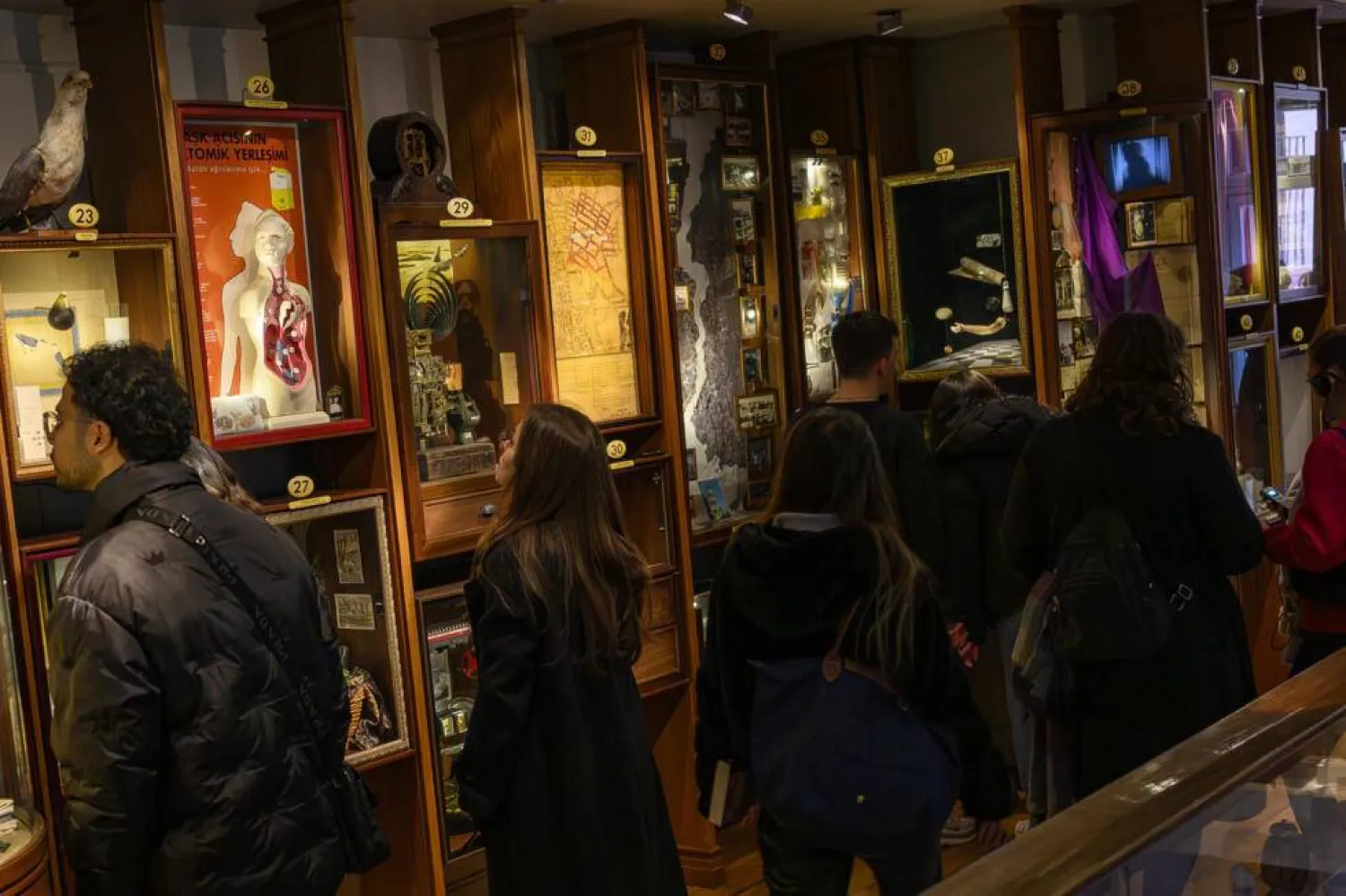

Crowds Flock to Istanbul's Museum of Innocence before TV Adaptation

Pamuk brought his bestselling novel to life in a red-painted house in Istanbul. Yasin AKGUL / AFP
TT

Crowds Flock to Istanbul's Museum of Innocence before TV Adaptation

Pamuk brought his bestselling novel to life in a red-painted house in Istanbul. Yasin AKGUL / AFP

On a cobbled street in Cukurcuma, a district on Istanbul's European side known for its antiques shops, the story penned by Nobel laureate Orhan Pamuk in his bestselling novel "The Museum of Innocence" has been brought to life.

Inside a red-painted house, visitors are confronted by a wall of 4,213 cigarette butts, many of them lipstick-stained, others angrily stubbed out, all obsessively kept by the book's protagonist, Kemal Basmaci.

Just days before Friday's launch of a serialized Netflix adaptation of the novel, hundreds of curious visitors have come to the museum, squeezing past one another on the narrow wooden stairs up to Basmaci's attic room.

At the entrance, Umit, who runs the museum and declined to give his surname, said there had been about 500 visitors per day since Netflix began running trailers for the nine-part series, compared to 200 on a normal day.

"And that will likely double after it comes out," he predicted.

Set in the 1970s, the series features a young man from a wealthy Istanbul family who is devastated by the end of his relationship with Fusun, a distant cousin from a working-class background.

The break-up sends him on an obsessive mission to collect anything that is hers, AFP said.

Hence the wall of cigarette butts mounted on pins, each painstakingly labelled by circumstance, collected over an eight-year period starting from 1976.

There are hundreds more items on display, from bits of jewelry to items of clothing, photos, cinema tickets and bottles of Meltem soda, which was popular in the 1970s -- a huge collection of mundane mementoes passionately collected to fill the void left by Fusun's absence.

They are laid out in 83 display cases, the same number of chapters in the book.

Nobel literature prize-winner Pamuk, who opened the museum in 2012, four years after the novel was published, has admitted to being a similarly compulsive collector.

- 'Truth in it' -

The novel emerged when he began writing about the objects he had saved, everything from family keepsakes to trinkets picked up at the bazaars, which gradually brought his characters to life.

The museum showcases objects that make up the story, but the story also developed as he acquired new objects, the museum website says.

And the whole novel opens a unique window onto a decade of Istanbul history.

Songul Tekin, 28, a visitor who loved the book, said she is convinced some of it really happened and came to the museum to "see it in real life".

"It's told in real depth. There has to be some truth in it because otherwise you would never have so many objects and so much detail," she told AFP.

She arrived with a friend and her copy of the novel -- a gesture which lets visitors enter for free, thanks to a ticket on page 485 of the Turkish version of the book.

Also visiting was Aydin Deniz Yuce, a psychologist in his 30s who is a huge fan of Pamuk's works.

Although "The Museum of Innocence" was not his "favorite", he said he was really keen to see the Netflix series and is convinced the "handsomeness" of the main actor, Selahattin Pasali, will be perfect for creating a credible Kemal.

- Turkish series, global popularity -

With the novel translated into more than 60 languages, the museum has drawn international interest.

Visitors from China, Hungary, Italy, Japan and Russia turned up over the space of a few hours, an AFP correspondent said.

Poring over the display cabinets, Zeng Hu and Zeng Lin An, sisters from Hubei province in central China, said they were now intrigued to read the book and watch the series, although Netflix is not available in China.

Speaking to AFP at the screening late on Thursday, Pamuk said he was happy with the adaptation by Istanbul-based production company Ay Yapim after a disastrous first attempt several years ago.

"Since I was so dissatisfied and unhappy with my first try with Hollywood, I decided I wouldn't allow anyone to make a film of any of my books without seeing the complete script first," he said.

That meant working closely with a scriptwriter for 18 months before any money changed hands, which gave him "tight control" over the script.

"Once every two months, we would meet, like students doing homework. I would go over the scriptwriter's texts, criticize it, improve it, suggest other things," Pamuk said.

"It worked magically."

Hugely popular, Turkish television dramas and series, known as "dizi", are now available in 170 countries.

Global demand for them rose by 184 percent between 2020 and 2023, figures from Parrot Analytics show.

In 2024, Türkiye was the world's third-largest exporter of television series, after the United States and the UK.



Oscar Contender ‘Hamnet’ Boosts Tourism at Shakespeare Heritage Sites 

A view of Shakespeare’s Birthplace, William Shakespeare's childhood home, in Stratford-upon-Avon, Britain, February 9, 2026. (Reuters)
TT

Oscar Contender ‘Hamnet’ Boosts Tourism at Shakespeare Heritage Sites 

A view of Shakespeare’s Birthplace, William Shakespeare's childhood home, in Stratford-upon-Avon, Britain, February 9, 2026. (Reuters)

On a cloudy winter's day, visitors stream into what was once William Shakespeare's childhood home in Stratford-upon-Avon and the nearby Anne Hathaway's cottage, family residence of the bard's wife.

Hathaway's cottage is one of the settings for the BAFTA and Oscar best film contender "Hamnet", and the movie's success is drawing a new wave of tourists to Shakespeare sites in the town in central England.

Shakespeare's Birthplace is the house the young William once lived in and where his father worked as a glove maker, while Hathaway's cottage is where he would have visited his future wife early in their relationship.

Typically, around 250,000 visitors, from the UK, Europe, the United States, China and elsewhere, walk through the locations each year, according to the Shakespeare Birthplace Trust. ‌The charity looks after ‌Shakespeare heritage sites, which also include Shakespeare's New Place, the site of ‌the ⁠Stratford home where the ⁠bard died in 1616.

Visitors are flocking in this year thanks to "Hamnet", the film based on Maggie O'Farrell's 2020 novel, which gives a fictional account of the relationship between Shakespeare and Hathaway, also known as Agnes, and the death of their 11-year-old son Hamnet in 1596.

"Visitor numbers have increased by about 15 to 20% across all sites since the film was released back in January. I think that will only continue as we go throughout the year," Richard Patterson, chief operating officer for the Shakespeare Birthplace Trust, said.

"They particularly want ⁠to look (at) Anne Hathaway's cottage and the specifics around how the family ‌engaged in the spaces and the landscape in and around ‌the cottage... you can see why he would have been inspired."

NEW ACCESS TO SHAKESPEARE

"Hamnet" has 11 nominations at ‌Sunday's British BAFTA awards, including best film and leading actress for Jessie Buckley, who plays Agnes. It ‌also has eight Oscar nominations, with Buckley seen as the frontrunner to win best actress.

"Hamnet" is set in Stratford-upon-Avon and London although it was not filmed in Stratford.

It sees Paul Mescal's young Shakespeare fall for Agnes while teaching Latin to pay off his father's debts. The drama, seen mainly through Agnes' eyes, focuses on their ‌life together and grief over Hamnet's death, leading Shakespeare to write "Hamlet".

"Shakespeare... is notoriously enigmatic. He writes about humanity, about feeling, about emotion, about conflict, ⁠but where do we understand ⁠who he is in that story?" said Charlotte Scott, a professor of Shakespeare studies and interim director of collections, learning and research at the Shakespeare Birthplace Trust.

"And that's driven people creative and otherwise for hundreds and hundreds of years. Where is Shakespeare's heart? And this is what the film I think has so beautifully opened up."

Little is known about how the couple met. Shakespeare was 18 and Hathaway 26 when they married in 1582. Daughter Susanna arrived in 1583 and twins Judith and Hamnet in 1585.

The film acknowledges the names Hamnet and Hamlet were interchangeable back then. While grief is a dominant theme, audiences also see Shakespeare in love and as a father.

"A lot of people will see this film not necessarily having... had any kind of relationship with Shakespeare," Scott said.

"So people will come to this film, I hope, and find a new way of accessing Shakespeare that is about creativity, that is about understanding storytelling as a constant process of regeneration, but also crucially, looking at it from that kind of emotive angle."


Culture Ministry Continues Preparations in Historic Jeddah to Welcome Visitors during Ramadan 

Historic Jeddah has emerged as a leading cultural tourism destination during Ramadan. (SPA)
TT

Culture Ministry Continues Preparations in Historic Jeddah to Welcome Visitors during Ramadan 

Historic Jeddah has emerged as a leading cultural tourism destination during Ramadan. (SPA)

The Saudi Ministry of Culture is continuing its efforts to revitalize Historic Jeddah in preparation for welcoming visitors during the holy month of Ramadan, offering cultural programs, events, and heritage experiences that reflect the authenticity of the past.

The district has emerged as a leading cultural tourism destination at this time of year as part of the “The Heart of Ramadan” campaign launched by the Saudi Tourism Authority.

Visitors are provided the opportunity to explore the district’s attractions, including archaeological sites located within the geographical boundaries of the UNESCO World Heritage-listed area, which represent a central component of the Kingdom’s urban and cultural heritage.

The area also features museums that serve as gateways to understanding the city’s rich heritage and cultural development, in addition to traditional markets that narrate historical stories through locally made products and Ramadan specialties that reflect authentic traditions.

These initiatives are part of the ministry’s ongoing efforts to revitalize Historic Jeddah in line with the objectives of Saudi Vision 2030 and aiming to transform it into a vibrant hub for arts, culture, and the creative economy, while preserving its tangible and intangible heritage.


Thousands of Animals, Rare Specimens Stolen from Sudan Museum

Skulls of several mammals before the destruction (Asharq Al-Awsat)
TT

Thousands of Animals, Rare Specimens Stolen from Sudan Museum

Skulls of several mammals before the destruction (Asharq Al-Awsat)

“Everything is over.” With that short and painful phrase, a Sudanese government official summed up the loss of nearly a century and a half of history after war destroyed the headquarters of the Sudan Natural History Museum in central Khartoum, stripping the country of thousands of taxidermied and live endangered animals, as well as rare reference specimens.

In the first days after fighting erupted in April 2023, activists on social media called for food and water to be provided to save the live animals. When that proved impossible, cages were opened, and the animals fled, even though some of the reptiles were venomous snakes.

The museum, officially affiliated with the University of Khartoum, lies about one kilometer from the Sudanese army’s general command headquarters in central Khartoum.

Its close proximity led to severe damage from clashes and shelling between the Sudanese army and the Rapid Support Forces, which later took control of the surrounding area for more than a year.

Dr. Othman Ali Haj Al-Amin, Dean of the Faculty of Science at the University of Khartoum, said: “We lost thousands of taxidermied animals, birds, and reptiles that are more than 150 years old.”

“It is most likely that the live animals were stolen or looted and did not die,” he added. “We did not find remains or skeletons of those animals inside the museum.”

Al-Amin broke down in tears as he described to Asharq Al-Awsat the scale of devastation inflicted on one of the world’s oldest natural history museums.

“We lost about 2,000 taxidermied animal specimens, in addition to more than 600 endangered reference specimens that were on display, and nearly all geological records, including animal, plant, and rock fossils,” he said.

“The greatest loss was around 100 species representing all families of animals, birds, and reptiles that had been cared for and preserved for decades.”

Among them were fossil bird specimens collected between 1885 and 1945 that cannot be replaced, as well as a Kordofan giraffe, an endangered subspecies.

The war also claimed “the oldest crocodile, which had lived in the museum for many years and had been cared for since it was an egg,” along with numerous reptiles, including venomous snakes, scorpions, and a Nile monitor lizard.

A taxidermied lioness was recovered and transferred to the university’s veterinary faculty.

Asharq Al-Awsat learned that the International Committee of the Red Cross attempted in those early days to evacuate civilians, including university students who were trapped inside the museum for weeks, as well as to move live and taxidermied animals. The effort failed due to intense fighting in the heart of Khartoum.

According to the Sudanese official, the preserved specimens were collected in the mid-19th century by British army officers.

During World War II, they were transferred from the Sudan National Museum to the Natural History Museum next to the University of Khartoum, which has managed them since its establishment in 1929.

Al-Amin said the museum housed specimens illustrating biodiversity from across Sudan, including South Sudan before its secession, as well as samples gifted to Sudan by international museums.

The Sudan Natural History Museum included multiple sections, among them halls displaying rare bird species, another devoted to animal skulls preserved for decades, a section for medicinal and aromatic plants, geological rock samples collected from ancient eras and environments, and enclosures for live animals.

The dean said restoring the museum to its original state would require many years of work and significant funding. He voiced pessimism about recovering the rare animals, historical specimens, and old records lost during the war.

Many live animals were likely deliberately killed or died of hunger and thirst, he said, while taxidermied animals and rare rock and herb specimens — painstakingly collected, sorted, and classified over many years by researchers — were looted.

The Natural History Museum was a scientific and cultural institution dedicated to the study of biodiversity and natural specimens, and one of the oldest museums in Sudan.