
Qiddiya City Begins Construction of Landmark Performing Arts Center

The Qiddiya Performing Arts Center supports the city’s positioning as a destination for creativity and cultural expression - SPA
TT

Qiddiya City Begins Construction of Landmark Performing Arts Center

The Qiddiya Performing Arts Center supports the city’s positioning as a destination for creativity and cultural expression - SPA

Qiddiya Investment Company has announced the commencement of construction works for the Performing Arts Center in Qiddiya City, marking an important milestone in the development of Qiddiya City as a destination for entertainment, sports and culture.

The announcement coincided with the laying of the foundation stone, signaling the start of construction works to be carried out by Nesma and Partners.

During the ceremony, held at the project site perched on the edge of the Tuwaiq Mountains, Managing Director of Qiddiya Investment Company Abdullah Aldawood delivered a speech announcing the official start of construction. He highlighted the importance of the project as a transformative addition that strengthens Qiddiya City’s cultural offering.

The Qiddiya Performing Arts Center supports the city’s positioning as a destination for creativity and cultural expression, while contributing to the development of local talent and attracting international artistic experiences.

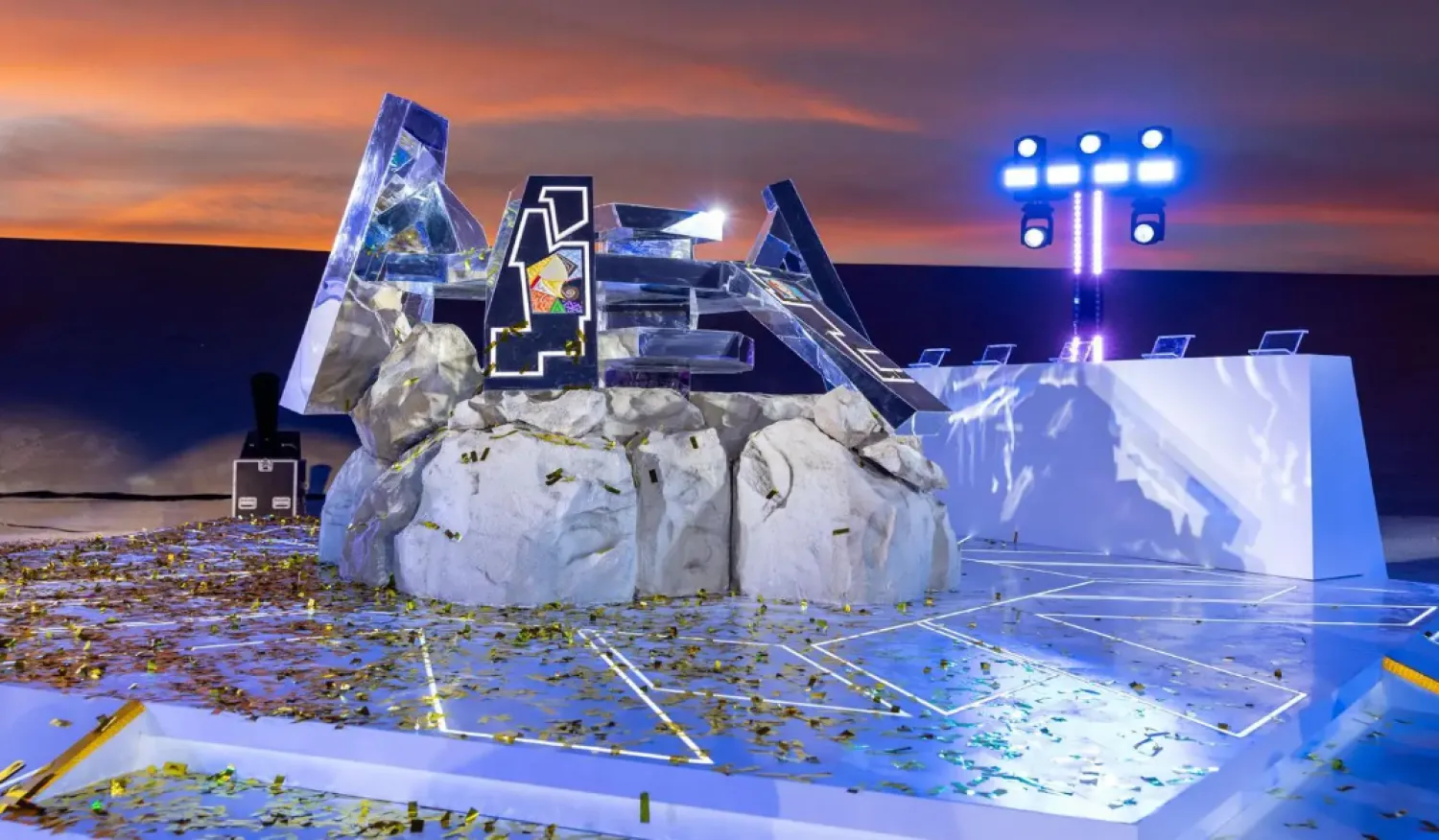
The Qiddiya Performing Arts Center has been designed by Tom Wiscombe Architecture, in collaboration with BSBG, and features a futuristic architectural style defined by monumental forms. The design comprises interlocking architectural panels and five illuminated blades that blend harmoniously with the desert landscape, forming a prominent cultural landmark within Qiddiya City.

The start of construction follows the launch of the first phase of Qiddiya City in December 2025, which included the opening of Six Flags Qiddiya City. It’s part of the company’s broader approach to developing integrated destinations that enhance quality of life and deliver distinctive experiences across entertainment, sports and culture.
Georg Baselitz, the German Painter Who Turned Postwar Art Upside Down, Dies at 88

German artist Georg Baselitz attends the opening of his exhibition "The Heroes" (Die Helden) at the Staedel museum in Frankfurt, Germany June 29, 2016. (Reuters)
TT

Georg Baselitz, the German Painter Who Turned Postwar Art Upside Down, Dies at 88

German artist Georg Baselitz attends the opening of his exhibition "The Heroes" (Die Helden) at the Staedel museum in Frankfurt, Germany June 29, 2016. (Reuters)

Georg Baselitz liked to insist — sometimes as a taunt, ‌sometimes as a shield — that he did not know how to paint. That he had "no talent".

Rejected at 17 by the Dresden Academy of Fine Arts, he talked his way into an academy in East Berlin only to be expelled two semesters later for "sociopolitical immaturity".

"I was stupid," he recalled. "I was uneducated, but I was a rebel."

From that rebellion, Baselitz forged a career that made the child of Nazi Germany, schooled under Soviet communism, into one of the defining artists of postwar Germany.

The painter and sculptor, known for his depictions of raw bodies and inverted landscapes, has died at the age of 88, Germany's Die Welt newspaper reported on Thursday. No cause of death was given.

A REBEL SHAPED BY TWO DICTATORSHIPS

Georg Baselitz was born Hans-Georg Bruno Kern on January 23, 1938, in the Saxon village of Deutschbaselitz, a name he later adopted.

His father, a village schoolteacher and Nazi Party member, recorded Hans-Georg's birth in his diary. Inexplicably, he recorded the birth of none of his other four children, the Sächsische Zeitung daily reported in 2018.

After the war, ‌his father was ‌barred from teaching. Baselitz's mother took over his duties at the school.

Baselitz spent his childhood ‌amid ⁠the unforgiving discipline of ⁠Nazi Germany, and his adolescence amid the rubble and ideological re-education of the country's Soviet occupation zone.

"I was born into a destroyed order, a destroyed landscape, a destroyed people, a destroyed society," he later recalled. "And I didn't want to reestablish an order: I had seen enough of so-called order. I was forced to question everything, to be 'naive', to start again."

After he was expelled from the East Berlin academy, he moved to West Berlin, where he finished his studies and absorbed modernism in a way that felt, he said, like a sudden intake of oxygen.

He recalled the shock of first seeing works by Jackson Pollock and other abstract expressionists — evidence, in his telling, that ⁠the United States had a serious culture despite what he had been taught.

But rather than ‌imitate an American style, Baselitz turned back to German sources, drawing on expressionism, ‌folk traditions and imagery often dismissed by critics as ugly or even "degenerate".

SCANDAL AS A CALLING CARD

At a 1963 solo show in Berlin, authorities ‌seized two of his paintings on obscenity grounds. The episode made Baselitz famous.

The early pictures, marked by raw bodies, stunted masculinity and abrasive humor, were widely seen as provocation.

Supporters and museum curators have also framed them as a blunt report on postwar German life: damaged, compromised and struggling to find a new footing.

That sensibility carried into his mid-1960s "Heroes" paintings, which presented hulking, battered figures that looked less like victors than survivors ‌stumbling out of a defeated national myth.

But Baselitz's most recognizable works came in 1969, when he began painting motifs upside down.

After earlier experiments that fractured or partially inverted figures, he ⁠produced fully inverted works including "The ⁠Wood on Its Head" and "The Man by the Tree".

He did not simply flip finished images, he composed and painted them inverted from the start.

That approach altered how viewers read his works. By disrupting recognition, it forced attention onto the mechanics of painting — its color, balance and composition.

"An object painted upside down is suitable for painting because it is unsuitable as an object," Baselitz said.

The inversions made Baselitz an international figure in the 1970s and 1980s, as the market and institutions that once treated him as scandalous increasingly positioned him as a pillar of European postwar art.

His public reputation, however, did not settle into quiet respectability.

He repeatedly sparked backlash with remarks about female painters, including a widely reported claim that women "don't paint very well".

He also confronted the limits Germany's history places on gesture and imagery: a wooden sculpture shown at the 1980 Venice Biennale was widely read as evoking a Nazi salute, a reading he denied.

He was married to Johanna Elke Kretzschmar, known as Elke, with whom he had two sons.

In later life, Baselitz painted huge canvases from his wheelchair and moved his brushes and paints in a rolling cart.

"The sensible thing, in my situation, would naturally be to say: 'I stick to small formats'," he told Spanish newspaper El Pais at age 87. "But of course I don't do what's sensible. What's right for me is the nonsensical."


Saudi Arabia Holds Cultural Event in Moscow to Mark Centenary of Ties with Russia

The event marked 100 years of Saudi-Russian bilateral relations. SPA
TT

Saudi Arabia Holds Cultural Event in Moscow to Mark Centenary of Ties with Russia

The event marked 100 years of Saudi-Russian bilateral relations. SPA

The Saudi Ministry of Education, in cooperation with the Kingdom’s embassy in Russia, organized an academic and cultural event titled “A Century of Friendship and Cultural and Scientific Exchange between the Kingdom of Saudi Arabia and the Russian Federation” at the headquarters of the Peoples' Friendship University of Russia in Moscow.

The event marked 100 years of bilateral relations since 1926 and aimed to strengthen cultural and educational exchange, which has grown over the past decades.

The opening ceremony was attended by Saudi Ambassador to Russia Sami Al-Sadhan, Deputy Minister for International Cooperation Dr. Latifa Al-Faryan, and Rector of the Peoples' Friendship University of Russia Dr. Oleg Yastrebov, along with several academic and diplomatic officials from both sides, and broad participation from Saudi scholarship students and international students.

During the ceremony, Al-Faryan said that the ministry is continuing its plans to expand high-quality international partnerships, strengthen cooperation in higher education, scientific research, and innovation, and support academic exchange programs.

The scientific and cultural event in Moscow featured a series of academic sessions with leading scholars from Saudi and Russian universities, alongside the honoring of several individuals and institutions that contributed to advancing joint scientific and cultural cooperation.

Holding the event in Moscow reflects the Saudi Ministry of Education’s direction to consolidate academic partnerships between Saudi Arabia and Russia and to strengthen educational cooperation as a pillar of bilateral relations, supporting sustained knowledge exchange and the development of educational and research opportunities between the two countries.


Diving Robot Explores Mystery of France's Deepest Shipwreck

Marine Sadania, a maritime archaeologist in charge of scientific and heritage management for the PACA Coastal Observatory, observes the “ROV C 4000,” a remotely operated vehicle manufactured by the French company LD Travocean and designed for seabed exploration,  during its launch aboard the Jason (BSAA), chartered for an archaeological mission on the wreck of the CAMARAT 4 off the coast of Ramatuel, in southeastern France on April 7, 2026. (Photo by Thibaud MORITZ / AFP)
Marine Sadania, a maritime archaeologist in charge of scientific and heritage management for the PACA Coastal Observatory, observes the “ROV C 4000,” a remotely operated vehicle manufactured by the French company LD Travocean and designed for seabed exploration, during its launch aboard the Jason (BSAA), chartered for an archaeological mission on the wreck of the CAMARAT 4 off the coast of Ramatuel, in southeastern France on April 7, 2026. (Photo by Thibaud MORITZ / AFP)
TT

Diving Robot Explores Mystery of France's Deepest Shipwreck

Marine Sadania, a maritime archaeologist in charge of scientific and heritage management for the PACA Coastal Observatory, observes the “ROV C 4000,” a remotely operated vehicle manufactured by the French company LD Travocean and designed for seabed exploration,  during its launch aboard the Jason (BSAA), chartered for an archaeological mission on the wreck of the CAMARAT 4 off the coast of Ramatuel, in southeastern France on April 7, 2026. (Photo by Thibaud MORITZ / AFP)
Marine Sadania, a maritime archaeologist in charge of scientific and heritage management for the PACA Coastal Observatory, observes the “ROV C 4000,” a remotely operated vehicle manufactured by the French company LD Travocean and designed for seabed exploration, during its launch aboard the Jason (BSAA), chartered for an archaeological mission on the wreck of the CAMARAT 4 off the coast of Ramatuel, in southeastern France on April 7, 2026. (Photo by Thibaud MORITZ / AFP)

Deep below the surface of the Mediterranean off the French coast, the pincer of a remotely guided underwater robot delicately closes around a centuries-old jug lying near a 16th-century shipwreck.

"You have to be extremely precise so as not to damage the site, so as not to stir up sediment," says navy officer Sebastien, who cannot give his second name for security reasons.

A two-hour journey from the French Riviera, Sebastien is overseeing the first of several archaeological missions on the deepest shipwreck in French territorial waters.

A routine army survey of the seabed uncovered the 16th-century merchant ship by chance last year in waters off the coast of Ramatuelle, close to Saint-Tropez.

Archaeologists believe the ship was sailing from northern Italy loaded with ceramics and metal bars before it sank.

Now the French navy and the culture ministry's underwater archaeology department are back to inspect the surviving artifacts lost more than 2,500 meters (1.5 miles) below sea level.

- Cannon, piles of jugs -

The navy is keeping secret the location of the wreckage site, which they have dubbed "Camarat 4" -- even if most people would unlikely have the means to reach a site so deep.

The sun has barely risen when the mission's navy tugboat arrives on site, carrying an underwater robot and two large containers acting as makeshift offices for marine archaeologists.

Its crew lower the robot -- which is equipped with cameras as well as pincers -- into the water.

A navy officer guides the robot down, linked to the ship through a long cable, as experts monitor its slow descent on screens.

An hour later, the device -- which is designed to plunge as deep as 4,000 meters -- is gliding over piles of round pitchers on the sea floor.

Slowly, through its cameras, it reveals the wreck to the team sitting on deck, AFP reported.

It captures footage of a cannon, as well as hundreds of pitchers and plates, decorated with floral motifs, crosses and fish.

The robot shoots eight pictures per second for three hours, grabbing more than 86,000 images that will then be used to create a 3D model of the site.

Archaeologist Franca Cibecchini is delighted the water is so clear.

"The visibility is excellent. You almost can't tell it's so deep," she says.

"It is most likely a merchant ship carrying glazed pottery from Liguria," a region in the northwest of Italy, Cibecchini adds.

She says it could have been loaded on to the ship in the ports of Genoa or nearby Savona.

- 'Valuable information' -

Marine Sadania, the lead archaeologist on the underwater dig, says findings will be key to understanding trade routes at the time the ship sank.

"We don't have very detailed texts about merchant ships in the 16th century, so this is a valuable source of information on maritime history," she says.

The experts hold their breath as the robot lowers a pitcher into a case as gently as possible, so as not to break it.

A third of all ceramics extracted from sea digs end up breaking, Sadania says.

In total, the team hauls up several jugs and plates.

Back on land, in a laboratory in the southern port city of Marseille, Sadania runs water over one of the jugs.

Dark blue lines run across its rounded side, creating rectangles, some of which are colored in with turquoise blue or decorated with saffron-yellow symbols.

"It's one of the deepest objects ever recovered from a wreck in France," she says.