


Picasso’s ‘Guernica’ at Heart of Battle in Spain Over Location

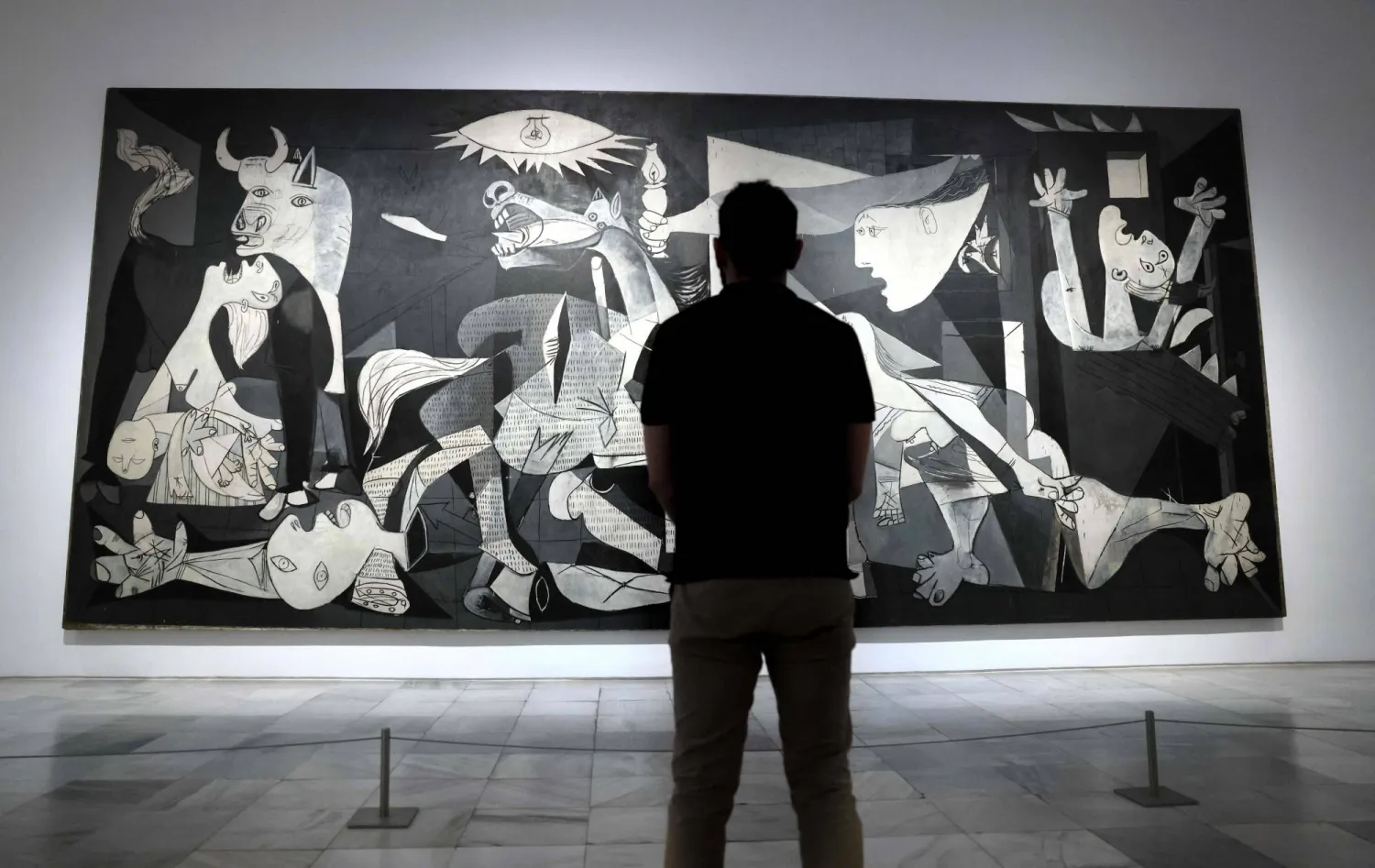
A visitor looks at Spanish painter Pablo Picasso's master piece "Guernica" during a press conference presenting the "Year of Picasso" events, marking the 50th anniversary of the painter's death, at the Reina Sofia museum in Madrid, on September 12, 2022. (Thomas Coex/ AFP)
TT

Picasso’s ‘Guernica’ at Heart of Battle in Spain Over Location

A visitor looks at Spanish painter Pablo Picasso's master piece "Guernica" during a press conference presenting the "Year of Picasso" events, marking the 50th anniversary of the painter's death, at the Reina Sofia museum in Madrid, on September 12, 2022. (Thomas Coex/ AFP)

Pablo Picasso's anti-war masterpiece "Guernica" is swept up in a conflict in Spain, where Basque leaders want the government in Madrid to move the painting to their region, whose 1937 bombing inspired it.

The mural-sized painting has been on display since 1992 at the Reina Sofia museum in the Spanish capital, and repeated requests for it to be moved to Spain's Basque Country have been refused.

The latest demand was made by the head of the regional Basque government, Imanol Pradales, during talks with Socialist Prime Minister Pedro Sanchez.

The Basque government wants the painting to be hung in the Guggenheim Museum in Bilbao to commemorate the 90th anniversary of the April 26, 1937, bombing, in which forces from Nazi Germany and Fascist Italy razed the town of Guernica to help General Francisco Franco in the Spanish Civil War.

Bringing the painting to Bilbao from October until June would be a form of "reparation and historical memory", the Basque government said.

Sanchez -- whose minority government depends on the support of two Basque parties in parliament to pass laws -- did not reject the proposal outright, instead referring it to the culture ministry.

The ministry asked the Reina Sofia museum for a technical report on the viability of the request, which once again "strongly advised" against moving the painting.

The report said the painting is too fragile to travel, citing risks of damage from vibration or movement.

Picasso's black-and-white masterpiece is the highlight of the Reina Sofia museum, which welcomed around 1.6 million visitors last year.

The outspoken head of the regional government of Madrid, Isabel Diaz Ayuso of the conservative Popular Party (PP), weighed in on Monday, calling the request to move the painting "provincial".

"It makes no sense for everything to be returned to its origin. In that case we should send all of Picasso's works to Malaga," she said, a reference to the southern Spanish city where Picasso was born.

- Return from New York -

Asked about the controversy on Tuesday, Spain's central government spokeswoman Elma Saiz said the government relies on the advice of "professionals", referring to the museum report, and "never resorts to insults".

Painted in 1937 in the aftermath of the bombing, "Guernica" debuted in Paris at the World's Fair, then was placed in the care of the Museum of Modern Art in New York.

When Franco's forces overthrew the Spanish republic, Picasso stipulated that the painting should not return to Spain until democracy had been restored.

The work was moved to Spain in 1981, six years after Franco's death.

It was first displayed at the Prado museum, then moved to the Reina Sofia in 1992.

Picasso, who died in 1973, never lived to see the painting on exhibit in Spain.

In 1995, Spanish authorities refused to lend it to the Pompidou Center in Paris, citing the damage the work could suffer during its transport.



‘Unique’ 16th Century Wreck Found off Sweden

A Swedish flag flutters in front of residential houses in Stockholm, Sweden, September 14, 2023. (Reuters)
TT

‘Unique’ 16th Century Wreck Found off Sweden

A Swedish flag flutters in front of residential houses in Stockholm, Sweden, September 14, 2023. (Reuters)

A 16th century shipwreck providing "unique historical and archaeological information" has been discovered off Sweden's southeastern coast, officials announced on Tuesday.

The ship, which has yet to be identified, is believed to have been built in the late 1500s, which would make it older than Sweden's iconic 17th-century warship "Vasa" on display in Stockholm after being salvaged in the 1960s.

A navy vessel found the wreck during a military exercise in late 2025 in Kalmar Strait, located between Sweden's southeastern mainland and the Baltic Sea island of Oland.

"After dendrochronological analysis of part of the wreck, results indicate that the ship was built in the late 1500s," the County Administrative Board in Kalmar said in a statement, referring to the scientific method of dating wood and trees.

"The shipwreck is of significant cultural historical value," antiquarian Daniel Tedenlind said in the statement.

The site is currently under protection, monitored by the coast guard, and has been designated a historic monument. No diving, fishing or anchoring is permitted near the area.

Thanks to the Baltic Sea's unique combination of brackish water, cold, darkness and low oxygen, many wooden shipwrecks are preserved in good condition.


Saudi Museums Commission Explores Tapline's Historical and Cultural Legacy

Saudi Museums Commission Explores Tapline's Historical and Cultural Legacy
TT

Saudi Museums Commission Explores Tapline's Historical and Cultural Legacy

Saudi Museums Commission Explores Tapline's Historical and Cultural Legacy

Saudi Arabia’s Museums Commission organized a virtual session as part of its monthly open-meeting series, during which it explored the historical and social legacy of the Trans-Arabian Pipeline (Tapline) and its role in shaping the identity of Northern Borders Region, reported the Saudi Press Agency on Tuesday.

The meeting highlighted Tapline’s story as one of the largest construction projects of the 20th century. Construction began in 1947, and operations commenced in 1950, linking the oil fields of eastern Saudi Arabia to the port of Sidon on Lebanon’s Mediterranean coast.

Pumping operations ceased permanently in 1990.

Speakers focused on transforming this industrial legacy into a contemporary museum narrative that highlights Tapline's impact on the emergence of modern cities in the Northern Borders Region.

The meeting concluded with an open dialogue on the role of museums and exhibitions in preserving industrial memory while transforming it into cultural platforms that strengthen connections to national identity.


Archaeologists at Pompeii Use AI to Reveal the Face of One of the Victims

A view of the Pompeii Archeological Park, near Naples, southern Italy, on Dec. 14, 2022. (AP)
TT

Archaeologists at Pompeii Use AI to Reveal the Face of One of the Victims

A view of the Pompeii Archeological Park, near Naples, southern Italy, on Dec. 14, 2022. (AP)

Archaeologists at the ancient Roman site of Pompeii have used artificial intelligence for the first time to digitally reconstruct the face of a victim of the AD 79 eruption of Mount Vesuvius that smothered the city, offering a new way to understand one of history’s most famous natural disasters.

The digital portrait represents an older man who was among two victims discovered as they attempted to flee the city toward the coast of what is now Italy during the volcanic eruption. Researchers believe the man died earlier in the disaster, during a heavy fall of volcanic debris.

The reconstruction was developed by the Pompeii Archaeological Park in collaboration with the University of Padua and is based on archaeological survey data from excavations near the Porta Stabia necropolis, just outside the walls of the ancient city.

Pompeii, a UNESCO World Heritage site near Naples, was buried under ash and pumice when Mount Vesuvius erupted nearly 2,000 years ago, preserving the city and thousands of its inhabitants in remarkable detail.

Archaeologists found the victim holding a terracotta mortar, which they interpret as an improvised attempt to shield his head from falling lapilli, the small volcanic stones rained down during the eruption.

Ancient accounts, including those of Roman writer Pliny the Younger, describe residents using objects to protect themselves as ash and debris blanketed the city.

The man was also carrying an oil lamp, a small iron ring and 10 bronze coins, personal objects that offer insight into his final moments, as well as daily life in Pompeii before the catastrophe.

The digital portrait was created using artificial intelligence and photo-editing techniques designed to translate skeletal and archaeological data into a realistic human likeness.

“The vastness of archaeological data is now such that only with the help of artificial intelligence will we be able to adequately protect and enhance them. If used well, AI can contribute to a renewal of classical studies,” Pompeii park director Gabriel Zuchtriegel said in a statement.

The project aims to make archaeological research more accessible and emotionally engaging for the public while maintaining a scientific foundation, researchers said.