

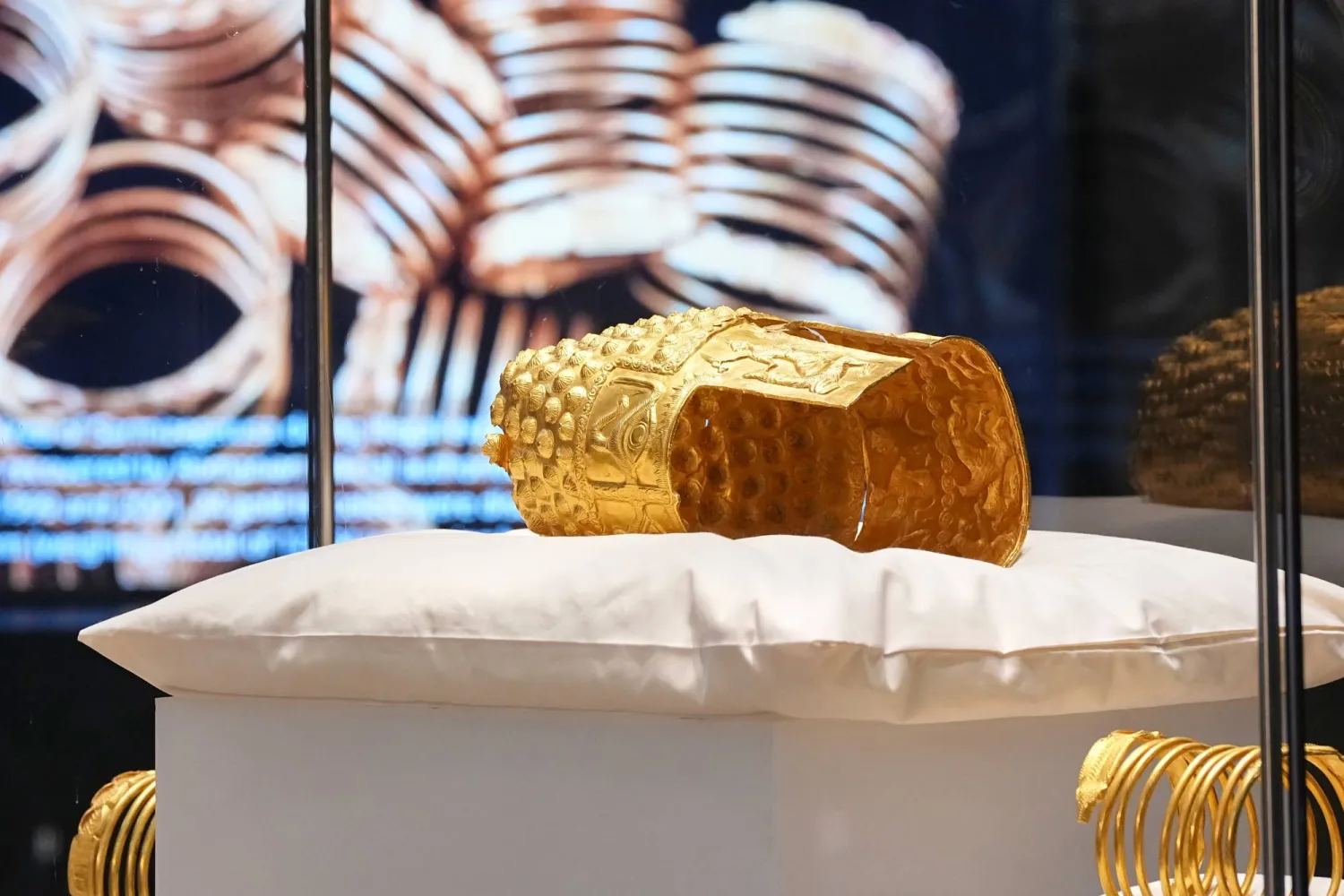

Priceless 2,500-year-old Golden Helmet Returned to Romania after Dutch Museum Raid

Dacian gold items, a 2,500-year-old helmet and wristbands, stolen from a museum in the Netherlands and then recovered by Dutch authorities, are presented during a press conference after being returned, at the National Museum of Romanian History, in Bucharest, Romania, Tuesday, April 21, 2026. (AP Photo/Andreea Alexandru)
TT

Priceless 2,500-year-old Golden Helmet Returned to Romania after Dutch Museum Raid

Dacian gold items, a 2,500-year-old helmet and wristbands, stolen from a museum in the Netherlands and then recovered by Dutch authorities, are presented during a press conference after being returned, at the National Museum of Romanian History, in Bucharest, Romania, Tuesday, April 21, 2026. (AP Photo/Andreea Alexandru)

A priceless golden helmet dating back 2,500 years was returned to Romania on Tuesday after the national heirloom was stolen from a Dutch museum where it was on loan last year.

The ornate Cotofenesti helmet and three golden bracelets — some of Romania’s most revered national treasures from the Dacia civilization — were taken from the Drents Museum in January 2025 in a raid which shocked the art world and devastated Romanian authorities.

But after 14 months of investigations, diplomatic tensions, and three suspects in an ongoing trial, most of the artifacts arrived at Bucharest Henri Coanda International Airport on Tuesday from where authorities transported them under guard to Bucharest’s National History Museum. They were displayed in a glass cabinet, flanked by masked, armed guards.

Cornel Constantin Ilie, the museum's interim director, said that the artifacts have been returned “not as simple patrimony items, but as relics of our historical memory, as the legacy of a civilization that continues to define us.”

“For us, this is a moment of joy, but also of contemplation,” he said. “For months, we have lived with the fear that part of our past could be lost forever. Today we can say that an essential part of this treasure has returned.”

Robert van Langh, the Drents Museum director, described the recovery and return of the relics as “an emotional moment for all involved,” and acknowledged “the grief, the anger and now the relief have naturally been even greater” in Romania than in the Netherlands.

“Romanian national heritage has returned home,” The Associated Press quoted him as saying. “The impact of this robbery was already significant in the Netherlands, but here it must have been truly unparalleled ... The police and judicial authorities of both countries have done extraordinary work.”

Dutch prosecutors unveiled the recovered items at a news conference in the eastern Dutch city of Assen earlier this month. The whereabouts of the third golden bracelet remains unknown, but van Langh vowed the search would continue and that a judicial verdict is expected in the coming weeks.

During its disappearance, the golden helmet was slightly dented, while the recovered bracelets were in perfect condition.

Romania’s Minister of Culture Demeter Andras Istvan said the return of the artifacts had shown “how strong the connection between heritage and collective consciousness can be.”

“This entire episode reminds us at the same time how exposed heritage can be. It can be exposed to violence, illegal trafficking, negligence, oblivion,” he said.

After the raid, Dutch authorities were left with grainy security footage of three people wrenching open a museum door with a crowbar, after which an explosion was seen. Before its recovery, there were fears the helmet may have been melted down because its fame and distinctive appearance made it virtually unsellable.

The artifacts will be exhibited to the public in Bucharest before undergoing some restoration work, the museum's interim director said.

“We believe that the public has the pleasure of celebrating them ... not only as splendid objects, but as a witness to an ordeal, an almost irreparable loss, and a return that we owe to the operation between institutions and the perseverance of the authorities,” he said. “Today, these treasures returned home.”



Saudi Heritage Commission Discovers Abbasid-Era Gold Jewelry in Qassim

The Saudi Heritage Commission logo
TT

Saudi Heritage Commission Discovers Abbasid-Era Gold Jewelry in Qassim

The Saudi Heritage Commission logo

Saudi Arabia’s Heritage Commission announced the discovery of a collection of Abbasid-era gold jewelry at the archaeological site of Diriyyah in Qassim Region during the fourth season of excavation and survey work.

The discovery includes 100 gold pieces adorned with floral and geometric motifs, along with architectural remains from the Abbasid period, including stone foundations, mud walls, pottery, and metal tools.

The findings indicate human settlement dating back to the late third century AH and highlight the site’s historical importance along pilgrimage and trade routes.

The discovery reflects the Heritage Commission’s ongoing efforts to document and preserve the Kingdom’s archaeological heritage, supporting cultural development goals aligned with Saudi Vision 2030.


Jeddah’s House of Islamic Arts Marks International Museum Day 2026

The House of Islamic Arts in Jeddah marked International Museum Day 2026 with a special exhibition offering visitors a cultural journey into the past. (SPA)
TT

Jeddah’s House of Islamic Arts Marks International Museum Day 2026

The House of Islamic Arts in Jeddah marked International Museum Day 2026 with a special exhibition offering visitors a cultural journey into the past. (SPA)

The House of Islamic Arts in Jeddah marked International Museum Day 2026 with a special exhibition offering visitors a cultural journey into the past.

The exhibition showcased aspects of traditional life and reflected the atmosphere of old homes through rare collectibles and personal items contributed by collectors and heritage enthusiasts from within the Kingdom and abroad, the Saudi Press Agency reported on Tuesday.

Through several interactive stations, the exhibition highlighted social life inside traditional homes, featuring settings inspired by majlis gatherings, evening social events, home interiors, and offices, alongside collectibles, furniture, and memorabilia associated with daily life and social traditions of the past.

The exhibition included collectibles representing diverse cultures and artistic styles, featuring rare Arab and European pieces, vintage devices, classic furniture, paintings, antiques, and personal household items displayed by their owners as reflections of the memories of people and places.

The exhibition is part of the events celebrating International Museum Day 2026, which aim to highlight the role of museums in preserving heritage and promoting cultural dialogue through interactive experiences that connect generations with their history and shared memory.


Private Museums in Jazan Offer a Window into the Region's Cultural Past

A number of private museum owners in Jazan stressed that these museums are no longer limited to preserving and displaying heritage collections - SPA
TT

Private Museums in Jazan Offer a Window into the Region's Cultural Past

A number of private museum owners in Jazan stressed that these museums are no longer limited to preserving and displaying heritage collections - SPA

Private museums in Jazan Region are reintroducing local memory through a contemporary cultural vision by preserving collections and artifacts documenting features of old life and bringing details of the past closer to new generations while also enhancing tourist attraction and enriching visitors’ knowledge experience.

As the world celebrates International Museum Day, observed on May 18 each year, these museums emerge as cultural spaces combining documentation and exhibition, allowing visitors to move through different eras, from daily life tools that shaped the details of old homes to collections associated with agriculture, the sea, crafts, and travel, reaching heritage artifacts and coins that reveal the depth of the relationship between humans and their environment throughout the ages, SPA reported.

A number of private museum owners in Jazan stressed that these museums are no longer limited to preserving and displaying heritage collections, but also enhance awareness of local heritage and convey details of old life to new generations through methods that are closer and more interactive. They noted that the increasing presence of heritage enthusiasts and visitors has contributed to transforming the museum into a space for learning and discovering the history of the place through its authentic collections.

With growing national interest in preserving cultural heritage and enhancing the presence of licensed museums within the cultural landscape, these destinations have become part of the tourism and knowledge movement in Jazan Region, receiving history enthusiasts, researchers, students, and visitors as windows overlooking a history that is not read in books alone, but seen in objects and collections that remained witnesses to the life of humans and place.