


Medieval Book in Rome Has Been Hiding the Oldest English Poem

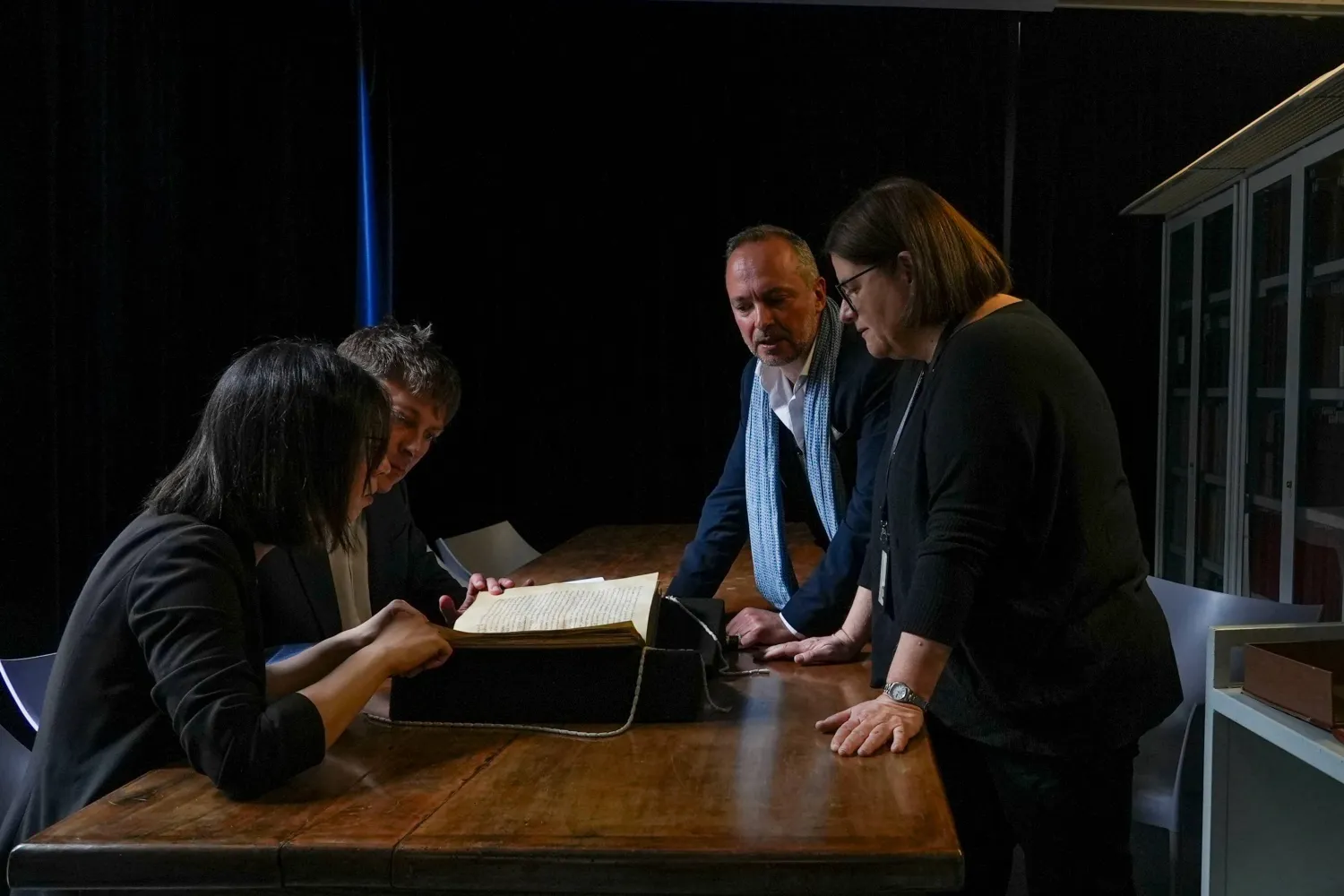
From left, Elisabetta Magnanti, Mark Faulkner of Dublin's Trinity College, Andrea Cappa and Valentina Longo of Rome's National Central Library examine a manuscript containing a rare, long-lost copy of Caedmon's Hymn — the first poem ever written down in Old English — at Rome's National Library, Thursday, May 8, 2026. (AP Photo/Andrea Rosa)
TT

Medieval Book in Rome Has Been Hiding the Oldest English Poem

From left, Elisabetta Magnanti, Mark Faulkner of Dublin's Trinity College, Andrea Cappa and Valentina Longo of Rome's National Central Library examine a manuscript containing a rare, long-lost copy of Caedmon's Hymn — the first poem ever written down in Old English — at Rome's National Library, Thursday, May 8, 2026. (AP Photo/Andrea Rosa)

The researchers in Ireland looked at their computer screen, marveling at a medieval book tracked down in a Roman library. They flipped through its digitized pages and found their sought-after treasure: the oldest surviving English poem.

“We were extremely surprised. We were speechless. We couldn’t believe our eyes when we first saw that,” Elisabetta Magnanti, a visiting research fellow at Trinity College Dublin's school of English, told The Associated Press.

What's more, she said, the poem was within the main body of Latin text: "It was extraordinary.”

Composed in Old English by a Northumbrian agricultural worker in the 7th century, "Caedmon’s Hymn" appears within some copies of the “Ecclesiastical History of the English People,” written in Latin by a monk and saint known as the Venerable Bede. His history is one of the most widely reproduced texts from the Middle Ages, with over 200 manuscripts, according to Magnanti's colleague Mark Faulkner, an associate professor of medieval literature at Trinity.

He considers Caedmon’s poem to be the start of English literature.

The manuscript he and Magnanti found is one of the oldest, dating from the 9th century. Two earlier copies contain the poem in Old English, but as afterthoughts — translated from Latin and scrawled into the margin by later scribes or appended but not within the text's main body, according to the researchers.

The discovery sheds light on the English language's wide diffusion, long before what was previously understood, Faulkner said in Rome, where the duo had traveled to view the text in person for the first time.

“Prior to the discovery of the Rome manuscript, the earliest one was from the early 12th century. So this is three centuries earlier than that. And so it attests to the importance that was already being attached to the English in the early 9th century,” Faulkner said.

And it's something of a miracle they uncovered it at all.

The book had a long and twisted provenance Caedmon is said to have composed the poem while working at Whitby Abbey in North Yorkshire, after guests at a feast began reciting poems, Faulkner said.

“Embarrassed that he didn’t know anything suitable, Caedmon left the feast and went to bed," he said. "A figure then appeared to him in his dreams telling him to sing about creation, which Caedmon miraculously did, producing the nine-line hymn."

Some 1,400 years later, this copy of his poem resurfaced in Rome’s main public library — but not before crossing the Atlantic Ocean at least twice and changing hands even more times.

Monks transcribed this copy of Bede's history in the scriptorium of the Benedictine abbey of Nonantola, one of the most important transcription centers during the Middle Ages, located near modern-day Modena in northern Italy, according to Valentina Longo, curator of medieval and modern manuscripts at Rome's National Central Library.

In the 17th century, as the abbey's importance declined, its vast collection of manuscripts was shifted to another abbey in Rome, then moved to the Vatican and finally on to a small church.

Along the way, some of the texts went missing, only to emerge in the early 19th century in the possession of famous international collectors, Longo said.

This copy of Bede's history went to renowned English antiquarian Thomas Phillipps. He fell on hard times, selling off bits and pieces of his collection, and Swiss bibliophile Martin Bodmer secured the book. From there, somehow, it arrived in New York City, in the trove of Austrian-born rare bookseller H.P. Kraus during the 20th century.

Italy's culture ministry was scouring the world for the Nonantola abbey's missing manuscripts, snapping them up in auctions and from collectors around the world. It bought the copy of Bede's history from Kraus in 1972, Longo said, and since then the illustrious text has remained in Rome's library — but received scant notice.

Enter Magnanti, who had spent over four years studying Bede’s history and was compiling a catalog of extant copies.

“I knew that the book was listed in the library’s catalog, so I was almost certain that the book was, in fact, still here," she said. “I realized that, because of the very complex history of this book, no big scholar had really looked at it. So it had been virtually unstudied."

She emailed the library, which confirmed the book was in its stacks. Three months later, she received digital images of the entire manuscript.

The library is making more rare books available The library has digitized the entire Nonantolan collection and it is freely accessible through the website, Longo said.

It's part of a massive project by the library to make thousands of rare books and manuscripts available to researchers around the world, according to Andrea Cappa, the library's head of manuscripts and the rare books reading room.

“The discovery made by the experts of Trinity College is just one starting point, a single manuscript that might pave the way for countless other discoveries, in countless other fields, through international cooperation like this,” Cappa said.




Jeddah’s House of Islamic Arts Marks International Museum Day 2026

The House of Islamic Arts in Jeddah marked International Museum Day 2026 with a special exhibition offering visitors a cultural journey into the past. (SPA)
TT

Jeddah’s House of Islamic Arts Marks International Museum Day 2026

The House of Islamic Arts in Jeddah marked International Museum Day 2026 with a special exhibition offering visitors a cultural journey into the past. (SPA)

The House of Islamic Arts in Jeddah marked International Museum Day 2026 with a special exhibition offering visitors a cultural journey into the past.

The exhibition showcased aspects of traditional life and reflected the atmosphere of old homes through rare collectibles and personal items contributed by collectors and heritage enthusiasts from within the Kingdom and abroad, the Saudi Press Agency reported on Tuesday.

Through several interactive stations, the exhibition highlighted social life inside traditional homes, featuring settings inspired by majlis gatherings, evening social events, home interiors, and offices, alongside collectibles, furniture, and memorabilia associated with daily life and social traditions of the past.

The exhibition included collectibles representing diverse cultures and artistic styles, featuring rare Arab and European pieces, vintage devices, classic furniture, paintings, antiques, and personal household items displayed by their owners as reflections of the memories of people and places.

The exhibition is part of the events celebrating International Museum Day 2026, which aim to highlight the role of museums in preserving heritage and promoting cultural dialogue through interactive experiences that connect generations with their history and shared memory.


Private Museums in Jazan Offer a Window into the Region's Cultural Past

A number of private museum owners in Jazan stressed that these museums are no longer limited to preserving and displaying heritage collections - SPA
TT

Private Museums in Jazan Offer a Window into the Region's Cultural Past

A number of private museum owners in Jazan stressed that these museums are no longer limited to preserving and displaying heritage collections - SPA

Private museums in Jazan Region are reintroducing local memory through a contemporary cultural vision by preserving collections and artifacts documenting features of old life and bringing details of the past closer to new generations while also enhancing tourist attraction and enriching visitors’ knowledge experience.

As the world celebrates International Museum Day, observed on May 18 each year, these museums emerge as cultural spaces combining documentation and exhibition, allowing visitors to move through different eras, from daily life tools that shaped the details of old homes to collections associated with agriculture, the sea, crafts, and travel, reaching heritage artifacts and coins that reveal the depth of the relationship between humans and their environment throughout the ages, SPA reported.

A number of private museum owners in Jazan stressed that these museums are no longer limited to preserving and displaying heritage collections, but also enhance awareness of local heritage and convey details of old life to new generations through methods that are closer and more interactive. They noted that the increasing presence of heritage enthusiasts and visitors has contributed to transforming the museum into a space for learning and discovering the history of the place through its authentic collections.

With growing national interest in preserving cultural heritage and enhancing the presence of licensed museums within the cultural landscape, these destinations have become part of the tourism and knowledge movement in Jazan Region, receiving history enthusiasts, researchers, students, and visitors as windows overlooking a history that is not read in books alone, but seen in objects and collections that remained witnesses to the life of humans and place.


Rare Inscribed Marble Column Chronicles Grand Mosque Minaret's Construction

This artifact is part of the collection at the Exhibition of the Two Holy Mosques Architecture - SPA
TT

Rare Inscribed Marble Column Chronicles Grand Mosque Minaret's Construction

This artifact is part of the collection at the Exhibition of the Two Holy Mosques Architecture - SPA

The Exhibition of the Two Holy Mosques Architecture in Makkah showcases a rare marble column bearing an inscription documenting the construction of one of the Grand Mosque’s minarets in 1370 CE (772 AH).

The marble column is regarded as a historical, documentary artifact of significant value, bearing inscriptions that highlight an important phase in the construction and restoration of the Grand Mosque and revealing aspects of the evolution of its architectural elements, SPA reported.

The exhibition allows visitors to closely examine the column’s details, along with the Islamic decorations and inscriptions it features, reflecting the artistic style prevalent during that era. It also offers insight into the development of minaret architecture, which has historically been one of the most prominent features of the Grand Mosque.

This artifact is part of the collection at the Exhibition of the Two Holy Mosques Architecture, which documents the historical stages of care for the Grand Mosque and the Prophet’s Mosque through a collection of rare pieces, models, photographs, and artifacts.