

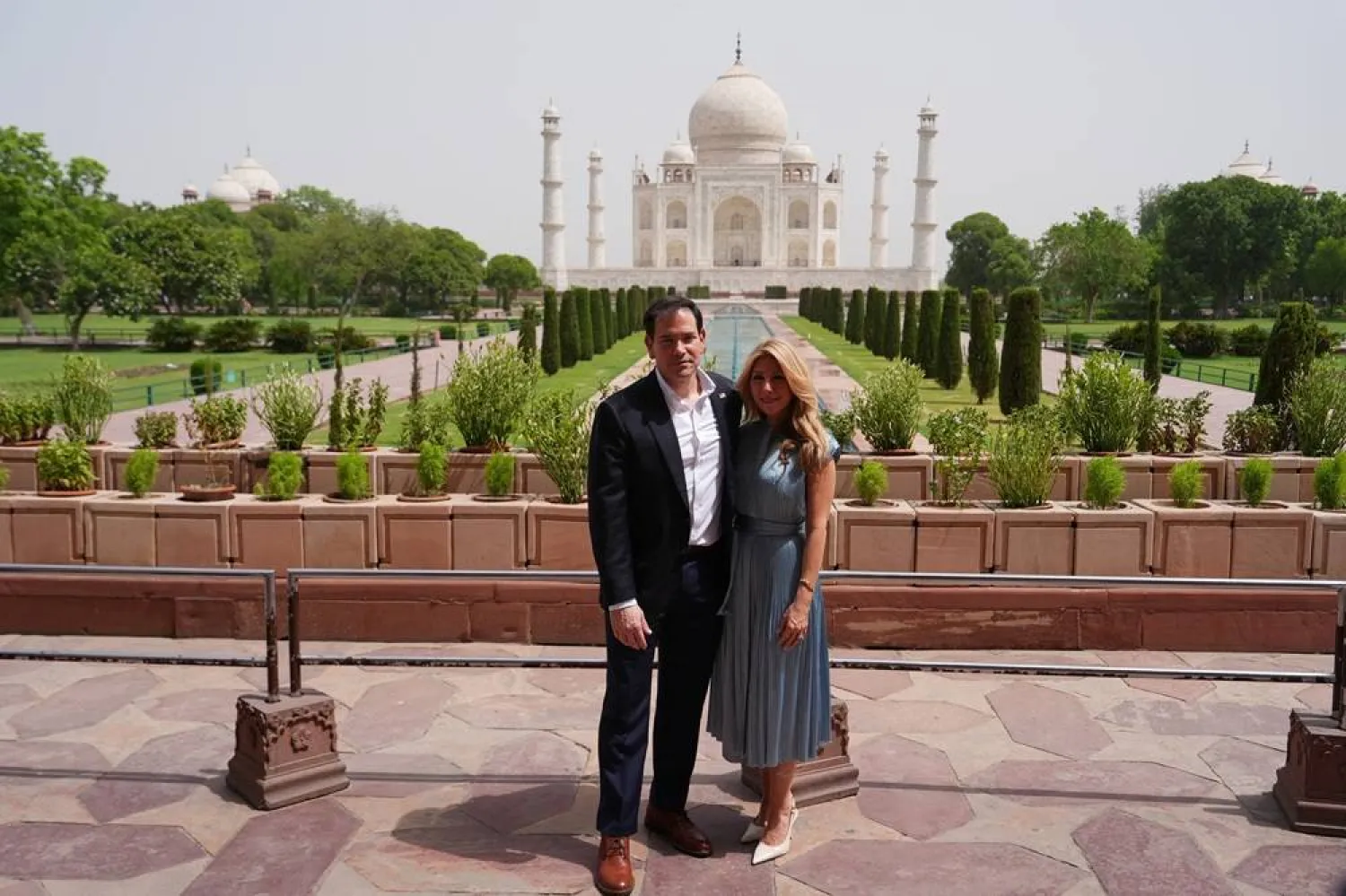

As Iran Diplomacy Picks Up, Rubio Tours Taj Mahal

United States Secretary of State Marco Rubio poses with his wife, Jeanette Rubio, during their visit to the Taj Mahal in Agra, India, Monday, May 25, 2026. Pool via Reuters
TT

As Iran Diplomacy Picks Up, Rubio Tours Taj Mahal

United States Secretary of State Marco Rubio poses with his wife, Jeanette Rubio, during their visit to the Taj Mahal in Agra, India, Monday, May 25, 2026. Pool via Reuters

As diplomacy intensifies on ending the Iran war, top US diplomat Marco Rubio was spending Monday not in negotiations but at India's world-famous monument to love, the Taj Mahal.

Rubio, on his first-ever visit to India, flew to Agra and spent 45 minutes at the Taj Mahal with his wife Jeanette, who usually shuns the spotlight.

"It's one of the wonders of the world," Rubio said of the Taj Mahal.

"I think it's important to show respect to the culture of the countries that you visit."

Under a blazing sun in 40C heat, Rubio removed the tie from his navy-blue suit, put his arm around Jeanette, who wore a flowing dress with elegant heels.

The couple posed for pictures on the bench from where Princess Diana was photographed alone in an iconic 1992 shot.

The US ambassador to India, Sergio Gor, a high-octane former aide to President Donald Trump, smiled and eagerly joined some of the couple's pictures.

The normally teeming street leading to the Taj Mahal were cleared for Rubio, with other tourists kept 100 meters away from him -- although it was only a partial shutdown unlike when Vice President JD Vance visited.

Rubio was not entirely away from Iranian influence at the Taj Mahal, whose domes and four-way charbagh gardens are heavily influenced by Persian architecture.

The Taj Mahal was built in the 17th century on orders of Mughal emperor Shah Jahan as a mausoleum for his beloved wife Mumtaz Mahal who died in childbirth.

The excursion is unusual for Rubio, who in nearly a year and a half on the job has preferred short, business-like trips and rarely done events outside of government meetings.

Rubio said he was taking advantage of a one-day break in his schedule before a meeting in New Delhi on Tuesday of the Quad -- Australia, India, Japan and the United States.

He will also visit the palace-filled city of Jaipur on Monday to tour the Amber Fort.

Rubio is visiting four cities over four days in India as he seeks to revive ties with a country successive US administrations saw as a like-minded partner in a world dominated by China's rise.

Trump has shaken up that approach since returning to office, temporarily imposing high tariffs, warming to both China and India's historic adversary Pakistan, curbing visas used by Indian professionals and reposting insulting language about Indian immigrants.

Trump, in remarks Sunday by speakerphone to a celebration in New Delhi for the 250th anniversary of US independence, insisted he was on board with the relationship, telling the crowd, "we've never been closer to India, and India can count on me 100 percent".



Students Discover 1,800-Year-Old Roman Villa Beneath School Gym

Students' curiosity uncovered what had lain hidden beneath the earth for centuries. (Special Superintendency of Rome)
TT

Students Discover 1,800-Year-Old Roman Villa Beneath School Gym

Students' curiosity uncovered what had lain hidden beneath the earth for centuries. (Special Superintendency of Rome)

Archaeologists in Rome have uncovered the remains of a luxury Roman residence dating to the second century CE beneath a high school near the Colosseum, after students' curiosity about mysterious underground rooms led to a formal excavation of the site.

According to Live Science, students at Liceo Scientifico Cavour, located just steps from the Colosseum, had long shared stories about hidden chambers beneath the school's gymnasium. What began as rumors ultimately led to a remarkable archaeological discovery.

During unofficial explorations of the underground spaces, students came across evidence of an ancient structure beneath the school.

After informing a teacher, who alerted the relevant authorities, archaeologists were called in to investigate the site. Excavations carried out earlier this year revealed that the dark passageways and partially lit rooms formed part of an elaborate Roman residence dating back nearly 1,800 years.

Liceo Scientifico Cavour occupies a building near the Colosseum that originally served as the headquarters of a Catholic missionary organization. When the complex was constructed in the late nineteenth century, preliminary excavation work uncovered part of an ancient domus, the term used for a large Roman urban residence.

The area is among the most historically significant parts of ancient Rome. Prominent figures including Cicero, Pompey and Octavian, later known as Augustus, are known to have lived there. Yet the district remains only partially understood by archaeologists because layers of modern construction cover much of the ancient landscape.

Researchers say the discovery offers a rare opportunity to study a section of ancient Rome that has remained largely inaccessible, while shedding new light on the city's residential life during the height of the Roman Empire.


Saudi, Malaysian Translation Associations Sign MoU to Promote Cultural Exchange

The MoU aims to enhance cooperation in the fields of translation and publishing, promote cultural and knowledge exchange, and support scientific and academic efforts of mutual interest. SPA
TT

Saudi, Malaysian Translation Associations Sign MoU to Promote Cultural Exchange

The MoU aims to enhance cooperation in the fields of translation and publishing, promote cultural and knowledge exchange, and support scientific and academic efforts of mutual interest. SPA

The Saudi Arabian Translation Association and the Malaysian Translators Association have signed a memorandum of understanding (MoU) at Saudi Arabia's pavilion, the guest of honor at the 2026 Kuala Lumpur International Book Fair.

The MoU aims to enhance cooperation in the fields of translation and publishing, promote cultural and knowledge exchange, and support scientific and academic efforts of mutual interest.

It also seeks to facilitate the exchange of expertise and specialized consultations, contributing to advancing the translation sector and strengthening its presence on the international cultural scene.

The memorandum represents an important step toward building sustainable professional and cultural partnerships that contribute to strengthening civilizational dialogue between Saudi Arabia and Malaysia, while opening the door to joint projects and initiatives that support translation activities and expand the exchange of literature and knowledge between the two languages.

The MoU comes as part of the cultural momentum witnessed by the Kingdom’s pavilion at the 2026 Kuala Lumpur International Book Fair, led by the Literature, Publishing and Translation Commission through a diverse cultural and knowledge-based program that highlights the growing stature of Saudi culture and its presence in international forums.

This underscores the importance of international book fairs as effective platforms for enhancing cultural cooperation and signing agreements and partnerships that contribute to expanding prospects for joint work among cultural and knowledge institutions around the world.


Saudi Heritage Commission Uncovers Over 1,700 Artifacts at Ancient Al-Juhfah Miqat Site

Discoveries included diverse fragments used in daily life, six pottery kilns, a water channel - SPA
TT

Saudi Heritage Commission Uncovers Over 1,700 Artifacts at Ancient Al-Juhfah Miqat Site

Discoveries included diverse fragments used in daily life, six pottery kilns, a water channel - SPA

Saudi Arabia's Heritage Commission completed the first season of its joint scientific mission with the University of Exeter at the ancient Al-Juhfah Miqat site, uncovering more than 1,700 artifacts, including pottery, glass, stone pieces, shells, and worked objects, confirming the site's significance along the Egyptian pilgrimage route.

Discoveries included diverse fragments used in daily life, six pottery kilns, a water channel believed to have served pilgrims and travelers, and 13 tombstones dating to the Umayyad and Abbasid periods. Some finds originated from the Levant, Egypt, and Ethiopia, reflecting the diverse origins of pilgrims who passed through this miqat, SPA reported.

Al-Juhfah Miqat is located 187 kilometers northwest of Makkah and has been an established miqat since the early Islamic period, associated with the Prophet's migration, and is known to have flourished in the second Hijri century, with water facilities and shops serving pilgrims.

These works are part of the Heritage Commission's efforts to survey and document archaeological sites along the Hijrah route between Makkah and Madinah, using advanced technologies to reveal the historical and civilizational depth of the Kingdom.