Festival Honoring Lithuania’s Iconic Cold Beet Soup Brings Thousands to Vilnius

"Šaltibarščiai" beetroot soup is prepared during the Pink Soup Fest 2026, an annual event celebrating the in Vilnius, Lithuania, on May 30, 2026. (AFP)
TT

Festival Honoring Lithuania’s Iconic Cold Beet Soup Brings Thousands to Vilnius

"Šaltibarščiai" beetroot soup is prepared during the Pink Soup Fest 2026, an annual event celebrating the in Vilnius, Lithuania, on May 30, 2026. (AFP)

A festival honoring Lithuania’s iconic cold beet soup brought tens of thousands of visitors Saturday to its capital city, which was fully decked out in pink.

The colorful three-day Vilnius Pink Soup Fest featured a synchronized "Pink Break" lunch of revelers from across the globe all sharing in the beet soup, known as šaltibarščiai, sitting at long tables.

Organizers estimated that more than three metric tons (6,614 lbs) of the fermented milk drink kefir, a key ingredient, would be consumed over the three days and more than 100,000 people would attend the event.

Lithuanians devour the refreshing soup during the Baltic country's short summer. Besides beets and kefir, the ingredients include boiled potatoes, eggs, cucumbers and dill.

The festival attracted an international crowd, including tourist Connor Holmes, who came from the United Kingdom after he found the event online and thought "it was completely ridiculous in the best possible way."

"Before I knew it, I was building a suit of pink knight armor, carrying a spoon instead of a sword, and decorating my shield with eggs, dill and potatoes," he said. "At that point, coming to Vilnius and seeing all this craziness myself felt like the next logical step."

The city transformed into a giant pink playground as tourists and locals alike dressed up in pink. Others celebrated in cucumber, egg and beet costumes as the city hosted a parade on land as well as along the Neris River.

Jolanta Žukienė, a teacher from Vilnius, said this year was her fourth time attending the festival. She brought her three children and her husband along on Saturday.

"I can see how the number of attractions and visitors from abroad is growing, and Vilnius is becoming a real magnet for everyone who loves good food and unique experiences," she said.

The festival is part of the city's efforts to increase tourism to the Baltic country.

"Looking at the crowds on the banks and the decorated boats, we joked that cold beet soup already dominates both land and water," said Dovilė Aleksandravičienė, director of Go Vilnius, the city's development agency. "Perhaps the air is next."


Lucian Freud Sue Tilley Portrait Could Fetch $47 Million at Auction

Sue Tilley, a model for British painter Lucian Freud, speaks in front of Freud's painting of her, titled "Sleeping by the Lion Carpet" during an interview in Sotheby's auction house in London, Thursday, May 28, 2026. (AP)
TT

Lucian Freud Sue Tilley Portrait Could Fetch $47 Million at Auction

Sue Tilley, a model for British painter Lucian Freud, speaks in front of Freud's painting of her, titled "Sleeping by the Lion Carpet" during an interview in Sotheby's auction house in London, Thursday, May 28, 2026. (AP)

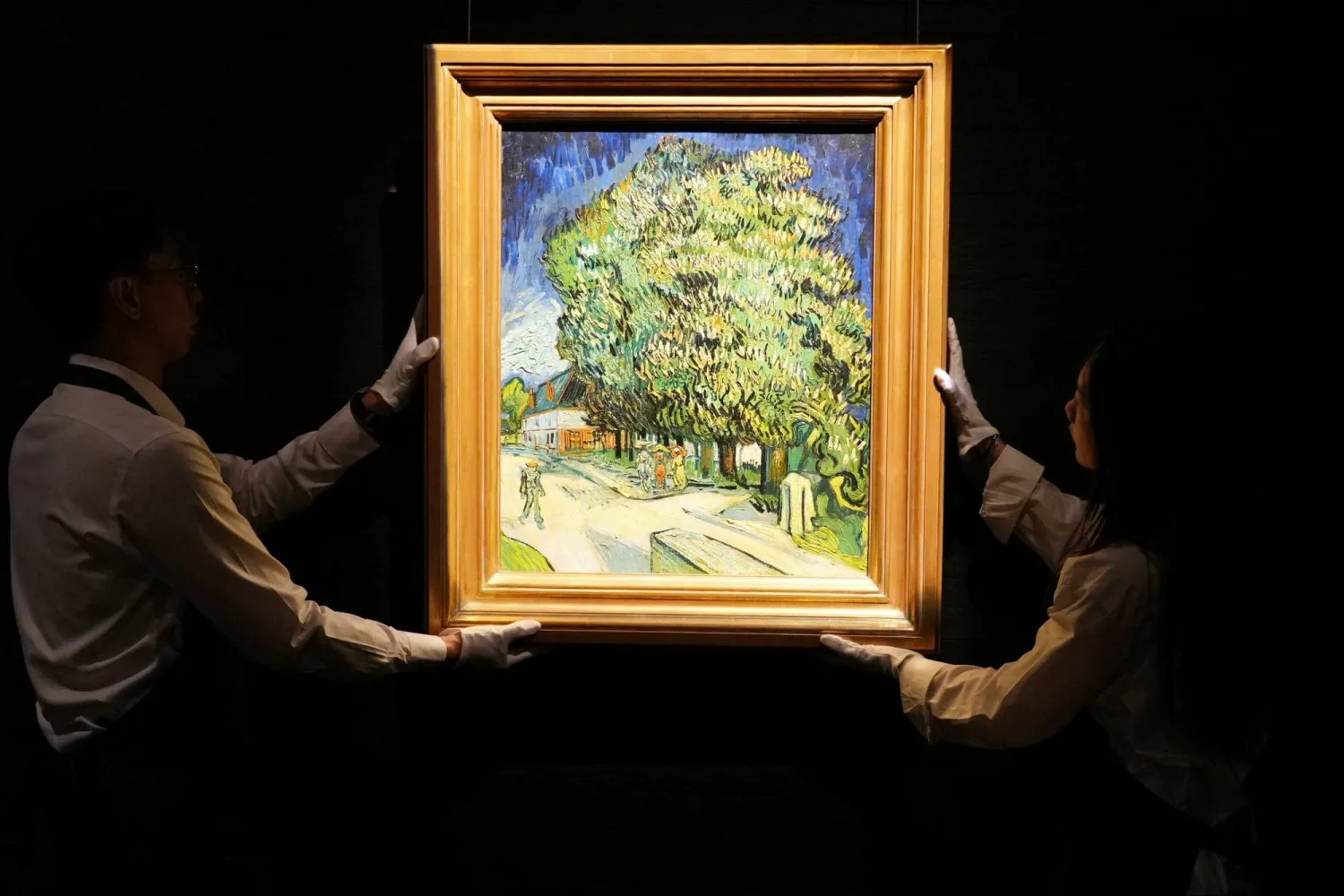
A painting of Sue ‌Tilley, who found fame after artist Lucien Freud depicted her in the nude, will be auctioned next month with a price estimate of up to $47 million.

"Sleeping by the Lion Carpet" (1995-1996) is the last of four portraits the late British artist painted of Tilley or "Big Sue", a benefits supervisor and considered among his greatest works.

Depicting her naked and sleeping in an armchair, the painting has been part of businessman Joe Lewis's family collection since 1996. It is being offered at auction for the ‌first time at Sotheby's ‌with a price estimate of £25 million ‌to £35 ⁠million ($33.56 million to $46.99 ⁠million)

"It's made my life exciting," Tilley told Reuters on Friday at Sotheby's in London.

"I think that people can't believe that such a fat woman would take her clothes off and let someone paint her... I'm not really a vain person... everybody in the world is all different, all different shapes ⁠and sizes, so it's nice to have a ‌nice big one up there."

The ‌four canvases of Tilley, which Freud painted between 1993 and 1996, "are widely ‌regarded not only as the artist’s greatest body of ‌work, but also among the most important, most radical and most powerful paintings of the human figure in the entire history of art," Sotheby's said.

Among the four, "Benefits Supervisor Sleeping" (1995), showing Tilley sleeping on a ‌sofa, sold at auction for $33.6 million in 2008 - at the time, a record for a ⁠work by ⁠a living artist. In 2015, "Benefits Supervisor Resting" (1994), depicting Tilley sitting in the corner of a sofa with her head back, sold for $56.2 million.

"It's very rare that at auction we handle literally one of the greatest works the artist ever produced. So this is a real opportunity for a great collector and a masterpiece collector to acquire something," Oliver Barker, chairman of Sotheby's Europe, said.

"Sleeping by the Lion Carpet" will be sold as part of the "Masterpieces from the Lewis Collection" London auction on June 24.

Freud, known for his nude, fleshy portraits of family, friends and himself, died in 2011.


Sunken Treasures Exhibition Showcases Red Sea Maritime Heritage, Conservation Efforts

The "Sunken Treasures: The Maritime Heritage of the Red Sea" exhibition at the Red Sea Museum in Historic Jeddah documents underwater archaeological discoveries off the Saudi coast. (SPA)
TT

Sunken Treasures Exhibition Showcases Red Sea Maritime Heritage, Conservation Efforts

The "Sunken Treasures: The Maritime Heritage of the Red Sea" exhibition at the Red Sea Museum in Historic Jeddah documents underwater archaeological discoveries off the Saudi coast. (SPA)

The "Sunken Treasures: The Maritime Heritage of the Red Sea" exhibition at the Red Sea Museum in Historic Jeddah documents underwater archaeological discoveries off the Saudi coast. It highlights national and international partnerships, including collaboration with UNESCO, to explore, protect, and document underwater cultural heritage within an integrated ecological and cultural framework.

By showcasing these discoveries, the exhibition elevates public awareness around preserving marine history and underscores the Kingdom’s growing leadership in the field of maritime archaeology, the Saudi Press Agency said.

The exhibition illustrates the historical transformations of the Red Sea as a vital trade, pilgrimage, and communication route linking Asia, Africa, and the Mediterranean over thousands of years.

Visitors can explore documented evidence of historic shipwrecks discovered off the coastlines of Jeddah, Yanbu, Umluj, and the Farasan Islands. These sites have revealed the remains of ancient merchant vessels that succumbed to the sea during various historical periods, offering a rare glimpse into the intense maritime activity that defined the region over the centuries.

Among the displayed collections are diverse maritime archaeological finds, including stone and wooden anchors, Chinese and Islamic ceramics, ancient pottery, glassware, coins, and vintage navigational instruments used to transport goods across the waves. These artifacts reflect the historical prominence of Saudi ports and their strategic role in connecting global trade routes between the East and West.

Additionally, the exhibition highlights ongoing Saudi research, scientific documentation, and specialized training programs designed to cultivate national expertise in deep-sea conservation, ensuring these treasures are safeguarded for future generations.


Egypt Discovers Rare Reservoirs, Buildings at Ancient Aydhab Port in Halaib

A collection of archaeological finds and fragments of Chinese porcelain (Ministry of Tourism and Antiquities)
TT

Egypt Discovers Rare Reservoirs, Buildings at Ancient Aydhab Port in Halaib

A collection of archaeological finds and fragments of Chinese porcelain (Ministry of Tourism and Antiquities)

Egypt’s Ministry of Tourism and Antiquities announced Thursday the discovery of massive water reservoirs and cisterns, along with rare buildings and service facilities, at the archaeological site of the ancient port of Aydhab on the Red Sea coast in the Halaib region in southern Egypt near the Sudanese border. The port once served as a major transit point for pilgrims.

The discovery was made during excavation work carried out by an Egyptian archaeological mission affiliated with the Supreme Council of Antiquities at the site of the ancient port of Aydhab, which the ministry described as “one of the most prominent and important Egyptian ports during the Islamic period.”

Some of the artifacts discovered at the site (Ministry of Tourism and Antiquities)

Hisham el-Leithy, secretary-general of the Supreme Council of Antiquities, said the discovery highlights an important aspect of the service infrastructure on which the historic port of Aydhab depended. He noted that the water cisterns played a vital role in supporting maritime and trade activity, as well as meeting the needs of pilgrims arriving at the port on their way to the holy lands, according to the ministry’s statement.

Excavation work uncovered a massive main reservoir measuring approximately 15.10 meters in length, 3.15 meters in width and nearly three meters in height. It was constructed using sandstone and local coral stones, then coated with a layer of white lime mortar to insulate the water and prevent leakage. Several additional cisterns were also uncovered in the southern part of the site.

Diaa Zahran, head of the Islamic, Coptic and Jewish Antiquities Sector, said archaeological surveys in the surrounding area also revealed the remains of residential building foundations, watchtowers and service facilities, indicating the existence of an integrated system for managing the port and meeting the needs of pilgrims and merchants who passed through it over many centuries.

The mission also uncovered a collection of artifacts, including pottery fragments dating back to the Fatimid era, some glazed in green, in addition to shards of imported Chinese porcelain. The finds reflect the flourishing commercial activity at the port and the breadth of its maritime trade network with many regions, particularly India, Yemen and East Africa.

The site includes service buildings used by pilgrims (Ministry of Tourism and Antiquities)

Egyptian Tourism and Antiquities Minister Sherif Fathi described the discovery as “a contribution to highlighting the development witnessed by ancient Egyptian ports and the advanced infrastructure they possessed to serve trade routes and pilgrims.” In a press statement, he said the discovery confirms Egypt’s strategic status as a major civilizational and commercial center throughout history.

Fathi stressed the ministry’s commitment to excavation work and archaeological studies in border and remote areas because of their significant historical and cultural importance.

Historian Bassam el-Shammaa described the discovery as “one of the most important archaeological discoveries of the 21st century,” telling Asharq Al-Awsat that “the importance of archaeological discoveries lies not in their size, but in the extent to which they deepen understanding of history across different periods.”

He said the discovery proves the existence of social and commercial ties linking Asia and Egypt that extended to China and other civilizations. He added that it also carries humanitarian and security dimensions through the discovery of service buildings and water cisterns dedicated to serving pilgrims during that period, as well as watchtowers used to secure the borders.

El-Shammaa proposed organizing tourism trips to Egypt’s ancient ports and making use of archaeological discoveries at several historic ports along the Red Sea and Mediterranean coasts.

The port of Aydhab was among the most prominent Red Sea ports during the Middle Ages, serving as a key station for pilgrims arriving from Egypt and the Maghreb on their way to the holy sites, in addition to playing a central role in maritime trade.