
Ukrainian Haiku Poet Finds Small Miracles in War

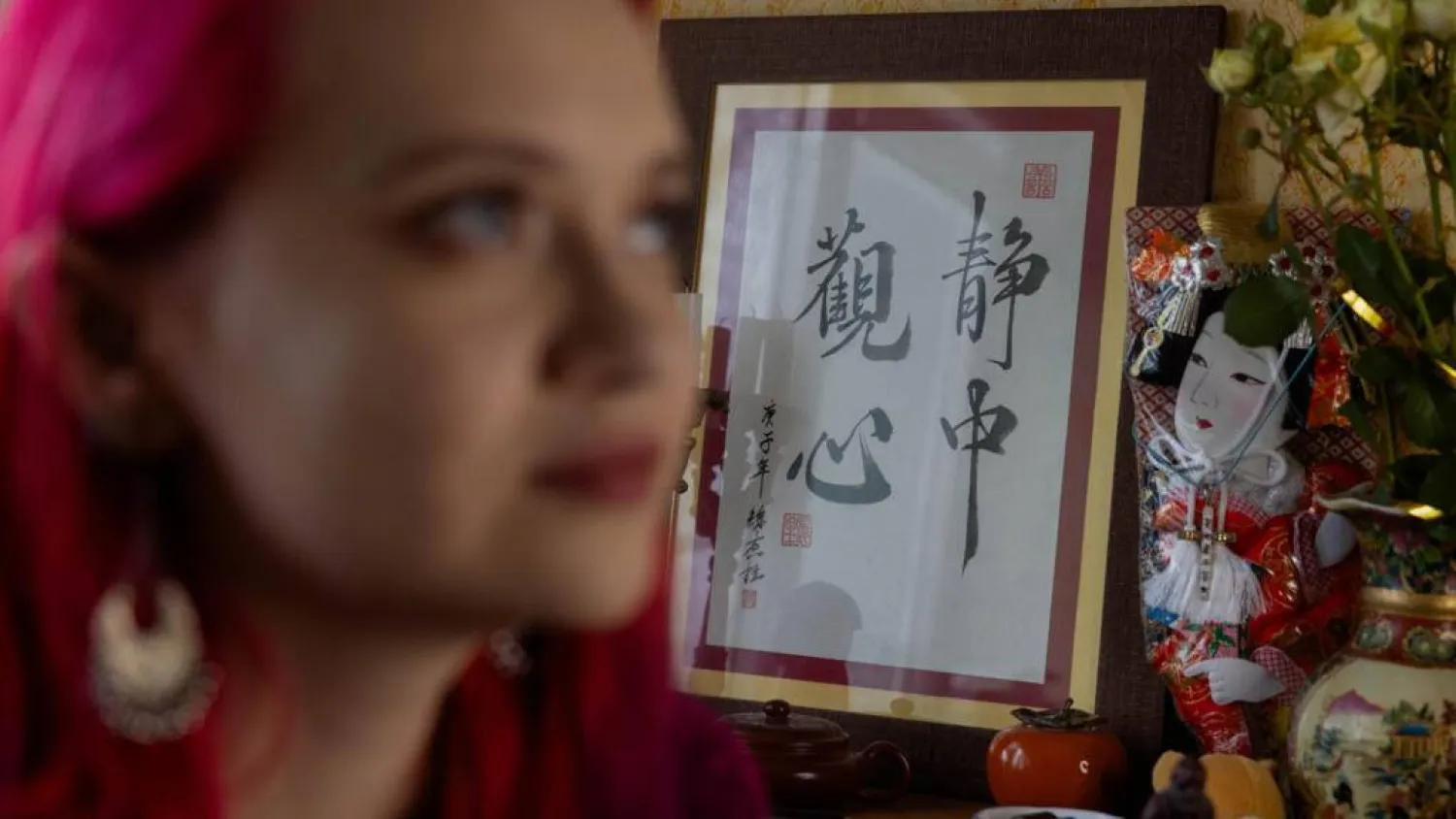
For Vladislava Simonova, haiku is a way of finding poetry in ordinary moments. Tetiana DZHAFAROVA / AFP
TT

Ukrainian Haiku Poet Finds Small Miracles in War

For Vladislava Simonova, haiku is a way of finding poetry in ordinary moments. Tetiana DZHAFAROVA / AFP

A temperamental lift leads to the apartment in central Ukraine of a 27-year-old poet celebrated in Japan but almost unknown in her own country.

With pink hair, fuchsia sweater and matching socks, Vladislava Simonova tells the story of her burgeoning career 7,800 kilometers (4,850 miles) away in a country she has never visited.

But here in the central Ukrainian city of Poltava, she lives near a trolleybus depot, which is just one of the sites targeted by Russian drones whose constant buzzing puts her on edge.

Just as she mentions the word "explosion" to describe the terror of Russian strikes, a drone whizzes overhead and explodes in the distance.

Next to her, a shelf holds 15 books with colorful spines -- a collection of contemporary Ukrainian poets -- two Japanese teapots, three religious icons and a figurine of Phoebe Buffay from the series "Friends".

"I never thought that I would be writing about war," she told AFP.

"With time, I somehow came to realize that ... tiny details can convey the tragedy of this great war much better than perhaps dozens of reports," she added.

Simonova is among a whole generation of artists bearing witness to the invasion that has devastated Ukrainian cultural life.

Simonova said she discovered haiku -- her preferred form -- in 2013, when she was a teenager.

The three-line poems, made up of 17 syllables in a 5-7-5 pattern, were codified in 17th-century Japan to capture the beauty of nature, daily life and fleeting moments with simplicity.

For years, she studied the Japanese masters -- Basho, Buson, Issa -- and wrote more than 600 haiku which, she said, gradually became less "clumsy":

He walks so proudly,

On soft apricot petals

This plump little cat.

24.04.2015

Not bothered by rain,

I tremble my way back home

With a pine sapling.

16.10.2014

- 'Communion' -

In 2018, Simonova won a competition organized by a Japanese foundation.

When Russia launched its full-scale invasion in February 2022, she was living in Kharkiv.

Russian forces tried to seize the northeastern city and have been shelling it constantly since being pushed back.

For three months when Russian troops first crossed the border, she survived by living in an underground shelter.

Instead of a storm --

The rumbling of explosions.

Springtime has arrived.

14.05.2022

A house in ruins.

Through the hole in the rooftop,

Stars are glimmering.

14.05.2022

In March 2022, from her shelter, Simonova gave a written interview to Japan's The Asahi Shimbun newspaper.

A few weeks later, renowned poet Madoka Mayuzumi got in touch.

She told AFP that Simonova has a "deep understanding" of the essence of haiku.

"Even in the midst of war, she gazes up at the moon and stars and admires flowers... her haiku reflect a communion with nature," Mayuzumi said.

"Despite the themes that tend to be sombre, her work possesses a sense of optimism," Mayuzumi added.

Bees oblivious

To the air-raid siren's sound.

Linden trees in bloom.

19.06.2022

With around 10 others, Mayuzumi helped Simonova translate and publish her first collection in Japan in 2023.

The book received "very high praise", Mayuzumi said.

Throughout Japan's history, she added, people have written haiku in dark times, including after the 1945 atomic bombings and the 2011 tsunami.

- 'Cherry blossoms' -

In August 2022, the underground shelter in Kharkiv where Simonova had lived was destroyed by a Russian missile. She moved to Poltava.

She published a second collection in Japan in 2024, followed by another in Denmark in early 2026.

She dreams of publishing one in Ukraine.

Before the war, she wrote in Russian. She later switched to Ukrainian.

The translation of the poems was complex. The two related languages often use words of different lengths -- "umbrella", for example, is one syllable in Russian, but four in Ukrainian.

Simonova does not read prose, "only poetry". And the Bible. She belongs to Poltava's tiny Catholic community.

During AFP's visit, she suggests going to the park, says goodbye to her husband -- who stays at home -- before hurrying down the stairs of her Soviet-era apartment block. The lift was not working.

It is a cold spring Sunday and the park is almost empty. She sits on a tree branch near a pond, wearing a multicolored puffer jacket.

Since childhood, Simonova has suffered from a serious heart condition that leaves her exhausted.

She discovered haiku in a hospital, in an anthology that also contained "Persian poems".

As the wind blows, she stands up and reads aloud for the first time in public, reciting each poem twice.

The first is for friends no longer around:

They scatter away

Like cherry blossoms in wind,

People I hold close.

The second is a memory of Kharkiv.

I clutch in my palm

Some fragments of a missile.

The pain stays with me.

She leafs through her pink-covered collection, then chooses one last poem.

What a sky it is!

And yet from that very sky

Missiles fall on us.


David Hockney, the British Artist Who Went in Search of Californian Color, Dies at 88

British artist David Hockney poses as he unveils his painting "Bigger Trees Near Water", the largest painting ever shown at the Royal Academy's Summer Exhibition, London, Friday, May 25, 2007. (AP)
TT

David Hockney, the British Artist Who Went in Search of Californian Color, Dies at 88

British artist David Hockney poses as he unveils his painting "Bigger Trees Near Water", the largest painting ever shown at the Royal Academy's Summer Exhibition, London, Friday, May 25, 2007. (AP)

As a child growing up in gloomy northern England, David Hockney noticed the sharply ‌defined shadows in the Hollywood films of comedy duo Laurel and Hardy.

"Strong shadows meant a lot of sun," the painter recalled to BBC television in 2009. "So I thought, well, wherever that is, it's always sunny."

Two decades later, Hockney moved to Los Angeles to immerse himself in that dazzling light.

The artist, whose brightly colored renditions of California would go on to make him one of the most celebrated artists of the 20th and 21st centuries, has died, Sky News reported on Friday. He was 88.

No cause of death was given.

'HERE I FELT FREE'

Initially, almost as much as his paintings, Hockney was known for his own image — thick-rimmed spectacles, peroxide hair, shiny gold jacket — which became a symbol of Britain's Swinging Sixties.

As an art student in the northern English city of Bradford — where he was born to an accountancy clerk father and a devout Methodist mother — Hockney rebelled against convention.

To continue his studies, in 1959 he moved to London where he had a meteoric rise in the British pop art movement and rubbed shoulders with stars from dancer ‌Rudolf Nureyev to ‌Mick Jagger.

But Hockney yearned for the excitement he saw in the work of American artists. Using money ‌from ⁠the sale of ⁠his art, he visited New York for the first time in 1961 — where he became a friend of Andy Warhol — and moved to California three years later.

"I thought people who produced such work must live in color, so I went in search of it," he is quoted as saying in a biography written by art critic and friend Peter Adam.

"I had spent the first 20 years of my life in the gothic gloom of the North. Here I felt free."

His pictures of swimming pools became icons of a sun-drenched lifestyle that he documented with luminous acrylic paint before dividing his time between Los Angeles, London and Paris in the late 1960s and 1970s.

He remained unpretentious despite his success.

"I am actually still a ⁠student," he told Adam. "I just happen to have quite a lot of credit cards in my pocket."

In ‌1985, when he was invited to the White House to dine with President Ronald Reagan, ‌Prince Charles and Princess Diana, he was held up for half an hour by security officers because he was the only guest to arrive on foot, ‌his biographer wrote.

'YOU DON'T RETIRE DOING THIS'

Hockney's images of love and material wealth led to claims by some art critics that ‌his work was trivial. But he won greater renown than any other British artist of the 20th century.

One of his most famous paintings, "Portrait of an Artist (Pool with Two Figures)" sold for $90.3 million in 2018, the most expensive work by a living artist sold at auction at the time.

As he grew older and his life turned more domestic, dogs replaced men in Hockney's work, at a time when many ‌of his friends were dying of AIDS.

He said he cried for two days when Stanley, one of his beloved dachshunds, died in 2001, having been immortalized in scores of paintings and sketches.

In the late ⁠1990s, Hockney began returning more frequently to ⁠visit his mother in the northern English county of Yorkshire, where he had grown up, and a terminally ill friend encouraged him to paint the local landscapes.

Feeling increasingly lonely, he moved from California to the seaside town of Bridlington on England's North Sea coast. For a decade he painted clumps of bare trees in winter, fields full of ripe crops and tracks stretching towards the gentle rolling hills of the Yorkshire Wolds region.

It was the most productive period of his entire career as he rushed to capture scenes that, he said, changed more dramatically with the seasons than did those of California.

"You don't retire doing this," he told the BBC in his broad Yorkshire accent when asked about his unflagging energy. "You just do it until you fall over."

The former enfant terrible of British art, a cigarette almost always in his hand, never stopped trying new techniques. He used faxes to share his work and then iPads to produce it. His Yorkshire paintings led to a stained-glass window for Westminster Abbey, in central London.

In 2018, Hockney bought a farmhouse in Normandy, in northern France, and turned his eye to the fields and flowers of his garden there. The 90-meter-long "A Year in Normandie" frieze was inspired by the nearly 1,000-year-old Bayeux Tapestry.

Hockney's work ethic — instilled in him from getting up daily at 6 o'clock to work in hospitals for two years, when he refused to do his military service in the army — barely relented in his later years.

"I tend to think that you should work every day," he said. "And I do."


Red Sea Museum Extends 'Sunken Treasures' Exhibition Until August 15

The exhibition offers a comprehensive educational and visual experience that traces the evolution of shipwrecks  - SPA
The exhibition offers a comprehensive educational and visual experience that traces the evolution of shipwrecks - SPA
TT

Red Sea Museum Extends 'Sunken Treasures' Exhibition Until August 15

The exhibition offers a comprehensive educational and visual experience that traces the evolution of shipwrecks  - SPA
The exhibition offers a comprehensive educational and visual experience that traces the evolution of shipwrecks - SPA

The Red Sea Museum is strengthening its cultural and educational offerings by extending its temporary exhibition, “Sunken Treasures: The Maritime Heritage of the Red Sea,” until August 15 at the Bab Al-Bunt building in Historic Jeddah.

The exhibition offers a comprehensive educational and visual experience that traces the evolution of shipwrecks from the remnants of maritime journeys into valuable historical archives and, ultimately, thriving natural habitats rich in coral reefs and marine life, SPA reported.

It reintroduces the Red Sea as a vital cultural and civilizational corridor that has long connected the Arabian Peninsula with Asia, Africa, and the Mediterranean, facilitating trade, cultural exchange, and human interaction across centuries.

The “Sunken Treasures” exhibition reflects the Red Sea Museum’s role as a knowledge platform dedicated to promoting public understanding and supporting scientific research in collaboration with the Heritage Commission and the Jeddah Historic District Program.


Saudi Film Commission Adds Kuwaiti Classic ‘Bas Ya Bahar’ to National Film Archive to Boost Cultural Cooperation

The Saudi Film Commission logo
TT

Saudi Film Commission Adds Kuwaiti Classic ‘Bas Ya Bahar’ to National Film Archive to Boost Cultural Cooperation

The Saudi Film Commission logo

The Film Commission of the Saudi Ministry of Culture announced the inclusion of the film "Bas Ya Bahar" (The Cruel Sea), one of the most prominent Gulf cinematic works, in the National Film Archive collection.

This step comes as part of the commission's efforts to preserve cinematic heritage, make these productions accessible to researchers, creators, and future generations, and highlight Arab cinematic works of cultural and historical significance, SPA reported.

Directed by Kuwaiti filmmaker Khalid Al-Siddiq in 1972, "Bas Ya Bahar" is the first full-length Kuwaiti feature film and one of the most important works in the history of Gulf cinema.

The film sheds light on the lives and hardships of pearl divers in their search for pearls before the discovery of oil, portraying the challenges faced by Gulf communities during that era.