Elizabeth Blackadder Exhibition Reveals Wintry Tuscan Landscapes

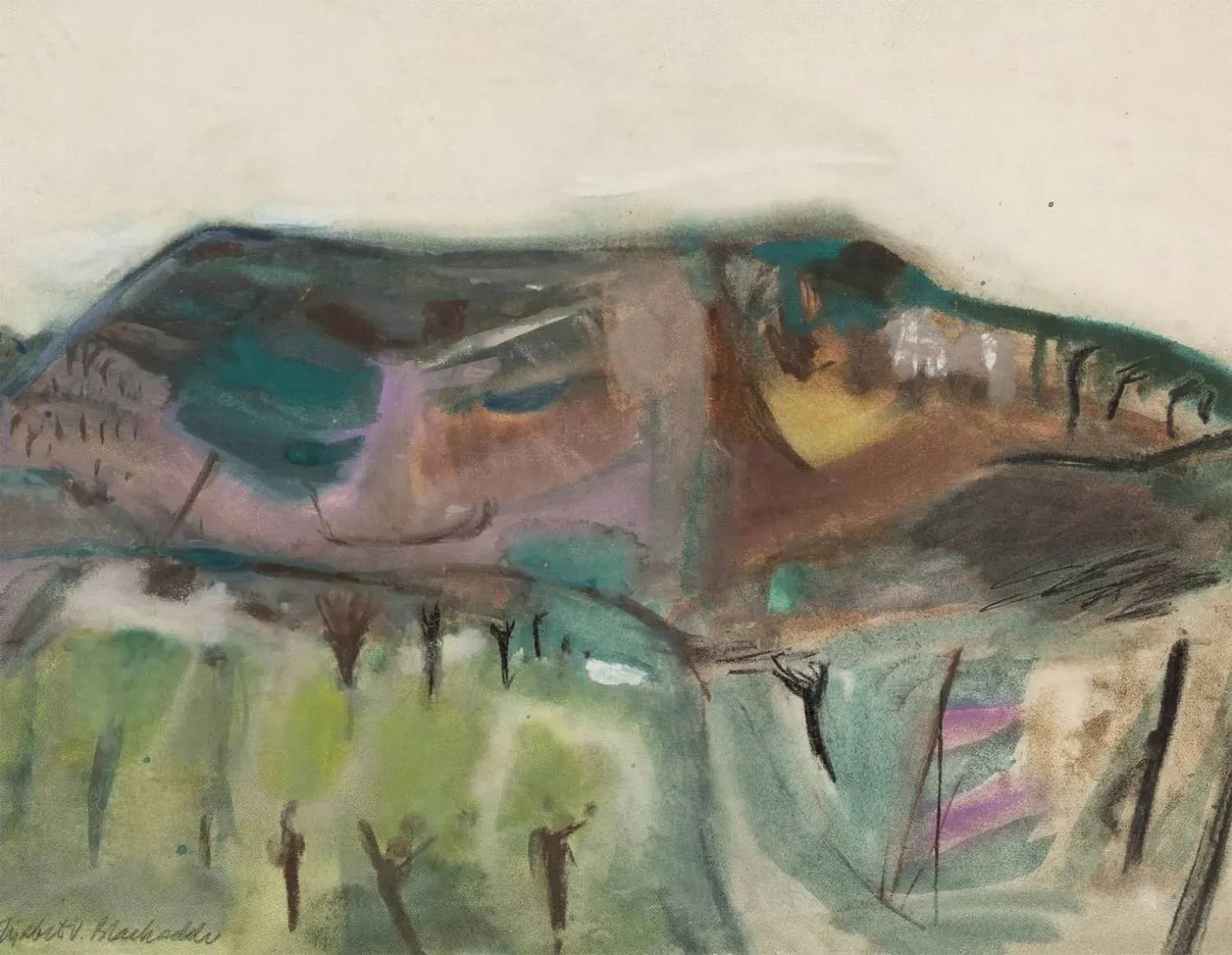
"Winter Hillside", circa 1955-56, is one of the works to be exhibited at the Jenna Burlingham Gallery. (Jenna Burlingham Gallery)
TT

Elizabeth Blackadder Exhibition Reveals Wintry Tuscan Landscapes

"Winter Hillside", circa 1955-56, is one of the works to be exhibited at the Jenna Burlingham Gallery. (Jenna Burlingham Gallery)

She may be best known for accessible paintings of flowers and cats, but a new exhibition of Elizabeth Blackadder’s work focuses instead on chilly landscapes and pared-back still life compositions.

The show in Hampshire, far from Blackadder’s Scottish home, presents a less familiar side of the artist, with most of the pieces exhibited for the first time, reported The Guardian.

Earlier works include a series of Italian landscapes rendered in gouache and watercolor in the 1950s soon after Blackadder left art college. The still life oil paintings are from the 1960s and 1970s.

The art writer and editor Anna Brady said Blackadder, who died in 2021 aged 89, painted the Italian landscapes after winning a travelling scholarship.

Writing in the show’s catalogue, she said: “Based in Florence, Blackadder would take a bus out into the countryside to paint. While we may have romantic ideals of painting trips to Tuscany, the reality of being a young woman, painting outside and alone, through a bitter winter in postwar Italy would have been altogether harsher. We can almost feel the chill on her fingertips in the group of inky Tuscan landscapes.”

In the later still life paintings, personal objects, such as a coffee pot, appear time and again.

Brady said: “Blackadder seems to gain confidence in doing more with less, her compositions becoming increasingly refined and pared back to the essentials.”

The gallery director, Jenna Burlingham, said: “What makes this exhibition so exciting is that it shines a light on works from the first two decades of Elizabeth Blackadder’s career.”


Heat Forces Yodelers at Annual Swiss Festival to Sing in Fountains

 Yodelers prepare for TV broadcast on the main festival stage at Petersplatz in Basel, Switzerland, Saturday, June 27, 2026. (AP)
Yodelers prepare for TV broadcast on the main festival stage at Petersplatz in Basel, Switzerland, Saturday, June 27, 2026. (AP)
TT

Heat Forces Yodelers at Annual Swiss Festival to Sing in Fountains

 Yodelers prepare for TV broadcast on the main festival stage at Petersplatz in Basel, Switzerland, Saturday, June 27, 2026. (AP)
Yodelers prepare for TV broadcast on the main festival stage at Petersplatz in Basel, Switzerland, Saturday, June 27, 2026. (AP)

City fountains became impromptu rehearsal spaces this weekend as yodelers at a festival in Basel, Switzerland, squeezed in last-minute practice while cooling off during Europe’s June heat wave.

At one fountain, a folk band dipped their toes in the water on Saturday, as festivalgoers clapped along or cooled their hands under the flowing stream.

From Friday to Sunday, singers and alphorn players filled the streets and spontaneous bursts of yodeling echoed through restaurants, where diners initially reacted with surprise before joining in.

In Petersplatz, in central Basel, seamstresses remained on call throughout the festival to repair the traditional Alpine folk costumes worn by participants in case of emergency.

This year, however, it was the fountain rehearsals that became the festival’s defining image, as the city battled record temperatures of around 39 degrees Celsius (102 degrees Fahrenheit).

Around 12,000 performers and nearly 200,000 visitors traveled to Basel for the Eidgenössisches Jodlerfest, Switzerland’s national yodeling festival. It was the first time the northwestern Swiss city hosted the event since 1924.

Swiss yodeling was added to UNESCO’s Representative List of the Intangible Cultural Heritage of Humanity in December 2025, making this the first national festival since the tradition received international recognition. It is a distinction many Swiss take great pride in.

Unlike the brighter, more melodic style often associated with Austria and the Tyrol region, Swiss yodeling is slower and more melancholic — an emotionally nuanced tradition rooted in distinct regional dialects.

"I’ve always loved music, and I left here as a child. When I moved back to New Zealand, I wanted to stay connected to Swiss culture, so I joined a New Zealand-Swiss-Kiwi yodeling club,” said Freddie Conquer, a member of Jodlerclub Echo Basel, one of the clubs hosting the festival.

The participants competed in three disciplines: yodeling, alphorn playing and flag-throwing.

The alphorn is a long wooden instrument traditionally used by herdsmen in the Alps. It can stretch to more than 3 meters (10 feet) in length, with its sound carrying across valleys — or, during the festival, through Basel’s streets. It produces all of its pitches using natural harmonics alone, with no valves or keys.

“Everything is down to the mouthpiece, hearing the note in your head, and then using your lips to shape the pitch. The higher the note, the harder you have to blow,” said Pierre-André Karlen, who was rehearsing on a school lawn.

On Sunday morning, participants gathered outside the town hall, eagerly awaiting the competition results. Members of Jodlerklub Balfrin, from the town of Visp in the canton of Valais, were nervously examining the lists and later celebrated loudly after receiving a perfect score of one, one of several such teams.

As flags were carried through the old town during the festival’s closing parade, members of Jodlerklub Muttenz rode past on a tractor to cheers from the crowd. Alphorn players followed — their instruments and costumes almost certainly a burden in the heavy heat, but the smiles remained.


GASTAT: 75.3% of Saudi Arabia's Population Visited Cultural Event Venues in 2025

The General Authority for Statistics (GASTAT) logo
TT

GASTAT: 75.3% of Saudi Arabia's Population Visited Cultural Event Venues in 2025

The General Authority for Statistics (GASTAT) logo

The General Authority for Statistics (GASTAT) said that 75.3% of Saudi Arabia's population visited venues hosting cultural events or activities in 2025. The figure highlights growing cultural momentum and increasing public participation in cultural events across the Kingdom.

The data was released as part of an initiative identified by the Arabic phrase, transliterated as "Raqam Saudi" ("Saudi Number"). The initiative aims to showcase national achievements, promote national pride and citizenship values, and demonstrate the role of official statistics in tracking progress toward the goals of Saudi Vision 2030 and sustainable development.

Under the initiative, the authority publishes a range of statistics each month through its social media platforms. The initiative highlights the Kingdom's economic, social, and developmental transformation while reinforcing the role of official statistics in raising public awareness.

The initiative targets government entities and their clients, media professionals and outlets, social media users, opinion writers, and the international community. It aims to promote the dissemination of statistical content and expand the use of official data.

GASTAT said the initiative highlights national collaboration in achieving development goals by tracking and measuring progress through statistical indicators. It also raises public awareness of the role of statistics and data in monitoring the country's development.


12th Saudi Film Festival Opens at Ithra with Broad International Participation

12th Saudi Film Festival Opens at Ithra with Broad International Participation
TT

12th Saudi Film Festival Opens at Ithra with Broad International Participation

12th Saudi Film Festival Opens at Ithra with Broad International Participation

The 12th edition of the Saudi Film Festival has opened at the King Abdulaziz Center for World Culture (Ithra), an initiative of Saudi Aramco, bringing together prominent figures from the local, regional, and international film communities, as well as filmmakers, film critics, and cinema enthusiasts from across the industry.

Organized by the Cinema Association in partnership with Ithra and supported by the Film Commission, the festival runs from June 26 to July 2, 2026, under the theme “Every Story is a Journey.” The theme celebrates filmmaking as a creative journey that begins with the spark of an idea and scriptwriting, moves through the challenges of production, and culminates in screening, where stories meet their audiences, SPA reported.

This year’s edition received 314 submissions, including 249 films and 65 production market projects. A total of 27 films were selected for the official competitions, while six films will be presented in parallel screenings, bringing the festival lineup to 50 films from more than 15 countries.

Participating films will compete for nine Golden Palm Awards across feature-length fiction, short fiction, and documentary categories, highlighting Saudi, Gulf, Arab, and international cinematic talent.

The festival program also features specialized panel discussions, masterclasses, training workshops, book-signing sessions for publications from the Saudi Cinema Encyclopedia, and the “Meet the Experts” program, which offers one-on-one mentoring sessions with professionals in production, directing, editing, film criticism, festival programming, and project development.