


Nigerian Museum Revamp Brings Treasures within Reach

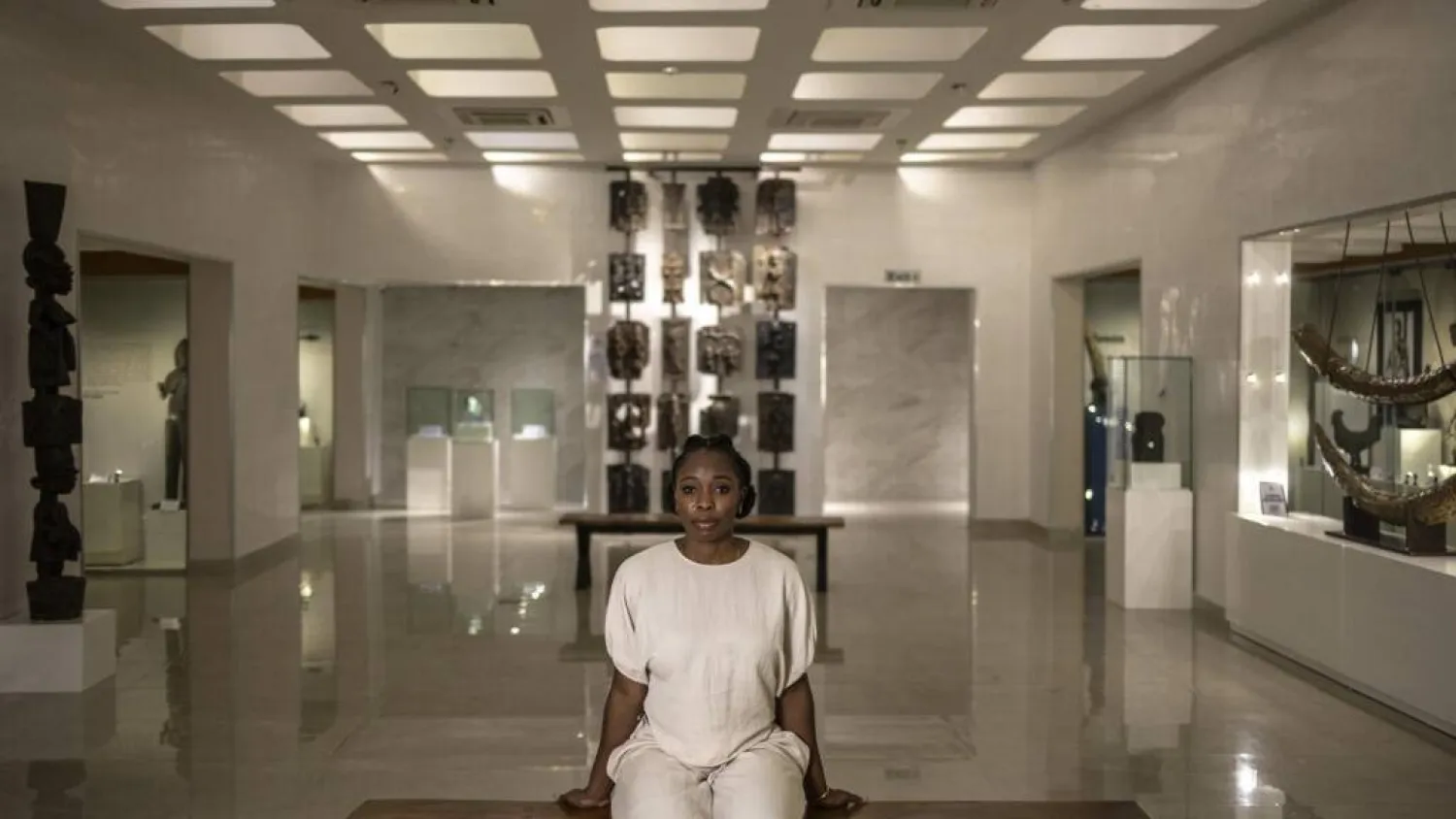
Tinuke Odunfa, the interior designer of the gallery, aimed to modernize the space and present Nigerian history in an an 'immersive' environment. OLYMPIA DE MAISMONT / AFP
TT

Nigerian Museum Revamp Brings Treasures within Reach

Tinuke Odunfa, the interior designer of the gallery, aimed to modernize the space and present Nigerian history in an an 'immersive' environment. OLYMPIA DE MAISMONT / AFP

Gazing at two large engraved 16th-century elephant tusks on display at Nigeria's National Museum Lagos, a guide surprised visitors by telling them: "You can touch them gently".

One of the three galleries at the museum in Nigeria's cultural and entertainment hub has been remodeled to allow visitors to interact with some artefacts, reversing the typical ban on touching exhibits, as well as take unrestricted photographs in an effort to engage younger audiences, curator Nkechi Adedeji told AFP.

As the group felt the texture of the elephant tusks to the tune of Afrobeats softly playing on overhead speakers, a young photographer was busy snapping away, likely for a social media post.

According to Tinuke Odunfa, the interior designer of the gallery, the plan was to modernize the space and present Nigerian history in an "intentional" and "immersive" environment.

"Everything was intentional in terms of how the space should be experienced, in terms of the colors, how the space leads you," Odunfa told AFP.

The gallery holds one of the country's most extensive collections, including major archaeological and ethnographic artefacts such as 5th-century terracotta by indigenous Nok people.

Its white walls are lined with artefacts encased in glass, arranged chronologically from the oldest to the newest, each accompanied by brief notes.

A few other items of the permanent exhibition, "Echoes of the Past", especially those made of wood and metal, are laid out in such a way that visitors can touch and "feel them", the museum's head of exhibition Olusegun Adeleye, 51, said.

Low ambient lighting casts a soft glow across the gallery, giving the space a quiet, reflective atmosphere.

Lagos, the vibrant mega city of more than 20 million people, and often described as Nigeria's melting pot, inspired Odunfa's design.

- 'Coming in droves' -

Since the renovated gallery opened to the public in April, it has been drawing more visitors than before, Adedeji said, without giving figures.

Its Instagram-ready spaces are drawing more schoolchildren and young adults, with pictures and videos increasingly shared online, making it a popular destination among "content creators".

"They come here, do content and before you know it, it is all over the place," Adedeji said. "Youths are coming in droves now".

"I love the way the artefacts are displayed," Oyin Isioye, a 25-year-old photographer, visiting the museum for the first time, told AFP. "I learned a lot of things... where the artefacts are from, what they represent."

- Repatriation calls -

In one corner of the gallery, three empty cases contain a sheet of paper bearing the inscription "British museum, how far??" (meaning "what's up?" in Nigerian Pidgin).

The installation sends a message to foreign museums that Nigeria is ready to pursue the repatriation of its looted artefacts.

Western museums, including those in Britain, the Netherlands and Germany, have in recent years returned several hundred artefacts, but countless more remain in galleries in Europe and America.

"This renovation shows that we can protect and preserve our objects ourselves, we do not need any other country to do it for us," said Adedeji.

The remodeling, funded by a private entity, also aimed at creating more display areas for the collection, the bulk of which are kept in storage.

More projects are in the works. Another gallery at the Lagos museum has been shut for renovation, along with other sites nationwide.

And Nigerian authorities are seeking partners to support future upgrades in preparation for more repatriated artefacts.


David Hockney, the British Artist Who Went in Search of Californian Color, Dies at 88

British artist David Hockney poses as he unveils his painting "Bigger Trees Near Water", the largest painting ever shown at the Royal Academy's Summer Exhibition, London, Friday, May 25, 2007. (AP)
TT

David Hockney, the British Artist Who Went in Search of Californian Color, Dies at 88

British artist David Hockney poses as he unveils his painting "Bigger Trees Near Water", the largest painting ever shown at the Royal Academy's Summer Exhibition, London, Friday, May 25, 2007. (AP)

As a child growing up in gloomy northern England, David Hockney noticed the sharply ‌defined shadows in the Hollywood films of comedy duo Laurel and Hardy.

"Strong shadows meant a lot of sun," the painter recalled to BBC television in 2009. "So I thought, well, wherever that is, it's always sunny."

Two decades later, Hockney moved to Los Angeles to immerse himself in that dazzling light.

The artist, whose brightly colored renditions of California would go on to make him one of the most celebrated artists of the 20th and 21st centuries, has died, Sky News reported on Friday. He was 88.

No cause of death was given.

'HERE I FELT FREE'

Initially, almost as much as his paintings, Hockney was known for his own image — thick-rimmed spectacles, peroxide hair, shiny gold jacket — which became a symbol of Britain's Swinging Sixties.

As an art student in the northern English city of Bradford — where he was born to an accountancy clerk father and a devout Methodist mother — Hockney rebelled against convention.

To continue his studies, in 1959 he moved to London where he had a meteoric rise in the British pop art movement and rubbed shoulders with stars from dancer ‌Rudolf Nureyev to ‌Mick Jagger.

But Hockney yearned for the excitement he saw in the work of American artists. Using money ‌from ⁠the sale of ⁠his art, he visited New York for the first time in 1961 — where he became a friend of Andy Warhol — and moved to California three years later.

"I thought people who produced such work must live in color, so I went in search of it," he is quoted as saying in a biography written by art critic and friend Peter Adam.

"I had spent the first 20 years of my life in the gothic gloom of the North. Here I felt free."

His pictures of swimming pools became icons of a sun-drenched lifestyle that he documented with luminous acrylic paint before dividing his time between Los Angeles, London and Paris in the late 1960s and 1970s.

He remained unpretentious despite his success.

"I am actually still a ⁠student," he told Adam. "I just happen to have quite a lot of credit cards in my pocket."

In ‌1985, when he was invited to the White House to dine with President Ronald Reagan, ‌Prince Charles and Princess Diana, he was held up for half an hour by security officers because he was the only guest to arrive on foot, ‌his biographer wrote.

'YOU DON'T RETIRE DOING THIS'

Hockney's images of love and material wealth led to claims by some art critics that ‌his work was trivial. But he won greater renown than any other British artist of the 20th century.

One of his most famous paintings, "Portrait of an Artist (Pool with Two Figures)" sold for $90.3 million in 2018, the most expensive work by a living artist sold at auction at the time.

As he grew older and his life turned more domestic, dogs replaced men in Hockney's work, at a time when many ‌of his friends were dying of AIDS.

He said he cried for two days when Stanley, one of his beloved dachshunds, died in 2001, having been immortalized in scores of paintings and sketches.

In the late ⁠1990s, Hockney began returning more frequently to ⁠visit his mother in the northern English county of Yorkshire, where he had grown up, and a terminally ill friend encouraged him to paint the local landscapes.

Feeling increasingly lonely, he moved from California to the seaside town of Bridlington on England's North Sea coast. For a decade he painted clumps of bare trees in winter, fields full of ripe crops and tracks stretching towards the gentle rolling hills of the Yorkshire Wolds region.

It was the most productive period of his entire career as he rushed to capture scenes that, he said, changed more dramatically with the seasons than did those of California.

"You don't retire doing this," he told the BBC in his broad Yorkshire accent when asked about his unflagging energy. "You just do it until you fall over."

The former enfant terrible of British art, a cigarette almost always in his hand, never stopped trying new techniques. He used faxes to share his work and then iPads to produce it. His Yorkshire paintings led to a stained-glass window for Westminster Abbey, in central London.

In 2018, Hockney bought a farmhouse in Normandy, in northern France, and turned his eye to the fields and flowers of his garden there. The 90-meter-long "A Year in Normandie" frieze was inspired by the nearly 1,000-year-old Bayeux Tapestry.

Hockney's work ethic — instilled in him from getting up daily at 6 o'clock to work in hospitals for two years, when he refused to do his military service in the army — barely relented in his later years.

"I tend to think that you should work every day," he said. "And I do."


Red Sea Museum Extends 'Sunken Treasures' Exhibition Until August 15

The exhibition offers a comprehensive educational and visual experience that traces the evolution of shipwrecks  - SPA
The exhibition offers a comprehensive educational and visual experience that traces the evolution of shipwrecks - SPA
TT

Red Sea Museum Extends 'Sunken Treasures' Exhibition Until August 15

The exhibition offers a comprehensive educational and visual experience that traces the evolution of shipwrecks  - SPA
The exhibition offers a comprehensive educational and visual experience that traces the evolution of shipwrecks - SPA

The Red Sea Museum is strengthening its cultural and educational offerings by extending its temporary exhibition, “Sunken Treasures: The Maritime Heritage of the Red Sea,” until August 15 at the Bab Al-Bunt building in Historic Jeddah.

The exhibition offers a comprehensive educational and visual experience that traces the evolution of shipwrecks from the remnants of maritime journeys into valuable historical archives and, ultimately, thriving natural habitats rich in coral reefs and marine life, SPA reported.

It reintroduces the Red Sea as a vital cultural and civilizational corridor that has long connected the Arabian Peninsula with Asia, Africa, and the Mediterranean, facilitating trade, cultural exchange, and human interaction across centuries.

The “Sunken Treasures” exhibition reflects the Red Sea Museum’s role as a knowledge platform dedicated to promoting public understanding and supporting scientific research in collaboration with the Heritage Commission and the Jeddah Historic District Program.


Saudi Film Commission Adds Kuwaiti Classic ‘Bas Ya Bahar’ to National Film Archive to Boost Cultural Cooperation

The Saudi Film Commission logo
TT

Saudi Film Commission Adds Kuwaiti Classic ‘Bas Ya Bahar’ to National Film Archive to Boost Cultural Cooperation

The Saudi Film Commission logo

The Film Commission of the Saudi Ministry of Culture announced the inclusion of the film "Bas Ya Bahar" (The Cruel Sea), one of the most prominent Gulf cinematic works, in the National Film Archive collection.

This step comes as part of the commission's efforts to preserve cinematic heritage, make these productions accessible to researchers, creators, and future generations, and highlight Arab cinematic works of cultural and historical significance, SPA reported.

Directed by Kuwaiti filmmaker Khalid Al-Siddiq in 1972, "Bas Ya Bahar" is the first full-length Kuwaiti feature film and one of the most important works in the history of Gulf cinema.

The film sheds light on the lives and hardships of pearl divers in their search for pearls before the discovery of oil, portraying the challenges faced by Gulf communities during that era.
