


Between Homer and Hollywood: Troy a Source of Turkish Pride

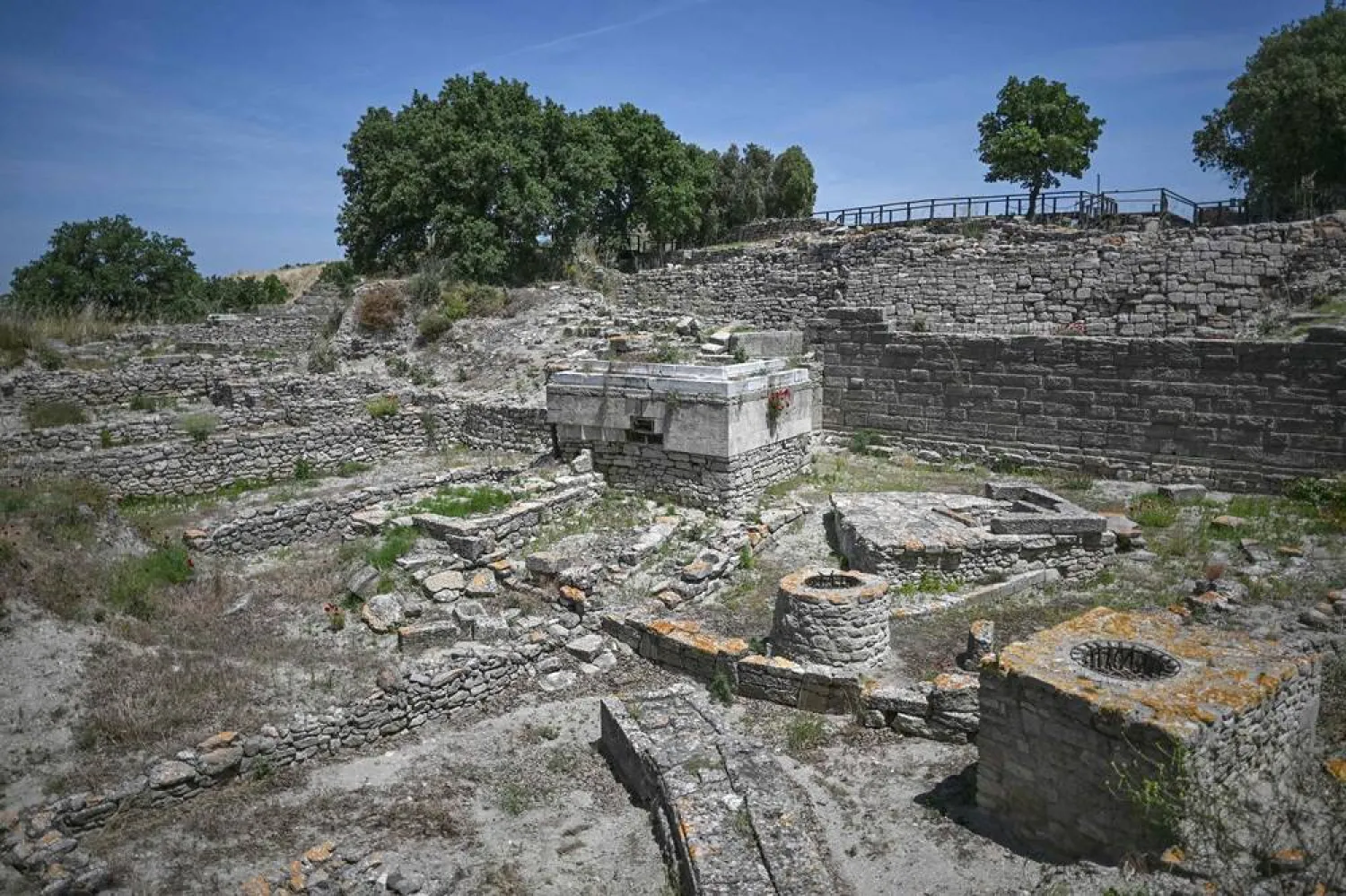
This photograph shows a general view of the ruins of the ancient city of Troy in Canakkale on June 2, 2026. (AFP)
TT

Between Homer and Hollywood: Troy a Source of Turkish Pride

This photograph shows a general view of the ruins of the ancient city of Troy in Canakkale on June 2, 2026. (AFP)

A gift from the film set of "Troy", a giant Trojan Horse replica looms over the port of Canakkale on the Dardanelles Strait in western Türkiye.

First related by Homer, then retold for the silver screen in 2004, with Brad Pitt as Achilles, the legend of the ancient city travels to Rome's Colosseum this week, where a major new exhibition opens on Friday.

Keen to showcase the city's Anatolian roots, Türkiye has loaned out more than 220 artifacts that will be on show at the exhibition, "Troy and Rome", which runs until mid-October.

"When you read Homer, you don't get a very clear idea of the Trojans' identity. But at the time of the Trojan War, they were certainly among the Anatolian peoples," said Reyhan Korpe, deputy head of the Troy excavations and an ancient history expert at Canakkale University.

Located on Türkiye's Aegean coastline, the remains of Troy are a UNESCO-listed World Heritage site comprising 185 hectares (457 acres) of stones and crumbling ramparts dotted with poppies and scampering squirrels.

For 30 years, Korpe has walked every inch of this huge site, whose layers tell the story of nine different settlements, the remains of their ramparts intertwined and layered on top of one another.
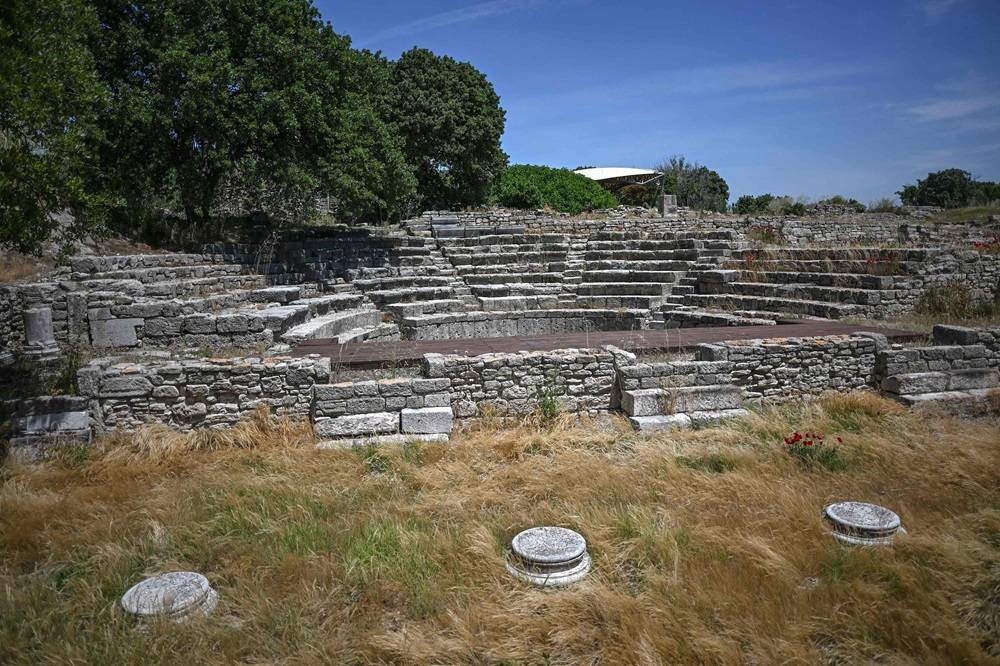
This photograph shows a view of the ancient theater in the ruins of the ancient city of Troy in Canakkale on June 2, 2026. (AFP)

- Western flank of the east -

"I spent a whole year just walking through the stones, maps in hand, trying to understand how they fit together," he told AFP.

His passion is evident for the site, which was founded in 3,000 BC and was constantly inhabited until being abandoned in the sixth century AD.

"It was the most western part of eastern civilization," which is what gave Troy its significance, Korpe said.

The Trojan War, which took place around 1,200 BC and lasted 10 years, until the siege and the city's defeat -- parts of which are recounted in the Iliad -- "was the first confrontation between the East and the West", he said of the Anatolian world and its Greek equivalent, referring to it as "the first world war".

It is an idea with strong resonance in these wooded hills, which several millennia later witnessed the World War I battles of 1915, when Allied troops suffered a bloody defeat trying to seize the Dardanelles from the Ottoman Empire.
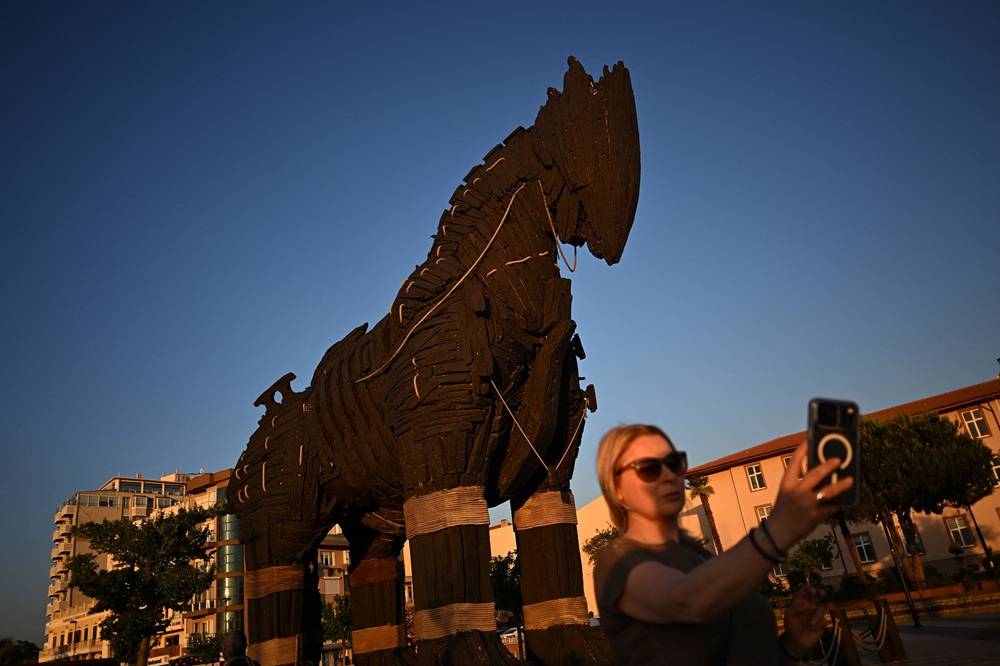
A tourist takes a selfie photograph in front of the Trojan Horse, which was donated to be displayed at Canakkale Square following the release of the movie “Troy” in Canakkale on June 1, 2026. (AFP)

- Luwian hieroglyphics -

Of the hundreds of artifacts Türkiye has loaned to the Rome exhibition, more than 100 come from the Troy museum, some of which will be on display for the first time.

One piece is a bronze seal marked with hieroglyphics that was discovered in 1995, which offers important clues about the city's Anatolian roots.

"It's the only trace of writing found at Troy that was written in an Anatolian language, which proves that the first language spoken there was that of the Luwian peoples," explained museum director Sinem Duzgoren.

The Luwians were an ancient people who lived in western and southern Anatolia during the Bronze and early Iron Ages, whose language played a major role in the Hittite empire.

- From Wilusa to Ilion -

Although Troy was not a Hittite city, it was part of the Hittite empire, which referred to it as Wilusa. That became Ilion for the Greeks -- or Ilios for Homer.

"These pieces may not be the most spectacular, but they are the most important from a historical point of view, because they bear witness to the history of Troy," Duzgoren told AFP.

Also sent to Rome are a large number of weapons for use in war -- stones for use in a sling, knives, spears and arrowheads.

"These weapons are mentioned in the Iliad and date from the same period that they were mentioned by Homer," she said.

But it is a reality that is a far cry from the epic, romanticized fighting that plays out in Wolfgang Petersen's "Troy" (2004).

Apart from bequeathing the 12-ton replica of the Trojan Horse looming over Canakkale's waterfront, the film did a lot to fuel renewed interest in Troy, Korpe said.

"Neither the producers nor the director came here, even though that was when we made some of the most significant discoveries," he said sadly.

"But the number of tourists did grow, even if they were just looking for traces of Brad Pitt among the ruins!"




UK's Bayeux Tapestry Exhibition Set to Wow Visitors with Battle Scenes, Scale

 The 70-meter-long Bayeux Tapestry is displayed during a press preview at the British Museum in London after returning to England, following a historic agreement between the UK and France, Monday, Sept. 7, 2026. (AP)
The 70-meter-long Bayeux Tapestry is displayed during a press preview at the British Museum in London after returning to England, following a historic agreement between the UK and France, Monday, Sept. 7, 2026. (AP)
TT

UK's Bayeux Tapestry Exhibition Set to Wow Visitors with Battle Scenes, Scale

 The 70-meter-long Bayeux Tapestry is displayed during a press preview at the British Museum in London after returning to England, following a historic agreement between the UK and France, Monday, Sept. 7, 2026. (AP)
The 70-meter-long Bayeux Tapestry is displayed during a press preview at the British Museum in London after returning to England, following a historic agreement between the UK and France, Monday, Sept. 7, 2026. (AP)

Visitors to the sell-out Bayeux Tapestry Exhibition should be ready for the "brutal reality" of battle scenes and expect to be astonished by the scale of the 1,000-year-old embroidery, as excitement mounts ahead of the London show's opening on Thursday.

King Charles and French President Emmanuel Macron were among the first viewers at the British Museum last week, where the monarch celebrated ‌the artwork ‌that depicts the conquest of England by his ancestor ‌William ⁠I in 1066.

Thought ⁠to have been stitched in Kent, southern England, the tapestry was subsequently taken across the Channel and is being shown outside France for the first time, generating a wave of interest in its significance to English history.

Millie Horton-Insch, a curator of the Bayeux Tapestry exhibition, told Reuters on Monday that its 70-meter (230-foot) length would stun visitors.

"No matter how many times ⁠I see it, I'm still blown away by its ‌size," she said.

The tapestry recounts ‌the events leading up to the famous Battle of Hastings and the subsequent ‌Norman defeat of Anglo-Saxon King Harold II.

"We see an incredible battle that ‌really doesn't shy away from the brutal reality of medieval warfare and how devastating it was for both sides," the curator added.

Initial tickets for the nine-month show sold out within hours, generating sales of £2.5 million and making it ‌the museum's best-selling exhibition. Another batch of tickets will go on sale in October.

William's conquest was the last ⁠time England was successfully ⁠invaded, and 1066 remains the most famous year in the nation's history.

The loan from France is seen as a sign of closer ties between the countries after the discord caused by the 2016 Brexit vote, and Macron talked of the unifying role of art to show "what humanity is capable of creating".

Horton-Insch said that it was difficult for a modern audience to comprehend the thousands of hours it would have taken the English seamstresses to weave it, including spinning the wool thread and mastering the natural dyes.

The Bayeux Tapestry arrived in Britain in July having travelled in an air-conditioned, anti-vibration crate under police escort from France.

"It seems to have borne the journey incredibly well," Horton-Insch said.


Makkah Advances Preservation and Development of Historical and Cultural Sites

Visitors to historical and cultural sites reached 5.9 million by the end of the second quarter of 2026 - SPA
TT

Makkah Advances Preservation and Development of Historical and Cultural Sites

Visitors to historical and cultural sites reached 5.9 million by the end of the second quarter of 2026 - SPA

The historical and cultural sites of Makkah bear witness to the city’s rich history, encompassing places associated with events from the life of the Prophet and Islamic history, as well as roads, markets, wells, inscriptions, and landmarks that have shaped the city's identity over the centuries.

With growing attention to these sites, a comprehensive system is now in place to preserve, study, and rehabilitate them, while presenting them in an accessible manner that enables visitors to learn their stories and appreciate their significance, SPA reported.

This approach builds on the strategy for historical and cultural sites in Makkah, which seeks to establish an integrated system covering documentation, protection, rehabilitation, experience development, partnership activation, and enhanced site readiness and sustainability.

Under the strategy, 65 development studies have been conducted, 56 sites documented, 32 rehabilitated, and 23 enhanced, with 28 sites now open to visitors.

Visitors to historical and cultural sites reached 5.9 million by the end of the second quarter of 2026, up 47% from 3.6 million during the same period in 2025. Visitor satisfaction reached 95.8%.

Since the strategy’s launch, total visits to historical and cultural sites have exceeded 19 million, reflecting not only increased visitation but also the expansion of the network of sites and experiences, improved access, and the transition of more sites from study and preservation to visitation and engagement.

Makkah’s historical and cultural sites thus remain an integral part of the city’s story: a heritage to be preserved, landmarks to be explored, and experiences that offer visitors a deeper understanding of Makkah and its history.


Saudi Arabia's King Abdulaziz Foundation Showcases Publications at Moscow Book Fair

King Abdulaziz Foundation (Darah) logo
TT

Saudi Arabia's King Abdulaziz Foundation Showcases Publications at Moscow Book Fair

King Abdulaziz Foundation (Darah) logo

The King Abdulaziz Foundation (Darah) is participating in the Moscow International Book Fair 2026, which began Wednesday in the Russian capital, as part of the Saudi pavilion.

Darah has a dedicated section featuring its publications and scientific and cultural projects, highlighting its efforts to promote the Kingdom's history, heritage, and culture.

The section also provides an opportunity to connect with academics, researchers, and others interested in historical and cultural affairs from various countries.

The section has attracted visitors interested in the Kingdom's history, heritage, and culture, as well as Darah's specialized publications on history, studies, sources, and cultural heritage.

Darah's participation reflects its efforts to promote the Kingdom's history, heritage, and culture internationally and strengthen its presence at cultural events. It also helps build connections with researchers and others interested in Saudi history and culture.