Louvre Museum ‘Running Out of Steam’, Says New Directorhttps://english.aawsat.com/culture/5285190-louvre-museum-%E2%80%98running-out-steam%E2%80%99-says-new-director
Louvre Museum ‘Running Out of Steam’, Says New Director
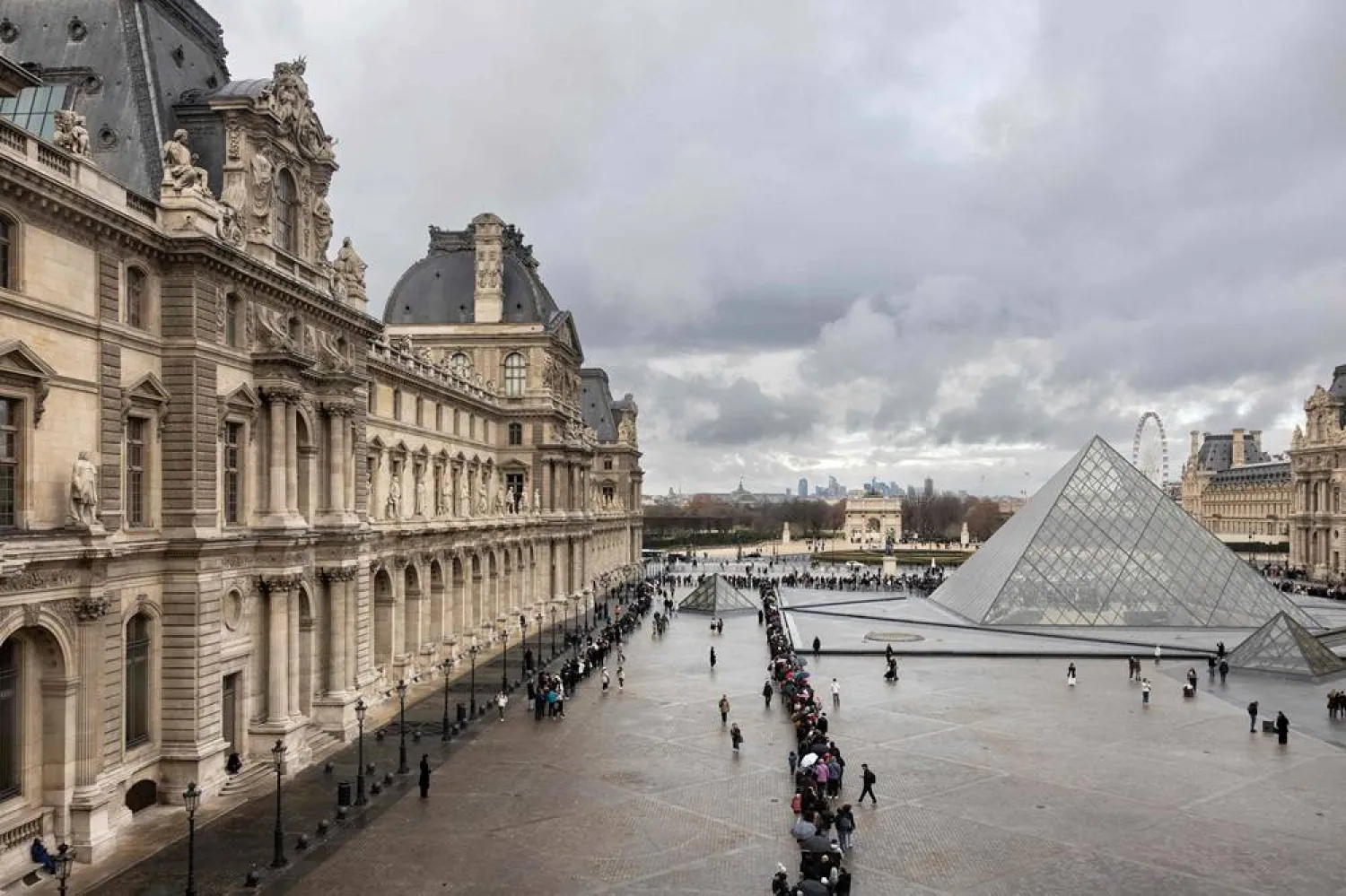
This photograph shows visitors, seen from the Sully wing, queuing in the Cour Napoleon by the pyramid designed by Chinese-US architect Ieoh Ming Pei, to enter the Louvre Museum in Paris on November 19, 2025. (AFP)
TT
TT
Louvre Museum ‘Running Out of Steam’, Says New Director
This photograph shows visitors, seen from the Sully wing, queuing in the Cour Napoleon by the pyramid designed by Chinese-US architect Ieoh Ming Pei, to enter the Louvre Museum in Paris on November 19, 2025. (AFP)
The Louvre museum is struggling to find funding to upgrade its ageing facilities, its new director said Wednesday, following a litany of problems that included a brazen $100-million jewellery heist.
"Despite its imposing majesty, despite the daily commitment of its staff, the Louvre is running out of steam," Christophe Leribault told a Senate committee.
"Its equipment and infrastructure are reaching the end of their life cycle."
Leribault, an art historian and museum director specializing in 18th-century art, took the helm in February, after his predecessor stepped down following an embarrassing daylight theft of imperial jewels in October that laid bare severe security failings.
Home to iconic pieces of art including Leonardo da Vinci's "Mona Lisa", the Louvre is the world's most visited museum, receiving around nine million visitors a year.
It is housed in a vast palace in central Paris on the banks of the Seine River, built over centuries by various French monarchs who at times used it as their official residence.
"Building-related emergencies are piling up, and we're facing a wall in terms of investments," Leribault said.
The museum had struggled with repeated strikes causing loss of revenue, a ticket fraud scheme that may have cost the museum 10 million euros ($11.7 million), a water leak, and other maintenance issues.
An archaeologist displays an artifact found from an archaeological site in the northern coastal Lebanese town of Batroun on August 14, 2026. (AFP)
TT
TT
Lebanon Archaeological Finds Showcase Rich Heritage Despite War Woes
An archaeologist displays an artifact found from an archaeological site in the northern coastal Lebanese town of Batroun on August 14, 2026. (AFP)
From a Roman temple to ancient olive presses, Lebanon keeps turning up archaeological treasures even as the latest Israel-Hezbollah war has caused excavations to grind to a halt at precious heritage sites in the country's south.
Important discoveries in recent years include the remains of columns and bases from a Roman temple in Maasser al-Shouf in the mountains southeast of Beirut, nestled next to a millennia-old cedar forest.
"A whole system was built around this temple," which dates to between the first century BC and the second century AD, said Myriam Ziade, regional antiquities official with the culture ministry.
She said the site was turned into a Crusader fortress between the 12th and 13th centuries.
The local municipality reported finding huge stone blocks on the hill in 2017, and excavations began five years later with a team from an Italian university, with the dig revealing the ruins of the large temple, she told AFP.
Archaeologists are to soon resume work at the site, located "on a network of roads leading from the Mediterranean coast to the Bekaa valley" in the country's east, she said.
The eastern city of Baalbek has one of Lebanon's best-known landmarks: a stunningly well-preserved Roman temple complex set against the mountainous border with Syria.
- Protecting heritage -
Lebanon is brimming with archaeological finds showcasing its rich history over thousands of years, from the Phoenician, Persian, Roman and Byzantine periods, the Crusades, and Arab and Islamic sultanates and empires.
After Iran-backed Hezbollah drew Lebanon into the Middle East war in March, triggering heavy Israeli airstrikes and a ground invasion in the south, the United Nations cultural agency UNESCO last month added several Lebanese sites to its World Heritage in Danger list.
Members from the team of archaeologists work at an archaeological site in the northern coastal Lebanese town of Batroun on August 14, 2026. (AFP)
They include the southern coastal city of Tyre, home to a Roman triumphal arch and a second-century hippodrome.
The list also includes five castles in south Lebanon's Jabal Amel area, among them the Crusader-era Beaufort fortress, which Israeli forces have been occupying since May.
Sarkis Khoury, head of antiquities at Lebanon's culture ministry, told AFP the war had forced archaeologists to switch tack.
We are "now focused on protecting endangered heritage in southern Lebanon and in the Bekaa, particularly in the Baalbek region", he said.
"Excavations in dangerous areas have come to a halt, and archaeological missions are going through a period of minimal activity throughout Lebanon, especially in the southern regions."
He said foreign archaeological teams had stopped going to Lebanon.
- Ancient port city -
Still, some work continues.
In Batroun, a northern coastal city home to the ruins of a small Roman amphitheater, an archaeologist was surrounded by tools and papers, documenting the latest finds as waves lapped rocks nearby.
Samar Karam, in charge of archaeological sites in north Lebanon, said a Roman-era olive press was found on private property along with pottery weights and items for textile production.
On another nearby property overlooking an ancient sea wall, excavations revealed two stone quarries "one Roman and the other Phoenician", she said.
The ruins of rooms from Phoenician, Persian and Roman periods have been uncovered, their pink or grey flooring helping to distinguish them.
Archaeologists have found pieces of Greek pottery, as well as rooms and large jars for storing goods from the harbor, discoveries that Karam said showed the ancient city's "lively commercial activity".
Tombs in the city date to a variety of historical periods, she added.
A view of the Phoenician wall is pictured in the northern coastal Lebanese town of Batroun on August 14, 2026. (AFP)
- Hippodrome search -
In Beirut, whose history spans over 5,000 years, Laure Salloum oversees archaeological excavations in the chaotic modern city.
She said current digs were "really construction projects" where workers had stumbled across historical treasures.
A recent discovery uncovered the remains of a Roman-era olive press, while work was ongoing in central Beirut in search of "the remaining part" of a Roman hippodrome, Salloum said.
The hippodrome was initially unearthed years ago when excavations began for a commercial and residential complex.
Other accidental discoveries in the city have included a 2,000-year-old Roman bathhouse.
Such finds often cause development plans to grind to a halt.
"We're constantly making new discoveries," Khoury said.
"Lebanon is at the crossroads of a region that has been full of crises for thousands of years."
Sakaka Cultural House, Cinema Association Screen Five Short Filmshttps://english.aawsat.com/culture/5312075-sakaka-cultural-house-cinema-association-screen-five-short-films
Sakaka Cultural House, Cinema Association Screen Five Short Films
Photo by SPA
The Sakaka Cultural House, in cooperation with the Cinema Association, hosted a cultural event featuring the screening of five independent short films to promote cinema culture and showcase local productions, SPA reported.
Marking the first collaboration between the two entities, the event aimed to enrich the region's cinematic landscape, provide an interactive platform connecting audiences with filmmakers, and foster critical discussion around the themes presented in the films.
Thieves Buy Tickets Before Plundering Necklace from Vienna Museumhttps://english.aawsat.com/culture/5312024-thieves-buy-tickets-plundering-necklace-vienna-museum
Austrian media said the Van Cleef and Arpels necklace, with 673 precious stones, was worth several million dollars. (Getty Images)
TT
TT
Thieves Buy Tickets Before Plundering Necklace from Vienna Museum
Austrian media said the Van Cleef and Arpels necklace, with 673 precious stones, was worth several million dollars. (Getty Images)
Two men bought tickets to enter Vienna's Museum of Applied Arts (MAK) before smashing a display case, grabbing a 200-carat platinum and diamond necklace and walking away, police said Friday.
Austrian media said the Van Cleef and Arpels necklace, with 673 precious stones, was worth several million dollars. It is the latest in a series of high-profile heists to hit European museums.
Police said the two men did not wear masks, paid to enter the museum and were clearly seen on surveillance cameras.
They "smashed a glass display case" with a hammer before "fleeing with the jewelry in an unknown direction," said a police statement.
The MAK museum confirmed the theft but said it would not comment while the investigation went ahead.
The necklace had been part of an exhibition devoted to the French designers Van Cleef and Arpels. Some 500 pieces had been on display since June. The exhibition was to end on September 27 but has been closed following the theft.
It was designed for the former Egyptian royal family, and was worn by Queen Nazli in 1939 for the marriage of her daughter Faiza to the future Shah of Iran, Mohammad Reza Pahlavi.
On its website, Van Cleef and Arpels called the stolen piece a "triumph of white jewelry". The French company did not immediately comment on the theft.
European museums have been hit by a series of spectacular thefts since thieves in October broke into the Louvre museum in Paris in broad daylight, escaping in less than eight minutes with jewelry worth $102 million.
Thieves on Thursday raided the Treasure of Villena -- one of the greatest Bronze Age gold collections -- at a museum in the Spanish city of Villena, taking most of the 50-plus mainly gold bracelets, bowls, bottles and other items on display.
Four works "of extraordinary value" by Renaissance artist Antonello da Messina were stolen from a museum in Sicily, Italy's culture ministry said Sunday.
Two days earlier, Italian police said they had recovered paintings by Renoir, Cezanne and Matisse worth over $10.4 million which were stolen from the Magnani-Rocca Foundation museum near Parma.
لم تشترك بعد
انشئ حساباً خاصاً بك لتحصل على أخبار مخصصة لك ولتتمتع بخاصية حفظ المقالات وتتلقى نشراتنا البريدية المتنوعة