


Venice Mayor Proposes Dynamic Pricing for Day-Trippers with 50-Euro Ceiling

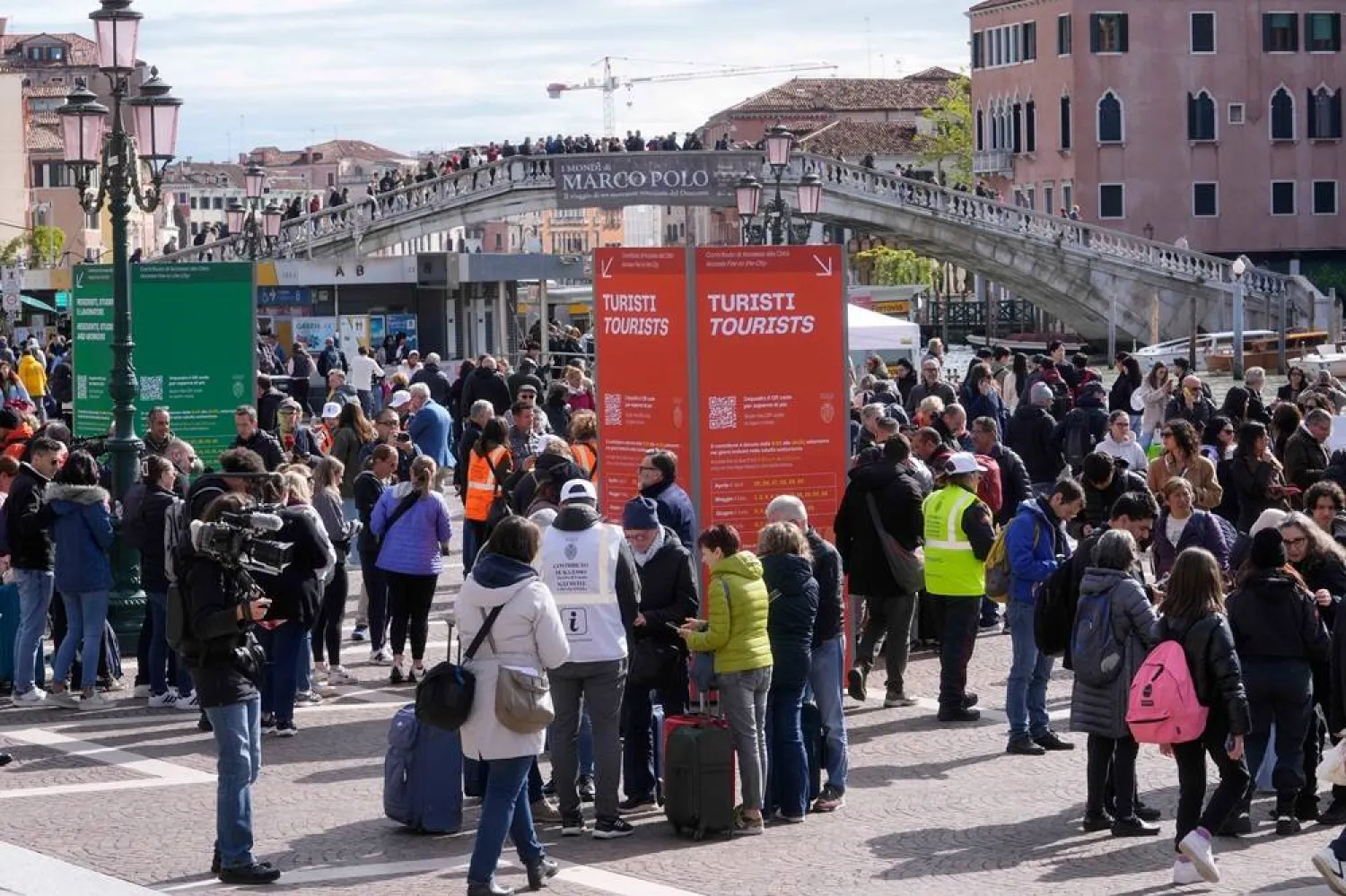
Stewards check tourists QR code access outside the main train station in Venice, Italy, on April 25, 2024. (AP)
TT

Venice Mayor Proposes Dynamic Pricing for Day-Trippers with 50-Euro Ceiling

Stewards check tourists QR code access outside the main train station in Venice, Italy, on April 25, 2024. (AP)

Venice’s new mayor is proposing a dynamic pricing system for the city’s three-year-old day-tripper access fee, seeking government approval to raise the charge to as much as 50 euros ($59) on the busiest days to ease overcrowding in the UNESCO world heritage city.

Mayor Simone Venturini told The Associated Press in an interview Friday that the current 10-euro fee for last-minute reservations has not done enough to discourage visitors on peak days. Instead of imposing a fixed higher fee, the city wants to enact a form of surge-pricing, allowing the charge to rise with demand on the busiest days.

Venturini said the system would both discourage overcrowding and help cover the costs of maintaining the city.

“We spend 100 million euros a year just to maintain Venice physically, and nobody gives us that money. Not Europe. Not the Italian state. International critics don’t pay it either. It’s paid by the people of Venice, and in part through tourism taxes,” said Venturini, who was elected mayor last month after serving as the city’s top tourism official when the day-tripper tax was launched in 2024.

The access fee itself has been widely criticized by activists, housing advocates and opposition politicians for not doing enough to ease crowding in the city, while reducing Venice to a tourist attraction by charging admission. They also say the focus is too much on managing tourist flows, and not enough on bringing more residents back to the historic part of the city.

Venturini said the money is necessary to clean and maintain the city. The proposal for a surge-pricing structure would require an amendment to Italy’s special law governing Venice, and Venturini said he had already discussed the idea with the tourism minister.

“Day-trippers obviously generate waste — they eat, they drink, they throw things away. That comes at a huge cost,” which he said are driven up “because everything has to be done by hand, with brooms, boats and handcarts.”

While the 50-euro price proposal has made headlines and drawn criticism for being prohibitive for many visitors, particularly families, Venturini said the amount was chosen as an upper limit, giving the city room to experiment with different pricing levels. He said they are still working with researchers to determine the right threshold.

“If, for example, more than 40,000 people had already booked for a given day, those above that threshold might be asked to pay a little more—20, 25 or 30 euros,” Venturini said. “We asked for a broad range, up to 50 euros, and then it would be up to the city to manage the system through further testing. It doesn’t mean everyone who comes to Venice would pay 50 euros.”

While opposition politicians have proposed putting a cap on the number of visitors a day, Venturini said current Italian law does not allow that.

The number of residents of Venice’s canaled historic center has dropped to below 48,000 — while the number of tourist beds has risen to more than 51,500, according to the most recent figures tracked by the Ocio housing advocacy group from January.

Venturini argued that the city’s population is understated because many students and seasonal workers spend most of the year in Venice without registering as residents.

“That doesn’t mean we are satisfied. We need to do more,” he said.

Venice collected 2.4 million euros on 29 peak days from more than 485,000 day-trippers during the test phase in 2024. That rose to 5.4 million euros last year after Venice increased the number of days to 54 and doubled the fee to 10 euros for last-minute registrations on the city platform. This year, an additional six days have been added, but no figures have yet been released on arrivals or revenues.

Venturini said the money collected covers “only a small part of the costs of managing tourism.”

“The goal is not to raise money or to turn Venice into a ticketed city,” he said. “The goal is to give both residents and visitors a better experience on days when the city would otherwise be too crowded.”



Jeddah Cultural Centers Offer Quality Programs to Support Arts, Creativity

Jeddah is witnessing growing cultural activity, reflected in the programs and events offered by cultural centers and institutions. (SPA)
TT

Jeddah Cultural Centers Offer Quality Programs to Support Arts, Creativity

Jeddah is witnessing growing cultural activity, reflected in the programs and events offered by cultural centers and institutions. (SPA)

Jeddah is witnessing growing cultural activity, reflected in the programs and events offered by cultural centers and institutions throughout the year, the Saudi Press Agency said on Monday.

These include art exhibitions, creative workshops, literary and knowledge-based gatherings, performing arts shows, and initiatives targeting children and youth, providing talents with spaces to learn, experiment, and express themselves while strengthening interaction between creatives and audiences.

The importance of these programs lies in their ability to discover talent and develop creative skills. They provide practitioners and enthusiasts with opportunities for training, networking, and the exchange of expertise, while opening avenues for young artists to showcase their work and reach audiences.

Jeddah's cultural scene derives its distinctive character from the city's identity and historical diversity. For centuries, the city has remained a meeting point for people from diverse cultures, which has influenced its arts, architecture, and social heritage, giving the contemporary cultural scene a rich foundation that draws inspiration from the past and presents it in a modern language combining the authenticity of place with contemporary creative trends.

Cultural programs also help build bridges between generations by presenting local heritage in contemporary forms and giving children and young people opportunities to discover and practice the arts in stimulating environments. This supports the sustainability of cultural knowledge and raises awareness of the value of heritage and national identity.


Mafia Link Feared in Sicilian Grand Master Theft

A drone view shows the grounds of the Museo Regionale di Messina, where four artworks by 15th-century painter Antonello da Messina were stolen overnight, in Messina, Sicily, Italy, August 16, 2026. (Reuters)
TT

Mafia Link Feared in Sicilian Grand Master Theft

A drone view shows the grounds of the Museo Regionale di Messina, where four artworks by 15th-century painter Antonello da Messina were stolen overnight, in Messina, Sicily, Italy, August 16, 2026. (Reuters)

The theft of four paintings by Renaissance master Antonello da Messina may have involved organized crime and raised troubling questions about security at a museum in the Sicilian artist's hometown, a local official said on Monday.

Enzo Caruso, Messina's councilor for culture, said it was difficult to understand how thieves could have removed the works in a matter of minutes without detailed knowledge of the museum's layout.

"It's a very, very strange affair," Caruso told Reuters.

The theft on Saturday has shocked Italy and revived memories of the infamous 1969 disappearance of a masterpiece by Caravaggio from a Palermo church -- a case long associated with Sicily's Cosa Nostra mafia ‌and never solved.

TOO ‌FAMOUS TO SELL

Caruso said the stolen Antonello works were ‌so ⁠famous that selling them ⁠even on the black market would be virtually impossible, raising the possibility that they could be used as bargaining chips or collateral in criminal dealings.

"The Mafia? It's possible they might try to blackmail the state itself in order to return them. These are the kinds of dynamics that ordinary people never get to see," he said.

He said another possibility was that the paintings could be used as guarantees or currency within the criminal underworld.

The thieves entered Messina's ⁠Accascina Regional Museum on Saturday evening, while the city was celebrating ‌a religious festival that brought thousands into the streets.

The ‌burglary only came to light some two hours later when tourists found two Antonello paintings, apparently discarded ‌by the thieves, leaning against the museum railings.

Renato Schifani, the president of Sicily, issued ‌a statement to say the museum's video surveillance system and alarm had been working normally, adding that an internal investigation was underway to see if any museum staff had been involved.

LOST PAINTINGS FOUND IN THE PAST

Caruso questioned how well prepared the thieves had been, pointing to the fact that two ‌paintings had been left in the street. "Perhaps they did not anticipate how heavy they would be. These are wooden panels ... stealing them ⁠is not as ⁠easy as stealing a canvas that can be cut from its frame," he said.

He also said a professional art thief would normally take greater care handling works worth tens of millions of euros, saying no attempt had been made to protect the paintings.

Italy's crack squad of art police are heading to Messina to take on the case, just three days after helping to retrieve paintings by Pierre-Auguste Renoir, Henri Matisse and Paul Cezanne stolen earlier this year from a museum near Parma.

While the Rome-based art theft police have established a strong track record in finding missing masterpieces, Sicily is still haunted by the memory of the missing Caravaggio.

"I have the feeling the thieves may be keeping the (Antonellos) hidden while things calm down," Caruso said.

"Or perhaps they immediately took the sea route," he added, noting that the museum lies close to the Strait of Messina.

"The hope is that sooner or later they reappear."


Palestinians Celebrate Jerusalem Festival Return After Gaza War Hiatus

Palestinian musicians take part in a final rehearsal before the opening of the Jerusalem Festival, held at the Yabous Cultural Center after a two-year hiatus, in East Jerusalem on August 16, 2026. (AFP)
TT

Palestinians Celebrate Jerusalem Festival Return After Gaza War Hiatus

Palestinian musicians take part in a final rehearsal before the opening of the Jerusalem Festival, held at the Yabous Cultural Center after a two-year hiatus, in East Jerusalem on August 16, 2026. (AFP)

Three years after its last edition, hundreds of fans are again able to enjoy the Jerusalem Festival, a Palestinian cultural celebration which had been on hold because of the horrors of the Gaza war.

The event, which will run for two months, opened on Sunday with a tribute to the late Lebanese musician Ziad Rahbani, a staunch supporter of the Palestinian cause.

At Yabous Cultural Center, in the Israeli-annexed east of the city, the Jerusalem Arabic Music Ensemble played a selection of Rahbani's work.

"An evening dedicated to Ziad Rahbani represents a major part of our memory. Jerusalem needs this kind of event," filmmaker Yousef al-Salhi told AFP.

The Lebanese musician and playwright, the son of iconic singer Fairuz and a musical pioneer in his own right, died last year aged 69.

Throughout the evening, Rahbani's repertoire, from mawwal --slow Arabic free-form vocal music-- to lively Levantine folk-pop, enthused the audience.

The last edition of the festival was held in the summer of 2023, before the war in the Gaza Strip erupted following Hamas's October 7 attack on Israel.

"We insist on coming back... Today we return to give people hope. The festival brings hope and brings people together," said musician Suheil Khoury, chairman of the board of the Yabous Cultural Centre.

The festival is now four decades old, though the city's tumultuous past means this is only the 30th edition, with several wars as well as the intifadas, or Palestinian uprisings, of the 1980, 90s and 2000s forcing it to pause.

The festival will continue with musical performances, cultural talks and art exhibitions taking place at various locations across east Jerusalem until October 15.

"Everyone is thirsty for this kind of gathering amid the difficult circumstances we are going through -- the genocidal war, restrictions on Jerusalem and the West Bank, and the violence being perpetrated against us," Mona al-Dajani, an academic researcher who attended the opening, said.

Moussa al-Qawasmi, a resident of east Jerusalem, was enthusiastic to attend an event promoting Palestinian culture.

"They (Israel) don't want us to exist, but no, we are always ready... we will continue to celebrate, sing and dance."