


Egypt Uncovers Lost Byzantine-era City in the Western Desert

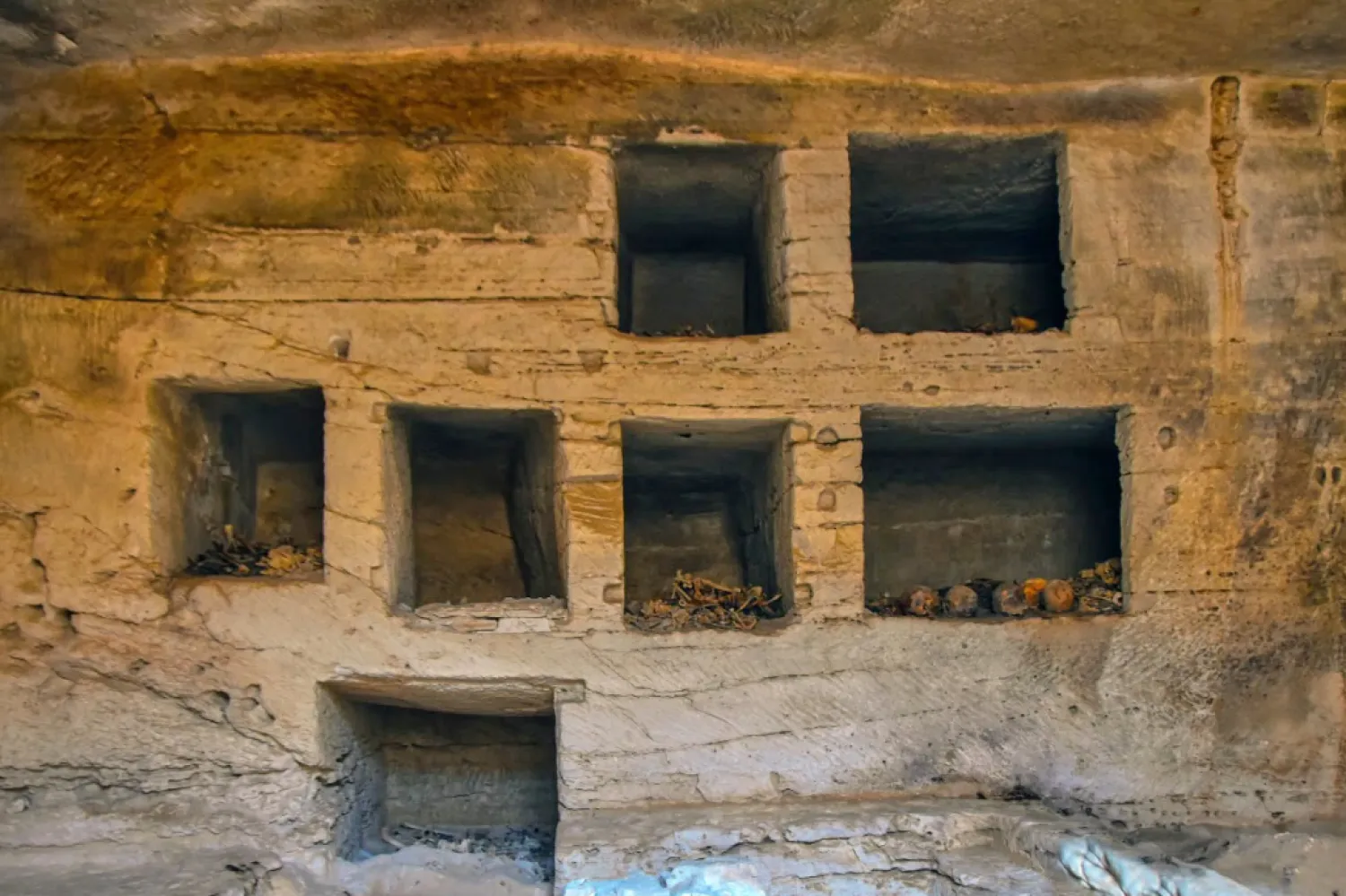
In this photo provided Saturday, July 4, 2026, by Ministery of Tourism and Antiquities, some of seven surface limestone-built tombs, discovered in the Marina el-Alamein archaeological site, are seen west of the Mediterranean city of Alexandria, Egypt. (Ministery of Tourism and Antiquities via AP)
TT

Egypt Uncovers Lost Byzantine-era City in the Western Desert

In this photo provided Saturday, July 4, 2026, by Ministery of Tourism and Antiquities, some of seven surface limestone-built tombs, discovered in the Marina el-Alamein archaeological site, are seen west of the Mediterranean city of Alexandria, Egypt. (Ministery of Tourism and Antiquities via AP)

A well-preserved Byzantine-era residential city in the western desert is one of two major archaeological finds announced by Egypt on Saturday.

The recent discoveries at the Dakhla Oasis and at the Marina el-Alamein archaeological site, near Alexandria, are the latest findings which the Egyptian government hopes will boost the country’s vital tourism sector, partially driven by antiquities sightseeing.

Along with the strategic Suez Canal, tourism is a major source of foreign currency in the cash-strapped country.

The Tourism and Antiquities Ministry said that the first discovery reveals details of daily life, urban development and economic activities in the Dakhla Oasis in the fourth century, when Egypt was part of the Byzantine empire.

The unearthed quarters included north-south thoroughfares intersected by east-west streets, forming open squares and public spaces, said Hisham el-Leithy, secretary general of the supreme council of antiquities.

A basilica church, dating back to the mid-fourth century, stands at the settlement’s head, overlooking its main streets, along with remains of two watchtowers to safeguard the outskirts, said Mahmoud Massoud, who chairs the archaeological mission.

The oasis, located in Egypt’s western province of New Valley in the western desert, is on UNESCO’s Tentative List, a step away from being added to the agency’s World Heritage List.

A heavily fortified structure with thick defensive walls, and many houses consisting of reception halls and vaulted roofs were found in the area, Massoud said.

Among them were the house of Tisous, identified as a church deacon and dating to the second half of the fourth century, which archaeologists believe served as a house church before the construction of the city’s basilica.

Archaeologists also uncovered bread ovens, kitchens and stone grinding tools that had been apparently used to produce food. Also found were well-preserved bronze coins bearing portraits of Byzantine emperors, Latin inscriptions and Christian symbols, alongside a group of gold coins dating to the reign of Roman emperor Constantius II, who ruled between 337 and 361, the ministry statement said.

Diaa Zahran, head of the Islamic, Coptic and Jewish Antiquities department, said they found a collection of about 200 pottery fragments which would have been used as writing material. The fragments, known as octraca, have inscriptions detailing commercial transactions, correspondence and other details of daily life, Zahran said.

Separately, archaeologists have found 18 ancient tombs in the Marina el-Alamein archaeological site, which is around 100 kilometers (62 miles) west of the Mediterranean city of Alexandria.

The findings included 11 rock-cut tombs, with an average depth of 8 meters, and seven surface limestone-built tombs, the ministry said. That has brought the total tombs found in the site to 48, ministry said.

In the site, archaeologists found pottery vessels, amphorae, lamps, plates, altars and limestone basins, it said.

Mission chief Eman Abdel-Khaliq said they found a 2.5-meter-long granite sarcophagus, with skeleton remains that were currently being studied. Close to the sarcophagus, they found the remains of a plaster sphinx statue, she said, The AP news reported.

Abdel-Khaliq said they also found 4 gold pieces placed inside the mouths of some of the deceased — known as “the golden tongue,” which had been a practice associated with funerary beliefs of that era.

Marina el-Alamein is an archaeological site close to the city of Alamein in Egypt’s Northern Coast. Unearthed in 1986, archaeologists believe that the site was the ancient Greco-Roman port city of Leukaspis on the Mediterranean, which was built in the second denture and thrived until the fourth century, the ministry said.

Egypt’s tourism has started to recover after years of years of political turmoil and violence following the 2011 uprising, as well as the coronavirus pandemic.

A record 19 million tourists visited Egypt last year, a 21% increase from 2024, according to official figures. The first four months of 2026 saw 6.1 million tourists, compared with 5.7 million during the same period in 2025, the figures showed.

Venice Mayor Proposes Dynamic Pricing for Day-Trippers with 50-Euro Ceiling

Stewards check tourists QR code access outside the main train station in Venice, Italy, on April 25, 2024. (AP)
TT

Venice Mayor Proposes Dynamic Pricing for Day-Trippers with 50-Euro Ceiling

Stewards check tourists QR code access outside the main train station in Venice, Italy, on April 25, 2024. (AP)

Venice’s new mayor is proposing a dynamic pricing system for the city’s three-year-old day-tripper access fee, seeking government approval to raise the charge to as much as 50 euros ($59) on the busiest days to ease overcrowding in the UNESCO world heritage city.

Mayor Simone Venturini told The Associated Press in an interview Friday that the current 10-euro fee for last-minute reservations has not done enough to discourage visitors on peak days. Instead of imposing a fixed higher fee, the city wants to enact a form of surge-pricing, allowing the charge to rise with demand on the busiest days.

Venturini said the system would both discourage overcrowding and help cover the costs of maintaining the city.

“We spend 100 million euros a year just to maintain Venice physically, and nobody gives us that money. Not Europe. Not the Italian state. International critics don’t pay it either. It’s paid by the people of Venice, and in part through tourism taxes,” said Venturini, who was elected mayor last month after serving as the city’s top tourism official when the day-tripper tax was launched in 2024.

The access fee itself has been widely criticized by activists, housing advocates and opposition politicians for not doing enough to ease crowding in the city, while reducing Venice to a tourist attraction by charging admission. They also say the focus is too much on managing tourist flows, and not enough on bringing more residents back to the historic part of the city.

Venturini said the money is necessary to clean and maintain the city. The proposal for a surge-pricing structure would require an amendment to Italy’s special law governing Venice, and Venturini said he had already discussed the idea with the tourism minister.

“Day-trippers obviously generate waste — they eat, they drink, they throw things away. That comes at a huge cost,” which he said are driven up “because everything has to be done by hand, with brooms, boats and handcarts.”

While the 50-euro price proposal has made headlines and drawn criticism for being prohibitive for many visitors, particularly families, Venturini said the amount was chosen as an upper limit, giving the city room to experiment with different pricing levels. He said they are still working with researchers to determine the right threshold.

“If, for example, more than 40,000 people had already booked for a given day, those above that threshold might be asked to pay a little more—20, 25 or 30 euros,” Venturini said. “We asked for a broad range, up to 50 euros, and then it would be up to the city to manage the system through further testing. It doesn’t mean everyone who comes to Venice would pay 50 euros.”

While opposition politicians have proposed putting a cap on the number of visitors a day, Venturini said current Italian law does not allow that.

The number of residents of Venice’s canaled historic center has dropped to below 48,000 — while the number of tourist beds has risen to more than 51,500, according to the most recent figures tracked by the Ocio housing advocacy group from January.

Venturini argued that the city’s population is understated because many students and seasonal workers spend most of the year in Venice without registering as residents.

“That doesn’t mean we are satisfied. We need to do more,” he said.

Venice collected 2.4 million euros on 29 peak days from more than 485,000 day-trippers during the test phase in 2024. That rose to 5.4 million euros last year after Venice increased the number of days to 54 and doubled the fee to 10 euros for last-minute registrations on the city platform. This year, an additional six days have been added, but no figures have yet been released on arrivals or revenues.

Venturini said the money collected covers “only a small part of the costs of managing tourism.”

“The goal is not to raise money or to turn Venice into a ticketed city,” he said. “The goal is to give both residents and visitors a better experience on days when the city would otherwise be too crowded.”


Historic Jeddah’s Red Sea Museum Showcases Rare Manuscripts from Ancient Hajj Sea Voyages

Other key exhibits include diverse religious artifacts, works on the Prophet’s biography, and poems of praise - SPA
TT

Historic Jeddah’s Red Sea Museum Showcases Rare Manuscripts from Ancient Hajj Sea Voyages

Other key exhibits include diverse religious artifacts, works on the Prophet’s biography, and poems of praise - SPA

The Red Sea Museum in Historic Jeddah stands as a prominent testament to the historic relationship linking the Red Sea to maritime Hajj pilgrimages across the centuries.

Through a specialized pavilion, the museum displays a rare collection of illuminated copies of the Holy Quran, Islamic books, historical manuscripts, and maps that once accompanied pilgrims on their sea voyages to Makkah.

The pavilion features illuminated copies of the Holy Quran dating back to various historical periods, including 17th-century Chinese manuscripts, 19th-century Kashmiri texts, and a small Ottoman Quran copy. Each piece is distinguished by intricate gold decorations, artistic calligraphy, and exquisite binding, showcasing the high level of precision achieved in the historical art of copying Quranic manuscripts, SPA reported.

Other key exhibits include diverse religious artifacts, works on the Prophet’s biography, and poems of praise. A standout feature is a landmark manuscript from 1506 CE documenting scenes from the Two Holy Mosques, which remains one of the most prominent historical works detailing Hajj.

By highlighting the historical care given to the Holy Quran, including the evolution of calligraphy, ornamentation, and bookbinding, the pavilion offers a deeply enriched cultural experience for visitors. It documents the spiritual and human journey of millions of pilgrims, serving as an enduring record of faith and heritage along one of the world's most significant historical routes.


Visitors Flock to Hira Cultural District for Immersive Islamic Heritage Experiences

The district is among the key projects highlighting Makkah's cultural and civilizational dimension in line with Saudi Vision 2030 - SPA
TT

Visitors Flock to Hira Cultural District for Immersive Islamic Heritage Experiences

The district is among the key projects highlighting Makkah's cultural and civilizational dimension in line with Saudi Vision 2030 - SPA

The Hira Cultural District in Makkah is witnessing a growing influx of domestic and international visitors with the start of the summer vacation, cementing its status as one of the Holy Capital's most prominent cultural and educational destinations.

Located at the foot of Mount Hira, home to Hira Cave, where revelation first descended upon Prophet Muhammad (peace be upon him), the district offers educational content through modern interactive technologies that blend authenticity with innovation, SPA reported.

The Revelation Exhibition, the district's most prominent component, documents the story of the first revelation through visual and audio presentations. The district also houses the Holy Quran Museum, which displays rare Quranic manuscripts and traces the stages of writing and developing the Holy Quran across Islamic eras.

Supporting facilities include open squares, restaurants, cafés, shops, and visitor reception areas, providing a suitable environment for families and visitors of all nationalities.

The district is among the key projects highlighting Makkah's cultural and civilizational dimension in line with Saudi Vision 2030's objectives to develop the cultural and tourism sectors and showcase Islamic heritage.
