


UK Museums at 'Sharp End' of Climate Change Challenge

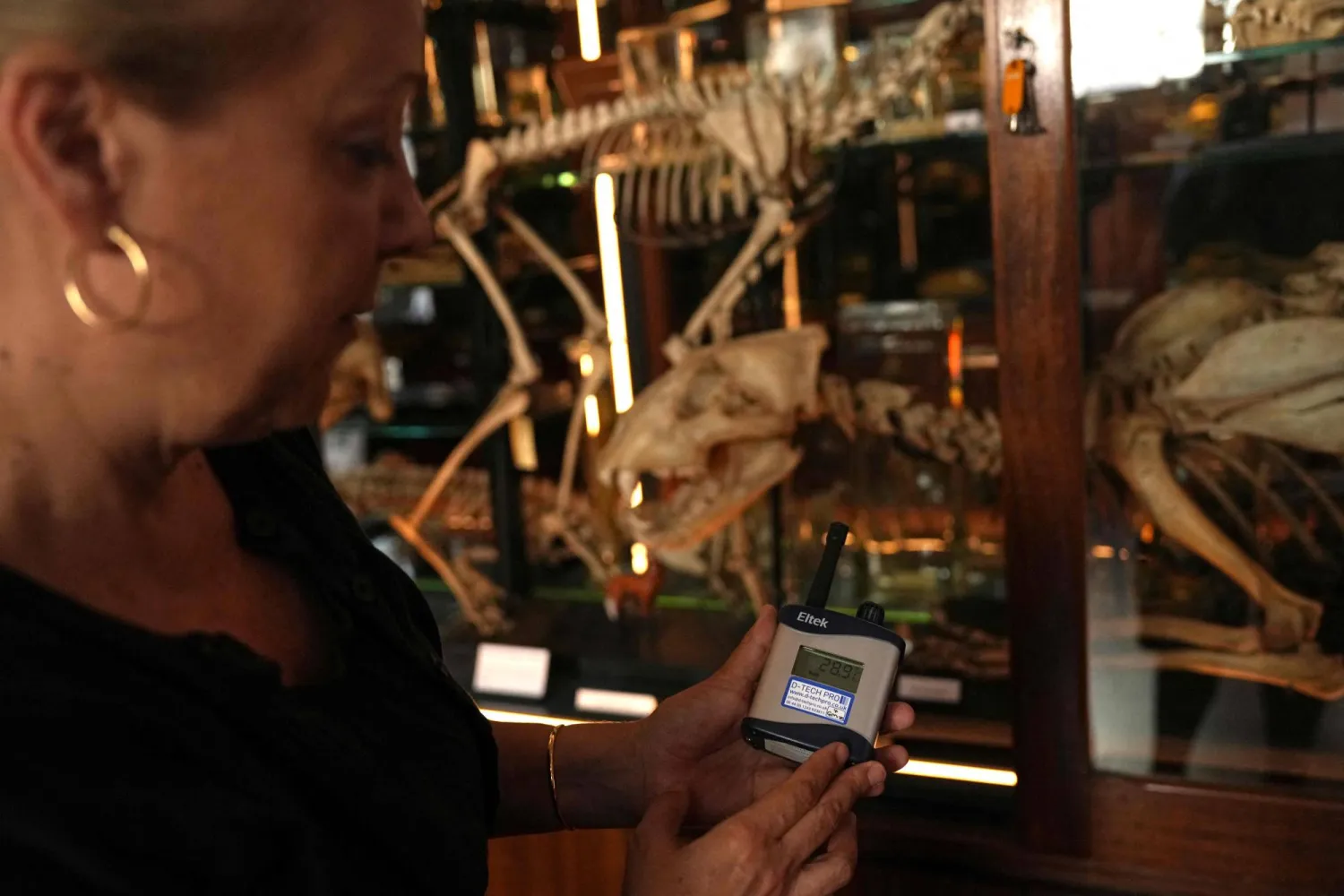
Tannis Davidson, Head of Zoology and Science collections at the Grant Museum of Zoology in London, holds a device displaying the temperature inside the display cases in the museum, in central London on June 26, 2026. (Photo by CARLOS JASSO / AFP)
TT

UK Museums at 'Sharp End' of Climate Change Challenge

Tannis Davidson, Head of Zoology and Science collections at the Grant Museum of Zoology in London, holds a device displaying the temperature inside the display cases in the museum, in central London on June 26, 2026. (Photo by CARLOS JASSO / AFP)

As visitors peered at skeletons and preserved animals in a London zoological museum during a UK heatwave, staff focused on a different attraction: a computer screen glowing with red and green temperature indicators.

With each one linked to a sensor in a different display case, the system allows staff to see when an exhibit is in danger of overheating.

Last year during a hot spell, staff arrived one morning to find an antique specimen jar -- containing a nearly two-centuries-old tabby cat -- had "blown out" amid the heat.

By monitoring temperatures in the display cases, staff at the Grant Museum of Zoology hope they can prevent damage to other exhibits by identifying any needing to be preventively decanted.

"They are very precious and valuable to us," said Tannis Davidson, head of zoology at the 200-year-old collection home to some 100,000 specimens covering every major animal group.

"We want to safeguard them for the next 200 years at least so students and researchers and members of public can enjoy the collection and learn more about the natural world," she told AFP.

But she said curators were having to deal with a whole "new set of challenges due to climate change and extended long periods of high temperatures within our spaces".

Emma Howard Boyd, chair of the independent National Heat Risk Commission, says the impact of climate change is no longer a distant threat but a present-day reality with the cultural sector at the "sharp end".

Last month's UK heatwave forced the closure of a number of London cultural attractions including the Young Victoria & Albert (V&A) museum, The Cutty Sark museum ship, Tower Bridge and some galleries at the V&A.

And the Met Office said Monday that the UK was entering its third heatwave of the year, although it was not expected to break any records.

Art works also require careful monitoring of temperature and humidity levels to prevent damage, according to Claire Teasdale of the National Trust heritage body.

"We're having more storms. We're having more wet weather and more extreme weather which is affecting everything," said Teasdale who manages the collections at Cragside, a 19th century mansion in northeastern Northumberland.

Cragside is home to an important art collection that includes works by J.M.W. Turner and John Everett Millais.

It was built to cope with "Victorian rainfall levels and not with 21st century rainfall levels," she said, adding rain and sunshine both hiked levels of potentially damaging humidity.

Six of the UK's 10 wettest years have occurred since 1998, the Met Office says.
Flooding poses another threat to cultural treasures.

The Museum of Making in the central city of Derby suffered major flooding in October 2023 during Storm Babet.

None of the industrial heritage museum's collections were damaged, but the cost of damage to the building was estimated at over £100,000 and the museum closed for nearly three months.

"Heat waves often end with flash flooding because of intense rainfall," added Howard Boyd who chaired a 2024 review of London's preparedness for more extreme weather commissioned by mayor Sadiq Khan.

John Calautit, lecturer in sustainable and low carbon technologies at University College London, said installing air conditioning was not a silver bullet for large spaces and historic buildings often subject to highly restrictive building regulations.

But he said experts were developing alternatives to provide ventilation and cooling based on the "windcatcher" principles used for centuries in architecture.

It is "a ventilation system which is attached to the roof which can capture air at higher altitude. It brings air flow into the space at higher volume ... and extracts air out of the space," he told AFP.

Modern-day systems incorporated some form of low energy cooling and had already been commercially produced and used in Middle Eastern countries, he said.

Howard Boyd argues museums and historic properties need to explore all options for climate resilience.

She envisages a future in which venues become community hubs offering people a refuge from the heat.

A joint UK-wide initiative launched last month by organizations including the British Film Institute highlights venues where people can find local spaces to keep cool.



Hegra Highlights Status as Saudi Arabia’s First UNESCO World Heritage Site

Hegra Highlights Status as Saudi Arabia’s First UNESCO World Heritage Site
TT

Hegra Highlights Status as Saudi Arabia’s First UNESCO World Heritage Site

Hegra Highlights Status as Saudi Arabia’s First UNESCO World Heritage Site

The Kingdom of Saudi Arabia, a land that has witnessed successive civilizations whose traces remain across its regions, is home to AlUla Governorate, where the Hegra Archaeological Site stands as part of this rich human heritage.

It was the first Saudi site inscribed on the UNESCO World Heritage List, a testament to Saudi Arabia’s deep civilizational heritage and its commitment to preserving and safeguarding it for future generations.

As Saudi Arabia celebrates Saudi National Day, Hegra evokes part of the history of the Arabian Peninsula and the civilizational and cultural exchanges that took place across the region through the ages, according to SPA.

The Hegra Archaeological Site was inscribed on the UNESCO World Heritage List in 2008, becoming the first Saudi site to be added to the list, in an achievement that reflects its exceptional historical and civilizational significance. The site contains archaeological remains and carved rock facades that showcase the Nabataeans’ engineering and sculptural expertise.

Saudi Arabia, represented by the Royal Commission for AlUla (RCU), pays particular attention to the Hegra Archaeological Site through comprehensive efforts to preserve the site and safeguard its archaeological and historical components.

These conservation efforts are complemented by archaeological studies, surveys, and research conducted by the RCU in cooperation with experts and academic institutions.

Hegra remains one of the Kingdom’s most prominent heritage sites and a destination for visitors and researchers from around the world.


Tyre’s Ruins Survived the Strikes. Now Divers are Finding their Way Back Underwater

A diver passes above Roman-era columns at an archaeological site near the coast in the southern port city of Tyre, Lebanon, Thursday, Sept. 17, 2026. (AP Photo/Bilal Hussein)
TT

Tyre’s Ruins Survived the Strikes. Now Divers are Finding their Way Back Underwater

A diver passes above Roman-era columns at an archaeological site near the coast in the southern port city of Tyre, Lebanon, Thursday, Sept. 17, 2026. (AP Photo/Bilal Hussein)

Beneath the Mediterranean waters off the southern Lebanese city of Tyre, divers swim past stone walls, ancient structures and a submerged road — remnants of parts of a city that once stood above the water.

With a shaky ceasefire in place after the latest Israel-Hezbollah war, visitors are returning to Tyre, a city known for its Roman ruins and its much older Phoenician history. Diving operators say interest in the underwater archaeological sites is increasing, though the number of visitors remains below prewar levels, The Associated Press said.

“The diving season is not like it used to be before, but the number of people coming to dive to see the ruins is increasing day by day,” said Yousef al-Jundi, manager of the Lebanon Diving Center.

The remains underwater are part of Tyre’s wider archaeological landscape. UNESCO says substantial archaeological remains of the ancient city are submerged, while underwater archaeological research has documented walls, harbor structures and other remains along the former island and coastline.

“This is the identity of this city, which tells us how old this city is and what its history is,” al-Jundi said. He said the underwater sites attract divers from around the world who want to see what is commonly described as Tyre’s “sunken city.”

Tyre was one of the major Phoenician maritime cities of antiquity, with trading networks that extended across the Mediterranean. The city was also famous for its purple dye and later became an important Greek and Roman center. Its archaeological remains were added to UNESCO’s World Heritage List in 1984.

The war raised concerns over the preservation of those remains, both on land and underwater.

“We were worried about the archaeological sites on land, which were affected by the war and the strikes, but at the same time we were also worried about the archaeological sites underwater, but thank God they were not affected,” al-Jundi said.

Before the ceasefire in late June, Tyre came under intense Israeli airstrikes, with neighborhoods in the coastal city heavily damaged during the fighting. UNESCO’s World Heritage Committee placed Tyre on its List of World Heritage in Danger in July 2026, citing the threat and damage caused by the ongoing hostilities.

Ali Badawi of Lebanon’s Directorate General of Antiquities said protecting the underwater sites remains a challenge.

“They’re not very well protected," Badawi said, adding that “encroachments” sometimes happen. “But we are trying very hard through surveys and research that we’re conducting, and we’re trying to develop laws to ensure their safety in the future.”

Badawi said the authorities also want to expand research and investment in underwater tourism, including the creation of underwater archaeological parks that would allow more visitors to see the sites.

The effort comes as Tyre seeks to rebuild its tourism sector after the war, while preserving archaeological remains that reflect thousands of years of the city’s history.


Historic Linah Marks Saudi National Day with Heritage Events, International Performances

Linah is one of the most prominent historical sites in northern Saudi Arabia - SPA
TT

Historic Linah Marks Saudi National Day with Heritage Events, International Performances

Linah is one of the most prominent historical sites in northern Saudi Arabia - SPA

Historic Linah, located south of Rafha in Northern Borders Region, will celebrate Saudi National Day with a series of national and heritage events at the Historic Linah Market.

The program features performances by local and international artistic groups, along with a variety of artistic segments, solo musical performances, and equestrian and camel-riding displays, SPA reported.

The festivities will also include puppet shows, children’s competitions, and a musical evening showcasing traditional songs.

The Historic Linah Municipality has completed preparations across sites, parks, and roads, decorating streets with national flags and festive lighting to welcome visitors and create a celebratory atmosphere that reflects national pride.

Linah is one of the most prominent historical sites in northern Saudi Arabia.

Once a key stop along ancient caravan routes, the town’s historic palaces and market continue to stand as enduring witnesses to the region’s collective memory.