


Face-to-Face with Ancient Rome: Exhibition in Hungary Brings Forgotten Faces to Life

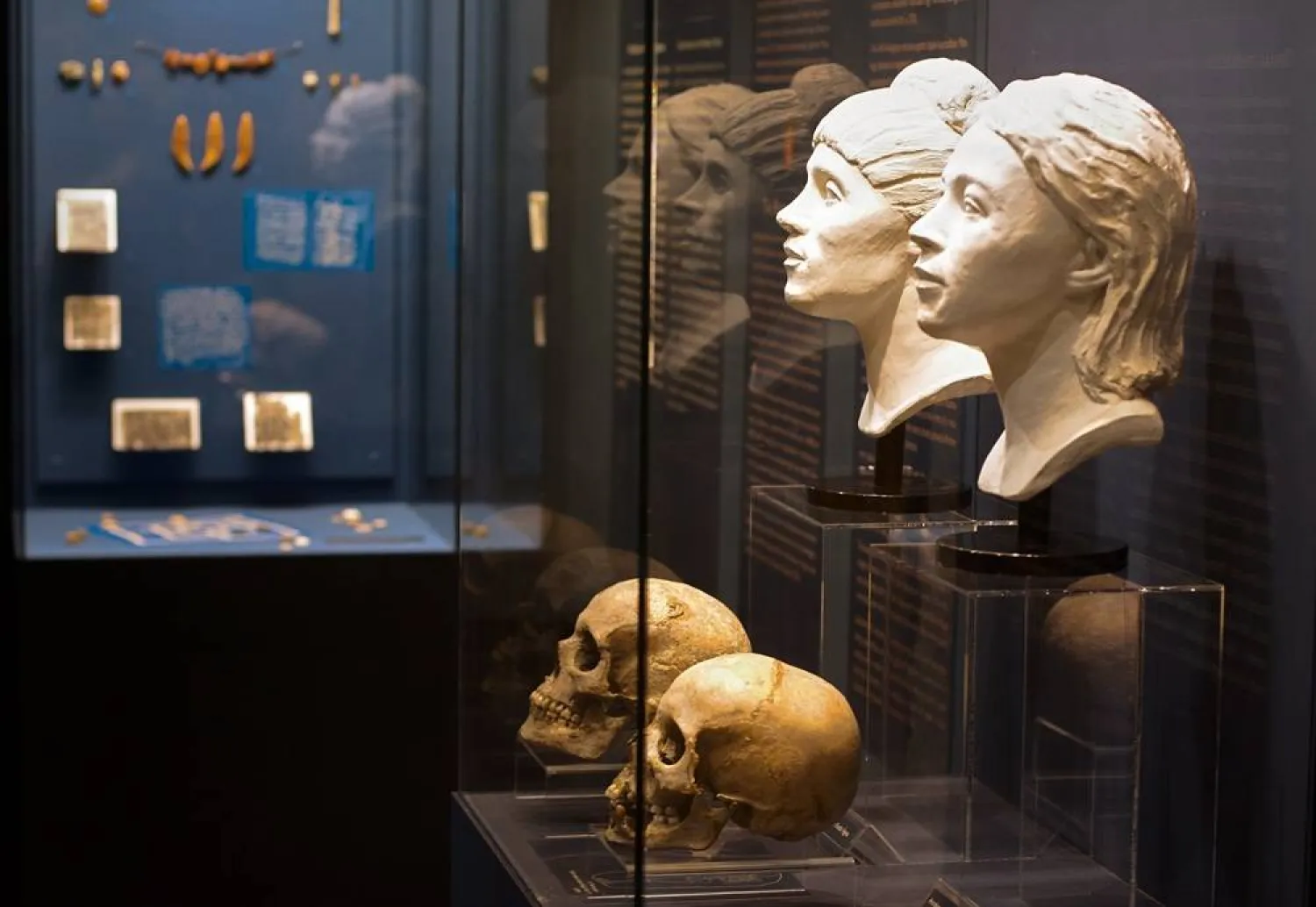
Roman-era skulls and their facial reconstructions are on display at the Aquincum Museum's exhibition titled "Once we were like you" which showcases characters and the fictional life stories of those who once lived in the bustling Roman settlement of Aquincum, in Budapest, Hungary, Tuesday, July 7, 2026. (AP)
TT

Face-to-Face with Ancient Rome: Exhibition in Hungary Brings Forgotten Faces to Life

Roman-era skulls and their facial reconstructions are on display at the Aquincum Museum's exhibition titled "Once we were like you" which showcases characters and the fictional life stories of those who once lived in the bustling Roman settlement of Aquincum, in Budapest, Hungary, Tuesday, July 7, 2026. (AP)

A blacksmith, a stable boy, a soldier, a slave: The faces and stories of these and other residents of an ancient Roman city in modern Hungary have been brought to life in remarkable fidelity for a new exhibition in Budapest.

The display, which runs until Oct. 31, showcases highly detailed facial reconstructions from over a dozen skulls found in the ancient city of Aquincum, once a bustling Roman settlement on the empire's Danube frontier.

Visitors to the Aquincum Museum come face-to-face with hyper-realistic models of Roman-era individuals, each crafted using DNA analysis and other techniques from fields such as archaeology and anthropology to determine how the people may have looked in life nearly 2,000 years ago.

“Our main goal was to bring a few of these individuals closer to the people of today,” said Loránt Vass, an archaeologist and the exhibition's co-curator.

The title of the exhibition, “Once we were like you,” attempts to answer questions about ordinary people in ancient societies: What did they look like? What were their names? What was their fate?

Experts with the Aquincum Museum used DNA analysis of unearthed bones to reveal skin, hair and eye color and whether the person may have had freckles.

The shape, density and other characteristics of the skull revealed details of the structure of the face as well as the person's age and whether they had sustained any injuries or suffered from disease.

Based on the findings, curators came up with names, trades and biographical stories to each of the reconstructed faces, giving them new life.

Péter Vámos, another of the exhibit’s co-curators, said the invented details were “based on authentic historical foundations” as well as information gathered from analysis of the skulls, which are displayed under the reconstructions.

“We don’t even know their names, unfortunately, but we tried to incorporate everything that anthropology and genetic studies could tell us about their life history,” he said.

One character, a construction worker they named Respectus, is described as having made his living in Aquincum plastering walls and splitting stone blocks. The exhibit says the work took its toll on his bones, and in a wine-fueled skirmish in a local tavern, his nose was broken and one of his teeth knocked out.

The story and social status of Respectus is typical of many Aquincum residents depicted. Vass said their studies showed that the bones of almost all individuals show a “fairly high degree” of inflammation.

“They were subjected to regular physical labor, and in many cases they were exposed to starvation for a certain period of time,” he said. “Based on this, it can be concluded that most of them belonged to the lower middle class, which is the least remembered segment of Roman society.”

Of the 16 reconstructions, six are silicon moldings that have been painted and meticulously adorned with true-to-life hair, clothing and jewelry.

Emese Gábor, who handcrafted the silicon reconstructions, said that while artificial intelligence also can be used to model ancient faces, “they just appear on a screen.”

“The advantage of this kind of reconstruction is that it can be displayed in a museum, it can be viewed from all angles and is totally life-size,” she said. “I stick to scientific methods and combine classical and modern scientific methods in this work.”

Another valuable piece of information that DNA can reveal is the ethnic origin of the person — quite illuminating in Aquincum's diverse settlement.

Analyses showed the presence of not only Roman citizens with origins in the heart of the empire in modern-day Italy, but also people from as far away as today's Scotland and Syria, as well as members of the nomadic Sarmatian tribes of the Eurasian steppes.

Also among Aquincum’s residents were Celts, who inhabited the region in the Iron Age before Roman settlement.

Vass said that during typical excavations of Roman-era skeletons, artifacts are examined, documented and stored, meaning “the bodies have no weight, no life, no soul.”

But by confronting visitors with their ancient predecessors, the museum hopes to forge a connection.

The exhibition's title “suggests that they were like we are today. They had the same occupations, the same problems,” Vass said.

“They may have had different life conditions, different social status, but people are people,” he said. “I don’t think that has changed much across history.”



AI-Powered Cultural Programs to Transform Saudi Arabia’s Creative Sector

The Ministry of Culture and the Cultural Development Fund signed a memorandum of understanding with SDAIA to explore joint AI programs serving the cultural sector. Photo: Ministry of Culture
TT

AI-Powered Cultural Programs to Transform Saudi Arabia’s Creative Sector

The Ministry of Culture and the Cultural Development Fund signed a memorandum of understanding with SDAIA to explore joint AI programs serving the cultural sector. Photo: Ministry of Culture

Saudi Arabia is preparing to launch a new generation of AI-powered cultural initiatives aimed at reshaping innovation, boosting the efficiency of creative institutions, and helping Saudi artists expand their presence at home and abroad.

On Monday, the Ministry of Culture and the Cultural Development Fund signed a trilateral memorandum of understanding with the Saudi Data and AI Authority (SDAIA) to explore joint AI programs serving the cultural sector, creators, and cultural enterprises.

The move reflects a broader national drive to accelerate the adoption of advanced technologies across the cultural economy as the Kingdom prepares to designate 2026 the Year of Artificial Intelligence.

Building an Enabling Ecosystem

Raed bin Khalil Al Eid, a cultural innovation adviser and founder of the Cultural Management Platform, said the agreement reflects growing recognition of AI’s role in the future of culture.

Although the initiative comes some time after the launch of the Year of AI, he said the delay should not prevent institutions and practitioners from benefiting from the programs expected to emerge.

What matters most, he added, is effective implementation that translates the memorandum into projects with tangible impact.

Al Eid cited a specialized study by the Cultural Management Platform that documented AI applications across all 16 cultural sectors officially recognized in Saudi Arabia, including heritage, museums, libraries, literature, publishing, translation, music, theater, film, architecture, fashion, and culinary arts.

The findings showed that AI has become an enabling technology applicable across the entire cultural ecosystem rather than a tool limited to a single discipline, broadening investment opportunities and making its adoption in Saudi Arabia increasingly practical.

He argued that the Ministry of Culture’s primary role at this stage is to create an enabling environment for AI by establishing policies, regulations, professional standards, and governance frameworks covering intellectual property, data, and ethics.

This, he said, would allow private companies, nonprofit organizations, and community initiatives to develop AI solutions with confidence.

Culture in the Year of AI

Al Eid said cultural innovation is no longer optional but essential as audiences, cultural consumption habits, generational interests, and regional priorities continue to evolve.

He emphasized that coupled with AI, cultural innovation can do more than improve efficiency: it can broaden culture’s reach, engage new audiences, and create more diverse, interactive, and sustainable cultural experiences.

Saudi Arabia’s cultural sector is already undergoing a rapid digital transformation, with further momentum expected as the Kingdom marks 2026 as the Year of Artificial Intelligence. The Ministry of Culture and its affiliated commissions have launched competitions and hackathons to attract innovators and encourage the development of AI applications across the cultural sector.

For Saudi artists and cultural professionals, the initiative is expected to open new opportunities to combine human creativity with advanced AI capabilities across a wide range of creative fields.


Misk Art Institute Launches Summer Art Exhibition in Riyadh

Riyadh is hosting the Prince Faisal bin Fahd Arts Hall Exhibition: Summer 2026, organized by the Misk Art Institute. (SPA)
TT

Misk Art Institute Launches Summer Art Exhibition in Riyadh

Riyadh is hosting the Prince Faisal bin Fahd Arts Hall Exhibition: Summer 2026, organized by the Misk Art Institute. (SPA)

Riyadh is hosting the Prince Faisal bin Fahd Arts Hall Exhibition: Summer 2026, organized by the Misk Art Institute—an affiliate of the Mohammed bin Salman Foundation (Misk)—as part of the Saudi Summer program. The exhibition welcomes visitors through August 1, The Saudi Press Agency said on Tuesday.

Featuring over 40 artworks by more than 30 Saudi and resident artists, the exhibition features visual arts, photography, video, multimedia, and installations. The works explore the intersection of creative practice with diverse fields of knowledge and forms of social engagement.

An accompanying public program of panel discussions and interactive activities complements the exhibition, offering visitors the opportunity to engage directly with participating artists and gain deeper insight into the ideas and creative processes behind their work.


Mayan Astronomer’s Name Deciphered from Ancient Ruins

Guatemala's Minister of Culture and Sports Luis Mendez speaks during a press conference on new findings in the decipherment of hieroglyphs on Maya murals at the Xultun archaeological site, at the National Palace of Culture in Guatemala City on July 13, 2026. (AFP)
TT

Mayan Astronomer’s Name Deciphered from Ancient Ruins

Guatemala's Minister of Culture and Sports Luis Mendez speaks during a press conference on new findings in the decipherment of hieroglyphs on Maya murals at the Xultun archaeological site, at the National Palace of Culture in Guatemala City on July 13, 2026. (AFP)

Archaeologists have transcribed mural symbols from Mayan ruins to learn the name of an astronomer and mathematician from the ancient civilization for the first time, Guatemala's Ministry of Culture said Monday.

The name "White-chested Fox" was found in drawings dating from 400 BC to 900 AD at the San Bartolo-Xultun archaeological site on the Mexican border.

Culture minister Luis Mendez told reporters researchers at Xultun unearthed a "complete mathematical and astronomical formula" authored by Sak Tahn Waax, which translates to White-chested Fox.

Mendez said it's the only work of its kind attributed to a mathematician from the Maya Classic period, considered the peak of the Mesoamerican civilization.

The discovery was "made possible by the epigraphic analysis of more than 50 mathematical and astronomical microtexts written on the wall," the ministry said in a statement.

The glyphs appeared in "a context where art was intertwined with science, mathematics, astronomy and everyday life," Mendez said.

The Maya civilization went into decline around 900 AD, until its collapse with the arrival of Spanish conquistadors at the turn of the 16th century.