


Saving Gaza's Past, One Artifact at a Time

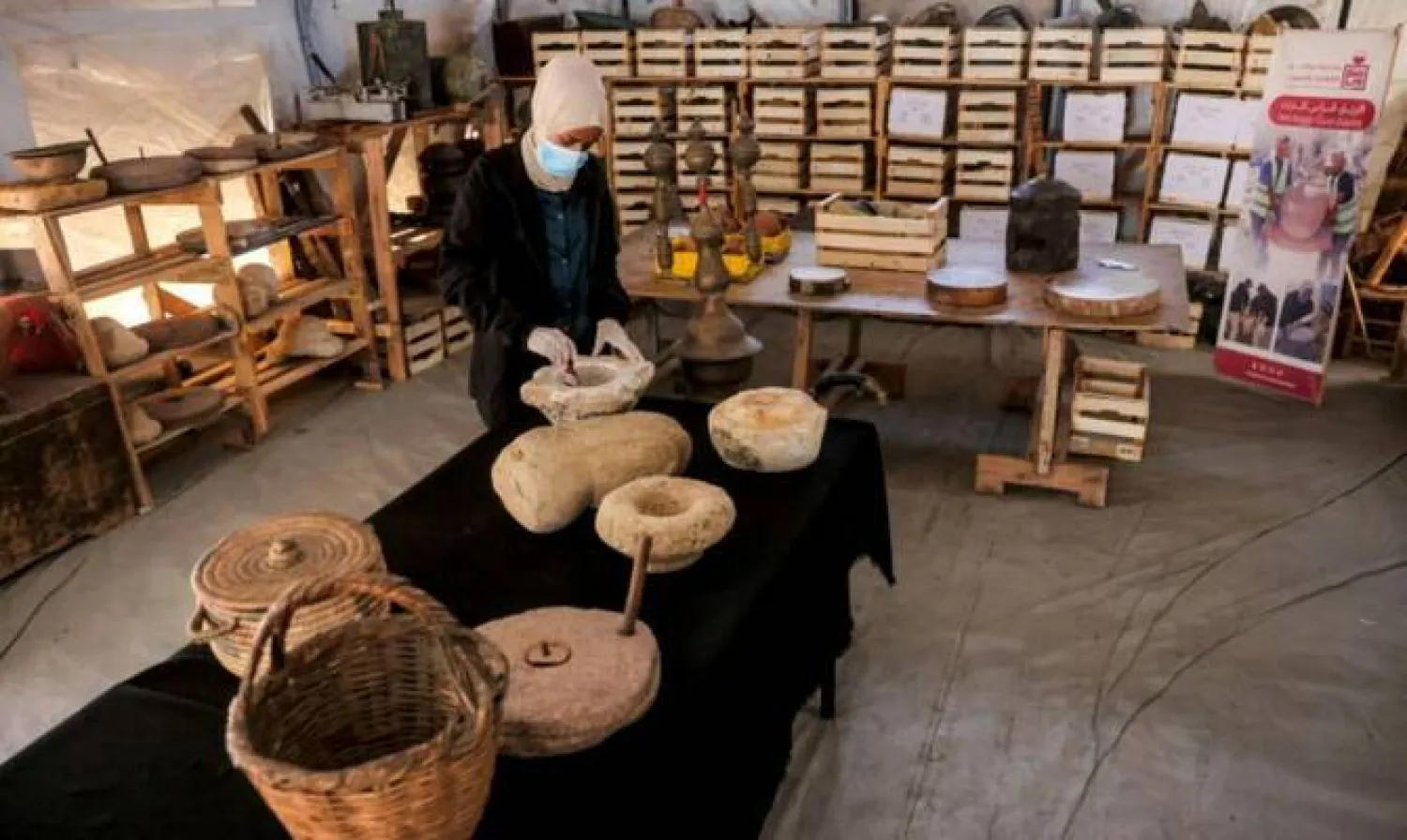
Palestinian curators working to restore ancient artifacts amid the ruins of war-devastated Gaza. (AFP)
TT

Saving Gaza's Past, One Artifact at a Time

Palestinian curators working to restore ancient artifacts amid the ruins of war-devastated Gaza. (AFP)

Armed with paintbrushes and wearing surgical gloves, volunteers inside a large tent in Gaza delicately brushed dust from a stone mosaic before placing it into storage, part of an effort to preserve cultural heritage hit by war.

More than 160 historic and cultural sites across the Palestinian territory have been damaged during the conflict between Israel and Hamas, according to the United Nations.

Many of these artifacts date back thousands of years.

"Several mosaic artworks have been lost or destroyed, either completely or partially," said Mohammed Abu Lahia, a Palestinian visual artist taking part in the preservation efforts in the south Gaza city of Khan Yunis.

"It is important that we work to revive this art, remind our children and our community, and send a message to the world that we are committed to our heritage and our Palestinian cause."

Beyond archaeological treasures, more recent cultural artifacts are also at risk of being damaged or buried beneath rubble from shelling and airstrikes.

More than 90 percent of Gaza's buildings have been damaged or destroyed during the conflict, according to the UN.

Over the centuries, Persians, Greeks, Romans, Byzantines and Ottomans all left their mark on Gaza, creating a rich historical landscape of churches, mosques, ports and artifacts, many of which have suffered damage during the conflict.

"This stone is a piece called a mortar, and it was used for grinding grains and herbs. It is approximately 5,000 years old," said Muhannad Abu Lahia, a cultural heritage guide with the Mayasem Association for Culture and Arts, the NGO leading the preservation efforts.

Behind him, artifacts already catalogued for safekeeping were stacked on wooden shelves inside weatherproof plastic containers.

- Preserving the past -

With Israel maintaining tight controls over goods entering the Gaza Strip -- restrictions that have at times contributed to severe shortages of food and other supplies -- volunteers have had to work without professional conservation equipment.

Instead, they gently removed dust from mosaics using ordinary paintbrushes and built a makeshift scanning station by mounting a camera above a box lined with black craft paper.

The improvised scanner allowed volunteers to digitize old photographs and paper documents, which were then uploaded to a computer for preservation.

Not everything entering storage is ancient.

Many items date from the 20th century, including the late Ottoman period, the British Mandate and the Egyptian administration. Their owners sought to save them from destruction or loss after being displaced.

"This is a paper archive containing maps of Khan Yunis and structural maps of the Khan Yunis area from the time of the British Mandate," said 29-year-old volunteer Taghreed Hajjari.

At one table, three women painstakingly rearranged hundreds of fragments to recreate a contemporary mosaic, using a printed copy of the original artwork as a guide and trimming excess stone with carpenter's pincers.

Many artifacts, however, remain beyond the so-called "Yellow Line", which separates territory under Hamas control from areas held by the Israeli forces.

Israel says it now controls more than 60 percent of the Gaza Strip, up from about half when the ceasefire took effect in October last year.

Volunteers say retrieving artifacts from Israeli-controlled areas remains extremely difficult.

Meanwhile, Hajjari said efforts continue to preserve everything still within reach, including documents that chronicle centuries of Gaza's history.

"We also have newspapers and documents here from the British Mandate and the Egyptian era until the arrival of the Palestinian Authority," she said.

"They were collected through visits and conversations with elderly residents.

"We documented their oral histories so they can serve as a reference for future generations."


Riyadh to Host Security and History Dialogue Conference in September

File photo of the Saudi flag/AAWSAT
TT

Riyadh to Host Security and History Dialogue Conference in September

File photo of the Saudi flag/AAWSAT

Under the patronage of Minister of Interior Prince Abdulaziz bin Saud bin Naif bin Abdulaziz, the Ministry of Interior will organize the Security and History Dialogue Conference in Riyadh from September 6 to 8, 2026, with the participation of experts, researchers, and academics from Saudi Arabia and abroad.

The conference organizing committee said the event serves as a national platform for exploring the Kingdom’s history through the lens of security and development, aiming to deepen awareness of the Kingdom’s journey, strengthen national identity, and produce documented knowledge for researchers and future generations, SPA reported.

The conference will feature more than 50 dialogue and interactive sessions, with over 160 experts and specialists and more than 30 partner organizations.

Discussions will cover the Saudi state’s history and its security, developmental, economic, social, and cultural dimensions, as well as national identity, international relations, the development of security institutions, and the role of security in supporting investment and quality of life.


From the Louvre to AlUla: How Culture Built a Strategic Bridge Between Riyadh and Paris

Saudi Arabia and France boosted their culture cooperation through nine executive programs signed during President Emmanuel Macron’s visit to the Kingdom in December 2024. (SPA)
TT

From the Louvre to AlUla: How Culture Built a Strategic Bridge Between Riyadh and Paris

Saudi Arabia and France boosted their culture cooperation through nine executive programs signed during President Emmanuel Macron’s visit to the Kingdom in December 2024. (SPA)

When Saudi artifacts were exhibited at the Louvre Museum, the Saudi-French relationship had not yet reached its current breadth. At the time, culture was a window through which the French could discover the Kingdom's history, while Riyadh was testing a new avenue to introduce its heritage beyond its borders.

More than a decade and a half later, the landscape has changed. Culture has become one of the foundational components of the Saudi-French relationship, and AlUla has turned into one of the clearest examples of this cooperation.

Meanwhile, cinema, museums, heritage, tourism, sports, and major events have entered the network of interests linking the two nations.

The visit by Prince Mohammed bin Salman, Saudi Crown Prince and Prime Minister, to France comes at a time when these fields have become part of the Kingdom's new economy, rather than merely a cultural activity running parallel to political relations.

AlUla: When culture becomes an economic project

In AlUla, antiquities intersect with tourism, engineering with the environment, and arts with the economy. The Saudi-French partnership in the governorate has expanded the scope of cooperation to encompass urban planning, heritage, tourism, culture, education, training, and the arts, presenting a model that differs from the traditional relationship between an investing nation and foreign companies.

The project is not limited to developing a historical site, but is rather based on building a global destination that rests on local identity and benefits from international expertise.

This type of cooperation aligns directly with the goals of Saudi Vision 2030 to transform culture, tourism, and entertainment into active components of the economy.

A journey that began at the Louvre

AlUla was not the beginning; in 2010, the Louvre Museum hosted the "Roads of Arabia. Archaeology and History of the Kingdom of Saudi Arabia" exhibition, marking a milestone that reflected growing French interest in Saudi history. This was preceded by another exhibition in Paris in 1986, while the UNESCO headquarters in Paris hosted the Saudi Cultural Days events in 2012.

These milestones reveal a long trajectory in which the cultural relationship has shifted from introducing Saudi Arabia abroad to building joint projects within the Kingdom itself.

Culture and the economy come together

The most significant change is that culture is no longer a sector isolated from the economy. Tourism requires transport, hospitality, and technology; museums require engineering, operation, and education; and major events require sports, media, and digital services. Consequently, culture has become part of an interconnected economic system.

This is evident in the expanding scope of potential cooperation between the two countries to include tourism, hospitality, the creative economy, electronic gaming, and sports - sectors that align with the Kingdom’s direction toward building a more diversified economy.

Sports: A new opportunity for partnership

Sports give the relationship an added dimension. France's hosting of events related to the Esports World Cup, coinciding with the Crown Prince's visit, offers an example of the shift of sports from a space of competition to a space for economic and cultural rapprochement.

Saudi sports itself has become a global industry attracting investments, talents, and events, while France possesses extensive experience in organizing tournaments and major events.

Interests intersect here just as they do in culture and tourism: Saudi Arabia provides a growing market, projects, and capital, while France provides long-standing industrial, organizational, and cultural expertise.

Education: The least visible, longest-lasting investment

The exchange is not limited to projects; cooperation between universities, research centers, and educational institutions in both countries opens a different path for knowledge transfer and human capital development.

The importance of this track is evident in the sectors where the Kingdom aims to expand, particularly science, technology, innovation, health, and engineering.

While projects can be built within a few years, the talent that manages them can create an impact that lasts for decades.

Partnership and different experiences

The Saudi experience differs from the French one in many details, but this very difference creates space for cooperation.

France possesses a long history in culture, museums, arts, and creative industries, while Saudi Arabia is experiencing a vast transformation which it is reshaping its culture, tourism, entertainment, and sports sectors.

Therefore, the new partnership is not based on transferring a ready-made model from Paris to Riyadh, but rather on blending French expertise with the new Saudi project. This is what makes culture in the relations between the two countries more than a "soft file"; it is one of the tools through which to build a new economy, introduce peoples to one another, and forge shared interests that are not easily affected by changing political files.

Past to future

For nearly a century, Saudi-French relations have progressed through multiple stages: from the initial diplomatic representation to the historic meeting between King Faisal and de Gaulle, followed by expansion into the economy and defense, culminating in a new vision for partnership during the reign of Custodian of the Two Holy Mosques King Salman bin Abdulaziz.

Today, Riyadh does not go to Paris merely to speak of the past, but rather of a future city, a new museum, a tourist destination, an advanced creative and technological industry, an energy project, and a long-term investment.

Within this transformation lies one of the clearest characteristics of the Saudi-French relationship: the bridge that began with culture now carries the economy, politics, and technology along with it.


Saudi Heritage Commission, University of Vienna Study Reveals Pottery Production Identity in Arabia 3,600 Years Ago

Saudi Heritage Commission, University of Vienna Study Reveals Pottery Production Identity in Arabia 3,600 Years Ago
TT

Saudi Heritage Commission, University of Vienna Study Reveals Pottery Production Identity in Arabia 3,600 Years Ago

Saudi Heritage Commission, University of Vienna Study Reveals Pottery Production Identity in Arabia 3,600 Years Ago

The Saudi Heritage Commission, in collaboration with the University of Vienna, has conducted a new international scientific study revealing evidence that specialized production systems emerged in the oases of northwestern Arabia during the Bronze Age.

The findings point to an early form of production identity, offering new insights into the history of trade and innovation in the Arabian Peninsula more than 3,500 years ago, the Saudi Press Agency said on Thursday.

Published in PLOS One, the study drew on archaeological excavations at the oasis of Qurayyah in Tabuk Region.

It found that the two-color pottery discovered at the site was produced through a consistent manufacturing tradition characterized by stable features. These characteristics helped the products spread widely, reflecting a clear production identity associated with both product quality and origin.

The study involved an international team of researchers from the Massachusetts Institute of Technology, Harvard Museum of the Ancient Near East, the Austrian Archaeological Institute, the Austrian Academy of Sciences, TU Wien, and the University of Sydney.

The research partnership sought to employ advanced technologies to study and analyze archaeological finds.

The researchers conducted advanced archaeological and laboratory analyses of a collection of pottery vessels unearthed at the oasis of Qurayyah. The findings helped revise earlier assumptions about what was known as “Midianite Pottery,” suggesting that this pottery type may have originated in the oasis in northwestern Arabia.

The results showed that the earliest painted pottery at Qurayyah dates to around 3,600 years ago, with production peaking around 3,200 years ago.

The pottery spread across areas extending north to the southern Levant and Egypt and south to northern Arabia. Production continued until the end of the Iron Age in the mid-first millennium BCE.

The study underscores the historical importance of the oasis of Qurayyah as a major production center in northwestern Arabia during ancient times.

It also highlights the Heritage Commission’s role in supporting archaeological research, strengthening international scientific partnerships, and using research to deepen knowledge of Saudi Arabia’s history and showcase its cultural heritage globally.
