


Mount Olympus, Home of Ancient Greek Gods, is a Candidate for UNESCO World Heritage List

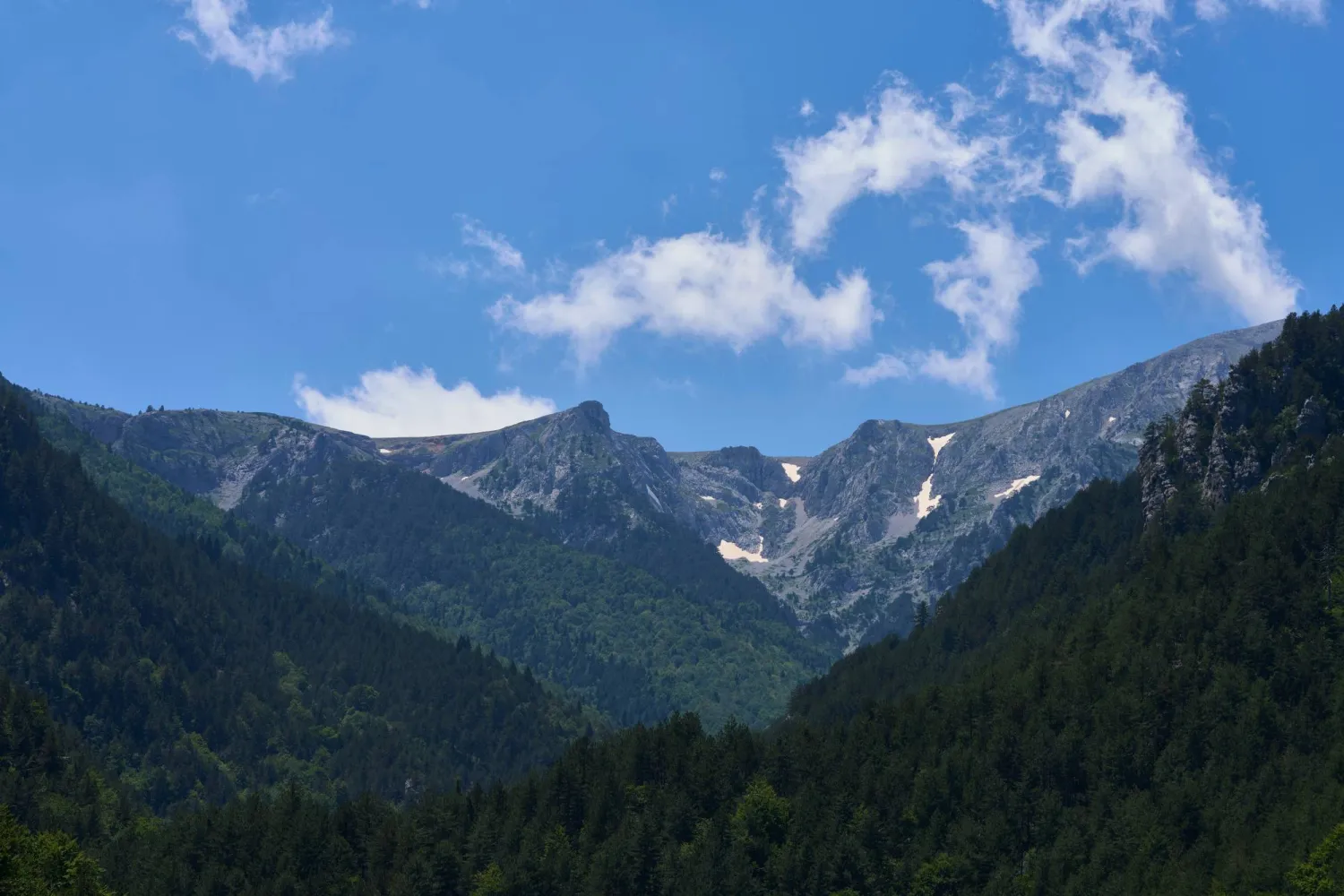
Snow patches remain on the upper slopes of Mount Olympus in northern Greece, Tuesday, July 14, 2026. (AP Photo/Petros Giannakouris)
TT

Mount Olympus, Home of Ancient Greek Gods, is a Candidate for UNESCO World Heritage List

Snow patches remain on the upper slopes of Mount Olympus in northern Greece, Tuesday, July 14, 2026. (AP Photo/Petros Giannakouris)

Snow-capped for much of the year, Mount Olympus, mythological home of ancient Greece’s 12 Olympian gods, has captured the imagination through the millennia. Rising to 2,918 meters (9,573 feet) from a base practically at sea level, the ancient Greeks believed the throne of Zeus, king of the gods, stood on the highest of its craggy, often mist-shrouded peaks.

Now, modern-day Greeks hope their tallest mountain will be inducted into UNESCO’s World Heritage List as a mixed cultural and natural site. The nomination is to be discussed when the World Heritage Committee meets in Busan, South Korea from Sunday through July 29.

“Olympus is our life. It is the place we grew up in,” said Evagelos Geroliolios, mayor of Dion-Olympus, based in Litochoro, the mountain’s main town. “It is the place we see every day, but at the same time, it is also a place which carries with it myth, history, biodiversity, extraordinary beauty and a very great cultural weight.”

Few locations are as central to ancient Greek mythology as Mount Olympus. It was here that Zeus was said to have established his court after overthrowing his father, Cronus, in a 10-year war that ended the reign of the Titans.

Interest in Olympus may receive another boost with the theatrical release this week of Christopher Nolan’s “The Odyssey,” a new adaptation of Homer’s epic, in which the mountain serves as the home of Zeus and the Olympian gods who influence Odysseus’ journey.

On one of Olympus’s lower peaks, excavations have uncovered an open-air sanctuary, with the oldest finds dating to the Hellenistic period, which ran from 323 B.C. to 30 B.C. According to Greece’s original UNESCO nomination, the sanctuary is believed to have been one mentioned by the ancient philosopher and historian Plutarch, who in the 2nd century wrote of processions to one of Olympus’s peaks for animal sacrifices to Zeus.

The mountain retained religious significance into the Christian era. Α chapel on the peak of Prophet Elias, at 2,803 meters, is believed to be the highest altitude chapel in the Christian Orthodox world. The mountain’s Enipeas Gorge holds the remains of a monastery founded in 1542, while a roughly 20-minute walk from there leads to the Holy Cave of St. Dionysios, a chapel built into a cave from where a small spring flows, believed to carry holy water.

The mountain’s slopes, which reach practically to the sea, also host a wealth of flora and fauna, including endemic species. It is this blending of culture, myth, natural beauty and biodiversity that locals hope will see their mountain declared a World Heritage site, The Associated Press reported.
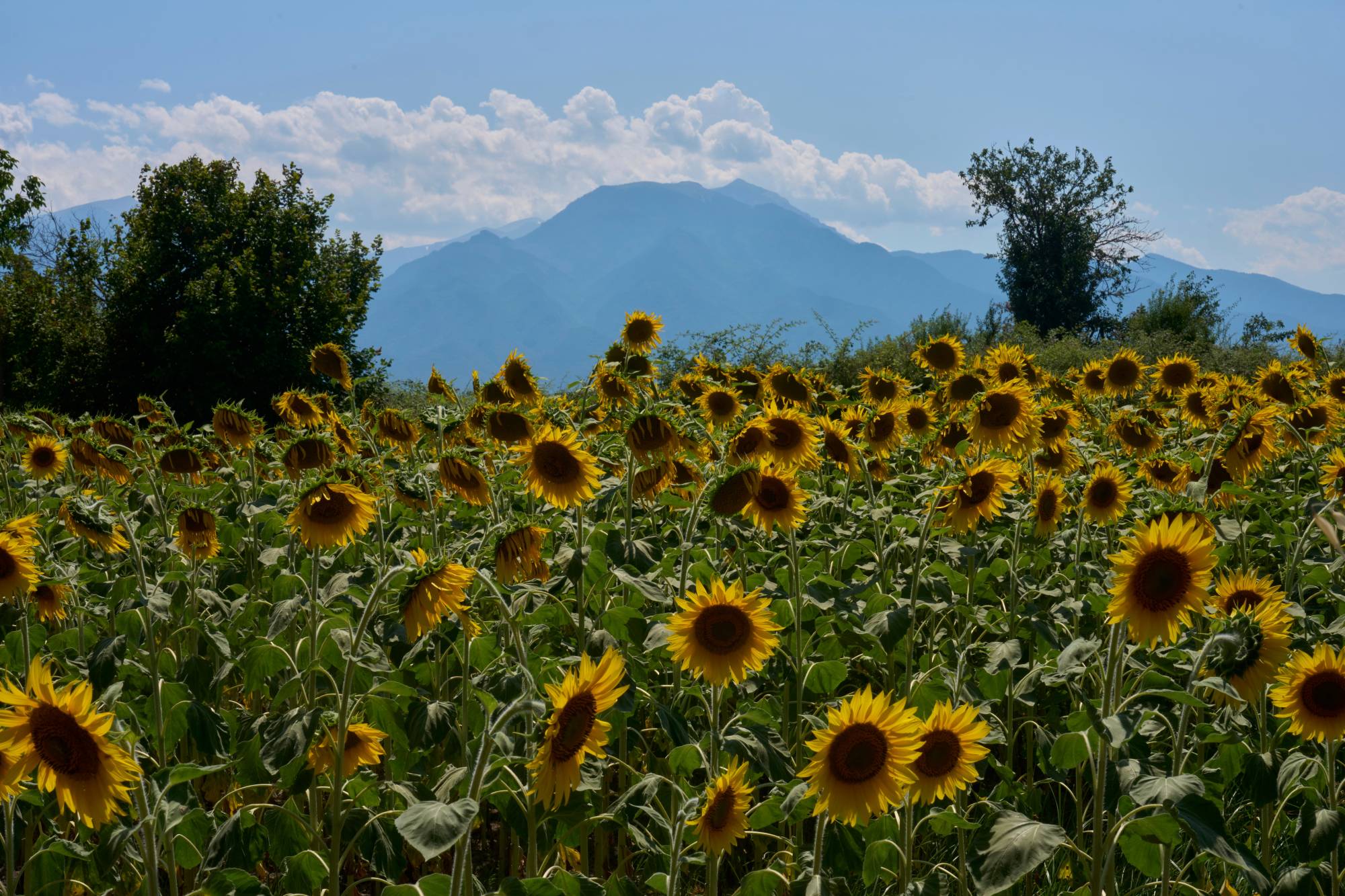
Sunflowers bloom in Kalyvia Varikou, near Litochoro in northern Greece, backdropped by Mount Olympus, Wednesday, July 15, 2026. (AP Photo/Petros Giannakouris)

“It is a place we love. It is a place that many people from all over the world visit to see, to live, to experience. We want to protect it,” Geroliolios said. Its inclusion on UNESCO’s list would be “something very big that goes beyond not just local boundaries, but national boundaries. It is something that concerns the entire world. It is very important.”

Greece began the process to have Mount Olympus recognized as a World Heritage site in 2014, inscribing it on its Tentative List — the mandatory first step in any nomination. The Tentative List is where countries include sites they can then formally nominate over the next five to 10 years.

The nomination process includes a preliminary assessment followed by submission of a full nomination file, which is then evaluated over 14 months by advisory bodies, including the International Council on Monuments and Sites, ICOMOS, and the International Union for Conservation of Nature.

Recommendations by the advisory bodies are then discussed during the World Heritage Committee’s annual meeting, where representatives of 21 countries vote on nominated sites.

Greece's Mount Olympus nomination is far from certain. A draft of the Busan meeting's agenda indicates the committee will refer the nomination back to Greece and request further details.
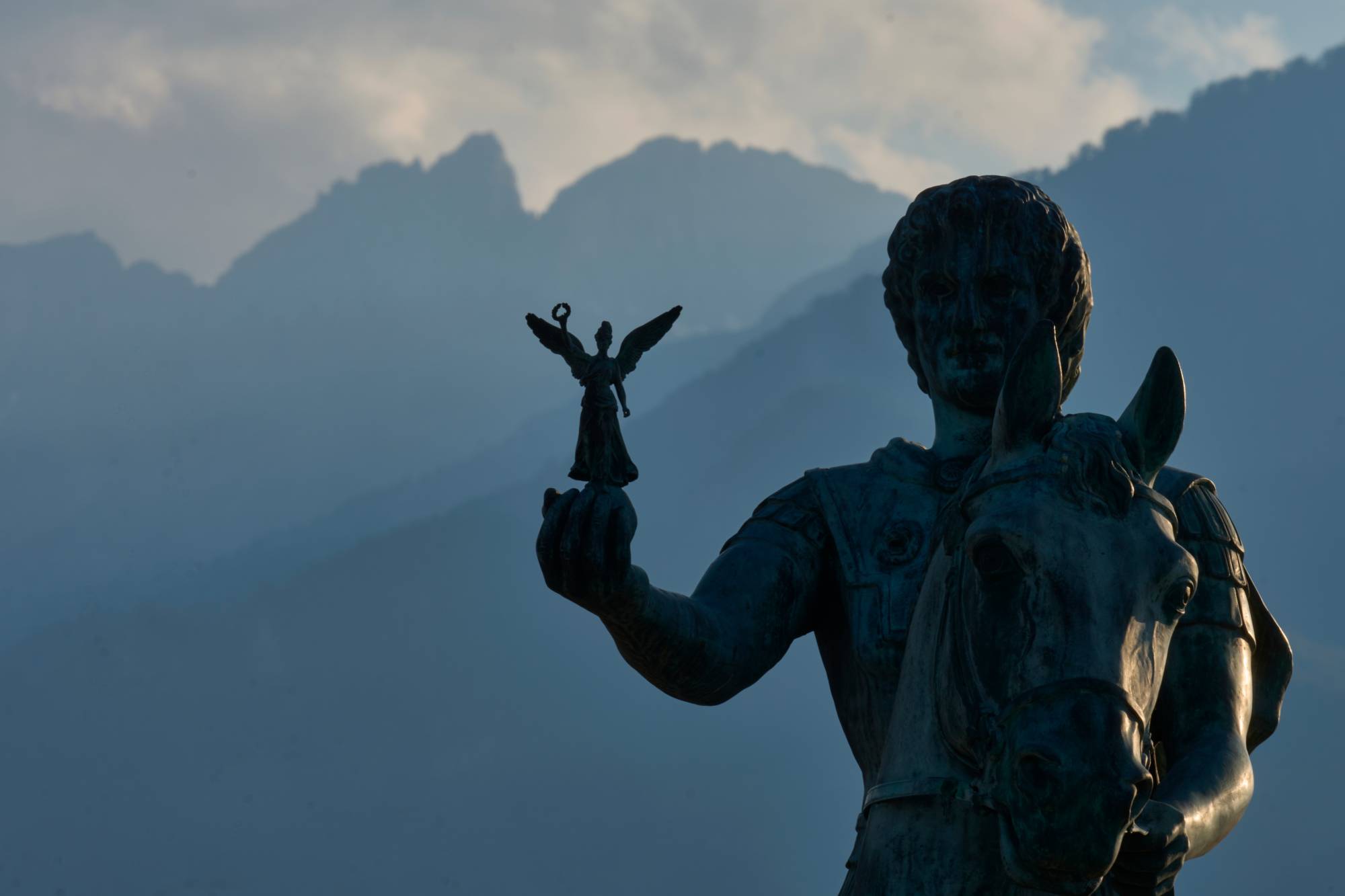
A statue of Alexander the Great holding Nike, the Greek goddess of victory, stands near Litochoro in northern Greece, Tuesday, July 14, 2026, backdropped by Mount Olympus' highest peaks, Mytikas and Stefani. (AP Photo/Petros Giannakouris)

Still, locals hope the mountain’s cultural and natural wonders will secure it a place and will play a role in securing more protection for the mountain.

The need for protection The mayor, Geroliolios, said inclusion on the World Heritage list “places some greater obligations on our part to protect this environment.”

Environmental protection is also foremost in the mind of mountain guide Babis Marinidis, president of the Alpine Club of Litochoro.

Including Olympus on UNESCO’s World Heritage list would likely attract more people to the mountain and the surrounding area, Marinidis said. “How many people can this mountain, this ecosystem, bear?” he asked.

Although much of Olympus was designated a national park decades ago and there are regulations in place, many are openly flouted, with Marinidis saying visitors regularly ignore “no swimming” or “no camping” signs.

The ever-growing number of visitors had led local authorities to consider imposing entrance fees and registering visitor numbers. “I used to be against that,” Marinidis said. “But now with so many people, I believe some limit must be imposed.”


Italian Police Recover Stolen Renoir, Cezanne and Matisse Worth 9 mn Euros

Carabinieri officers pose with three paintings by Paul Cezanne, Henri Matisse and Pierre-Auguste Renoir recovered after they were stolen from the Magnani Rocca Foundation in Mamiano, Italy, in this handout image released on August 14, 2026. Carabinieri/Handout via REUTERS
TT

Italian Police Recover Stolen Renoir, Cezanne and Matisse Worth 9 mn Euros

Carabinieri officers pose with three paintings by Paul Cezanne, Henri Matisse and Pierre-Auguste Renoir recovered after they were stolen from the Magnani Rocca Foundation in Mamiano, Italy, in this handout image released on August 14, 2026. Carabinieri/Handout via REUTERS

Paintings by Renoir, Cezanne and Matisse worth over nine million euros which were stolen from a museum in Italy in March have been recovered, Italian police said Friday.

The paintings were taken by masked thieves from the villa of the Magnani Rocca Foundation, near Parma in northern Italy, in a heist that lasted under three minutes.

Video footage released by the police showed two thieves wearing headlamps and with their faces covered entering the villa by breaking through a window, Reuters reported.

They headed straight into the room where the three paintings hung and took them off the wall, before heading back to the window and passing them through to an accomplice waiting outside.

They made off with "Fish" by Auguste Renoir, "Still Life with Cherries" by Paul Cezanne, and "Odalisque on the Terrace" by Henri Matisse.

The Renoir is worth six million euros, the Cezanne three million and the Matisse some 20,000 euros, police said.

The Magnani Rocca Foundation -- 20 kilometres (12 miles) from Parma -- houses the collection of art historian Luigi Magnani, which also includes works by Durer, Rubens, Van Dyck, Goya and Monet.

The theft is the latest in a series of robberies targeting major museums in Europe.

Last October, thieves broke into the Louvre in Paris -- the most visited museum in the world -- in broad daylight, escaping in less than eight minutes with jewellery worth $102 million.


Brazilian Police Recover Matisse Works Stolen in 2025

This handout picture released on August 13, 2026, by the Sao Paulo police press office shows eight recovered works by French artist Henri Matisse that had been stolen in December 2025 in Sao Paulo. (Photo by Handout / SAO PAULO'S POLICE PRESS OFFICE / AFP)
TT

Brazilian Police Recover Matisse Works Stolen in 2025

This handout picture released on August 13, 2026, by the Sao Paulo police press office shows eight recovered works by French artist Henri Matisse that had been stolen in December 2025 in Sao Paulo. (Photo by Handout / SAO PAULO'S POLICE PRESS OFFICE / AFP)

Police in Brazil have recovered eight engravings by French artist Henri Matisse that were stolen from a Sao Paulo library last year by an organized gang of thieves, officials said on Thursday.

Vividly colored artwork from Matisse's limited-edition art book "Jazz" were laid out on a table alongside a handgun, in an image released by police.

The works, estimated to be worth $200,000, were found at a home in the town of Sao Bernardo do Campo, near Sao Paulo.

Officers arrested a man who was keeping the works for the mastermind of the heist, police said, adding that he will face charges of receiving stolen goods and illegal weapon possession.

The alleged mastermind was apprehended in April and a woman has also been arrested in the case.

According to AFP, police said the gang behind the robbery was highly organized and structured, with specific tasks assigned to members as it stole artworks in Brazil and sold them on the black market.

In the Matisse robbery last year, police say thieves overpowered a security guard and an elderly couple visiting the Mario de Andrade Library, grabbed the engravings and other items from a glass dome where they were kept, and fled.

They also stole five works by the Brazilian artist Candido Portinari, but these have not been recovered and may have already been sold.

One of the suspects was arrested the day after the theft via the use of the city's facial recognition system.

As part of the investigation, police conducted operations targeting "establishments related to the auction market and the sale of artworks" in municipalities such as Sao Paulo and Rio de Janeiro.

The Matisse engravings were part of a modern art exhibition highlighting a collaboration between the library and the Museum of Modern Art of Sao Paulo.

"Jazz" was published in France in 1947 and there are 250 copies signed by the artist, according to auction house Christie's.


Spain Removes Remains of 11th Century Kings from Monastery as Wildfire Rages

This screen grab of a handout video taken and released by Spain's Military Emergencies Unit (UME) shows firefighters taking away a painting amid a wildfire threatening San Juan de la Pena Monastery in Penas de Riglos in the Spanish southwestern province of Aragon, on August 13, 2026. (Photo by Handout / UME / AFP)
TT

Spain Removes Remains of 11th Century Kings from Monastery as Wildfire Rages

This screen grab of a handout video taken and released by Spain's Military Emergencies Unit (UME) shows firefighters taking away a painting amid a wildfire threatening San Juan de la Pena Monastery in Penas de Riglos in the Spanish southwestern province of Aragon, on August 13, 2026. (Photo by Handout / UME / AFP)

Spanish authorities on Thursday removed the remains of three kings who ruled the Aragón region in the 11th century from a monastery threatened by a wildfire.

Their remains were taken to the provincial museum of Huesca, located 80 km (50 miles) south of the monastery, for their protection until conditions improve, said the northeastern region's vice-president Mar Vaquero.

After the wildfire that had been raging since Monday began moving toward the 10th century San Juan ⁠de la Peña ⁠monastery late on Thursday, concern that it could be engulfed by flames prompted authorities to launch a rescue operation, Vaquero told reporters.

An emergency military unit team managed to enter the monastery, located in a mountain range, and ⁠take ceremonial clothing belonging to an 18th century count buried there, before the proximity of the flames forced them to flee.

A Spanish firefighter and local officials carry boxes containing remains of the first kings of Aragon after their removal from a monastery that is being threatened by a wildfire in San Juan de la Pena, Spain, August 13, 2026. Spanish Military Emergency Unit/Handout via REUTERS

The team returned a second time, accompanied by police officers and heritage officials, and removed the remains of the first three kings of Aragón — who ruled between 1035 and 1104 — from a pantheon within the monastery, as well as some historical paintings.

Vaquero praised ⁠the bravery ⁠of the rescue team, Reuters reported.

The wildfire had intensified earlier on Thursday, fueled by higher temperatures and strong winds. It has burned more than 9,000 hectares and forced the evacuation of 16 towns, although the monastery remained unharmed on Friday morning.

In southern Spain, a much larger wildfire also worsened on Thursday. It has so far burned 31,000 hectares in the province of Huelva and forced the evacuation of around 700 people.