Self-taught Turkish 'Linguist' Keeps Dead Language Alive

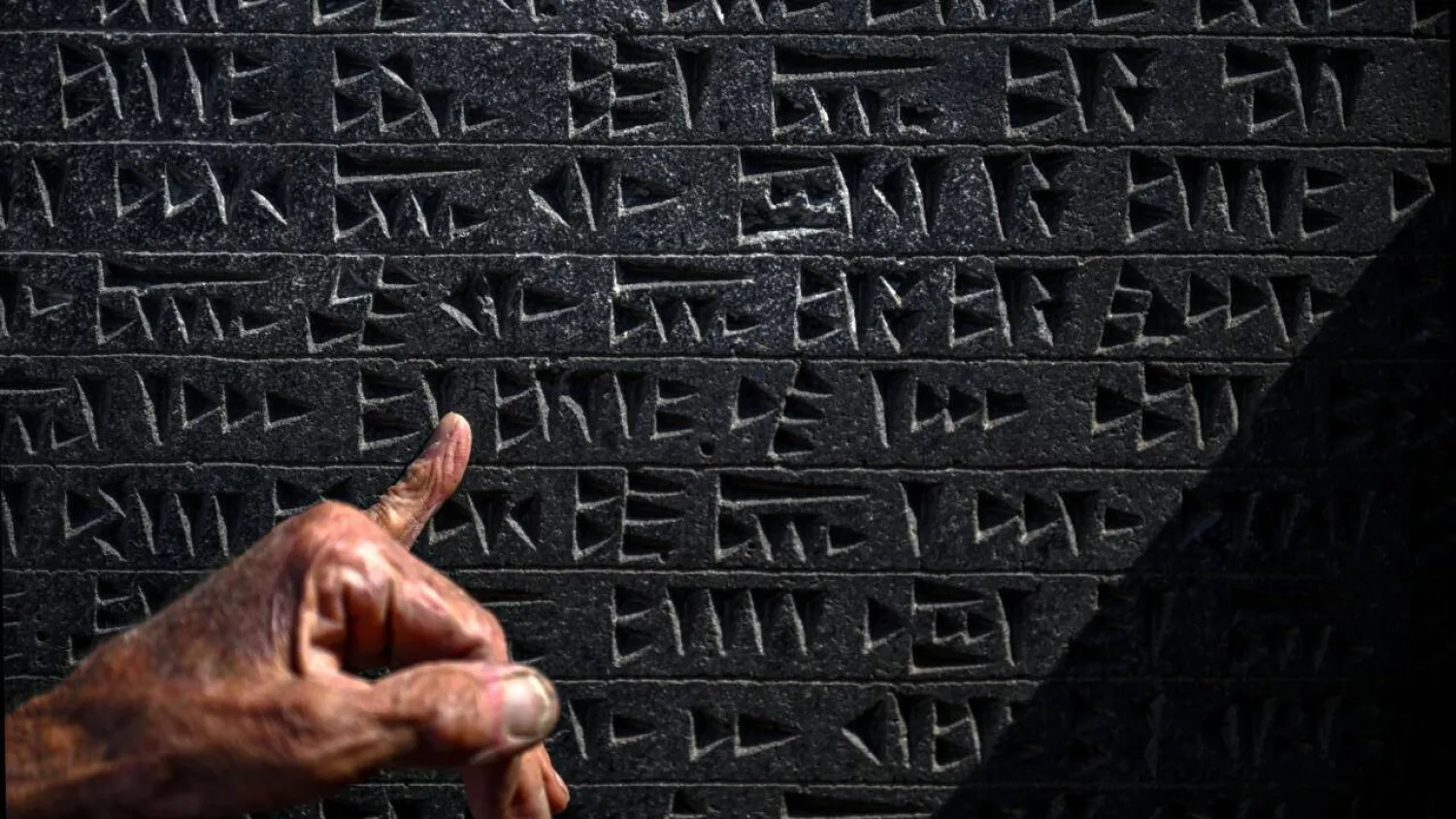
Kusman runs his finger over a tablet engraved with the ancient Urartu language. Ozan KOSE / AFP
TT

Self-taught Turkish 'Linguist' Keeps Dead Language Alive

Kusman runs his finger over a tablet engraved with the ancient Urartu language. Ozan KOSE / AFP

Mehmet Kusman did not spend very long at school, but he traced the ancient inscriptions chiseled into the black basalt rock and read: "Before me there was nothing. But by the power of the god Haldi I founded this city."

Kusman, 86, has dedicated his life to the fortress of Cavustepe in eastern Türkiye, and to learning the language of the vanished kingdom of Urartu, to honor its forgotten gods and rulers.

Brisk of step and sharp of mind despite his years and the hot winds that whip the castle, he stood at the foundations of a temple dedicated to Haldi. Kusman wore a cap bought in Los Angeles on which he has written "USA 2009" in the cuneiform script typical of the region's ancient civilizations.

Kusman was hired as a laborer on the Cavustepe excavations after his military service in the 1960s and there encountered his first stele.

"The inscription was very beautiful," he told AFP. But the head of the dig discouraged him from learning this "very difficult" script, which borrowed its cuneiform alphabet from Assyrian.

"His telling me 'No' hurt me," he said. "I became relentless, thinking: 'In my lifetime, I will learn it.'"

Despite a lack of formal education, Kusman began copying the inscriptions found during excavations carried out in eastern Türkiye, Iran and Armenia, over which Urartu once stretched.

In three years, he said, he mastered the alphabet, but "it took me 22 years to master 650 words" of vocabulary.

- One of the last -

Academics contacted by AFP praised Kusman's enthusiasm and devotion. He has become something of a local curiosity, calling himself "one of the last seven people in Türkiye to speak the Urartian language."

Erkan Konyar, professor of ancient history at Istanbul University, describes the kingdom as "one of the most powerful states of the ancient Near East, between the 9th and 7th centuries BC."

Urartu -- more recent than the great Mesopotamian kingdoms of Assyria, Sumeria and Babylon -- brought the tribal mountain communities together under a centralized state, building cities, fortresses, irrigation networks and vast food storage facilities, Konyar said.

Despite retiring in 2005, Kusman continues to watch over Cavustepe, said Konyar, a specialist on Tuspa, the kingdom's founding capital.

"For 60 years, he has lived amid the excavations and introduced thousands of visitors to the history of Urartu."

But Konyar is careful to qualify Kusman's claims to speak the language. In fact, historians do not really know how it was pronounced, he said.

"The available inscriptions allow us to understand it up to a certain point, but we lack vocabulary and texts," he said. "Only the meaning of certain words is known with certainty. So no one can claim to speak Urartian."

"Even in the time of Urartu, people did not speak this language; it was only written," said Mehmet Isikli, director of the Department of Near Eastern Archaeology at Ataturk University in Erzurum.

- 'Grandson of the Urartians' -

Kusman's passion for the language has made him a local celebrity. His lectures have taken him "to America, five times, to Germany, the Netherlands, Belgium," he said, reeling off the list with a touch of showmanship.

"Now, I'm thinking of going to Japan," he added.

Isikli is excavating the fortress of Ayanis, the last of the great strongholds built in the kingdom before it collapsed, 35 kilometers (22 miles) north of Van, with a commanding view of the lake.

"Our excavations may tell us something about the end of Urartu," he said, noting that researchers have found "the traces of a very powerful earthquake."

Isikli admits to a certain respect for the old guardian.

"I admire him," he added. "He has worked hard and brought Urartian culture to light.

"Mehmet Kusman provides a sort of publicity for Urartu, but it has nothing to do with academic work: he knows only a few alphabetical signs, or a few letters, and some very, very general information about them."

In his small stone hut at the entrance to the Cavustepe site, Kusman is undaunted by the doubters.

"I am a descendant of the Urartians, their grandson," he said. "They disappeared, but look, they are not all dead," he declared, as he stood to welcome visitors.


Saudi Visual Arts Commission Signs MoU with Cité Internationale des Arts in Paris to Strengthen Collaboration in Visual Arts

Saudi Visual Arts Commission Signs MoU with Cité Internationale des Arts in Paris to Strengthen Collaboration in Visual Arts
TT

Saudi Visual Arts Commission Signs MoU with Cité Internationale des Arts in Paris to Strengthen Collaboration in Visual Arts

Saudi Visual Arts Commission Signs MoU with Cité Internationale des Arts in Paris to Strengthen Collaboration in Visual Arts

The Saudi Visual Arts Commission has signed a memorandum of understanding with Cité Internationale des arts in Paris to strengthen collaboration, exchange expertise in the visual arts, and explore areas of cooperation that support artists and practitioners and broaden their access to artistic, cultural, and professional exchange.

Areas of collaboration include developing visual arts-related initiatives and residency programs, exploring opportunities to involve local and international artists and talent in programs organized by both parties, and supporting Saudi artists and expanding their opportunities to connect with the global art scene, SPA reported.

The two parties will also collaborate on organizing joint initiatives and exhibitions, exchanging expertise and knowledge, and engaging experts and professionals in mentorship, professional guidance, and talent development initiatives.

The MoU forms part of the commission’s efforts to support the visual arts ecosystem in Saudi Arabia, strengthen international cultural exchange and collaboration, and expand opportunities for artists and cultural practitioners to engage and develop professionally, in line with the objectives of Saudi Vision 2030 to support the growth of the cultural sector, empower practitioners, and enhance the Kingdom’s cultural presence internationally.


Pompeii’s Grandest House Gets a $1.6 Million Restoration Funded by Private Sponsor

 In this undated handout photo provided on Tuesday, Oct. 20, 2026, by the Pompeii Archaeological Park, restorers work inside the House of Marcus Fabius Rufus in Pompeii, near Naples, Italy. (Silvia Vacca/ Pompeii Archaeological Park via AP)
In this undated handout photo provided on Tuesday, Oct. 20, 2026, by the Pompeii Archaeological Park, restorers work inside the House of Marcus Fabius Rufus in Pompeii, near Naples, Italy. (Silvia Vacca/ Pompeii Archaeological Park via AP)
TT

Pompeii’s Grandest House Gets a $1.6 Million Restoration Funded by Private Sponsor

 In this undated handout photo provided on Tuesday, Oct. 20, 2026, by the Pompeii Archaeological Park, restorers work inside the House of Marcus Fabius Rufus in Pompeii, near Naples, Italy. (Silvia Vacca/ Pompeii Archaeological Park via AP)
In this undated handout photo provided on Tuesday, Oct. 20, 2026, by the Pompeii Archaeological Park, restorers work inside the House of Marcus Fabius Rufus in Pompeii, near Naples, Italy. (Silvia Vacca/ Pompeii Archaeological Park via AP)

An ancient residence believed to be the grandest in the Pompeii archaeological site is being restored with the entire 1.4 million euros ($1.6 million) cost being covered by a private sponsor, officials announced Tuesday.

The house of Marcus Fabius Rufus, modeled after Rome’s imperial palaces and buried in the eruption of Mt. Vesuvio that destroyed the ancient city in 79 A.D., has been inaccessible to the public since 1980. Originally built on Pompeii’s city walls, it features four floors connected by a maze of corridors and staircases.

Part of it is expected to open to guided groups by Christmas, officials for the Archeological Park of Pompeii said.

The renovation is being paid for by a German entrepreneur, Frank Hoefer, who contacted the archaeological park after reading superintendent Gabriel Zuchtriegel’s 2023 book: “Pompeii: The Enchanted City.”

“Restoring the spectacular residence of Marcus Fabius Rufus ... is a project I find exciting,” Hoefer said in a release. “I also have the impression that Pompeii is very open to innovative approaches to preservation and public access.”

Zuchtriegel said the goal is to expand such sponsorships.

“This does not mean that from tomorrow on if we had 50 such sponsors we would be able to abolish the entrance ticket, putting it at just a symbolic one-euro price, but it is a perspective towards which we have to work to develop the site,” Zuchtriegel said in a video statement.

Structural work was carried out on the house from 2021-2023, and current renovations are focused on the frescoes, including the famous Venus of Pompeii located in a chapel within the residence. The owner was believed to be a magistrate or a freedman of the imperial household.

Zuchtriegel said work was also being done to make the complex more accessible, and digital technology was being developed to help people grasp the “incredible labyrinth” that makes up the house.

“At times, you feel like you are in a 19th-century palace in Naples, yet this is a Roman house from 2,000 years ago,” Zuchtriegel said.


Saudi Arabia Named Guest of Honor at Algiers International Book Fair 2026

Saudi Arabia Named Guest of Honor at Algiers International Book Fair 2026
TT

Saudi Arabia Named Guest of Honor at Algiers International Book Fair 2026

Saudi Arabia Named Guest of Honor at Algiers International Book Fair 2026

Saudi Arabia will be the guest of honor at the Algiers International Book Fair 2026, taking place from October 28 to November 7 at the Palais des Expositions in Pins Maritimes. The Kingdom's participation aims to strengthen cultural exchange with Algeria.

Saudi Arabia's selection as guest of honor reflects the strong fraternal relations between the two countries and the rapid development of the Kingdom's cultural sector, supported by the Saudi leadership. These efforts have helped strengthen the global presence of Saudi culture and raise awareness of the Kingdom's cultural heritage.

The Literature, Publishing and Translation Commission will lead the Kingdom's participation in the fair, organizing a cultural program featuring seminars, panel discussions, and poetry evenings. The events will bring together a distinguished group of intellectuals, writers, and specialists. The program will also highlight Saudi Arabia's literary scene and the creative momentum across various cultural fields.

The Saudi pavilion will feature sections dedicated to handicrafts, traditional Saudi attire, and musical instruments, alongside an exhibition of manuscripts and archaeological replicas.

It will host performances of Saudi performing arts that reflect the depth of the Kingdom's cultural heritage, as well as screenings of Saudi films.

Several government entities, authorities, and cultural organizations will participate, presenting a comprehensive picture of cultural activity across various sectors in Saudi Arabia.

The pavilion is expected to offer an integrated cultural experience that reflects the richness and diversity of Saudi identity. It will showcase cultural achievements made under Saudi Vision 2030, which seeks to establish culture as a component of quality of life and a means of fostering cultural exchange among peoples.