


Istanbul Cymbals: From Ottoman Weapon of War to Pulse of Global Music

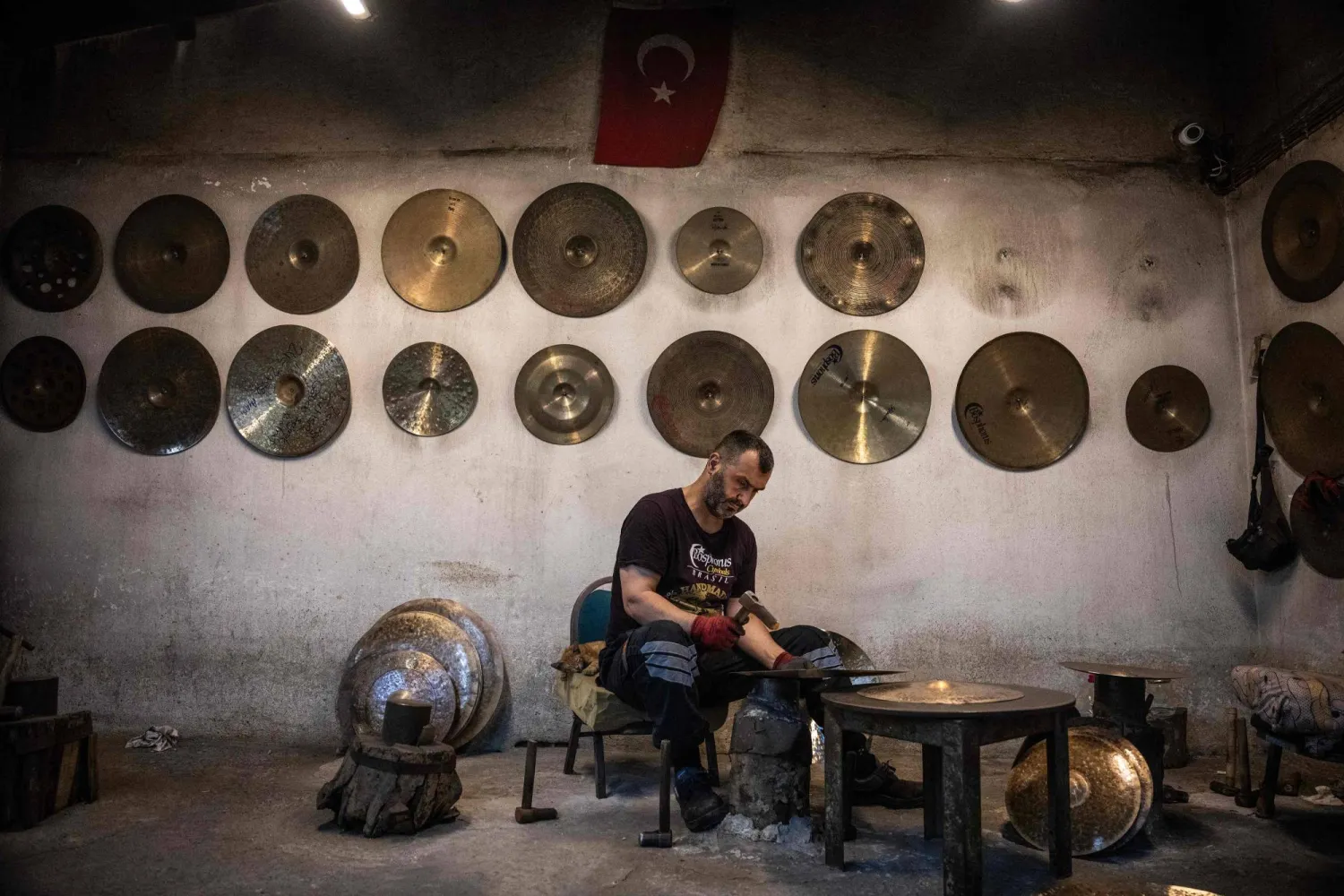
A worker hammers a cymbal at a workshop in Istanbul on July 30, 2026. (AFP)
TT

Istanbul Cymbals: From Ottoman Weapon of War to Pulse of Global Music

A worker hammers a cymbal at a workshop in Istanbul on July 30, 2026. (AFP)

The rhythmic clanging of hammers on bronze echoes through the Istanbul workshop where three craftsmen are landing blows with astonishing precision to transform featureless metal discs into highly prized handcrafted cymbals.

First used by Ottoman military "mehter" bands to frighten and demoralize the enemy, cymbals were a useful tool for an empire on the warpath.

But it would take the skill of a 17th-century Armenian alchemist called Avedis Zildjian to transform them into a percussion instrument whose exotic sound would first captivate Europe's classical composers and then shape the world of jazz.

Although cymbals existed long before Zildjian, he developed a unique alloy and special process for treating the metals that made them less fragile, winning plaudits in 1623 from the Ottoman sultan who let him set up a workshop.

"It's really hard to make good cymbals because they're consistently being crashed, so to make something that wasn't brittle which could withstand continuous use is quite an achievement," said ethnomusicologist Audrey Wozniak, who specializes in Turkish musical traditions.

The secret was passed down through the generations and although the original Zildjian operation left Istanbul for America in the dying days of the Ottoman Empire, others who learned from the Zildjian masters have continued the tradition.

Today, Istanbul remains the center of excellence for cymbals, where a handful of brands still produce hand-hammered bronze using techniques developed more than 400 years ago.

- 'A cymbal's soul' -

"We are producing 100-percent handmade cymbals with traditional methods, without using electricity or gas, only coal and wood," said Mehmet Ozturk, sales rep at Bosphorus Cymbals on Istanbul's northern outskirts, who said casting a cymbal takes up to a week.

First is the casting stage. Most cymbals are made of a copper and tin alloy that is melted into molten bronze which is poured into molds and cooled into disc-shaped blanks.

Moving swiftly, a worker using a long-handled peel places the blanks into the glowing furnace then removes others that are put through a rolling mill in a cycle repeated up to 15 times to compress and spread the metal which is then water tempered.

"Every stage is crucial," said master cymbalsmith Hasan Seker, a burly 56-year-old who co-founded Bosphorus Cymbals in 1996 and was sweating after hauling glowing blanks into and out of the furnace.

"We use copper and tin and one more ingredient which is secret. Even though it's in very small quantities, it gives the cymbal a different character in terms of consistency and sound," he told AFP.

After punching out the raised bell and cutting it to size, what looks like the now recognizable cymbal must undergo the all-important hammering process.

"Not a single blow is random," he said as a trio of craftsmen and their expert struck the cymbals to create the darker, more complex tones so prized by jazz drummers.

This is where a man's emotional state is poured into his work, said Seker, who began working in the trade aged 12 as a summer job.

"When someone is hammering, he might hit softly, then something comes to mind, he gets angry and hits harder. Those variations in the metal's surface, the reservations, the tension patterns diversify the sound. In a way, he gives the cymbal its soul."

Over the years, Seker has met countless grateful musicians, some of whom come on "a pilgrimage" to the workshop whose grubby walls are lined with ageing posters of jazz drummers like Jeff Hamilton, Stanton Moore and Ari Hoenig.

- 'Every one is different' -

Inside Nardis Jazz Club, a dimly lit venue with an intimate feel in the shadow of Istanbul's Galata Tower, a jazz trio is rehearsing ahead of an evening show with a singer.

For drummer Derin Bayhan, he would only ever use Istanbul-made cymbals because they're "100 percent handmade" and each one has a unique sound.

"Even if you bought two from the same series, the same weight and structure, the two cymbals wouldn't perfectly match. Because it's handmade, it's basically an adventure," the 42-year-old told AFP.

"So you search for one and when you find it, no one else will have it: that sound is yours."

As to why the Istanbul tradition remains so popular among jazz musicians despite the Zildjian family's move to America where they set up a factory, jazz historian Berk Ozler said it was the search for uniqueness.

"Mass production started when Zildjian went to the USA whereas the ones that stayed in Istanbul were handcrafted and still are. Jazz musicians chase after that uniqueness so that's why they are very valuable."




Red Sea Museum Concludes Six-Month 'Sunken Treasures' Exhibition

The galleries showcased underwater archaeological discoveries and Saudi Arabia's ongoing efforts to protect and document submerged cultural assets - SPA
TT

Red Sea Museum Concludes Six-Month 'Sunken Treasures' Exhibition

The galleries showcased underwater archaeological discoveries and Saudi Arabia's ongoing efforts to protect and document submerged cultural assets - SPA

The "Sunken Treasures: The Maritime Heritage of the Red Sea" exhibition concluded its six-month run at the Red Sea Museum in Historic Jeddah, offering visitors an educational journey into centuries of maritime trade, navigation, and pilgrimage.

Housed at the historic Bab Al-Bunt building since February 25, the exhibition highlighted the Red Sea's historical role as a vital trade artery connecting the Arabian Peninsula with the Mediterranean, Africa, and Asia.

Structured across four thematic zones, the galleries showcased underwater archaeological discoveries and Saudi Arabia's ongoing efforts to protect and document submerged cultural assets, SPA reported.

Among the exhibition's centerpiece displays was the 18th-century Umluj shipwreck, discovered submerged 20 to 22 meters deep amid coral reefs. Its recovered cargo—including commercial containers, pottery, coins, ceramics, and daily shipboard tools alongside antique navigational instruments and nautical maps—illustrated the vibrant human exchange that traversed regional waters.

Organized in collaboration with the Heritage Commission and the Historic Jeddah Program, the exhibition was also part of the summer season's cultural offerings, combining interactive public programming with scientific research to bolster cultural tourism and raise awareness of the Kingdom's underwater heritage.


Diriyah Art Futures Opens Second Edition of 'CONTINUUM' Exhibition

Diriyah Art Futures (DAF) launched its latest exhibition CONTINUUM ’26 on Thursday, showcasing the works of its second cohort of emerging artists and the program’s mentors. (SPA)
TT

Diriyah Art Futures Opens Second Edition of 'CONTINUUM' Exhibition

Diriyah Art Futures (DAF) launched its latest exhibition CONTINUUM ’26 on Thursday, showcasing the works of its second cohort of emerging artists and the program’s mentors. (SPA)

Diriyah Art Futures (DAF), the first center for New Media Arts in the Middle East and North Africa, launched its latest exhibition CONTINUUM ’26 on Thursday, showcasing the works of its second cohort of emerging artists and the program’s mentors.

Visitors explored a diverse range of cutting-edge technological media, including immersive and multimedia installations, light, sound, moving image, virtual reality, mixed reality, and AI-generated projects, the Saudi Press Agency reported.

CONTINUUM ’26 features artworks produced by 16 emerging artists and two mentors during DAF’s year-long Emerging New Media Artists Program. Curated by Irini Papadimitriou and Bushra Alghamdi, Assistant Curator, the exhibition explores questions surrounding memory, identity, place, belonging, repetition, and interspecies relationships.

Developed under the mentorship of artists Louis-Philippe Demers and Rick Treweek, the artworks explore the boundaries between the real and the artificial, human and artificial intelligence, the organic and synthetic.

Speaking at the exhibition launch, CEO of the Museums Commission Eng. Abdullah bin Abdulaziz Al-Hammad said: “Programs like the Emerging New Media Artists Program represent the long-term, deliberate investment needed to shape the future of the Kingdom's museum sector.

“By providing our artists with world-class facilities, mentorship, and the dedicated time to refine their craft, we are fueling innovation and sparking vital cultural conversations. CONTINUUM 26 brings a full year of that dedication into the public eye.”

The opening program kicked off with a panel conversation between exhibition artists Noel Apitta, Njood Albwardi, Badriya Alsalem, and Harpreet Sareen, in conversation with Bushra Alghamdi about the ideas behind their works in CONTINUUM '26.

The artists discussed the exhibition's themes – the power of artificial intelligence; memory and time; and embodied perception – exploring how each artist navigated their creative process and what questions drove them.

CONTINUUM ’26 is the second installment in a series of exhibitions at DAF, spotlighting diverse voices shaping the future of New Media Art in the region and beyond.

Developed in collaboration with Le Fresnoy – Studio national des arts contemporains in France, the Emerging New Media Artists Program gives emerging artists access to cutting-edge professional equipment and a production budget, as well as a wide range of multidisciplinary learning opportunities.

CONTINUUM ’26 is open to the public at Diriyah Art Futures and runs until November 7. The exhibition is accompanied by a public program of workshops, talks and other activities spanning AI, VR, digital photography, and much more.

Meet the Artists: an invitation to encounter the works of CONTINUUM '26 through the perspectives of the artists who made them. Over the opening weekend, artists will discuss the ideas and processes behind their works with visitors.


US Hands Over Ancient Sarcophagus Fragments to Lebanon

This New York City Police Department photo shows one of three ancient sarcophagi fragments that the FBI Art Crime Team returned to the government of Lebanon during a September 2, 2026, ceremony in New York. (New York City Police Department)
TT

US Hands Over Ancient Sarcophagus Fragments to Lebanon

This New York City Police Department photo shows one of three ancient sarcophagi fragments that the FBI Art Crime Team returned to the government of Lebanon during a September 2, 2026, ceremony in New York. (New York City Police Department)

The United States on Thursday announced the return of Roman-era sarcophagus fragments to Lebanon that were looted from the southern city of Tyre and recovered by an FBI investigation.

The decorative, lead fragments were returned to the Lebanese consulate in New York on Wednesday, ahead of their repatriation, the US embassy in Lebanon said.

The recovery "reflects the strong US-Lebanon partnership in the fight against illicit trafficking of cultural property", the embassy said.

Lebanese Culture Minister Ghassan Salame said the fragments "were unearthed in the Tyre area during illegal excavations".

"The fragments bear distinctive artistic, decorative and technical characteristics typical of workshops that produced lead sarcophagus in Tyre, which were among the city's active and prolific workshops in antiquity."

According to the FBI, the antiquities "were stolen from illicit excavations in or around Tyre and were exported outside of Lebanon's borders".

The trade in looted antiquities is widespread in the Middle East. New York, one of the world's art capitals, is home to many wealthy collectors, galleries, and auction houses.

In December 2017, three ancient artifacts were returned to Lebanon, including a bull's head of Greek origin that had been exhibited at the Met Gala, valued at $1.2 million.

Salame said the Tyre region "is exceptionally rich in archaeological heritage" and "has recently suffered severe destruction" due to heavy Israeli strikes during the latest war between Israel and Iran-backed Hezbollah.

UNESCO, the United Nations cultural agency, added Tyre to its World Heritage in Danger list in July.