


Athens Is Cleaning Its All-Marble Olympic Stadium for the First Time in More Than a Century

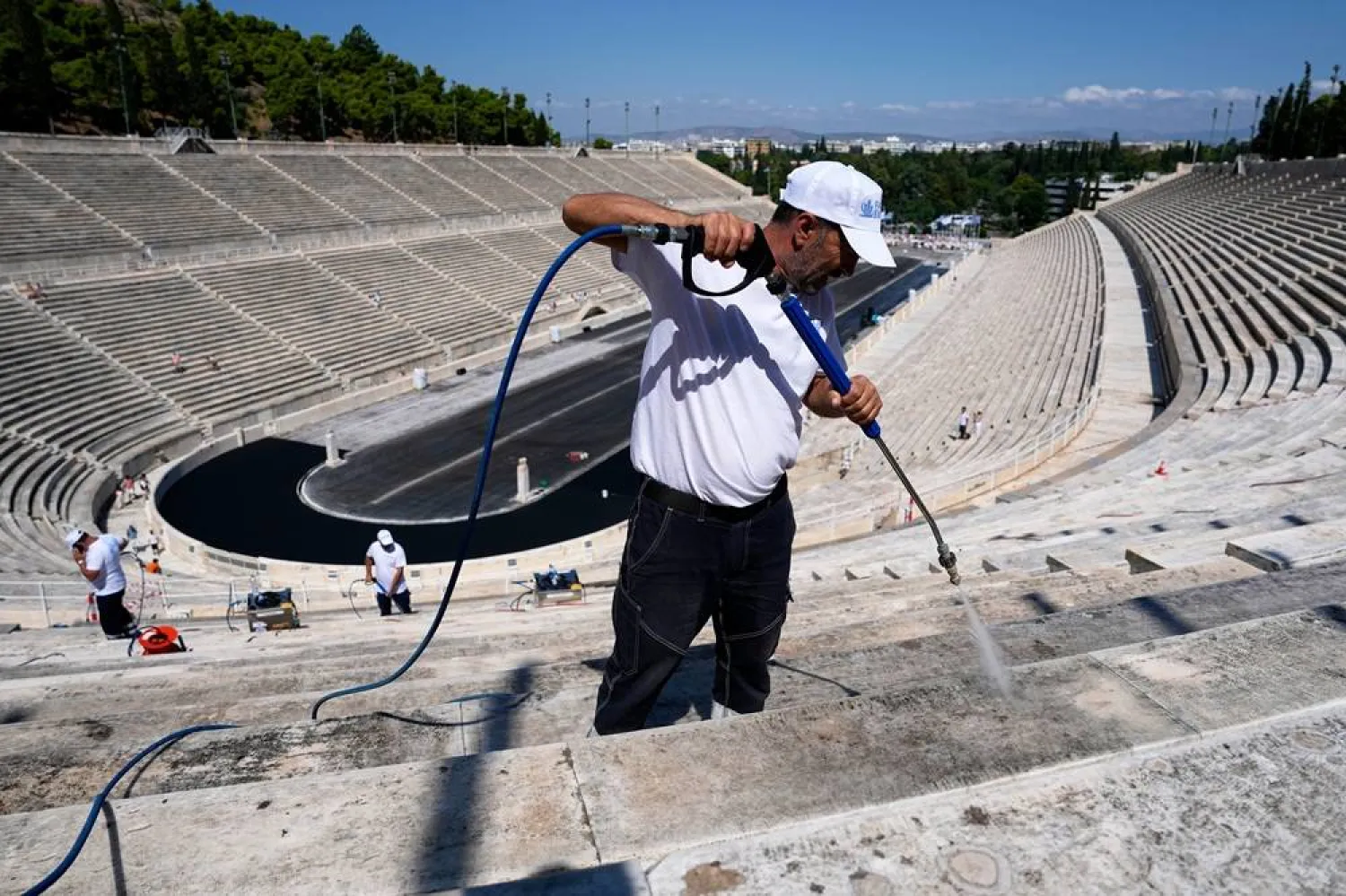
A worker cleans the marble surfaces of the Panathenaic Stadium, also known as "Kallimarmaro," or beautiful marble, which hosted the first modern Olympic Games in 1896, using a high-pressure water hose during renovation work in Athens, Greece, Thursday, Aug. 13, 2026. (AP Photo/Thanassis Stavrakis)
TT

Athens Is Cleaning Its All-Marble Olympic Stadium for the First Time in More Than a Century

A worker cleans the marble surfaces of the Panathenaic Stadium, also known as "Kallimarmaro," or beautiful marble, which hosted the first modern Olympic Games in 1896, using a high-pressure water hose during renovation work in Athens, Greece, Thursday, Aug. 13, 2026. (AP Photo/Thanassis Stavrakis)

It has welcomed marathon runners, rock stars and the first modern Olympic athletes. Now it’s time for a monumental scrub.

Athens’ U-shaped Panathenaic Stadium — made entirely of white marble — is getting its first systematic cleaning in more than a century.

Rebuilt for the first modern Olympics in 1896, the site is the ceremonial send-off point for the Olympic flame, including for Los Angeles 2028.

A fresh look in Athens ahead of LA 2028 The stadium is made of the same glittering marble used on the Acropolis, making the cleanup job delicate.

The work is revealing a monument changed by time, weather and millions of visitors. Cleaners in white and blue overalls move across the stadium’s 47 steep tiers with thin spray lances, using clean water at carefully controlled, low pressure. Machines vacuum up the runoff as they go.

“The goal of cleaning is not to make everything white. It’s to remove the dirt and the first layers of organic material that are deposited on the surface,” said Dimitris Selemis, a senior conservator at the site.

“The idea is to clean all the material that (contains) dirt from the surface, so we have a better understanding of the monument,” he said, noting that there is more weed growth and dirt in areas that receive less direct sunlight.

Crews are also using steam to remove blotches of chewing gum, which have turned black over time. Stadium officials say chewing gum, high heels and soft-drink stains are among the main culprits that stain the marble.

Now slowly being revealed, the original gleaming look of the venue earned it the widely used Greek nickname “Kallimarmaro,” or beautiful marble.

“We call it Kallimarmaro because it is made of the finest marble, the best that was ever produced ... We are very proud of it,” Isidoros Kouvelos, president of the Hellenic Olympic Committee, told The Associated Press in an interview.

“It needed to be cleaned of everything that has accumulated over all these years," he said. "This way the Panathenaic Stadium will show all its brilliance and will once again be the foremost monument of humanity for the Olympic Movement.”

Built into a natural ravine, the stadium’s site was used for ancient Greek athletic contests and later Roman spectacles before falling into centuries of disuse.

An African celebration planned in Athens Since its 1896 revival, it has staged fashion shows, rock concerts, boxing matches and national celebrations — as well as lavish patriotic ceremonies ordered by a military dictatorship in the 1960s.

Today, it’s a popular draw for tourists. Apart from the cleanup, the Kallimarmaro is also getting a new track, upgraded lighting and fresh support facilities. The project is privately funded by a shipping company and overseen by the Hellenic Olympic Committee with guidance from Culture Ministry experts.

The work will continue through 2026 but is currently concentrated on the stadium’s “sling,” or curved end, in time for the next torch-passing ceremony on Sept. 10.

That will be for the Dakar Youth Olympics, scheduled for Oct. 31-Nov. 13 in Senegal, which will be the first Olympic competition ever hosted in Africa.

IOC President Kirsty Coventry, a swimming gold medal winner from Zimbabwe, is due to attend the Sept. 10 ceremony, Kouvelos said.



Red Sea Museum Concludes Six-Month 'Sunken Treasures' Exhibition

The galleries showcased underwater archaeological discoveries and Saudi Arabia's ongoing efforts to protect and document submerged cultural assets - SPA
TT

Red Sea Museum Concludes Six-Month 'Sunken Treasures' Exhibition

The galleries showcased underwater archaeological discoveries and Saudi Arabia's ongoing efforts to protect and document submerged cultural assets - SPA

The "Sunken Treasures: The Maritime Heritage of the Red Sea" exhibition concluded its six-month run at the Red Sea Museum in Historic Jeddah, offering visitors an educational journey into centuries of maritime trade, navigation, and pilgrimage.

Housed at the historic Bab Al-Bunt building since February 25, the exhibition highlighted the Red Sea's historical role as a vital trade artery connecting the Arabian Peninsula with the Mediterranean, Africa, and Asia.

Structured across four thematic zones, the galleries showcased underwater archaeological discoveries and Saudi Arabia's ongoing efforts to protect and document submerged cultural assets, SPA reported.

Among the exhibition's centerpiece displays was the 18th-century Umluj shipwreck, discovered submerged 20 to 22 meters deep amid coral reefs. Its recovered cargo—including commercial containers, pottery, coins, ceramics, and daily shipboard tools alongside antique navigational instruments and nautical maps—illustrated the vibrant human exchange that traversed regional waters.

Organized in collaboration with the Heritage Commission and the Historic Jeddah Program, the exhibition was also part of the summer season's cultural offerings, combining interactive public programming with scientific research to bolster cultural tourism and raise awareness of the Kingdom's underwater heritage.


Diriyah Art Futures Opens Second Edition of 'CONTINUUM' Exhibition

Diriyah Art Futures (DAF) launched its latest exhibition CONTINUUM ’26 on Thursday, showcasing the works of its second cohort of emerging artists and the program’s mentors. (SPA)
TT

Diriyah Art Futures Opens Second Edition of 'CONTINUUM' Exhibition

Diriyah Art Futures (DAF) launched its latest exhibition CONTINUUM ’26 on Thursday, showcasing the works of its second cohort of emerging artists and the program’s mentors. (SPA)

Diriyah Art Futures (DAF), the first center for New Media Arts in the Middle East and North Africa, launched its latest exhibition CONTINUUM ’26 on Thursday, showcasing the works of its second cohort of emerging artists and the program’s mentors.

Visitors explored a diverse range of cutting-edge technological media, including immersive and multimedia installations, light, sound, moving image, virtual reality, mixed reality, and AI-generated projects, the Saudi Press Agency reported.

CONTINUUM ’26 features artworks produced by 16 emerging artists and two mentors during DAF’s year-long Emerging New Media Artists Program. Curated by Irini Papadimitriou and Bushra Alghamdi, Assistant Curator, the exhibition explores questions surrounding memory, identity, place, belonging, repetition, and interspecies relationships.

Developed under the mentorship of artists Louis-Philippe Demers and Rick Treweek, the artworks explore the boundaries between the real and the artificial, human and artificial intelligence, the organic and synthetic.

Speaking at the exhibition launch, CEO of the Museums Commission Eng. Abdullah bin Abdulaziz Al-Hammad said: “Programs like the Emerging New Media Artists Program represent the long-term, deliberate investment needed to shape the future of the Kingdom's museum sector.

“By providing our artists with world-class facilities, mentorship, and the dedicated time to refine their craft, we are fueling innovation and sparking vital cultural conversations. CONTINUUM 26 brings a full year of that dedication into the public eye.”

The opening program kicked off with a panel conversation between exhibition artists Noel Apitta, Njood Albwardi, Badriya Alsalem, and Harpreet Sareen, in conversation with Bushra Alghamdi about the ideas behind their works in CONTINUUM '26.

The artists discussed the exhibition's themes – the power of artificial intelligence; memory and time; and embodied perception – exploring how each artist navigated their creative process and what questions drove them.

CONTINUUM ’26 is the second installment in a series of exhibitions at DAF, spotlighting diverse voices shaping the future of New Media Art in the region and beyond.

Developed in collaboration with Le Fresnoy – Studio national des arts contemporains in France, the Emerging New Media Artists Program gives emerging artists access to cutting-edge professional equipment and a production budget, as well as a wide range of multidisciplinary learning opportunities.

CONTINUUM ’26 is open to the public at Diriyah Art Futures and runs until November 7. The exhibition is accompanied by a public program of workshops, talks and other activities spanning AI, VR, digital photography, and much more.

Meet the Artists: an invitation to encounter the works of CONTINUUM '26 through the perspectives of the artists who made them. Over the opening weekend, artists will discuss the ideas and processes behind their works with visitors.


US Hands Over Ancient Sarcophagus Fragments to Lebanon

This New York City Police Department photo shows one of three ancient sarcophagi fragments that the FBI Art Crime Team returned to the government of Lebanon during a September 2, 2026, ceremony in New York. (New York City Police Department)
TT

US Hands Over Ancient Sarcophagus Fragments to Lebanon

This New York City Police Department photo shows one of three ancient sarcophagi fragments that the FBI Art Crime Team returned to the government of Lebanon during a September 2, 2026, ceremony in New York. (New York City Police Department)

The United States on Thursday announced the return of Roman-era sarcophagus fragments to Lebanon that were looted from the southern city of Tyre and recovered by an FBI investigation.

The decorative, lead fragments were returned to the Lebanese consulate in New York on Wednesday, ahead of their repatriation, the US embassy in Lebanon said.

The recovery "reflects the strong US-Lebanon partnership in the fight against illicit trafficking of cultural property", the embassy said.

Lebanese Culture Minister Ghassan Salame said the fragments "were unearthed in the Tyre area during illegal excavations".

"The fragments bear distinctive artistic, decorative and technical characteristics typical of workshops that produced lead sarcophagus in Tyre, which were among the city's active and prolific workshops in antiquity."

According to the FBI, the antiquities "were stolen from illicit excavations in or around Tyre and were exported outside of Lebanon's borders".

The trade in looted antiquities is widespread in the Middle East. New York, one of the world's art capitals, is home to many wealthy collectors, galleries, and auction houses.

In December 2017, three ancient artifacts were returned to Lebanon, including a bull's head of Greek origin that had been exhibited at the Met Gala, valued at $1.2 million.

Salame said the Tyre region "is exceptionally rich in archaeological heritage" and "has recently suffered severe destruction" due to heavy Israeli strikes during the latest war between Israel and Iran-backed Hezbollah.

UNESCO, the United Nations cultural agency, added Tyre to its World Heritage in Danger list in July.