

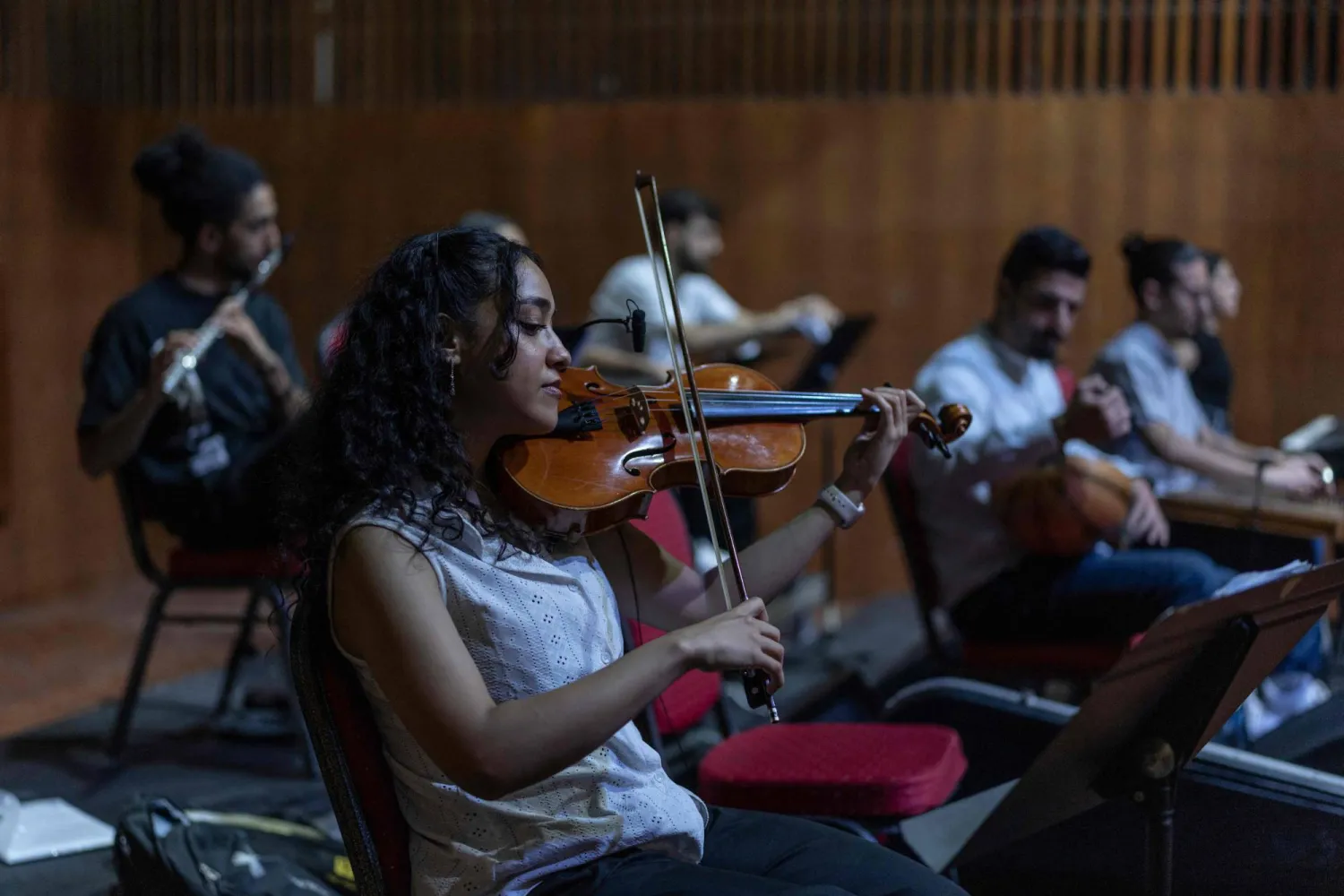

Palestinians Celebrate Jerusalem Festival Return After Gaza War Hiatus

Palestinian musicians take part in a final rehearsal before the opening of the Jerusalem Festival, held at the Yabous Cultural Center after a two-year hiatus, in East Jerusalem on August 16, 2026. (AFP)
TT

Palestinians Celebrate Jerusalem Festival Return After Gaza War Hiatus

Palestinian musicians take part in a final rehearsal before the opening of the Jerusalem Festival, held at the Yabous Cultural Center after a two-year hiatus, in East Jerusalem on August 16, 2026. (AFP)

Three years after its last edition, hundreds of fans are again able to enjoy the Jerusalem Festival, a Palestinian cultural celebration which had been on hold because of the horrors of the Gaza war.

The event, which will run for two months, opened on Sunday with a tribute to the late Lebanese musician Ziad Rahbani, a staunch supporter of the Palestinian cause.

At Yabous Cultural Center, in the Israeli-annexed east of the city, the Jerusalem Arabic Music Ensemble played a selection of Rahbani's work.

"An evening dedicated to Ziad Rahbani represents a major part of our memory. Jerusalem needs this kind of event," filmmaker Yousef al-Salhi told AFP.

The Lebanese musician and playwright, the son of iconic singer Fairuz and a musical pioneer in his own right, died last year aged 69.

Throughout the evening, Rahbani's repertoire, from mawwal --slow Arabic free-form vocal music-- to lively Levantine folk-pop, enthused the audience.

The last edition of the festival was held in the summer of 2023, before the war in the Gaza Strip erupted following Hamas's October 7 attack on Israel.

"We insist on coming back... Today we return to give people hope. The festival brings hope and brings people together," said musician Suheil Khoury, chairman of the board of the Yabous Cultural Centre.

The festival is now four decades old, though the city's tumultuous past means this is only the 30th edition, with several wars as well as the intifadas, or Palestinian uprisings, of the 1980, 90s and 2000s forcing it to pause.

The festival will continue with musical performances, cultural talks and art exhibitions taking place at various locations across east Jerusalem until October 15.

"Everyone is thirsty for this kind of gathering amid the difficult circumstances we are going through -- the genocidal war, restrictions on Jerusalem and the West Bank, and the violence being perpetrated against us," Mona al-Dajani, an academic researcher who attended the opening, said.

Moussa al-Qawasmi, a resident of east Jerusalem, was enthusiastic to attend an event promoting Palestinian culture.

"They (Israel) don't want us to exist, but no, we are always ready... we will continue to celebrate, sing and dance."



Mafia Link Feared in Sicilian Grand Master Theft

A drone view shows the grounds of the Museo Regionale di Messina, where four artworks by 15th-century painter Antonello da Messina were stolen overnight, in Messina, Sicily, Italy, August 16, 2026. (Reuters)
TT

Mafia Link Feared in Sicilian Grand Master Theft

A drone view shows the grounds of the Museo Regionale di Messina, where four artworks by 15th-century painter Antonello da Messina were stolen overnight, in Messina, Sicily, Italy, August 16, 2026. (Reuters)

The theft of four paintings by Renaissance master Antonello da Messina may have involved organized crime and raised troubling questions about security at a museum in the Sicilian artist's hometown, a local official said on Monday.

Enzo Caruso, Messina's councilor for culture, said it was difficult to understand how thieves could have removed the works in a matter of minutes without detailed knowledge of the museum's layout.

"It's a very, very strange affair," Caruso told Reuters.

The theft on Saturday has shocked Italy and revived memories of the infamous 1969 disappearance of a masterpiece by Caravaggio from a Palermo church -- a case long associated with Sicily's Cosa Nostra mafia ‌and never solved.

TOO ‌FAMOUS TO SELL

Caruso said the stolen Antonello works were ‌so ⁠famous that selling them ⁠even on the black market would be virtually impossible, raising the possibility that they could be used as bargaining chips or collateral in criminal dealings.

"The Mafia? It's possible they might try to blackmail the state itself in order to return them. These are the kinds of dynamics that ordinary people never get to see," he said.

He said another possibility was that the paintings could be used as guarantees or currency within the criminal underworld.

The thieves entered Messina's ⁠Accascina Regional Museum on Saturday evening, while the city was celebrating ‌a religious festival that brought thousands into the streets.

The ‌burglary only came to light some two hours later when tourists found two Antonello paintings, apparently discarded ‌by the thieves, leaning against the museum railings.

Renato Schifani, the president of Sicily, issued ‌a statement to say the museum's video surveillance system and alarm had been working normally, adding that an internal investigation was underway to see if any museum staff had been involved.

LOST PAINTINGS FOUND IN THE PAST

Caruso questioned how well prepared the thieves had been, pointing to the fact that two ‌paintings had been left in the street. "Perhaps they did not anticipate how heavy they would be. These are wooden panels ... stealing them ⁠is not as ⁠easy as stealing a canvas that can be cut from its frame," he said.

He also said a professional art thief would normally take greater care handling works worth tens of millions of euros, saying no attempt had been made to protect the paintings.

Italy's crack squad of art police are heading to Messina to take on the case, just three days after helping to retrieve paintings by Pierre-Auguste Renoir, Henri Matisse and Paul Cezanne stolen earlier this year from a museum near Parma.

While the Rome-based art theft police have established a strong track record in finding missing masterpieces, Sicily is still haunted by the memory of the missing Caravaggio.

"I have the feeling the thieves may be keeping the (Antonellos) hidden while things calm down," Caruso said.

"Or perhaps they immediately took the sea route," he added, noting that the museum lies close to the Strait of Messina.

"The hope is that sooner or later they reappear."


Is this Cave in Türkiye Where Homer Wrote 'The Odyssey'?

Access to the rock-strewn cave is not easy. Ahmet Ayberk Cimen / AFP
TT

Is this Cave in Türkiye Where Homer Wrote 'The Odyssey'?

Access to the rock-strewn cave is not easy. Ahmet Ayberk Cimen / AFP

On a Turkish hillside overlooking the olive-covered slopes outside Izmir is a cave known to generations of locals as the place where Homer penned "The Odyssey".

"This place was always called Homer's Valley by the locals. Travelers from all over the world would come and see the cave where Homer is said to have composed his poems," explained Turkish researcher Altan Altin, who has written a book on the subject.

In fact, nobody knows exactly where Homer wrote his epic poems and there is much mythology around the idea of his cave. Today, of course, the debate has become livelier and more immediate thanks to Christopher Nolan's blockbuster film "The Odyssey".

The poet has for a very long time been associated with the Izmir region of Türkiye’s Aegean coast, which for most of its history was known as ancient Smyrna.

"The Smyrnaeans have the river Meles, with its lovely water, and at its springs is the grotto, where they say Homer composed his poems," wrote the 2nd-century Greek chronicler and geographer Pausanias.

Those words have fueled a centuries-long debate, one that continues today, about Homer's life and the location of the river where he was thought to have been born in the year 8 BC.

- Remarkable precision -

Visiting the cave, which is filled with rocks, is not easy.

Inside, travelers have left Greek scrawled on the walls, although it is not clear how old the writing is.

Although other places, notably the Greek island of Chios, also lay claim to Homer's origins, ancient Smyrna and its hinterland -- where Bornova is located -- are closely associated with the poet.

"For me, there's no doubt, Homer is from Bornova. In any case, he is from Ionia, which includes Smyrna and Chios. He's from these lands," Altin told AFP. Ionia is the name of an ancient Greek region on Türkiye’s Aegean coast.

To support his thesis, Altin pointed to a 3rd-century BC frieze depicting the deification of Homer, which he says reproduced the Bornova cave with remarkable precision.

"This bas-relief was already known, but no one had ever noticed the identical details to those found in Homer's cave. This is the first time such a detailed geographical description came to light," he said.

Archaeological evidence from the area also suggests a link to Homer.

"The discoveries from the excavations, especially coins bearing Homer's likeness, show us that the inhabitants of ancient Smyrna considered the poet to be one of their own," archaeologist Mehmet Akif Erdem said.

"'The Iliad' and 'The Odyssey' were written in the (ancient Greek) dialects of Ionic and Aeolic, suggesting that ancient Smyrna and Bornova could be among Homer's native lands," he said.

- Homer everywhere -

Beyond the academic debate about his origins, Homer is everywhere in Bornova.

At Yesilova Hoyuk, a Neolithic site considered to be the oldest known prehistoric human settlement in Izmir, there is a bust of Homer with the inscription: "I compiled The Iliad and The Odyssey epics on this land. I lived in Bornova."

The town -- which already hosts a book fair dedicated to Homer and has a statue of Trojan War hero Hector in a local park -- is planning to refurbish the cave and open it to visitors to capitalize on the revival of interest in the ancient poet.

"Preserving Homer's legacy is a duty we owe to humanity. He is one of the founding fathers of literature," Bornova Mayor Omer Eski told AFP.

"The stories he tells are about this land. The question is not whether we should claim Homer or not. His story is also ours," he said.

But not everyone shares his vision.

In 2024, municipal officials from President Recep Tayyip Erdogan's ruling AKP party proposed renaming Homer's Valley after a Turkish fighter, saying the site should not have a Greek name.

"Erasing Homer's name would be one of the worst things we could do to Bornova," retorted the mayor, whose aim is to "make Homer known to the whole world as a person from Bornova" and to make the town a tourist attraction.

- 'Proud to be his compatriot' -

Mustafa Kocyigit, who runs the Gargantua bookshop in Izmir, said the success of Nolan's film has revived interest in Homer and boosted sales of the poem "The Odyssey".

"I knew Homer was from these lands, but I didn't know he was specifically from Izmir. We are incredibly lucky," said teacher Safak Tosun outside one of the city's cinemas where the film is showing.

"I feel proud, honored and deeply privileged to be his fellow countryman."

For the researcher Altin, there are clues in Homer's writing that he says shows the poet came from the area.

"When you dive into the Iliad, you really understand that Homer was an Anatolian. You find anecdotes and cultural references that are completely unknown elsewhere," he said.

He believes Homer's origins should not stir up rivalry between Türkiye and Greece.

"Homer is 2,800 years old, while the Turkish-Greek border is only a century old," he shrugs.

"Homer is Greek. Homer is Anatolian. None of us is older than he is, not even our countries."


AlUla Royal Commission, National Museum of Asian Art Strengthen Cooperation Through Residence Program

The initiative is part of the commission’s efforts to promote international cultural dialogue and highlight the region’s exceptional cultural heritage. (SPA)
TT

AlUla Royal Commission, National Museum of Asian Art Strengthen Cooperation Through Residence Program

The initiative is part of the commission’s efforts to promote international cultural dialogue and highlight the region’s exceptional cultural heritage. (SPA)

Saudi Arabia’s Royal Commission for AlUla has strengthened its cultural partnership with the National Museum of Asian Art, part of the Smithsonian Institution in Washington DC, by launching the “Rawi in Residence” program, with the participation of storytellers Atif AlBalawi and Wedad Yaseen.

The initiative is part of the commission’s efforts to promote international cultural dialogue and highlight the region’s exceptional cultural heritage, reported the Saudi Press Agency on Sunday.

The program is the first public-facing initiative under the partnership agreement between the commission and the museum. It was delivered through three interactive sessions involving museum visitors, families, curators, guides, and specialists in heritage and culture.

During the program, the two storytellers led a series of talks and interactive experiences highlighting AlUla’s cultural landscape and historical sites. They also highlighted its historical role as a major hub of cultural exchange along the Incense Route, drawing on storytelling and heritage interpretation techniques.

The initiative builds on field visits and the exchange of expertise between the commission and the museum, which contributed to shaping the “Rawi” concept and incorporating it into the museum’s summer program in Washington. This strengthened shared understanding of heritage interpretation methods and enhanced the visitor experience in line with the highest international standards.

The program is aligned with the Royal Commission for AlUla’s objectives of empowering AlUla’s young men and women and showcasing their capabilities at international forums. It builds on previous participation by storytellers at prominent global venues in Beijing, the UNESCO pavilion at the Venice Biennale, and the organization’s headquarters in Paris.

These efforts are in line with the objectives of Saudi Vision 2030 to celebrate Saudi national heritage and strengthen its cultural presence on the international stage.