
Yayoi Kusama, Who Splashed Polka Dots Across the Art World, Dies at 97 in Tokyo

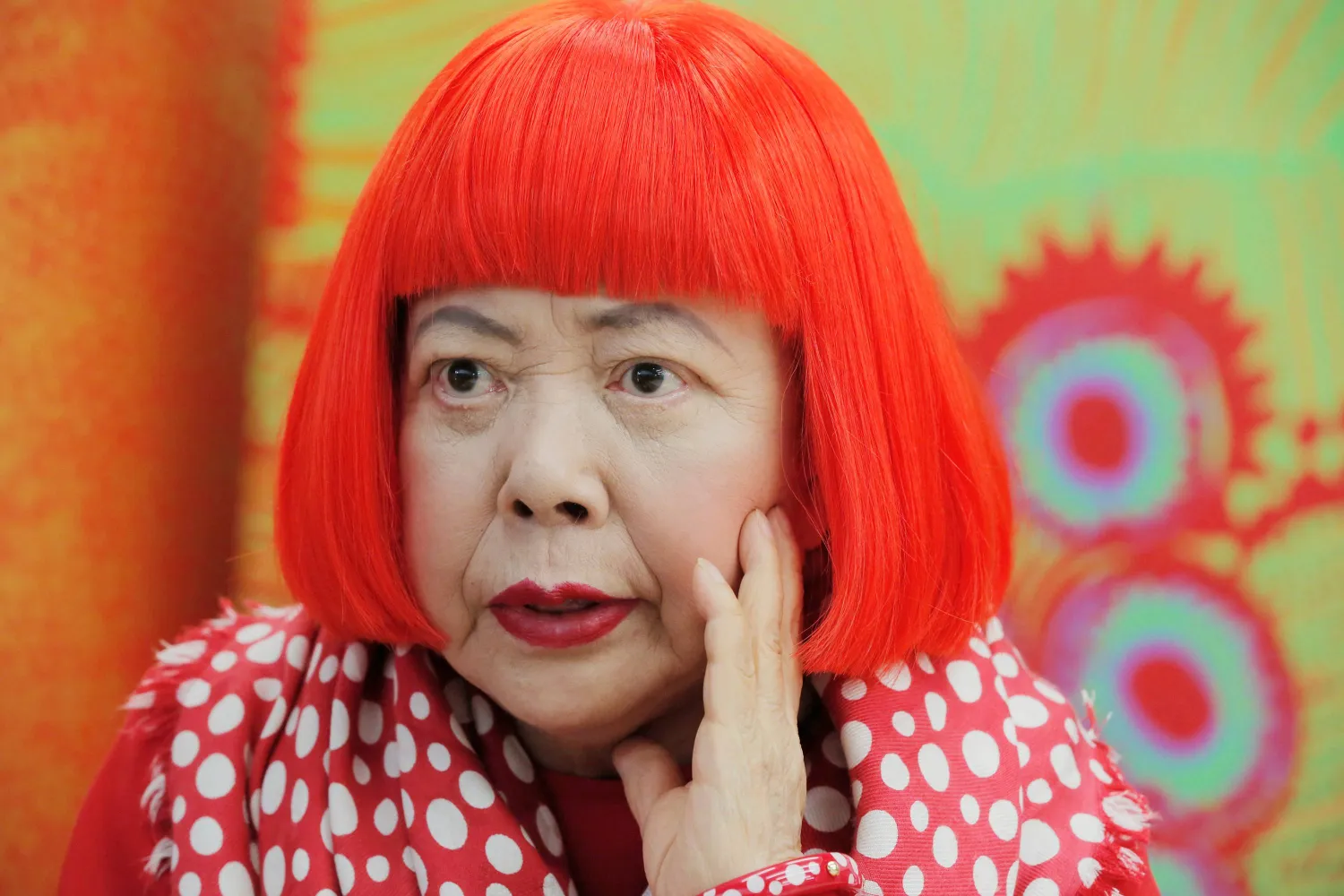
 Japanese avant-garde artist Yayoi Kusama, wearing a bright red wig and a Louis Vuitton polka dot scarf, speaks during an interview at her studio in Tokyo, on Aug. 1, 2012. (AP)
Japanese avant-garde artist Yayoi Kusama, wearing a bright red wig and a Louis Vuitton polka dot scarf, speaks during an interview at her studio in Tokyo, on Aug. 1, 2012. (AP)
TT

Yayoi Kusama, Who Splashed Polka Dots Across the Art World, Dies at 97 in Tokyo

 Japanese avant-garde artist Yayoi Kusama, wearing a bright red wig and a Louis Vuitton polka dot scarf, speaks during an interview at her studio in Tokyo, on Aug. 1, 2012. (AP)
Japanese avant-garde artist Yayoi Kusama, wearing a bright red wig and a Louis Vuitton polka dot scarf, speaks during an interview at her studio in Tokyo, on Aug. 1, 2012. (AP)

Japanese artist Yayoi Kusama, who splashed her signature polka dots on paintings, sculptures and museum installations around the world, has died, her studio said Thursday. She was 97.

Kusama died Aug. 14 at a hospital in Tokyo, Yayoi Kusama Studio said, without specifying the cause of death.

“She continued to paint until her final days, never setting aside her brush, and continued exploration of forever love and eternal soul,” the studio's statement said. “We will carry forward Kusama’s wishes and, through art, continue to bring hope and strength for the future to people around the world.”

Kusama, one of Japan’s most respected contemporary artists, was widely exhibited around the world, including the Museum of Modern Art, the Whitney Museum of American Art in New York and the Museum Ludwig in Germany.

Repetitive motifs were her trademark, in various shapes, resembling netting, swirls or worms, but most often dots, dancing proudly on her canvases, or as sparkling balls or dots of light in her installations, in all their vibrant psychedelic glory.

“Polka dots are fabulous,” Kusama said in a 2012 interview with The Associated Press, appearing in her signature orange bob wig and polka dot attire.

“I want to create a thousand paintings, maybe two thousand paintings, as many as I can draw,” she said in her childlike but matter-of-fact tone. “I will keep painting until I die.”

Kusama insisted she drew the way she saw the world: covered with spots, part of the hallucinations she said she had from childhood. She was in and out of psychiatric institution for decades, although her sickness did not hold her back as she was one of the first Japanese women to go to New York to pursue her art, in 1957.

Although soft-spoken and shy in her mannerisms, Kusama was always unabashedly bold in the assertion of her dotty vision, not only in sticking to the style for decades but also in making it accessible to the masses.

In her later years, as the times caught up with her art, she enjoyed fame. She signed on with fashion brands like Louis Vuitton as well as other licensed products like teacups, T-shirts and key chains with her illustrations, including replicas of her likeness that were used in show windows and other marketing.

In 2008, Christie’s auctioned her work for $5.8 million. In 2016, she won the most prestigious award Japan gives its artists, the Order of Culture.

Upon receiving the award, she told reporters she was more determined than ever to pursue her art, stressing that the sincerity and devotion she had demonstrated in her personal life were crucial parts of her artistic legacy.

“I feel there is little left in my life, but I am now still fighting to the death for my art,” she said. “I am giving all I have so that many people will continue to be interested in my art, even after I am dead.”

Kusama was called pop, avant-garde, feminist, just to name some of the categories thrown at her, most of which Kusama brushed off as not quite representative of her art.

She was born in a middle-class family but felt misunderstood, as her parents wanted her to simply get married. They wanted to buy her kimono, not paints and brushes. She knew she had to get away. She chose America.

When she arrived in New York, the fad was “action painting,” characterized by dribbles, swooshes and smears, not dots. She suffered years of poverty and obscurity. But she kept painting dots.

She put circles of paper on people’s bodies, and once a horse, in “happening” anti-war performances in the late 1960s, which got some people arrested for obscenity but helped get media attention for her art. While in New York, she befriended artists like Andy Warhol, Georgia O’Keeffe and Joseph Cornell, who praised her innovative style.

Over the years, Kusama made quirky but stunningly celebratory works like “Macaroni Girl,” a female figure plastered with macaroni, which expresses the fear of food and “The Visionary Flowers,” giant sculptures of twisting tulips.

Kusama, who has also made films and published several novels, said she wasn’t sure where she got her ideas. She just picked up her brush and started drawing. The process was so mysterious sometimes she surprised herself, she told AP.

“I think, ‘Oh, I drew that? I was thinking that,’” she said.

But she appeared happy to have her art be the focus of media attention and praise, reading one of her poems to a reporter or tackling her artworks with gusto for photos.

But she was also a charmingly disarming mix of vulnerability and defiance, at one moment declaring herself “an artistic revolutionary,” and then the next, mumbling: “I am so afraid, all the time, of everything.”

The news of her death was met with an outpouring of sadness from around the world, including museums that had exhibited her works.

Fans and artists alike praised her courageous persistence in vowing to continue creating art that, she said, will be recognized thousands of years after her death.

Messages recognizing her death were sent from people throughout Japan including Tokyo Gov. Yuriko Koike and Yoshitomo Nara, a younger Japanese artist who has exhibited widely abroad.

“RIP Kusama-sensei,” Nara wrote on his X account, respectfully calling her a teacher in Japanese.

Fashion Commission Launches Third Edition of Saudi Heritage Revival Program

The program includes a series of in-person workshops in Riyadh - SPA
TT

Fashion Commission Launches Third Edition of Saudi Heritage Revival Program

The program includes a series of in-person workshops in Riyadh - SPA

The Fashion Commission has announced the launch of the third edition of the Saudi Heritage Revival program, titled “Jewelry and Handcrafted Heritage”, in collaboration with Swarovski and Art of Heritage. The initiative aims to support and enable designers, artisans, and emerging creative talents to reinterpret Saudi Arabia’s rich cultural heritage through contemporary jewelry and accessory design.

Building on the success of previous editions, the program celebrates Saudi craftsmanship by merging traditional artisanal techniques with modern design practices. Participants will have the opportunity to incorporate Swarovski Reignited Crystals, reflecting a shared commitment to innovation, sustainability, and the preservation of cultural identity.

The competition has been developed to empower local creative talent while encouraging participants to draw inspiration from traditional Saudi crafts and transform them into contemporary designs that resonate with global audiences. Through a comprehensive educational journey, participants will gain direct access to industry experts, designers, and heritage specialists, equipping them with the technical and creative skills needed to elevate their work, SPA reported.

The program includes a series of in-person workshops in Riyadh, covering jewelry design, heritage crafts, traditional embroidery, accessories, and contemporary applications of Saudi cultural elements. Participants will also receive virtual mentorship sessions with specialists from Art of Heritage and Swarovski, which will support them throughout the design development process before they present their final collections to an expert judging panel.

The program began its early stages this month, with workshops that commenced in early August. Finalists will develop their concepts over several weeks before presenting their completed designs during the final showcase in Riyadh in September 2026, where the winning designer will be announced.

Through this initiative, the Fashion Commission continues to strengthen the Kingdom’s creative ecosystem by preserving traditional craftsmanship, promoting sustainable design practices, and creating meaningful opportunities for emerging designers to innovate while celebrating Saudi cultural heritage.

This program is a continuation of the Fashion Commission’s efforts to support local talents and enable them through training and development programs that contribute to reviving Saudi heritage through creative designs that merge traditional elements with innovation.


Misk Art Institute to Launch Creative Forum 2026 in September

This year's forum will explore the human imprint in contemporary cultural practices and the relationship between people and creativity as patterns of cultural and creative production and reception continue to change - SPA
TT

Misk Art Institute to Launch Creative Forum 2026 in September

This year's forum will explore the human imprint in contemporary cultural practices and the relationship between people and creativity as patterns of cultural and creative production and reception continue to change - SPA

Misk Art Institute, a subsidiary of Mohammed bin Salman Foundation (Misk), announced the launch of the Creative Forum 2026, to be held on September 3 and 4 at the King Abdullah Petroleum Studies and Research Center (KAPSARC) in Riyadh.

Over two days, the forum will bring together more than 48 cultural experts, curators, academics, artists, and policymakers from around the world across 16 specialized panel discussions, eight artistic and cultural mentorship sessions covering various topics, and six sessions of the "Coffee with a Cultural Expert" program to examine the rapid transformations taking place in cultural practices amid technological developments, SPA reported.

This year's forum will explore the human imprint in contemporary cultural practices and the relationship between people and creativity as patterns of cultural and creative production and reception continue to change.

It will also examine aspects of storytelling and identity, creative collaboration networks, and the impact of digital transformation and artificial intelligence on today's cultural landscape.

The forum reflects Misk Art Institute's commitment to fostering cultural dialogue at both the regional and international levels and creating spaces for discussion on issues shaping the future of the cultural sector.

It also underscores the importance of preserving the human dimension of creative practice and promoting the exchange of expertise and knowledge, contributing to a thriving creative ecosystem and reinforcing Saudi Arabia's position as a leading regional and international destination for cultural and artistic dialogue.

Since its launch in 2020, the Creative Forum has hosted more than 280 speakers from over 20 countries, attracted more than 14,000 participants, and generated more than three million digital impressions worldwide, reflecting its established position as one of the region's leading cultural events.


Palestinian Artist Sliman Mansour Dies at 79

Painter and sculptor Sliman Mansour and his landmark 1973 painting, "Camel of Hardships". (Sliman Mansour on Instagram)
TT

Palestinian Artist Sliman Mansour Dies at 79

Painter and sculptor Sliman Mansour and his landmark 1973 painting, "Camel of Hardships". (Sliman Mansour on Instagram)

Painter and sculptor Sliman Mansour, one of the most prominent names in Palestinian art, has died at the age of 79, his family announced.

Mansour, whose vivid artwork depicted both Palestinian traditions and his people's struggles under Israeli occupation, died on Monday at his home in east Jerusalem, his family said.

"The final chapter has been written. With hearts gripped by sorrow beyond description, we announce that our dear father has left this world," the family said in a statement.

"For the world, he leaves behind a life filled with beauty and memories, and a legacy that will continue through everyone whose lives he touched. As for us, we have lost a father who was the source of our love, our strength and our refuge."

Mansour was born in Birzeit, north of Ramallah, in 1947 and studied art and design in Jerusalem, graduating in 1970.

The Palestinian Culture Ministry mourned Mansour, calling him "one of the most important pillars of contemporary Palestinian visual art, whose career over decades formed part of the Palestinian visual and national memory".

The ministry hailed his landmark 1973 painting, "Camel of Hardships", depicting an elderly Palestinian porter carrying the city of Jerusalem on his back, as "an artistic and national icon", adding that his work served "as witness to Palestinian history and guardian of identity".

Mansour was the recipient of numerous awards, among them the UNESCO-Sharjah Prize for Arab Culture in 2019.