


Boat Builders Keep Pakistan’s Fishing Heritage Afloat

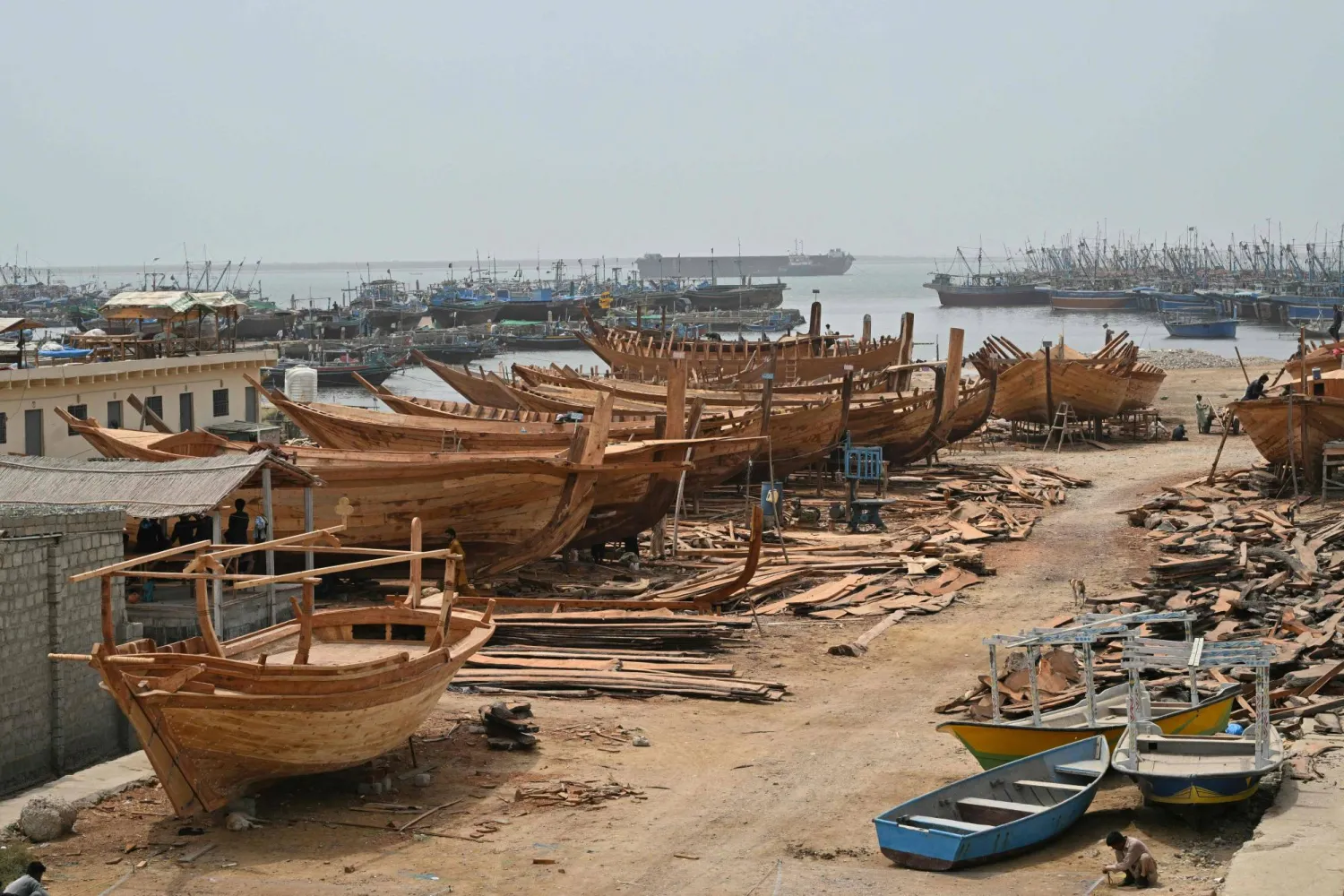
This photograph taken on July 8, 2026 shows traditional wooden boats at a yard in Ibrahim Hyderi in Karachi. (AFP)
TT

Boat Builders Keep Pakistan’s Fishing Heritage Afloat

This photograph taken on July 8, 2026 shows traditional wooden boats at a yard in Ibrahim Hyderi in Karachi. (AFP)

The rhythmic hammering of nails and the whine of saws echo around a coastal Karachi neighborhood, where small figures of men work atop massive wooden fishing hulls that loom beneath a pale summer sky.

Ibrahim Hyderi, a maritime town on the outskirts of the port city believed to date back centuries, is renowned for the construction of traditional fishing boats.

"This is the area that gave birth to Karachi, and that provided Karachi with its fishing sector," said Mehran Ali Shah of the Pakistan Fisherfolk Forum, which advocates for the local community.

Despite the rise of industrial shipbuilding, such practices -- where handcrafted vessels are assembled timber by timber -- have stood their ground.

Boat-builder Muhammad Asif, 22, learnt the craft from his father as a teenager, and is now proud that he can work on his own.

"I was drawn to this work, so I work at it with great dedication," Asif tells AFP as sawdust coats his face and sun-bleached hair.

"It has always been my passion, that is why I chose this line of work."

Asif, like other workers, starts at 7:00 am every day and heads home for dinner around 7:00 pm, only putting down his tools during a two-hour lunch break.

He earns up to 2,500 Pakistani rupees ($9) a day, working six days a week.

The workers brave the elements all year round, including the sweltering heat and humidity of summers and the soaking rains of the monsoon seasons.

The process begins with a fisherman selecting a boat design. A master craftsman drafts a template and the workers take it from there, drawing on their years of experience to painstakingly build the vessel.

The carpenters choose from different types of timber, such as local eucalyptus wood, or African teak for resilience against seawater.

The heavy blocks of wood are carefully cut using well-worn vertical and other saws, following hand-drawn pencil markings.

The boats are then assembled from the ground up, block by block and nail by nail, with the workers clambering up on rickety ladders as the hulls rise higher.

The time-consuming process means even a small boat measuring just several meters long could take up to three months to construct and cost one million Pakistani rupees ($3,600), Asif says.

Across the yard, the completed boats are given splashes of color by painter Muhammad Ismail.

The weather-beaten 38-year-old, his hands and nails tinged with blue, is painting petals on the hull of a vessel -- one of many he has worked on over a decade.

"Most of our fishermen prefer floral designs rather than fish," he tells AFP, adding that he experiences "great satisfaction" when an owner appreciates his artwork.

"Some people ask me to create a design according to my own ideas, while others tell me exactly what they want."

At a nearby harbor, fisherman Qadir Bux sits in a small boat owned by his family for at least two decades as he mends fishing nets. The fisherman hopes to give the wooden vessel a facelift soon.

"It's like looking after something very precious, or even like caring for our own child," he says.


Saudi Ministry of Culture, Asaan Sign MoU to Enhance Cooperation

The MoU aims to develop cultural experiences that showcase Saudi heritage, promote its preservation, and foster creativity and innovation in culture and heritage. (SPA)
TT

Saudi Ministry of Culture, Asaan Sign MoU to Enhance Cooperation

The MoU aims to develop cultural experiences that showcase Saudi heritage, promote its preservation, and foster creativity and innovation in culture and heritage. (SPA)

Saudi Arabia's Ministry of Culture and Misk Heritage Museum (Asaan), affiliated with the Mohammed bin Salman Foundation (Misk), signed on Monday a memorandum of understanding (MoU) to develop cultural experiences that showcase Saudi heritage, promote its preservation, and foster creativity and innovation in culture and heritage.

The MoU covers innovative museum experiences, national talent development, cultural heritage research and documentation, the exchange of studies, data, and statistics, media cooperation, and cultural programs.

The MoU supports the Ministry of Culture’s efforts to build an integrated cultural ecosystem through effective partnerships and advance the National Culture Strategy under Saudi Vision 2030.


Crafts and Handicrafts Exhibition 2026 Kicks off Tomorrow in Eastern Region

The exhibition will run until September 4 - SPA
TT

Crafts and Handicrafts Exhibition 2026 Kicks off Tomorrow in Eastern Region

The exhibition will run until September 4 - SPA

Eastern Region Deputy Governor Prince Saud bin Bandar bin Abdulaziz will inaugurate the ninth edition of the Crafts and Handicrafts Exhibition 2026 on Tuesday.

Organized by Asharqia Chamber, the exhibition will feature a number of artisans, craftswomen, families working in the cottage industry, and visual artists, along with several government and private entities and non-profit organizations, SPA reported. It will run until September 4.

The exhibition will showcase a diverse range of traditional crafts, including paintings and decorations, perfumes and incense, sweets, coffee, and spices.


Lebanon Archaeological Finds Showcase Rich Heritage Despite War Woes

An archaeologist displays an artifact found from an archaeological site in the northern coastal Lebanese town of Batroun on August 14, 2026. (AFP)
TT

Lebanon Archaeological Finds Showcase Rich Heritage Despite War Woes

An archaeologist displays an artifact found from an archaeological site in the northern coastal Lebanese town of Batroun on August 14, 2026. (AFP)

From a Roman temple to ancient olive presses, Lebanon keeps turning up archaeological treasures even as the latest Israel-Hezbollah war has caused excavations to grind to a halt at precious heritage sites in the country's south.

Important discoveries in recent years include the remains of columns and bases from a Roman temple in Maasser al-Shouf in the mountains southeast of Beirut, nestled next to a millennia-old cedar forest.

"A whole system was built around this temple," which dates to between the first century BC and the second century AD, said Myriam Ziade, regional antiquities official with the culture ministry.

She said the site was turned into a Crusader fortress between the 12th and 13th centuries.

The local municipality reported finding huge stone blocks on the hill in 2017, and excavations began five years later with a team from an Italian university, with the dig revealing the ruins of the large temple, she told AFP.

Archaeologists are to soon resume work at the site, located "on a network of roads leading from the Mediterranean coast to the Bekaa valley" in the country's east, she said.

The eastern city of Baalbek has one of Lebanon's best-known landmarks: a stunningly well-preserved Roman temple complex set against the mountainous border with Syria.

- Protecting heritage -

Lebanon is brimming with archaeological finds showcasing its rich history over thousands of years, from the Phoenician, Persian, Roman and Byzantine periods, the Crusades, and Arab and Islamic sultanates and empires.

After Iran-backed Hezbollah drew Lebanon into the Middle East war in March, triggering heavy Israeli airstrikes and a ground invasion in the south, the United Nations cultural agency UNESCO last month added several Lebanese sites to its World Heritage in Danger list.

Members from the team of archaeologists work at an archaeological site in the northern coastal Lebanese town of Batroun on August 14, 2026. (AFP)

They include the southern coastal city of Tyre, home to a Roman triumphal arch and a second-century hippodrome.

The list also includes five castles in south Lebanon's Jabal Amel area, among them the Crusader-era Beaufort fortress, which Israeli forces have been occupying since May.

Sarkis Khoury, head of antiquities at Lebanon's culture ministry, told AFP the war had forced archaeologists to switch tack.

We are "now focused on protecting endangered heritage in southern Lebanon and in the Bekaa, particularly in the Baalbek region", he said.

"Excavations in dangerous areas have come to a halt, and archaeological missions are going through a period of minimal activity throughout Lebanon, especially in the southern regions."

He said foreign archaeological teams had stopped going to Lebanon.

- Ancient port city -

Still, some work continues.

In Batroun, a northern coastal city home to the ruins of a small Roman amphitheater, an archaeologist was surrounded by tools and papers, documenting the latest finds as waves lapped rocks nearby.

Samar Karam, in charge of archaeological sites in north Lebanon, said a Roman-era olive press was found on private property along with pottery weights and items for textile production.

On another nearby property overlooking an ancient sea wall, excavations revealed two stone quarries "one Roman and the other Phoenician", she said.

The ruins of rooms from Phoenician, Persian and Roman periods have been uncovered, their pink or grey flooring helping to distinguish them.

Archaeologists have found pieces of Greek pottery, as well as rooms and large jars for storing goods from the harbor, discoveries that Karam said showed the ancient city's "lively commercial activity".

Tombs in the city date to a variety of historical periods, she added.

A view of the Phoenician wall is pictured in the northern coastal Lebanese town of Batroun on August 14, 2026. (AFP)

- Hippodrome search -

In Beirut, whose history spans over 5,000 years, Laure Salloum oversees archaeological excavations in the chaotic modern city.

She said current digs were "really construction projects" where workers had stumbled across historical treasures.

A recent discovery uncovered the remains of a Roman-era olive press, while work was ongoing in central Beirut in search of "the remaining part" of a Roman hippodrome, Salloum said.

The hippodrome was initially unearthed years ago when excavations began for a commercial and residential complex.

Other accidental discoveries in the city have included a 2,000-year-old Roman bathhouse.

Such finds often cause development plans to grind to a halt.

"We're constantly making new discoveries," Khoury said.

"Lebanon is at the crossroads of a region that has been full of crises for thousands of years."