


Renoir Paintings Are Worth a Fortune, but Not When They’re Stolen

Painting of "Coco Reading" by French painter Pierre-Auguste Renoir, which was stolen from Renoir Museum in Cagnes-sur-Mer, France, but was later retrieved, September 8, 2026, in this screen grab obtained from a page on the Renoir Museum's website. (Musée Renoir/Handout via Reuters)
TT

Renoir Paintings Are Worth a Fortune, but Not When They’re Stolen

Painting of "Coco Reading" by French painter Pierre-Auguste Renoir, which was stolen from Renoir Museum in Cagnes-sur-Mer, France, but was later retrieved, September 8, 2026, in this screen grab obtained from a page on the Renoir Museum's website. (Musée Renoir/Handout via Reuters)

Two Renoir paintings stolen from a small French museum have yet to be recovered but if the thieves are hoping to cash in on the artwork, they would be hard-pressed to find a buyer.

Selling well-known, stolen art is impossible to do at an auction house or through other public channels without raising eyebrows. Even under the table, the value plummets. And unlike other eye-catching artifacts such as jewels, paintings can't be chopped up and sold for parts without losing their entire worth.

Art crime experts stress that most buyers simply don't want the liability. In short, the reality looks nothing like the movies.

“People always think that there is this kind of ‘Dr. No’ type from the James Bond movie," said Arthur Brand, a private art detective based in the Netherlands. "But that’s Hollywood. In the real world, there are no collectors like that.”

Brand, who has investigated art crime for about 20 years, explains that often “nobody will touch” stolen art, particularly high-profile work. Sometimes that means paintings valued at millions of dollars are effectively “worth zero” once they're outside of the museum, he added, if not a small fraction of the price.

Tuesday's theft at the Renoir Museum — the last home of painter Pierre-Auguste Renoir in the French Riviera — marks the latest high-profile art crime targeting collections around the world, and experts warn there could be more.

Here's what we know.

Where the Renoirs could wind up

Cagnes-sur-Mer's mayor, Bryan Masson, said a group of “well-equipped” burglars stole a total of four Renoir paintings from the museum in his town on Tuesday. But they dropped two of them — Renoir’s “Portrait of Madame Pichon″ and “Coco Reading" — in the museum garden before they fled, the prosecutor’s office said in a statement.

Police are still searching for the perpetrators. In the meantime, Renoir's “Portrait of Madame Colonna Romano” and “Young Woman at the Well" remain missing.

Masson estimated the value of the combined Renoir works stolen Tuesday at 9 million euros ($10.5 million).

But the probability of profiting off such a heist is “extremely low,” said Erin Thompson, an art crime professor at the John Jay College of Criminal Justice in New York. In cases that end in arrests, the common takeaway is that “thieves are people who are good at stealing things and bad at thinking through the consequences,” she added.

Some may try to make money from heists in other ways, such as through demanding a ransom or looking for an insurance payout. But Thompson explains many museums don't have insurance because it's too costly. That's why the practice is so rare in the US, for example, and it would be difficult to negotiate with insurance companies elsewhere without the thieves incriminating themselves.
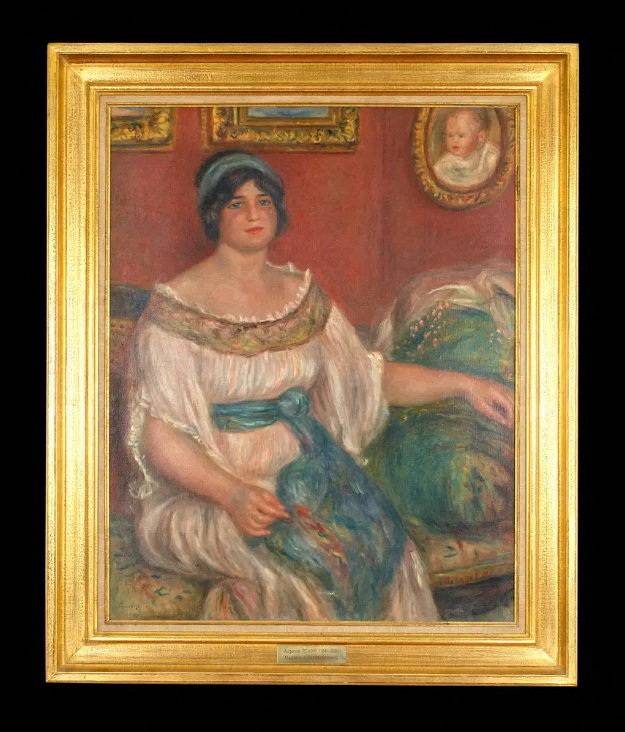
Painting of "Madame Colonna Romano" by French painter Pierre-Auguste Renoir, which was stolen from Renoir Museum in Cagnes-sur-Mer, France, September 8, 2026, in this screen grab obtained from a page on the Renoir Museum's website. (Musée Renoir/Handout via Reuters)

As a result, if not surrendered or otherwise recovered, stolen paintings may remain hidden or in some cases eventually destroyed to get rid of evidence, Thompson says.

Brand, who collaborates regularly with law enforcement in his art crime investigations, says that he's still seen limited cases of stolen paintings “floating around in the underworld” — perhaps as partial payments for products like drugs. And depending on country-by-country laws, he noted that the promise of returning the art has led to reduced sentences of other charges.

“Some more savvy criminal will acquire it as a get out of jail free card, sort of a bargaining chip,” added Christopher Marinello, a lawyer and founder of Art Recovery International. “So, if some drug dealer ever is arrested, he can bargain with the prosecutor and say, ‘Listen, give me a lesser sentence and I’ll show you where these Renoirs are.’ And that has always worked and it will work again.”

Paintings are harder to hide and sell than jewels

Stolen paintings are much more difficult to profit from than museums' other crown jewels — literally.

Jeweled and metal goods have increasingly become a target of theft because they can be melted down or broken down into parts. Last year, a handful of experts warned that could be the fate of the stunning heist of crown jewels at the Louvre Museum in Paris, for example, noting that, if done successfully, smaller pieces could later go up for sale as part of a new necklace, earrings or other jewelry without turning too many heads.

But of course, such pieces would lose their historical worth and, if actually sold, likely only go for a fraction of their original value. Experts also warn that it's far from a simple process overall and gems may still be identifiable by characteristics like clarity, for example.

Apart from an emerald-set imperial crown found outside the museum the day of the October 2025 heist, the stolen jewels remain unrecovered.

Paintings, in contrast, don't have the same commodity value that can potentially be parceled off. “It’s a canvas with some old oil paint on it,” said art theft expert James Ratcliffe, of the Art Loss Register. “You can’t touch it up. You can’t resell it other than for what it is.”

Uptick in art crime overall

Ratcliffe and others note that hasn't stopped thefts of famous paintings and other artwork from museums. Just earlier this year, three pieces by Renoir, Cézanne and Matisse worth millions of euros were stolen in Italy, for example, before being recovered last month.

Ratcliffe notes that smaller museums, in particular, are harder to secure because they might not have the funding necessary to invest in the latest technology or are located in historic buildings that may take more time and effort to install new guardrails.

Still, pressures are piling up, with some warning that future cases of art theft could be likely as vulnerabilities persist.

“We need to change the way we treat small and country house museums before we lose to our cultural heritage permanently,” said Marinello, who stresses that stronger security and enforcement is overdue. “We’re supposed to be preserving our cultural heritage, not allowing criminals to take what they want and using them as shopping malls.”



Saudi Ambassador Inaugurates Cultural Mission Headquarters in Cairo

Saudi Ambassador to Egypt Saleh Al-Husseini and Secretary-General of the Cultural Missions at the Ministry of Education Abdulaziz Al-Shehri. (SPA)
TT

Saudi Ambassador Inaugurates Cultural Mission Headquarters in Cairo

Saudi Ambassador to Egypt Saleh Al-Husseini and Secretary-General of the Cultural Missions at the Ministry of Education Abdulaziz Al-Shehri. (SPA)

Saudi Ambassador to Egypt Saleh Al-Husseini and Secretary-General of the Cultural Missions at the Ministry of Education Abdulaziz Al-Shehri opened the Saudi Cultural Mission’s headquarters in Cairo yesterday, the Saudi Press Agency said.

Al-Husseini toured the headquarters and was briefed on the mission’s operations, services, and programs that support students and strengthen cultural and academic ties between Saudi Arabia and Egypt.


Red Sea Fund Backs 30 Film Projects in First Two 2026 Funding Cycles

Red Sea Fund Backs 30 Film Projects in First Two 2026 Funding Cycles
TT

Red Sea Fund Backs 30 Film Projects in First Two 2026 Funding Cycles

Red Sea Fund Backs 30 Film Projects in First Two 2026 Funding Cycles

The Red Sea Fund, a program of the Red Sea Film Foundation, has announced 30 selected projects across its first two funding cycles of 2026, drawn from 916 submissions and continuing its year-round commitment to supporting distinctive filmmakers and stories from Saudi Arabia, the Arab world, Africa and Asia.

Cycle 1, dedicated to projects in post-production, received 220 submissions, the highest number for a post-production cycle since the inception of the fund, and one of its most competitive to date, with 13 projects ultimately selected, SPA reported.

Cycle 2, dedicated to projects in production, received 696 submissions, with 17 projects ultimately selected, spanning feature fiction, feature documentary and short fiction.

Five Saudi projects feature among the Cycle 2 selections: Remind Me to Forget by Lama Jamjoom, Green Corpse by Khaled Zidan, Maria’s Mansion by Raed Alsemari, Bait Bahar by Yaser Hammad and Microwave by Mishary Almazyaad.

Several of the Cycle 1 post-production titles have already premiered internationally. Ben’imana won the Caméra d’Or at the 2026 Cannes Film Festival, where it screened in Un Certain Regard alongside Strawberries. At the Toronto International Film Festival, Angh won the Platform Award, world premiering alongside Four Seasons in Java. Other films also screened in Venice and at the Locarno Film Festival.

CEO of the Red Sea Film Foundation Faisal Baltyuor said: “These two cycles reflect exactly what the Red Sea Fund is here to do: identify bold, distinctive projects and support filmmakers at critical stages of their journey. The international momentum already building around several Cycle 1 titles is a strong testament to the caliber of the work, and we are excited to see the Cycle 2 projects continue that journey."


AlUla Artist Residency Showcases Creative Excellence at International Design Awards

The AlUla Artist Residency Program has strengthened its presence on the international design scene, with several of its participants receiving awards at the fourth edition of the Design Award. (SPA)
TT

AlUla Artist Residency Showcases Creative Excellence at International Design Awards

The AlUla Artist Residency Program has strengthened its presence on the international design scene, with several of its participants receiving awards at the fourth edition of the Design Award. (SPA)

The AlUla Artist Residency Program has strengthened its presence on the international design scene, with several of its participants receiving awards at the fourth edition of the Design Award, organized by the Institut du Monde Arabe in Paris, the Saudi Press Agency said on Sunday.

Saudi architect and artist Aseel Alamoudi won the Emerging Talent Award for her project "Playformation: The Curve and The Dot," inspired by AlUla's rock formations and natural curves.

The Contemporary Craftsmanship Award was presented to Altin Studio, founded by Yasmine Sfar and Mehdi Kebaier, for their sculptural work "Our AlUla Trilogy" (2025), comprising three pieces titled "Wadi,Waha," and "Yusr." The pieces were crafted from palm wood and plant fibers. The project combines traditional crafts with contemporary design, drawing inspiration from AlUla's landscape and natural materials while evoking the palm cultures of Saudi Arabia and Tunisia.

The international awards won by the participants reflect the initiative's expanding reach and its creative output's growing presence on the global stage, as part of the cultural and artistic momentum taking place in AlUla through its diverse residency programs, exhibitions, events, and festivals.