
Ithra Unveils 96th Saudi National Day Celebrations

The festival features a curated selection of Saudi films - SPA
TT

Ithra Unveils 96th Saudi National Day Celebrations

The festival features a curated selection of Saudi films - SPA

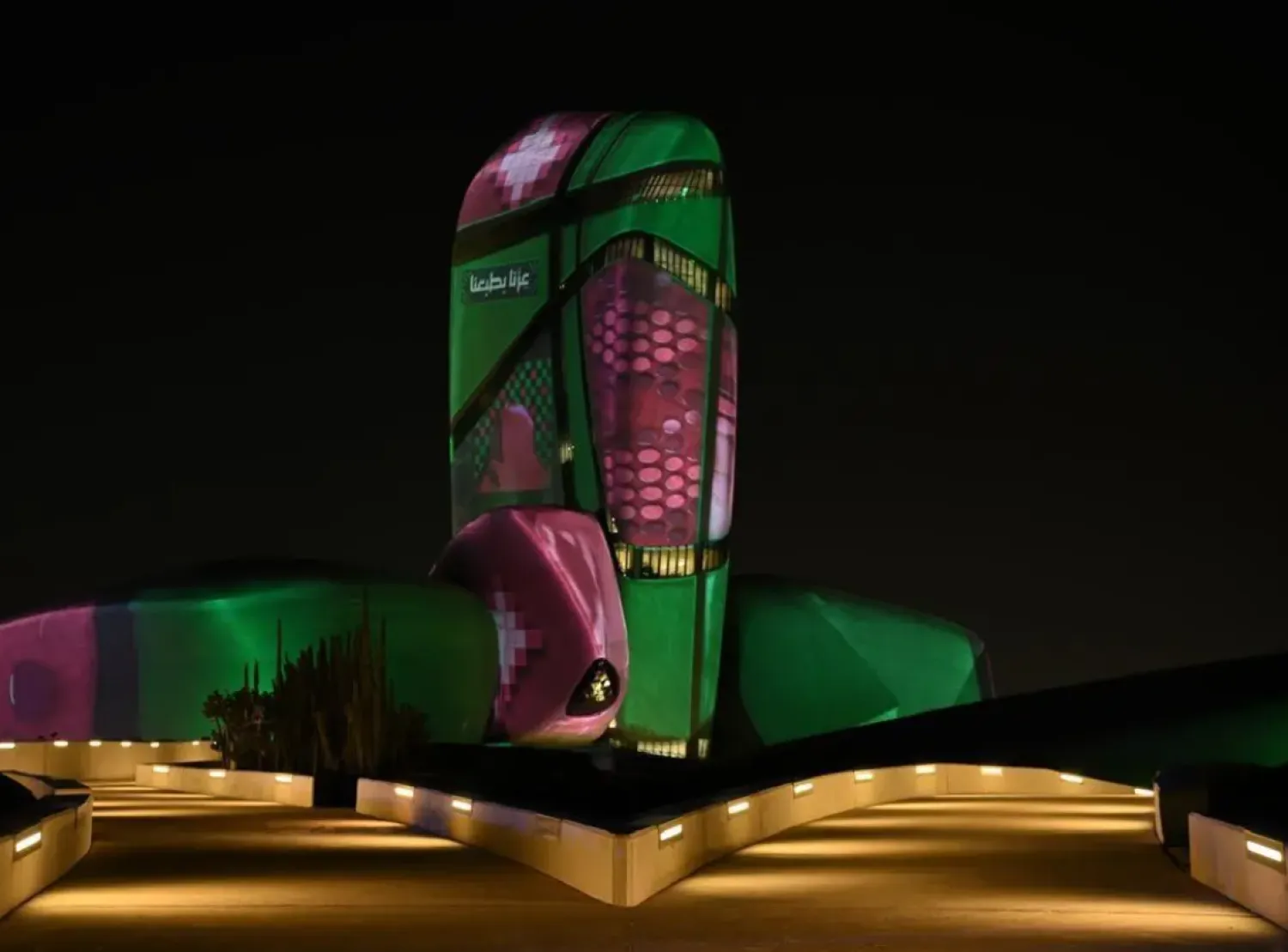
The King Abdulaziz Center for World Culture (Ithra) will celebrate the 96th Saudi National Day with a five-day program of diverse cultural events running from September 22 to 26, inviting local and international visitors to explore the Kingdom's origins and future ambitions.

This year's National Day program centers on the theme "Glory Through Our People," exploring the evolution of culture and the blend of heritage and modernity.⁠‌​‌‌​​​‌‌​‌‌‌‌​​‌‌‌​⁠ The celebrations kick off with a grand military parade, followed by a full program featuring 36 curated and distinct experiences designed to engage visitors, SPA reported.

​‌‌​​​‌‌​‌‌‌‌​​‌‌‌The event includes an examination of the unique architectural languages of the Kingdom's various regions in the "Inspired by Our Roots" workshop and also include "Saudi Calligraphy Art" sessions, where guests are invited to engage with the aesthetic power of Arabic script.

For those seeking immersive programs, Ithra is also integrating technology with "Pride Salute," a motion-sensing experience that translates military ceremonial movements into digital art, and a sonic experiment "Who Leads the Rhythm," that blends traditional Saudi instruments with contemporary electronic sounds to create innovative sounds.

The festival features a curated selection of Saudi films including ​‌‌‌‌​​‌‌"The Destination," a documentary film that showcases the Kingdom's transformative progress under Saudi Vision 2030, to new experimental films like Marjouj and Irtizaz.

At the Ithra museum, visitors can tour "Bedayat:⁠‌​‌‌​​​‌‌​‌‌‌‌​​‌‌‌​⁠ The Beginning of the Saudi Art Movement," an exhibition tracing the evolution of the national art scene from the 1960s to the 1980s. The exhibition, which features some of the most renowned early Saudi artists, also includes archival materials and examines how Saudi art has transformed over the decades.

The celebrations include an open-air concert in Ithra's Lush Garden featuring live musical performances alongside traditional folk ensembles. The program showcases the diverse sounds of the rhythmic folk dances of the West and South: the Majrour of Taif, the Khabiti, the Khatwa of the South, and the Rayeh of Bisha, as well as​​​‌‌​‌‌‌‌​​‌‌‌​⁠ a traditional sword dance, the Ardah, and the Samri, a poetic, melodious performance.

Ithra, an initiative by Aramco, is a leading cultural destination in Dhahran. The center focuses on enriching people's lives by offering impactful cultural and creative programs and initiatives.
Cultural Sector Participates in UNESCO Global Forum on Ethics of AI in Riyadh

The cultural sector's participation in the forum underscores the Ministry of Culture's interest in technological developments - SPA
TT

Cultural Sector Participates in UNESCO Global Forum on Ethics of AI in Riyadh

The cultural sector's participation in the forum underscores the Ministry of Culture's interest in technological developments - SPA

The cultural sector is participating in the fourth edition of the UNESCO Global Forum on the Ethics of Artificial Intelligence (AI) in Riyadh, taking part in panel discussions and workshops.

These sessions address cultural and linguistic diversity in AI, the ethical use of AI in museums, and the future of work in the field in the age of AI and digital technologies, SPA reported.

The forum brings together more than 100 international speakers and experts to discuss responsible governance frameworks and the ethical and safe development of emerging technologies, with a focus on issues including digital diplomacy, government readiness assessment, privacy, and the protection of cultural and linguistic diversity.

The cultural sector's participation in the forum underscores the Ministry of Culture's interest in technological developments, support for cultural innovation, and efforts to highlight AI-related cultural initiatives, products, and services.

It also provides a broad platform for exchanging expertise and experience with leading local and international experts and specialists.


Study Shows Marvels of the Roman Empire’s Road Network

A street in Ostia, the ancient seaport of Rome, Italy, at the mouth of the river Tiber, is pictured in this photograph released on September 14, 2026. (Tom Brughmans/Handout via Reuters)
TT

Study Shows Marvels of the Roman Empire’s Road Network

A street in Ostia, the ancient seaport of Rome, Italy, at the mouth of the river Tiber, is pictured in this photograph released on September 14, 2026. (Tom Brughmans/Handout via Reuters)

Augustus, ancient Rome's first emperor, placed a gilded monument called the Milliarium Aureum, or Golden Milestone, in the Roman Forum in 20 BC to mark the symbolic starting point for all roads in the sprawling empire. These roads indeed were the backbone of the world's first continental-scale transportation system.

Now, researchers have conducted a detailed structural analysis of the empire's road network, spanning roughly 190,000 miles (300,000 km) of routes crisscrossing Europe, the Middle East and North Africa.

The study showed the old adage "all roads lead to Rome" was not exactly true, and the empire's later imperial capital Constantinople — present-day Istanbul — was a better fit for that maxim. While the Romans preferred building straight roads, difficult terrain sometimes frustrated that goal, it found.

The researchers also documented a correlation in many regions between the old Roman roads and modern highways.

The Romans, master engineers and builders, constructed roads stretching from the Moroccan and Arabian deserts in the south and east, all the way to Scotland and the Atlantic Ocean in the north and west. These roads were linked ‌to navigable rivers ‌and sea lanes to form a comprehensive transportation web.

"This infrastructure meant that a vast region became ‌more tightly ⁠integrated: it provided ⁠a continent-sized platform for people, animals, pathogens, goods and ideas to spread," said classical archaeologist Tom Brughmans of Aarhus University in Denmark, who helped lead the study published on Tuesday in the journal Nature Communications.

"The Roman legions marched over roads to respond to threats, relieve colleagues and colonize new territories. Radical new ideas like early Christianity moved with people over land and sea. But the roads themselves were most used for the frequent commutes between farm and field, or to local markets for selling produce," Brughmans said.

Some roads were very durable, constructed with a combination of materials including crushed stone, lime cement, gravel and paving stones. Traffic consisted mostly of people walking and riding on animals including horses, donkeys, mules and camels, as well as pack ⁠animals and animal-drawn carts and carriages.

Road distances from Rome were measured from the Milliarium Aureum. But ‌was this ancient megalopolis really the center of the network?

"All roads lead to Rome? Not ‌really," Brughmans said. "Rome is centrally located for Mediterranean shipping, but not particularly central in the Roman road system. We found that provincial capitals were exceptionally well ‌located on the roads in their province, facilitating effective provincial administration and tax collection."

Some of these provincial capitals included Ankara in Turkey, London ‌in Britain and Corinth in Greece.

"Rome itself was centrally located on the roads on the Tyrrhenian coast of Italy. But when we consider all movement within the entire Italian peninsula, we were shocked to discover that the most central road actually follows the opposite Adriatic coastline, bypassing Rome altogether," Brughmans said.

A NEW CAPITAL

In the early fourth century AD, the Emperor Constantine moved the capital to Constantinople.

"This new capital was strategically located where Europe and Asia meet, and our ‌research has revealed that it was exceptionally central for empire-wide overland travel — way more so than Rome," Brughmans said. "It's on the Bosporus, and we know of ferries that crossed this strait in ⁠antiquity, effectively connecting European and Asian road ⁠traffic."

Roman engineers used tools and techniques to make roads as straight as possible, with the Via Appia south of Rome a prime example.

"But even the Romans had to bow to nature. We found that Roman roads tend to be straight only if the local topography allows for it, such as in the rather flat areas of Belgium, northern France or the Po Valley in Italy. On the whole, they did not move mountains just to build a road," Brughmans said.

These ancient roads structured interactions among hundreds of millions of people for more than two millennia, given the continued use of many long after the Western Roman Empire fell in 476 AD and the Eastern Roman Empire, also called the Byzantine Empire, succumbed in 1453.

"The persistency of the Roman road network can be demonstrated for many regions, from Britain to the Near East," said Adam Pazout, a postdoctoral fellow at the Autonomous University of Barcelona who helped lead the study. "And these roads in many places served as the main communications throughout the medieval period until development of the railroads in the 19th century and highways in the 20th century."

Many modern highways trace ancient roads.

"A great example is the Via Augusta, which goes from Cadiz in the south of Spain to the Pyrenees. The road passes under a triumphal arch called the Arc de Bera between Tarragona and Barcelona, where you can clearly see it has the same course as the modern N-340 motorway," Brughmans said.


On Arab Palm Day, AlUla Celebrates Agricultural Heritage Spanning Generations

AlUla is home to more than 4.2 million palm trees covering 16,484 hectares - SPA
TT

On Arab Palm Day, AlUla Celebrates Agricultural Heritage Spanning Generations

AlUla is home to more than 4.2 million palm trees covering 16,484 hectares - SPA

Palm trees are an integral part of AlUla Governorate's agricultural landscape and social and economic history. They remain a prominent feature of the governorate as a major crop and a source of food and income, coinciding with Arab Palm Day, observed annually on September 15.

According to SPA, AlUla is home to more than 4.2 million palm trees covering 16,484 hectares, while the governorate produces around 130,000 tons of dates annually.

These figures reflect the importance of palm trees to the governorate's agricultural sector and the significance of dates within its food production system.

Arab Palm Day highlights the importance of the palm tree in the Arab environment and culture. The designation of Arab Palm Day originated from a proposal submitted by Iraq's Ministry of Agriculture to the Arab League in 1981 to establish an annual day highlighting the palm tree and its importance across Arab countries.

In Saudi Arabia, the palm tree holds a firmly established place in the agricultural, cultural, and economic landscape. AlUla is among the most prominent examples, with its long-standing association with palm cultivation and its oases reflecting an agricultural heritage passed down through generations.