
Battered Duerer Masterpiece Up for Five-year Revamp

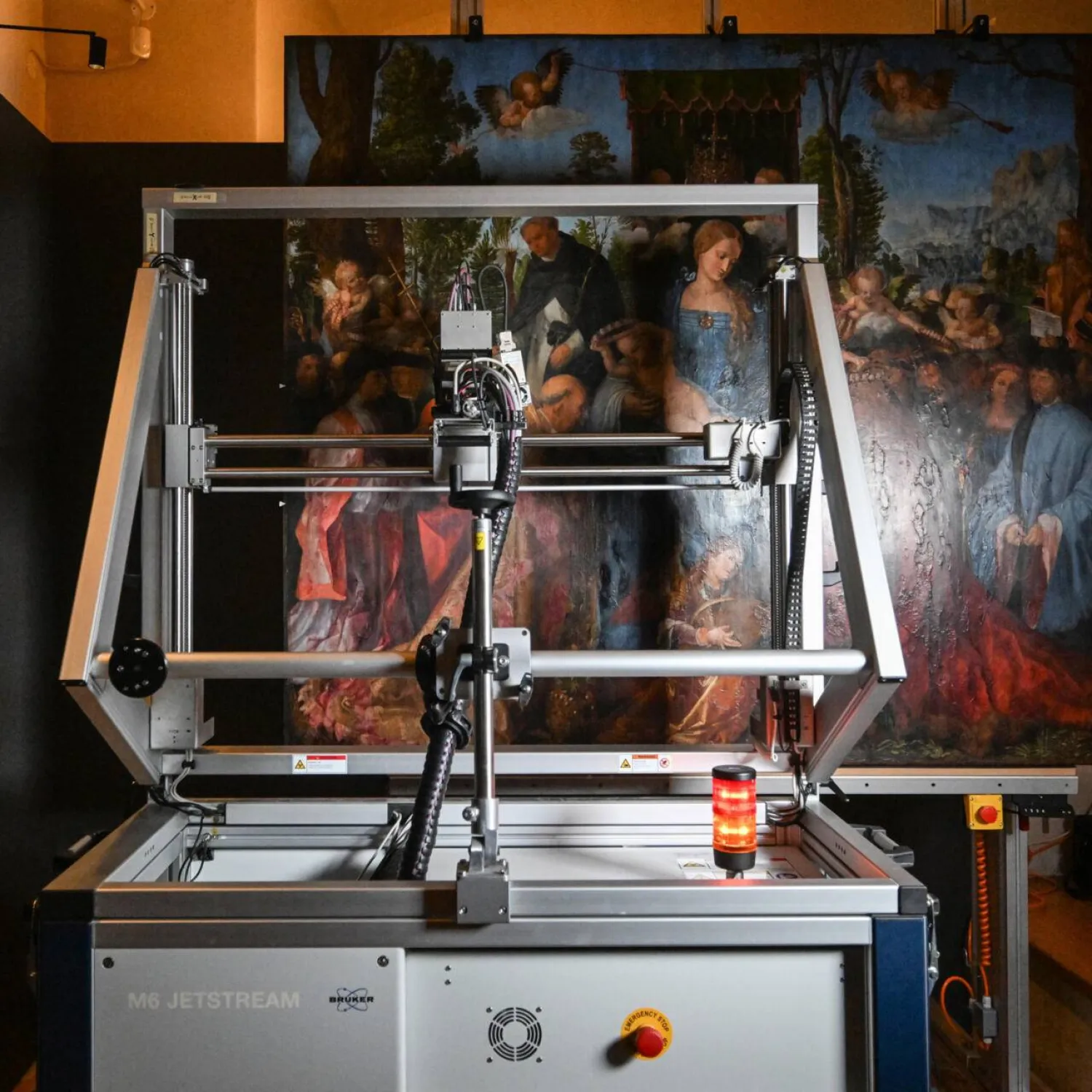
Prague's National Gallery expects to complete the reconstruction of Albrecht Duerer's "Feast of the Rosary" by 2031. Michal CIZEK / AFP
TT

Battered Duerer Masterpiece Up for Five-year Revamp

Prague's National Gallery expects to complete the reconstruction of Albrecht Duerer's "Feast of the Rosary" by 2031. Michal CIZEK / AFP

Albrecht Duerer's "Feast of the Rosary", a Renaissance gem of Prague's National Gallery, is facing a painstaking five-year reconstruction designed to set right five centuries of mistreatment and damage.

Experts have pointed out the poor condition of the colorful painting that the German master created for the San Bartolomeo church in Venice in 1506, said AFP.

"Its state of preservation has been poor since the late sixteenth century," University of Texas art historian Jeffrey Chipps Smith wrote in a 2007 review.

True to the Venetian technique, Duerer used oil on poplar wood to depict the Virgin Mary holding a baby Jesus handing out rose garlands to believers including future Emperor Maximilian I and Pope Julius II.

But the material did not last and countless repairs and moves caused damage requiring an extensive revamp, National Gallery head Olga Kotkova told AFP.

"People say paintings are an organism similar to people, and when someone lives a reprehensible life, it is reflected in their faces," she said.

"It's similar with works of art."

Also known as "The Feast of the Rose Garlands", the painting will undergo scans to reveal "the tiniest details", said Adam Pokorny, chief restorer at the National Gallery.

To map the composition of the painting, the gallery will use macro-XRF scanning employed in the ongoing reconstruction of Rembrandt's "The Night Watch" by the Rijksmuseum in Amsterdam.

"We are also planning to make a 3D model of the painting, which will be useful to understand the condition of the wooden base," Pokorny told reporters.

- The lost fly -

A book published by the National Gallery on the 500th anniversary of the painting details its history.

Commissioned by the Confraternity of the Most Holy Rosary, a Catholic association sheltered by the Dominican order, the painting was praised widely and drew crowds of German worshippers to Venice.

It was carried on foot to Prague in 1606 when Holy Roman Emperor Rudolph II bought it for his collection.

It escaped looting by the Swedish army during the Thirty Years' War but fell into oblivion as Rudolph's collection was plundered.

Described as "completely destroyed" in an 18th-century inventory, the painting changed hands several times before ending up at the Strahov monastery near Prague Castle in 1793.

It underwent the first repair before the move to Prague, and other attempts followed, crowned by the efforts in 1839-1841 of Czech painter Johann Gruss, who was criticized for changing its surface and appearance.

"The paint has begun to fall off on the border between the original Duerer and Gruss's repair, millimeter by millimeter. The revamp is essential," said Kotkova.

Over the centuries, the painting has also lost a disputed element -- a fly that Duerer painted on Mary's knee.

In 1934, the state bought it for 9.6 million koruna, a record price for an art purchase by the government at the time, after the monastery rejected even higher foreign offers.

It spent World War II hidden in shelters.

Kotkova said only 75-80 percent of the work in its current state was still Duerer's "beautiful painting".

Pokorny said its "visual rehabilitation", in consultation with an international committee, would involve fixing the paint, removing poor-quality retouches and repairing the wooden base.

"With this scenario, we are looking at completion in 2031," Pokorny said.


Culture Ministry: Level of Rome Colosseum Closed After Worker Death

FILE PHOTO: People walk across restored southern ambulatory areas of the Colosseum, in Rome, Italy, March 17, 2026. REUTERS/Yara Nardi/File Photo
TT

Culture Ministry: Level of Rome Colosseum Closed After Worker Death

FILE PHOTO: People walk across restored southern ambulatory areas of the Colosseum, in Rome, Italy, March 17, 2026. REUTERS/Yara Nardi/File Photo

The second level of the ancient Colosseum in Rome, a top tourist destination, was closed Wednesday due to the death of a worker inside overnight, the Culture Ministry said in a statement.

"Andrea Moretti, a specialist high-altitude rope access worker... died last night inside the Flavian Amphitheatre following a workplace accident," the ministry said.

"As a mark of mourning, the (Colosseum Archaeological) Park has decided to close to the public for the day the second-tier section where the accident occurred," AFP quoted it as saying.

It gave no further details but said police were working to determine the circumstances of the incident.

Minister of Culture Alessandro Giuli expressed "our deepest, heartfelt condolences to all for the senseless death of a young man while at work."

The Colosseum, the largest amphitheater in the world, was built in the first century and was used to host events like animal hunts and gladiatorial games.

It could hold around 50,000 spectators.

The monument gets up to 20,000 visitors a day at peak times.


Museums Commission Marks Saudi National Day with Cultural Programs

The Museums Commission logo
TT

Museums Commission Marks Saudi National Day with Cultural Programs

The Museums Commission logo

The Museums Commission has announced a special program of celebrations marking Saudi National Day across its museums, with the National Museum of Saudi Arabia in Riyadh, the Red Sea Museum and Tarek Abdulhakim Museum in Jeddah hosting dedicated events starting Wednesday.

The programs invite families and visitors of all ages to celebrate the national occasion through the stories, traditions and cultural expressions held within the Kingdom’s museums.

Inspired by this year’s Saudi National Day identity, “Our Pride in Our Nature,” the celebrations reflect the commission’s vision of museums as living national spaces, places where the Kingdom’s past is not only displayed, but experienced, shared and carried forward.

Each museum has developed a program rooted in its own identity: the National Museum guides visitors through the story of the Kingdom’s unification and the making of its national identity, the Red Sea Museum celebrates the occasion through the lens of Jeddah and the Red Sea, and Tarek Abdulhakim Museum brings the celebration to life through music, learning and creative family experiences.

From September 23 to 26, the National Museum will present an interactive journey that takes visitors through a series of stations across the museum, each revealing a different part of the story that shaped the Kingdom’s identity.

The journey opens with a shadow-theater performance telling the story of King Abdulaziz’s vision and the unification of the Kingdom, before leading visitors through stations dedicated to national figures who left their mark on the Kingdom’s history, the diversity of its regions, and the symbols, customs, and traditions passed down through generations.

Throughout the celebration, the museum lobby will feature live folk-art performances from across the Kingdom’s regions, presented in collaboration with the Theater and Performing Arts Commission.

Families can also enjoy interactive games and creative activities, alongside a new sensory discovery wall designed especially for the museum’s youngest visitors and a dedicated recording station where visitors can share their own messages about the Kingdom and its future.

On Wednesday, the Red Sea Museum, housed in the historic Bab Al-Bunt building in Jeddah, will host a full day of celebrations from morning until night. Families and children will be welcomed with all-day activities including national-themed face painting, creative coloring sessions and guided tours exploring the museum’s building, collections and stories connected to the Kingdom.

Coinciding with the International Day of Sign Languages, the museum will present “A Nation’s Story,” an inclusive storytelling experience delivered with Saudi Sign Language interpretation and open to Deaf children and people with disabilities, inviting children to reflect on the meaning of homeland, belonging and national identity.

The celebration will also mark the launch of Minaa Encounters, a new recurring platform supporting emerging Saudi photographers, artists and creative talent. Its first edition, “Between Sea and Stone,” invites visitors to rediscover Jeddah and its port through the work of emerging Saudi photographers, who will be present to discuss their work with the public from September 23 to 25. The showcase will remain on display until September 30.

Also from September 23 to 25, Tarek Abdulhakim Museum will celebrate Saudi National Day through a series of musical workshops and interactive experiences for children and families.

Held daily from 4:00 p.m. to 10:00 p.m., the program invites visitors to explore the Kingdom’s rich musical traditions through hands-on activities.

Designed to encourage participation and discovery, the workshops offer visitors of all ages an opportunity to engage with music as an important part of Saudi Arabia’s cultural heritage.


Hegra Highlights Status as Saudi Arabia’s First UNESCO World Heritage Site

Hegra Highlights Status as Saudi Arabia’s First UNESCO World Heritage Site
TT

Hegra Highlights Status as Saudi Arabia’s First UNESCO World Heritage Site

Hegra Highlights Status as Saudi Arabia’s First UNESCO World Heritage Site

The Kingdom of Saudi Arabia, a land that has witnessed successive civilizations whose traces remain across its regions, is home to AlUla Governorate, where the Hegra Archaeological Site stands as part of this rich human heritage.

It was the first Saudi site inscribed on the UNESCO World Heritage List, a testament to Saudi Arabia’s deep civilizational heritage and its commitment to preserving and safeguarding it for future generations.

As Saudi Arabia celebrates Saudi National Day, Hegra evokes part of the history of the Arabian Peninsula and the civilizational and cultural exchanges that took place across the region through the ages, according to SPA.

The Hegra Archaeological Site was inscribed on the UNESCO World Heritage List in 2008, becoming the first Saudi site to be added to the list, in an achievement that reflects its exceptional historical and civilizational significance. The site contains archaeological remains and carved rock facades that showcase the Nabataeans’ engineering and sculptural expertise.

Saudi Arabia, represented by the Royal Commission for AlUla (RCU), pays particular attention to the Hegra Archaeological Site through comprehensive efforts to preserve the site and safeguard its archaeological and historical components.

These conservation efforts are complemented by archaeological studies, surveys, and research conducted by the RCU in cooperation with experts and academic institutions.

Hegra remains one of the Kingdom’s most prominent heritage sites and a destination for visitors and researchers from around the world.