


US Returns Stolen Antiquities Worth $5 Million to Syria

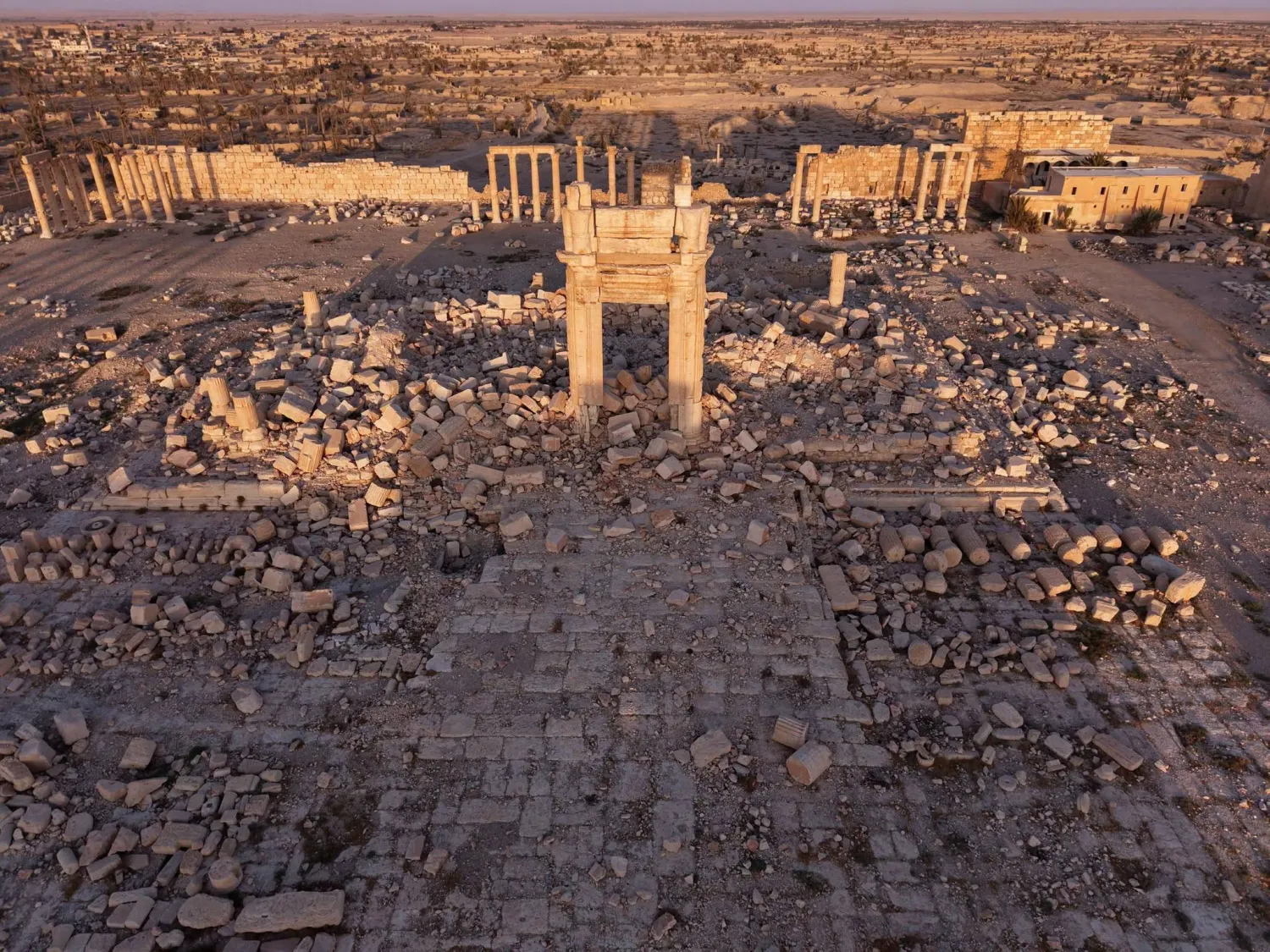
The Palmyran stone was removed from the UNESCO World Heritage site Palmyra before ISIS members destroyed much of the city from 2015 to 2017. (Reuters)
TT

US Returns Stolen Antiquities Worth $5 Million to Syria

The Palmyran stone was removed from the UNESCO World Heritage site Palmyra before ISIS members destroyed much of the city from 2015 to 2017. (Reuters)

US officials announced Wednesday the return of 36 stolen antiquities to Syria, including a stone trafficked during the ISIS group's destruction of the ancient site of Palmyra.

Authorities seized the items, collectively valued at more than $5 million, from New York's Metropolitan Museum of Art and several ancient art collectors.

"Repatriation ceremonies are a powerful reminder that preserving cultural heritage transcends any border or nationality," said Manhattan District Attorney Alvin Bragg.

The Palmyran stone was removed from the UNESCO World Heritage site Palmyra before ISIS members destroyed much of the city from 2015 to 2017, according to a press release.

Weighing more than 450 kilograms, the carved limestone sculpture depicts a reclining male surrounded by a woman and three children.

The United States has returned looted antiquities over the years to several countries, including China, Greece and Italy.

Mohammad Kanatri, Syria's charge d'affaires in Washington, said the transfer demonstrates how "a shared commitment to protecting cultural heritage can build lasting bridges between our two countries."

"Through Syrian-American cooperation, a part of Syria's history is finally returning home thanks to the efforts of the Manhattan District Attorney's Office," he said in a statement.

Four of the antiquities were seized from American collector Michael Steinhardt, who in 2021 returned about 180 items stolen from around the world as part of a deal with the US government. The pieces had a total value of $70 million.

The Manhattan District Attorney's office said the 13 items seized from the Met were among 402 antiquities valued at $98.7 million that it has taken from the cultural institution since 2017.



Ministry: Archeological 'Breakthrough' Could Confirm Origins of Paris

Paris Mayor Emmanuel Gregoire visits an archaeological site following the discovery of a Gallo-Roman era wall of Lutetia under the Hotel-Dieu hospital on the Ile de la Cite in central Paris, on September 22, 2026. (Photo by SIMON WOHLFAHRT / AFP)
TT

Ministry: Archeological 'Breakthrough' Could Confirm Origins of Paris

Paris Mayor Emmanuel Gregoire visits an archaeological site following the discovery of a Gallo-Roman era wall of Lutetia under the Hotel-Dieu hospital on the Ile de la Cite in central Paris, on September 22, 2026. (Photo by SIMON WOHLFAHRT / AFP)

An ancient wall discovered beneath Paris was described as a "major breakthrough" on Wednesday by France's culture ministry, with the archaeological find possibly confirming the location of the city's original settlement.

A roughly 20-meter (65-foot) wall dating from the Gallo-Roman period was discovered in Paris this summer beneath a hotel on the Ile de la Cite, a stone's throw from Notre Dame Cathedral in the heart of the City of Light.

The stone-and-wood find is thought to be a fragment of the ramparts of Lutetia -- the ancient name for Paris -- built by the Gallic Parisii tribe which lived along the river Seine in the Iron Age.

The Ile de la Cite has traditionally been regarded as the center of Lutetia, but a rival theory, backed by archaeological research, contends that it was in Nanterre, a suburb to the west.

"We may be looking at one of the most important remains ever discovered for understanding Gallic Lutetia," Culture Minister Catherine Pegard said in a statement from her ministry which was sent to AFP.

"Scientific caution still requires that we verify its function and its chronology, but the convergence of evidence is particularly remarkable at this stage."

Lutetia was first mentioned in book seven of Roman leader Julius Caesar's "Gallic Wars" series, where it was said to be on an island in the river Seine -- a vague description that has given rise to many theories about its location.

The wall, uncovered in the course of excavations beneath the Hotel-Dieu, also bears traces of fire, which may correspond to Caesar's account that the Gauls set fire to their town before the Battle of Lutetia against the Romans.

Through carbon dating technology, the charred evidence is estimated to date from 10-200 BC, the ministry said in its statement -- a timeframe that includes the Battle of Lutetia in 52 BC.

The Ile de la Cite, home to Notre Dame cathedral, is the largest island in the river Seine in the Paris region and became the center of the Roman settlement of Lutetia.


Battered Duerer Masterpiece Up for Five-year Revamp

Prague's National Gallery expects to complete the reconstruction of Albrecht Duerer's "Feast of the Rosary" by 2031. Michal CIZEK / AFP
TT

Battered Duerer Masterpiece Up for Five-year Revamp

Prague's National Gallery expects to complete the reconstruction of Albrecht Duerer's "Feast of the Rosary" by 2031. Michal CIZEK / AFP

Albrecht Duerer's "Feast of the Rosary", a Renaissance gem of Prague's National Gallery, is facing a painstaking five-year reconstruction designed to set right five centuries of mistreatment and damage.

Experts have pointed out the poor condition of the colorful painting that the German master created for the San Bartolomeo church in Venice in 1506, said AFP.

"Its state of preservation has been poor since the late sixteenth century," University of Texas art historian Jeffrey Chipps Smith wrote in a 2007 review.

True to the Venetian technique, Duerer used oil on poplar wood to depict the Virgin Mary holding a baby Jesus handing out rose garlands to believers including future Emperor Maximilian I and Pope Julius II.

But the material did not last and countless repairs and moves caused damage requiring an extensive revamp, National Gallery head Olga Kotkova told AFP.

"People say paintings are an organism similar to people, and when someone lives a reprehensible life, it is reflected in their faces," she said.

"It's similar with works of art."

Also known as "The Feast of the Rose Garlands", the painting will undergo scans to reveal "the tiniest details", said Adam Pokorny, chief restorer at the National Gallery.

To map the composition of the painting, the gallery will use macro-XRF scanning employed in the ongoing reconstruction of Rembrandt's "The Night Watch" by the Rijksmuseum in Amsterdam.

"We are also planning to make a 3D model of the painting, which will be useful to understand the condition of the wooden base," Pokorny told reporters.

- The lost fly -

A book published by the National Gallery on the 500th anniversary of the painting details its history.

Commissioned by the Confraternity of the Most Holy Rosary, a Catholic association sheltered by the Dominican order, the painting was praised widely and drew crowds of German worshippers to Venice.

It was carried on foot to Prague in 1606 when Holy Roman Emperor Rudolph II bought it for his collection.

It escaped looting by the Swedish army during the Thirty Years' War but fell into oblivion as Rudolph's collection was plundered.

Described as "completely destroyed" in an 18th-century inventory, the painting changed hands several times before ending up at the Strahov monastery near Prague Castle in 1793.

It underwent the first repair before the move to Prague, and other attempts followed, crowned by the efforts in 1839-1841 of Czech painter Johann Gruss, who was criticized for changing its surface and appearance.

"The paint has begun to fall off on the border between the original Duerer and Gruss's repair, millimeter by millimeter. The revamp is essential," said Kotkova.

Over the centuries, the painting has also lost a disputed element -- a fly that Duerer painted on Mary's knee.

In 1934, the state bought it for 9.6 million koruna, a record price for an art purchase by the government at the time, after the monastery rejected even higher foreign offers.

It spent World War II hidden in shelters.

Kotkova said only 75-80 percent of the work in its current state was still Duerer's "beautiful painting".

Pokorny said its "visual rehabilitation", in consultation with an international committee, would involve fixing the paint, removing poor-quality retouches and repairing the wooden base.

"With this scenario, we are looking at completion in 2031," Pokorny said.


Culture Ministry: Level of Rome Colosseum Closed After Worker Death

FILE PHOTO: People walk across restored southern ambulatory areas of the Colosseum, in Rome, Italy, March 17, 2026. REUTERS/Yara Nardi/File Photo
TT

Culture Ministry: Level of Rome Colosseum Closed After Worker Death

FILE PHOTO: People walk across restored southern ambulatory areas of the Colosseum, in Rome, Italy, March 17, 2026. REUTERS/Yara Nardi/File Photo

The second level of the ancient Colosseum in Rome, a top tourist destination, was closed Wednesday due to the death of a worker inside overnight, the Culture Ministry said in a statement.

"Andrea Moretti, a specialist high-altitude rope access worker... died last night inside the Flavian Amphitheatre following a workplace accident," the ministry said.

"As a mark of mourning, the (Colosseum Archaeological) Park has decided to close to the public for the day the second-tier section where the accident occurred," AFP quoted it as saying.

It gave no further details but said police were working to determine the circumstances of the incident.

Minister of Culture Alessandro Giuli expressed "our deepest, heartfelt condolences to all for the senseless death of a young man while at work."

The Colosseum, the largest amphitheater in the world, was built in the first century and was used to host events like animal hunts and gladiatorial games.

It could hold around 50,000 spectators.

The monument gets up to 20,000 visitors a day at peak times.