


KSGAAL Opens Fifth Annual International Conference on Arabic Language and Culture

The conference highlights the pivotal role of the Arabic language in shaping cultural identity - SPA
TT

KSGAAL Opens Fifth Annual International Conference on Arabic Language and Culture

The conference highlights the pivotal role of the Arabic language in shaping cultural identity - SPA

The King Salman Global Academy for Arabic Language (KSGAAL) opened its fifth annual international conference today in Riyadh, convening prominent researchers, linguists, and cultural scholars from Saudi Arabia and abroad for a two-day forum.

The conference highlights the pivotal role of the Arabic language in shaping cultural identity, collective memory, and intellectual discourse, while exploring its contributions to civilizational exchange, translation, and intercultural dialogue, SPA reported.

Sessions explore six key themes: language and cultural identity, language and civilizational interaction, language and intellectual and artistic creativity, language and digital culture, language and cultural policies, and language and the prospects for the cultural future.

The gathering serves as an international platform to exchange scholarly expertise, discuss emerging research in linguistic sciences, and advance initiatives that strengthen the presence of the Arabic language across global academic and cultural spheres.


AlUla Manara Marks World Space Week with Educational, Cultural Programs

Wednesday and Thursday will feature children’s crafts and storytelling activities, along with a family stargazing experience - SPA
TT

AlUla Manara Marks World Space Week with Educational, Cultural Programs

Wednesday and Thursday will feature children’s crafts and storytelling activities, along with a family stargazing experience - SPA

AlUla Manara team, part of the Royal Commission for AlUla, will launch “World Space Week” events tomorrow, running through October 8, with educational and cultural activities on astronomy and space sciences that offer visitors and enthusiasts a range of astronomical experiences.

The events will begin with a stargazing evening, and Tuesday will include an event exploring how ancestors used the stars to track changing seasons, SPA reported.

Wednesday and Thursday will feature children’s crafts and storytelling activities, along with a family stargazing experience.

Under the team’s supervision, licensed astronomy and tourism companies will offer excursions and experiences at various locations, including telescope-based observations of planets, stars, and other celestial bodies.

AlUla’s natural environment and clear skies provide ideal conditions for stargazing. Several sites are accredited by DarkSky International, reflecting efforts to preserve the night sky and reduce light pollution, and reinforcing AlUla’s status as an astrotourism destination.


Stone Towers of Aseer: A Legacy of Defense and Storage

Builders in Aseer used thick walls, narrow entrances, and tall structures for protection and storage, while some wooden doors were small and thick to enhance fortification - SPA
TT

Stone Towers of Aseer: A Legacy of Defense and Storage

Builders in Aseer used thick walls, narrow entrances, and tall structures for protection and storage, while some wooden doors were small and thick to enhance fortification - SPA

The “qasabat” (watchtowers) stand among houses and farms in several villages of old Aseer Region, bearing witness to an architectural tradition closely linked to residents’ security and daily lives.

Depending on their design and function, they monitored roads and village entrances and stored grain and provisions, forming part of the region’s architectural and social heritage.

The qasaba, the singular form of qasabat, is one of the architectural forms for which the villages of Aseer are known, the Saudi Press Agency reported.

Examples include tall, cylindrical towers, while others vary in design, including grain-storage qasabat, depending on the local environment and the function for which they were built.
The location and height of the qasaba were key to its defensive function, allowing it to monitor the surrounding area. Some were fitted with windows and small openings at the top for surveillance and defense, enabling residents to detect potential threats and respond early.
The construction of the qasabat relied on locally available materials, chiefly stone, mud, and timber.
Builders in Aseer used thick walls, narrow entrances, and tall structures for protection and storage, while some wooden doors were small and thick to enhance fortification.
Today, the qasaba stands as more than just an old tower; it is a stone-and-mud record of a period in Aseer’s social and architectural history.


Syrian Culture Minister Visits Madinah Research and Studies Center

Syrian Minister of Culture Mohammed Yassin Saleh at the Madinah Research and Studies Center. (SPA)
TT

Syrian Culture Minister Visits Madinah Research and Studies Center

Syrian Minister of Culture Mohammed Yassin Saleh at the Madinah Research and Studies Center. (SPA)

Syrian Minister of Culture Mohammed Yassin Saleh visited on Thursday the Madinah Research and Studies Center, where he reviewed the center's scientific and cultural work and projects, as well as its efforts to document the history of Madinah and preserve its heritage and civilizational legacy.

He toured the center's facilities and specialized library, reviewing its wealth of sources, references, and scholarly collections dedicated to the history, landmarks, and heritage of Madinah, as well as the knowledge and research services it provides to researchers and those interested in the city's history.

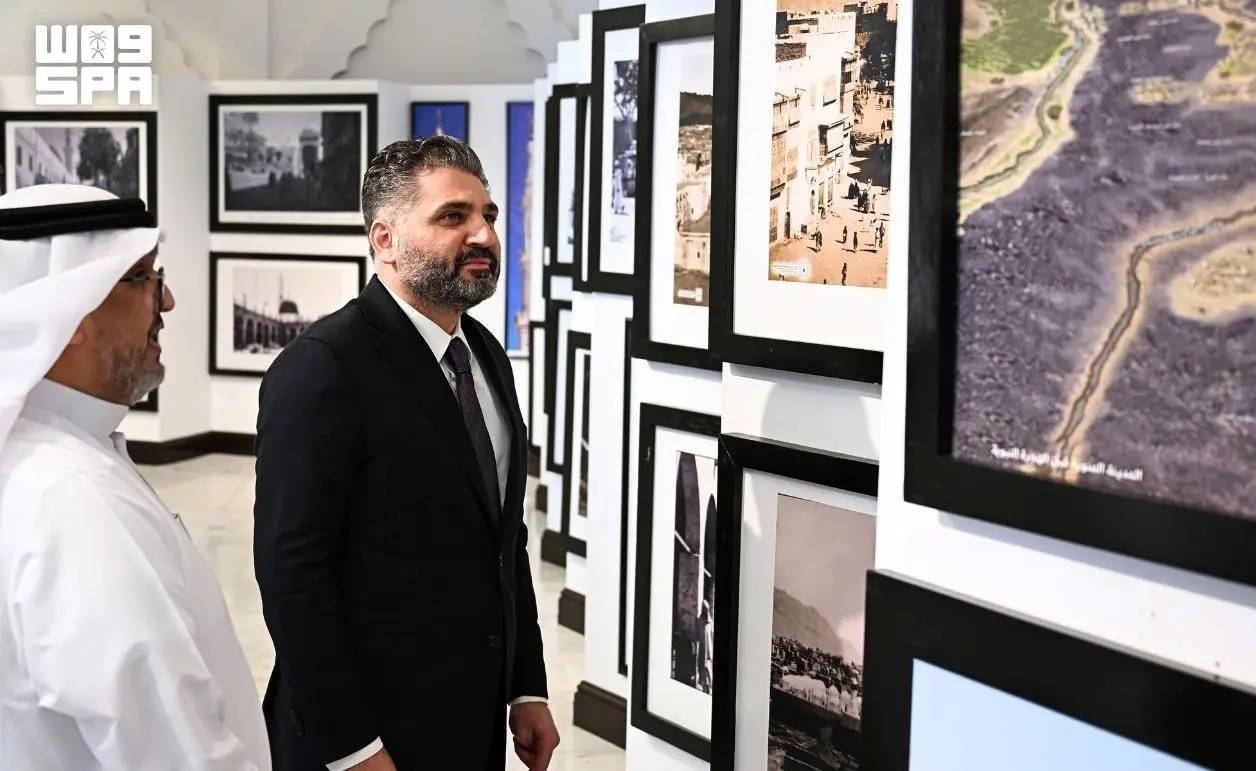
He also visited the Rare Photographs of Madinah Exhibition, where he viewed part of its collections documenting the historical and urban developments the city has undergone.

Syrian Minister of Culture Mohammed Yassin Saleh tours the Madinah Research and Studies Center. (SPA)

Saleh was briefed on the center's efforts to collect, preserve, catalog, and make available historical sources, documents, and photographs, in addition to its work in research, documentation, and scholarly publishing.

He reviewed its efforts to preserve the history of Madinah and the Two Holy Mosques, along with their historical, cultural, and civilizational heritage.

The minister praised the center's scientific and cultural role and its efforts to preserve the history and heritage of Madinah and safeguard historical sources and materials related to the Two Holy Mosques.

He commended its contributions to supporting scientific research, enriching knowledge, and preserving cultural heritage.
