


Makkah's Traditional Architecture Inspires Modern Urban Identity

Among the most prominent features of the traditional Makkah house are the Rawashin - SPA
TT

Makkah's Traditional Architecture Inspires Modern Urban Identity

Among the most prominent features of the traditional Makkah house are the Rawashin - SPA

Makkah's architecture reflects a long history in which an identity closely linked to the city's religious stature was formed, shaped by its geographical, climatic, and social environment to produce a distinct style that combines functionality and beauty.

Among the most prominent features of the traditional Makkah house are the Rawashin, projecting wooden windows and balconies that regulated light and air, reduced solar glare, ensured privacy, and gave facades their aesthetic character, SPA reported.

They are distinguished by their varied sizes, shapes, and intricate decorations, reflecting craftsmen's skill in merging practical requirements with artistic value.

The Royal Commission for Makkah City and Holy Sites has developed urban guidelines drawing on the city's architectural heritage to enhance the cityscape and integrate aesthetic, functional, and sustainability considerations. These guidelines are inspired by traditional elements including Rawashin, arched windows, recessed entrances, lattice patterns, and earth-tone colors.

Makkah's architecture today presents a model of balance between preserving identity and keeping pace with development, reinterpreting accumulated local knowledge and artistic values to meet the needs of the modern city.



KSGAAL Signs MoU with Jordan Academy of Arabic

KSGAAL Signs MoU with Jordan Academy of Arabic
TT

KSGAAL Signs MoU with Jordan Academy of Arabic

KSGAAL Signs MoU with Jordan Academy of Arabic

As part of its fifth annual international conference, themed "Arabic Language and Culture: Intersections and Dimensions," King Salman Global Academy for Arabic Language (KSGAAL) signed a memorandum of understanding (MoU) with the Jordan Academy of Arabic.

The agreement aims to foster cooperation in serving the Arabic language and its associated disciplines. It also establishes a framework for joint action to facilitate the exchange of expertise and integration of capabilities between the two academies.

KSGAAL was represented at the signing by its Secretary-General Dr. Abdullah bin Saleh Al-Washmi, while the Jordan Academy of Arabic was represented by its President Dr. Mohammad Adnan Al-Bakhit. The MoU was signed remotely.

The agreement outlines areas of cooperation, including research, studies, and scholarly projects related to the Arabic language and its sciences. It also covers the publication, translation, and printing of studies and the implementation of specialized training programs in linguistic sciences, SPA reported.

The MoU also covers the administration of the "Hamza" academic Arabic proficiency test for non-native speakers and the development of digital dictionaries and linguistic corpora. These resources will be made accessible through the "SIWAR" Linguistic Lexicon platform and the "FALAK" Linguistic Corpus platform. The two academies will also exchange linguistic and cultural data.

The memorandum provides for World Arabic Language Day celebrations and the organization of exhibitions, linguistic competitions, events, academic programs, seminars, training courses, and panel discussions. These activities aim to serve the Arabic language and enhance its presence, along with other areas agreed upon by both parties.


Prince Mohammed bin Salman Center Promotes Arabic Calligraphy Through Specialized Training

These initiatives support the center's efforts to develop the skills of practitioners and enthusiasts  - SPA
These initiatives support the center's efforts to develop the skills of practitioners and enthusiasts - SPA
TT

Prince Mohammed bin Salman Center Promotes Arabic Calligraphy Through Specialized Training

These initiatives support the center's efforts to develop the skills of practitioners and enthusiasts  - SPA
These initiatives support the center's efforts to develop the skills of practitioners and enthusiasts - SPA

The Prince Mohammed bin Salman Global Center for Arabic Calligraphy is conducting a series of specialized training programs and courses in Arabic calligraphy during the last quarter of 2026 across Madinah, Riyadh, and Dammam.

These initiatives support the center's efforts to develop the skills of practitioners and enthusiasts while promoting the art form as a key component of the Kingdom's cultural identity, SPA reported.

The programs support practitioners of all nationalities and contribute to the preservation of Arabic calligraphy by passing on its knowledge and skills to future generations.


Italy’s Lecce… Florence of the South

The city has an ancient history that stretches back more than 2,000 years (Getty Images) 
TT

Italy’s Lecce… Florence of the South

The city has an ancient history that stretches back more than 2,000 years (Getty Images) 

‘The best way to experience Lecce is to walk around looking up.’

That is what a tourist is told shortly after arriving in the second-largest city in Italy’s Puglia region, often described as the “Florence of the South.”

And not because it is a place filled with skyscrapers like New York. Rather, because so much of its beauty is built into its exquisite architecture, according to London’s Metro newspaper.

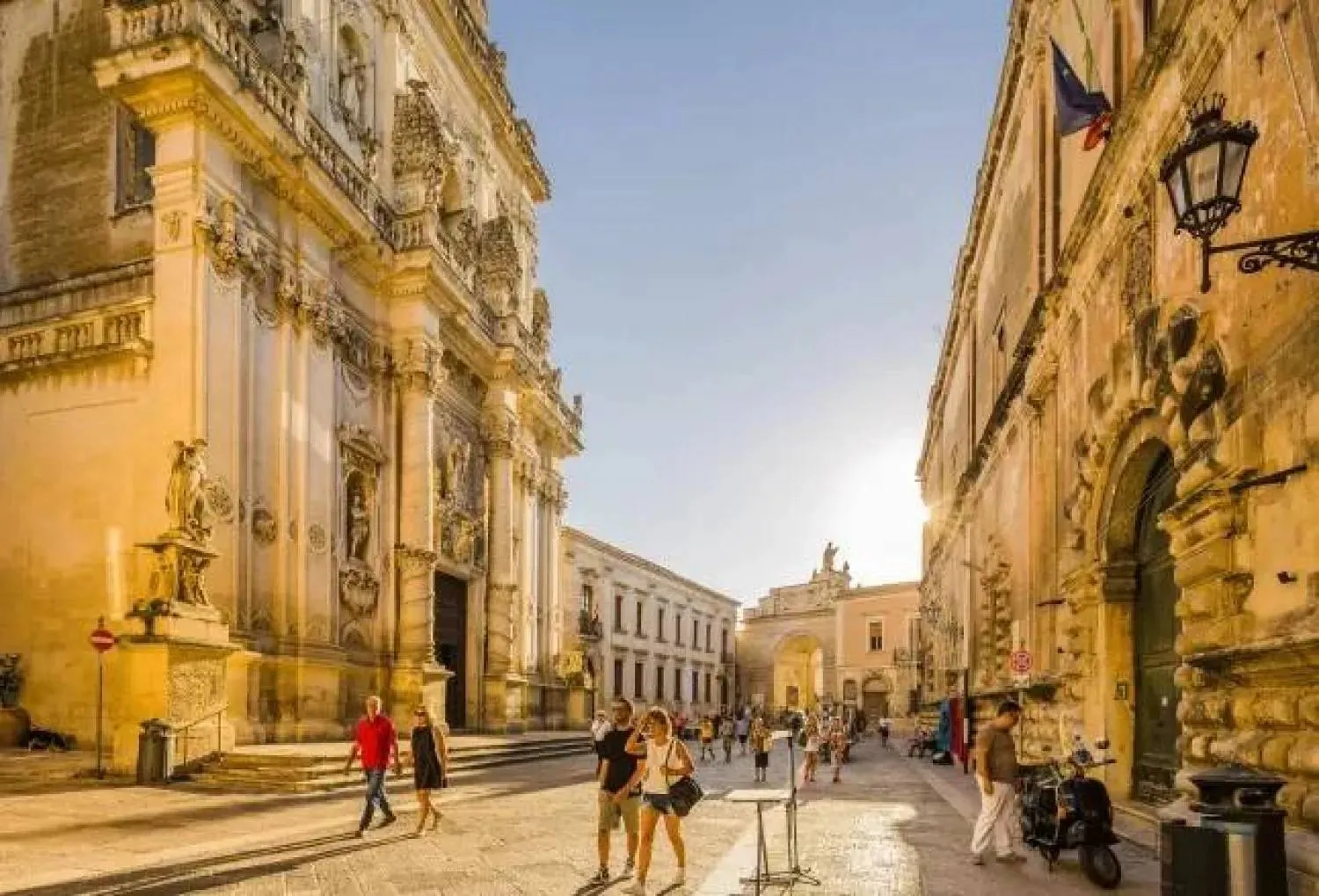
The cobbled streets are steeped in history, and every Baroque-era building tells a story, much like its northern sister.

Florence attracts millions of tourists each year, many of them drawn by world-famous masterpieces.

There are frescoes by Giotto, canvases by Botticelli, and sculptures by Michelangelo — it is the cradle of the Renaissance, after all.

As for Lecce, the city sits in the Salento peninsula of Puglia, and its honey-drenched limestone is its dominant feature.

Much like Florence, you are never far from a church. Again and again, you see an unassuming facade and find an incredible duomo inside.

Nothing compares to Lecce Cathedral, built in the 12th century in the heart of the historic center, the Piazza del Duomo.

You could spend hours taking in the intricacies of the artwork: pillars romanticized with tiny cherubs, altars carved in gold and huge stone fonts.

Remembering the advice, tourists should look up at the ceiling and find a version of The Last Supper, painted by Giuseppe da Brindisi.

By night, the streets of Lecce are a gorgeous setting for walking off hearty meals, shopping and finding hidden gems like secret gardens in courtyards.

Lecce is smaller than Florence and less crowded, but is just as impressive. This city might be big on siestas, but it’s certainly not one to be slept on.