


After Louvre Heist and String of Thefts, Europe’s Smaller Museums Are on Guard

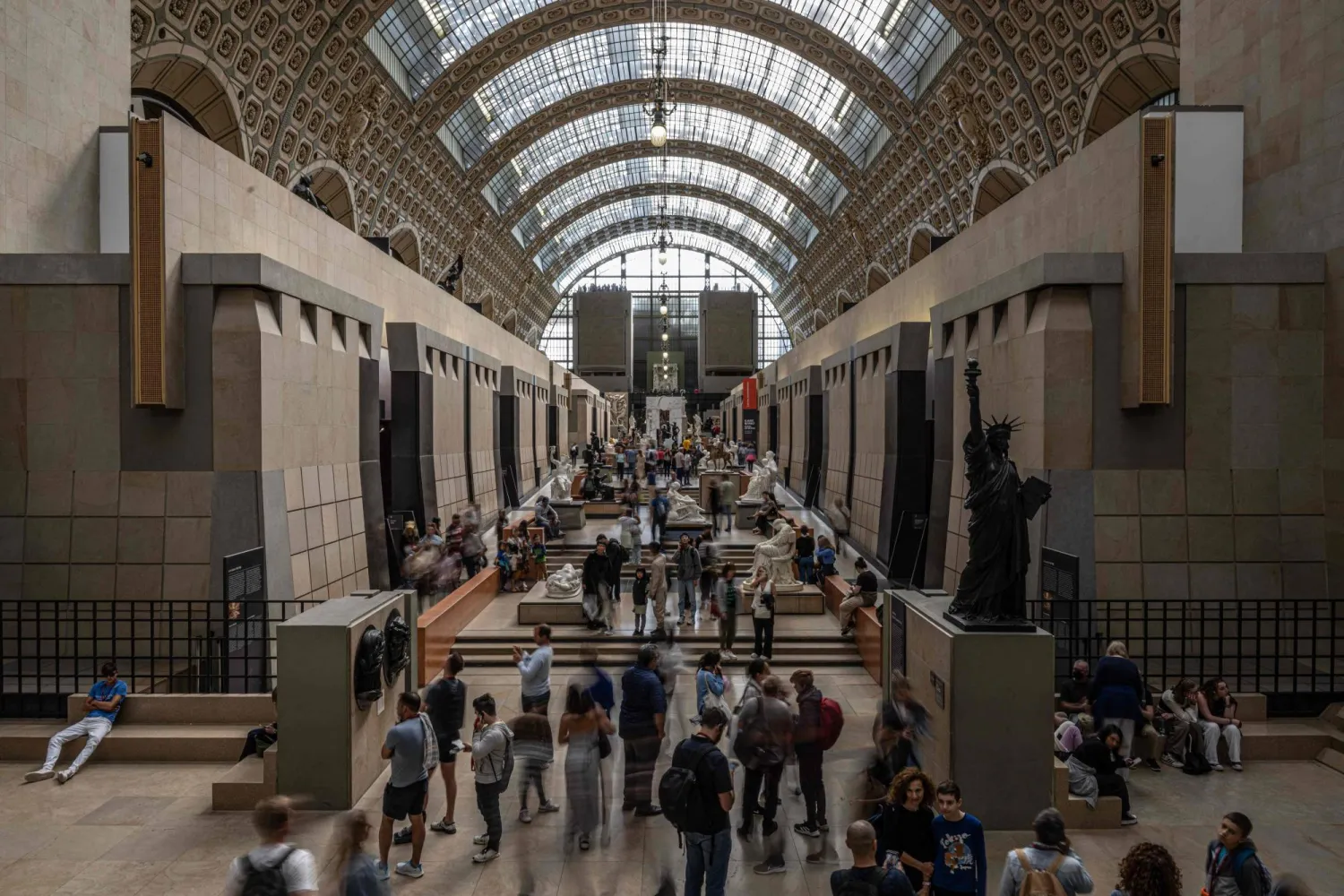
People visit The Orsay Museum in Paris, on August 30, 2023. (AFP)
TT

After Louvre Heist and String of Thefts, Europe’s Smaller Museums Are on Guard

People visit The Orsay Museum in Paris, on August 30, 2023. (AFP)

Two men wearing head torches climbed through a forced-open window ‌at the Fondazione Magnani Rocca museum near Parma on the night of March 22 and calmly lifted artworks by Cézanne, Renoir and Matisse from the walls.

Within three minutes, they had passed the works, valued at about €9 million ($10 million), to an accomplice and fled. At the museum's main gate, a fourth man discharged a fire extinguisher when the alarm sounded, distracting the custodian.

"Whatever could go wrong, did," said Stefano Roffi, director of the private foundation that runs the museum.

The raid was one of a string of museum thefts in France, Italy and Spain since last year's heist at the Louvre in Paris, raising concerns that criminals are increasingly targeting smaller institutions with fewer resources to protect valuable collections.

"This is where we see the 'Louvre effect'," said Marc Balcells, a Barcelona-based researcher specializing in crimes against cultural heritage. "If the Louvre was so easy to rob, just imagine a tiny museum in a rural area or a smaller town."

Works by Antonello da Messina vanished from a museum in his Sicilian hometown in August, while two Renoirs were stolen from Cagnes-sur-Mer on the French Riviera the following month.

In Spain, thieves stole hundreds of historic gold coins from museums in Badajoz and Albacete and made off with a Bronze Age treasure in Villena, near Alicante.

A 2024 survey by France's Culture Ministry found only one in four cultural institutions had an emergency and risk-prevention plan, while nearly half lacked video surveillance.

WHO CHECKS WHEN THE ALARM GOES OFF?

A French parliamentary report in May said museums lacked ‌the resources and preparation ‌to adequately protect artworks and artifacts.

In Italy, the challenge is amplified by the way the country's cultural heritage is spread across ‌hundreds ⁠of towns and institutions, ⁠a legacy of centuries of fragmented rule.

"That is also what makes our system distinctive: works remain in the places where they were created,” said Antonella Pinna, president of the Italian committee of the International Council of Museums. "But we need to make life harder for criminals."

The council worked with Italy's Culture Ministry and the Carabinieri on museum security guidelines published in 2015, but Pinna said technology alone was not enough.

"If an alarm goes off, someone has to make sure it is checked," she said.

In a narrow street in the Tuscan town of Sansepolcro, the civic museum displays four works by Renaissance master Piero della Francesca, born just steps away in the 15th century.

The Louvre theft "affected us deeply because cultural heritage is central to Sansepolcro's identity. It is our soul," culture councilor Francesca Mercati told Reuters.

After the Louvre raid, officers from the Carabinieri's cultural heritage protection unit recommended more cameras, longer retention of CCTV footage and tighter controls on bags and bulky ⁠clothing.

"We immediately implemented those recommendations," Mercati said.

A VAST NETWORK TO PROTECT

The scale of the challenge is daunting.

Italy has more than ‌4,400 museums and similar institutions, according to national statistics agency ISTAT. Spain has about 1,500 museums, while France has more ‌than 1,200 institutions carrying the official "Musees de France" designation, alongside hundreds of smaller collections.

Protecting such a broad network is particularly difficult for smaller institutions that depend on local funding.

Florence Imbert, a Paris-based ‌security consultant for cultural institutions, said 85% of small French museums were run by local authorities with limited financial resources.

"The budget is key to winning the war," she ‌said.

France's Culture Ministry announced a 33-point security plan in July, backed by €30 million over three years for local museums.

Recent figures suggest concern is warranted. The Carabinieri art squad recorded 17 thefts from Italian museums and galleries in 2025, up from 14 a year earlier.

Europol said in an August report that museum thefts were becoming more forceful and increasingly focused on precious metals, gemstones and other high-value artifacts.

A FAST BUCK?

Unlike gold or jewellery, which can be broken up or melted down, a well-known painting is difficult to turn into quick cash.

Celebrated works such as those by Renoir can rarely be ‌sold openly, Pinna said. Instead, stolen art is more likely to be hidden, used as leverage in ransom attempts or offered privately.

Even when works are recovered, museums can face significant costs linked to investigations, recovery efforts and upgraded security.

The recent thefts have ⁠also reignited debate about insurance.

Most major state-backed museums in ⁠Western Europe rely on government indemnity schemes rather than commercial cover, but some institutions have begun reassessing the risks, said Filippo Guerrini-Maraldi, a private wealth and fine art insurance specialist at broker Howden Specialty.

"And for the first time, really, in my 40-year career, I've seen art theft now becoming more of a major, major risk. It was always the minor risk," he said.

Insurers are also turning to technology. Beazley is exploring how AI can be used to analyze CCTV footage to identify suspicious behavior in museums and galleries, helping security staff spot threats sooner, said fine art underwriter Dishni Mahendran.

SECURITY VS ACCESS

For museum directors and cultural officials, the challenge is how to tighten security without cutting collections off from local communities or diminishing the visitor experience.

"Ultimately, museums must remain easy to access," Imbert said. "People should be able to enter without having to pass through 50 security checks."

Julien Volper, a conservator at Belgium's Africa Museum, said particularly vulnerable treasures should only be displayed when adequate security measures are in place.

"I'm not saying that's the ultimate solution, but it seems better than displaying replicas," he said. "We're not at Disneyland."

In August, the Carabinieri recovered the three artworks stolen from the Parma museum from a cardboard box hidden in an apartment. Five Moldovan nationals were arrested in connection with the theft.

Investigators said wiretaps indicated the suspects had unsuccessfully tried to find buyers in Eastern Europe and Russia.

The works have since returned to the museum in what Roffi called a "homecoming party".

"The theft triggered an outpouring of solidarity in Italy and abroad," he said. The museum now has round-the-clock guards funded by a local cheese consortium.

"It was seen not simply as a theft from a museum, but as an attack on art as a shared cultural heritage."



Red Sea Museum Showcases Jeddah's Black Coral Prayer-Bead Making Heritage

The gallery also features a wall displaying shells, molluscs and pieces of coral from the Red Sea - SPA
TT

Red Sea Museum Showcases Jeddah's Black Coral Prayer-Bead Making Heritage

The gallery also features a wall displaying shells, molluscs and pieces of coral from the Red Sea - SPA

The Red Sea Museum represents a valuable addition to Jeddah's cultural and tourism landscape, offering an educational experience that brings the history of the Red Sea to life and highlights Saudi Arabia’s rich civilization and cultural heritage associated with navigation, trade and Hajj.

As one of Saudi Arabia’s prominent cultural and educational destinations, the museum presents art exhibitions and cultural and educational programs that explore the history and civilization heritage of the Red Sea and document its connection with navigation, trade and human life through experiences that bring together visual arts, architecture, cinema and storytelling, SPA reported.

The Red Sea Museum showcases the craft of prayer-bead making. An identification label accompanying a set of prayer beads made from black coral on display at the museum bears the name of craftsman Ahmed Al-Halabi, who made the beads in Jeddah. The beads tell part of his family's history, as it is one of the oldest families known for this craft in the city.

The gallery also features a wall displaying shells, molluscs and pieces of coral from the Red Sea.

Visitors can observe coral in its natural form before seeing how the craftsman shaped black coral into beads, threaded them together to make a string of prayer beads, and designed them to pass smoothly between the fingers.


Landmark Bus Tours, Folk Arts, and Stargazing Draw Crowds to 'Wasm Hail' Cultural Festival

The program features traditional camel processions, folk arts, stage and musical performances, handicraft stalls, exhibition pavilions, and classic car displays - SPA
TT

Landmark Bus Tours, Folk Arts, and Stargazing Draw Crowds to 'Wasm Hail' Cultural Festival

The program features traditional camel processions, folk arts, stage and musical performances, handicraft stalls, exhibition pavilions, and classic car displays - SPA

The Wasm Hail events at Al-Qishlah Palace in Hail have welcomed thousands of residents and tourists from within the region and beyond to enjoy a diverse array of experiences blending heritage, culture, and entertainment.

The program features traditional camel processions, folk arts, stage and musical performances, handicraft stalls, exhibition pavilions, and classic car displays. A dedicated tourist bus service also offers guided tours of landmarks, SPA reported.

Adding an educational dimension, the festival includes an astronomical experience enabling visitors to observe the moon and planets through optical telescopes and safely view the sun via specialized solar telescopes, highlighting Hail's diverse cultural and tourism assets.


A Long-Buried Ancient Library in Rome Opens to the Public After Restoration

 Marble archaeological remains from the western library of Trajan's Forum, which archaeologists believe may have housed the ancient Bibliotheca Ulpia, one of ancient Rome's most important libraries, are displayed during a press preview of the restored site in Rome, Thursday, Nov. 19, 2026. (AP)
Marble archaeological remains from the western library of Trajan's Forum, which archaeologists believe may have housed the ancient Bibliotheca Ulpia, one of ancient Rome's most important libraries, are displayed during a press preview of the restored site in Rome, Thursday, Nov. 19, 2026. (AP)
TT

A Long-Buried Ancient Library in Rome Opens to the Public After Restoration

 Marble archaeological remains from the western library of Trajan's Forum, which archaeologists believe may have housed the ancient Bibliotheca Ulpia, one of ancient Rome's most important libraries, are displayed during a press preview of the restored site in Rome, Thursday, Nov. 19, 2026. (AP)
Marble archaeological remains from the western library of Trajan's Forum, which archaeologists believe may have housed the ancient Bibliotheca Ulpia, one of ancient Rome's most important libraries, are displayed during a press preview of the restored site in Rome, Thursday, Nov. 19, 2026. (AP)

The famed Alexandria Library in Egypt may have been lost, but another of the ancient world's repositories for texts has been restored in Rome and is reopening to the public this week.

The ruins of the Ulpia library are located in Emperor Trajan’s Forum, just next to the iconic column that celebrates his victorious campaigns against the Dacians and the Roman conquest of what is modern-day Romania. It remained inaccessible for almost a century.

“After the Alexandria Library of Egypt, after the Library of Pergamon in Asia Minor, this one in the Trajan’s Forum was certainly one of the most important, given both the number of ‘volumina,’ as books were called in ancient times, and the quantity of documents," Claudio Parisi Presicce, an archaeologist and Rome's superintendent for cultural heritage, said in an interview with The Associated Press.

The place was in a state of ruin when discovered in 1932 during clearing works by Benito Mussolini's government for the road that became the famous Via dei Fori Imperiali. Later, it was covered in concrete and used as a storage room for some of the countless pieces from Trajan's Forum, the last and greatest of the imperial fora, built in 112 AD.

But the niches in its walls were evidently spots to set cabinets for scrolls, signaling that this was one of the two, two-story buildings comprising the Ulpia library referenced in ancient texts, Presicce said.

Archaeologists from Rome's superintendency for cultural heritage identify it as the Ulpia library's western building, which ancient texts indicate stored Greek-language scrolls.

The new permanent exhibition offers visitors an idea of the space as it used to be, featuring the remains of some of the library’s rich marble decorations — white for the walls, and different colors for its floor and columns. Immersive videomapping is also projected on its walls, showing the history of the library and its discovery. Instead of scroll-filled cabinets, spread throughout the space today are broken Corinthian columns and pieces of sculptures.

The library was a fundamental part of the Forum, and a place that for centuries attracted citizens from all over Rome with its vast collection of edicts and documents.

“The libraries were used by both common citizens, those who could afford a certain cultural level and a better education than those from the lower classes, but also by magistrates who needed access to older documents, or needed to check the norms that regulated the life of the community,” he said.

Restoration started in 2025, and lasted about a year. The 1.75-million-euro cost ($1.92 million) came from the European Union’s pandemic recovery funds — just one of many restoration projects Rome is carrying out across the city with EU money.

It will initially be opened to visitors only on Fridays, Saturdays and Sundays. Visits are scheduled every 40 minutes, 20 people at a time.

The library's eastern building remains buried beneath an 18th-century church, on the other side of Trajan's Forum, and stored Latin-language scrolls. There are no plans for its excavation.