

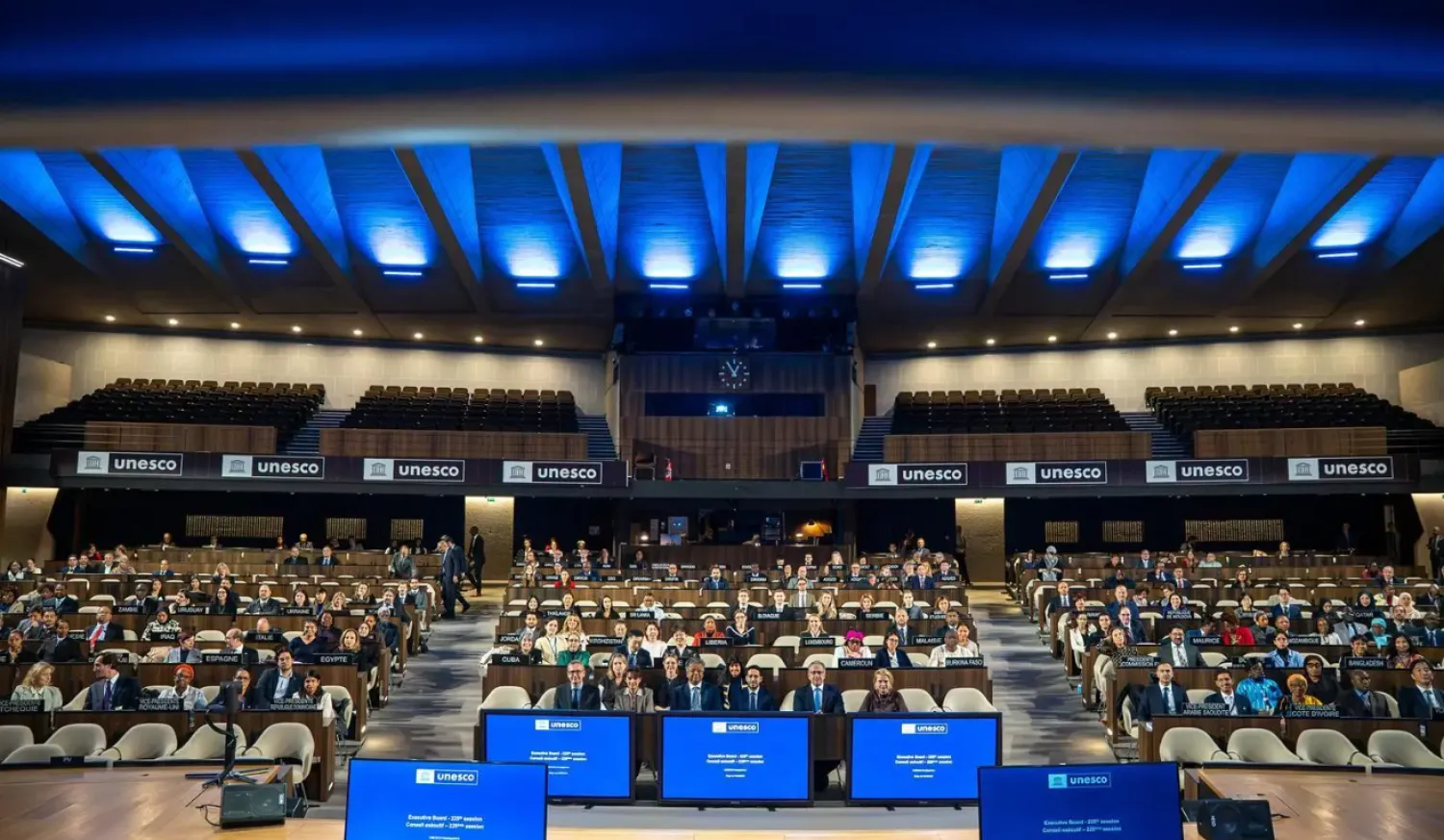

Saudi Arabia Marks 80 Years of Partnership with UNESCO

 Saudi Arabia's partnership with UNESCO has been marked by several major international milestones - SPA
 Saudi Arabia's partnership with UNESCO has been marked by several major international milestones - SPA
TT

Saudi Arabia Marks 80 Years of Partnership with UNESCO

 Saudi Arabia's partnership with UNESCO has been marked by several major international milestones - SPA
 Saudi Arabia's partnership with UNESCO has been marked by several major international milestones - SPA

Saudi Arabia marks the 80th anniversary of its membership in the United Nations Educational, Scientific and Cultural Organization (UNESCO) on November 4, having joined the organization in 1946.

Over eight decades of partnership and international cooperation, the Kingdom's role has evolved from membership and participation in UNESCO's activities to helping shape the organization's policies and strategic direction, while strengthening Saudi Arabia's presence in education, science, culture, and communication and information, SPA reported.

Throughout this period, the Kingdom has continued to support UNESCO and its programs through its assessed contributions to the organization's budget, alongside targeted contributions supporting its priorities and initiatives, reflecting its belief in the role of education, science, and culture in promoting peace, mutual understanding, and human solidarity.

Building on this commitment, Saudi Arabia hosts three UNESCO-affiliated centers: the Regional Center for Dialogue and Peace (RCDP), which promotes a culture of dialogue and tolerance through capacity building, training, research, and knowledge exchange; the International Center for AI Research and Ethics (ICAIRE), which specializes in research, ethics, and governance and supports the responsible use of emerging technologies; and the UNESCO Regional Center for Quality and Excellence in Education (RCQE), which works to enhance the quality of general education and develop education policies in Arab countries.

The Kingdom has also strengthened its participation in UNESCO's committees and councils and supported international awards and initiatives, including the UNESCO-Al Fozan International Prize for the Promotion of Young Scientists in Science, Technology, Engineering and Mathematics (STEM) and the Global Award for Quality and Excellence in Education (GAQEE). In digital empowerment, ICAIRE has helped train more than 6,000 women across 119 countries in artificial intelligence and emerging technologies.

Nonprofit and charitable institutions in the Kingdom have also played a role in this partnership, launching targeted initiatives to strengthen the international presence of the Arabic language and Arab culture. Among the most prominent is the Prince Sultan Bin Abdulaziz Program for the Arabic Language at UNESCO, launched in 2007.

Education has long been a key area of cooperation between Saudi Arabia and UNESCO. The Kingdom has participated in high-level education committees concerned with achieving Sustainable Development Goal 4 (SDG 4), supporting the development of global education policies and strategies, improving education quality, training teachers, promoting lifelong learning, and advancing digital transformation. It has also enabled male and female students to participate in regional and international competitions and forums.

In this context, eight Saudi cities have joined the UNESCO Global Network of Learning Cities: Riyadh, Madinah, AlUla, Yanbu Industrial City, Jubail Industrial City, King Abdullah Economic City, Al-Ahsa, and Riyadh Al-Khabra. The Kingdom also hosts several UNESCO Chairs under the UNITWIN/UNESCO Chairs Program, launched in 1992. In addition, several Saudi schools have joined the UNESCO Associated Schools Network, established in 1953.

In the natural sciences, Salma UNESCO Global Geopark in Hail Region and North Riyadh UNESCO Global Geopark in Riyadh Region became the first two Saudi sites to join the UNESCO Global Geoparks Network in 2025. Their inclusion strengthens the Kingdom's efforts to conserve its geological heritage and leverage it for scientific and tourism purposes.

The Farasan Islands Reserve in Jazan Region was designated in 2021 as Saudi Arabia's first biosphere reserve under UNESCO's Man and the Biosphere (MAB) Program. It was followed in 2022 by Harrat Uwayrid Reserve, which is home to 19 endangered animal species, 43 bird species, including eight species of birds of prey, and 55 rare plant species. Imam Turki bin Abdullah Royal Reserve was subsequently designated in 2025. The reserve extends across five administrative regions: Al-Jouf, Qassim, Hail, Northern Borders, and Eastern Region.

As part of its efforts to promote environmental sustainability and water resource management, Saudi Arabia cooperates with UNESCO's Intergovernmental Hydrological Program (IHP) as it prepares to host the 11th World Water Forum in Riyadh in 2027 under the theme “Action for a Better Tomorrow.”

In the field of sport, the Kingdom supports international frameworks aimed at safeguarding the integrity and values of sport through its continued backing of UNESCO's International Convention against Doping in Sport. Saudi Arabia also serves as a Vice-Chairperson of the Bureau of the Conference of Parties to the Convention, representing the Arab Group and reaffirming the role of sport in promoting tolerance, coexistence, and peacebuilding.

Saudi Arabia's partnership with UNESCO has also extended to safeguarding humanity's cultural heritage and enhancing its global visibility. The Kingdom became a party to the World Heritage Convention in 1978, and Hegra Archaeological Site became the first Saudi site inscribed on the UNESCO World Heritage List in 2008. The Cultural Landscape of Al-Faw Archaeological Area was inscribed in 2024 as the Kingdom's most recent addition to the list, bringing the total number of Saudi World Heritage sites to eight, alongside 18 elements inscribed on UNESCO's Lists of Intangible Cultural Heritage.

According to SPA, to support international cultural programs, the Kingdom allocated $25 million under a letter of intent signed on July 12, 2019, which led to the establishment of the Saudi Fund at UNESCO. The fund has launched six flagship projects covering digital technologies, sustainable tourism, sustainable construction, the conservation of World Heritage sites, and the development of creative economies. To date, 136 countries have benefited from its projects.

In partnership with UNESCO, the Kingdom also launched the UNESCO Virtual Museum of Stolen Cultural Objects and the Dive into Heritage platform to help safeguard cultural heritage, support the recovery of stolen objects, and make heritage accessible to future generations. Saudi Arabia is also preparing to host the UNESCO World Conference on Cultural Policies and Sustainable Development (MONDIACULT 2029), which will help shape cultural policy directions and strengthen culture's role in sustainable development.

In the field of communication and information, Saudi Arabia hosted the fourth edition of the UNESCO Global Forum on the Ethics of Artificial Intelligence in September 2026, in cooperation with the Saudi Data and AI Authority (SDAIA) and ICAIRE, to promote the responsible use of artificial intelligence technologies and harness them for the benefit of humanity.

The Kingdom was also elected to the Intergovernmental Council for UNESCO's Information for All Program (IFAP) for the 2025–2029 term, strengthening its participation in guiding the program's work and advancing international cooperation in access to and preservation of information, media and information literacy, and multilingualism in cyberspace.

Saudi Arabia's partnership with UNESCO has been marked by several major international milestones. These include hosting the extended 45th session of the World Heritage Committee in Riyadh in 2023; proposing and chairing the Open-ended Working Group tasked with improving the balance of the World Heritage List; hosting the UNESCO Global Forum on the Ethics of Artificial Intelligence in 2026; and preparing to host the 11th World Water Forum in 2027 and MONDIACULT in 2029.

Eight decades after joining UNESCO, Saudi Arabia continues to strengthen its partnership with the organization by supporting its programs, funding targeted initiatives, expanding its participation in UNESCO's global networks, and hosting international conferences and platforms.

These efforts reflect the evolution of the Kingdom's role from membership to helping shape international efforts, in line with Saudi Vision 2030's objectives of strengthening international cooperation and harnessing it to serve humanity and sustainable development.



Mercury Contamination Found at More Ancient Maya Sites

Tourists climb the Maya pyramid of Nohoch Mul at the archaeological site of Coba December 15, 2012. (Reuters)
TT

Mercury Contamination Found at More Ancient Maya Sites

Tourists climb the Maya pyramid of Nohoch Mul at the archaeological site of Coba December 15, 2012. (Reuters)

For the ancient Maya, the vibrant red mineral cinnabar held deep sacred meaning, representing blood, life and the soul. They used it widely as pigment in murals and temples while also employing it in ceremonies and funerary rites. What they did not know is that cinnabar is mostly mercury, which can be highly toxic.

Previous research showed how mercury from cinnabar left enduring contamination at the sites of certain ancient Maya cities such as Tikal in Guatemala. A new study reveals that this contamination was more widespread than previously known and documents how mercury, after leaching into the surrounding soil and bodies of water, proved deadly for many aquatic organisms.

Researchers obtained core samples from beneath lakes at two ancient Maya cities on Mexico's Yucatan peninsula — the well-studied site of Coba and the little-known site of Xcach.

The samples showed a mercury spike at Coba beginning around 250 AD ‌and lasting about ‌150 years around the outset of the golden age of Maya civilization, called the ‌Classic ⁠Period. At Xcach, there ⁠was a spike from around 125 AD to 200 AD, shortly before the Classic Period, then a second spike at about the same time as the one at Coba, and a third spike from about 535 AD to 820 AD, running to around the end of the Classic Period.

The study documents mercury contamination in the Maya northern lowlands, a region with previously sparse mercury records, and reveals some of the highest recorded Maya-era mercury concentrations.

Many of the great Maya cities collapsed and were abandoned at the end of the Classic Period. Varying hypotheses have been presented to explain this calamity, including climate change and warfare. The ⁠new research suggests mercury poisoning as one additional factor.

"Our study shows that modern toxicology ‌and pollution regulations were far exceeded at the most toxic levels for centuries ‌around Coba and Xcach," said paleolimnologist Matt Waters, a professor of environmental science at Auburn University in Alabama and lead author of ‌the study published in the journal Science Advances.

"Furthermore, we measured multiple biological markers in the sediments for bacteria, algae, cyanobacteria, ‌shelled organisms and insect midges, which all decreased or vanished in the lakes, meaning the mercury had made its way into multiple levels of the food chain," Waters said.

MERCURY POISONING

Mercury in people can harm the central nervous system, brain, kidneys, lungs and heart.

"While we do not show this in our sediment records, this trophic movement implies that the Maya people might have been exposed to mercury via ‌consumption of water or fish," said study co-author Savanna Wooten, a postdoctoral researcher at the Jones Center at Ichauway research facility in Georgia.

"This research does little to link ⁠mercury directly to the demise of ⁠Classic-era Maya cities. But it does add one more stressor to the growing list of environmental and climatic pressures documented to have co-occurred with the Classic Period Maya," Wooten said.

Coba (pronounced "koh-BAH") is estimated to have had a population of 60,000 to 90,000 people during the Classic Period. It is a well-known jungle archeological site visited by many tourists that features one of the tallest ancient pyramids in the Yucatan.

Less is known about Xcach (pronounced "SCOTCH"), a site on private land featuring multiple pyramids and structures where very little archeological work has been done.

Cinnabar is a naturally occurring mercury sulfide mineral and may have been a major trade commodity in places like Coba and Xcach where it is not found in natural abundance, the researchers said.

The Maya fashioned one of the great civilizations in the pre-Columbian New World, prospering in a broad area of Mexico as well as Guatemala, Belize, Honduras and El Salvador. Among other achievements, they built monumental structures, crafted great works of art, gained a sophisticated understanding of astronomy and mathematics, produced an advanced calendar and developed an intricate writing system.

"Their longevity as a culture and development in science, construction and art is both extensive and elegant. Cinnabar would have been a pigment that added beauty and culture to these people," Waters said.


Theater and Performing Arts Commission to Present a Variety of Performances across Six Saudi Cities

Theater and Performing Arts Commission to Present a Variety of Performances across Six Saudi Cities
TT

Theater and Performing Arts Commission to Present a Variety of Performances across Six Saudi Cities

Theater and Performing Arts Commission to Present a Variety of Performances across Six Saudi Cities

The Theater and Performing Arts Commission (TPAC) will present a variety of performances from November 11 to December 19, 2026, across six cities in the Kingdom. The program will kick off in the capital, Riyadh, with performances taking place in public spaces, offering visitors an immersive experience and a closer look at TPAC’s activities.

The program features theatrical shows, roving traditional performing arts, puppet shows, a traveling circus, and interactive experiences.
It includes 10 daily segments showcasing a variety of traditional performing arts rooted in each city's cultural heritage, SPA reported.

The performances will kick off at the U Walk complex in Riyadh from November 11 to 14; the House of Culture in Dammam from November 18 to 21; Al-Noor Park in Buraidah, in Qassim Region, from November 25 to 28; the House of Culture in Hail from December 2 to 5; and Arruddaf Park in Taif from December 9 to 12.

The program will conclude at Jeddah Promenade from December 16 to 19.
The venues will welcome visitors daily from 5:30 p.m. to 11:00 p.m.

The performances are part of TPAC’s efforts to develop the sector, empower creative talent, enhance their skills, and expand the presence of theater and performing arts in society.

The program also offers the public an opportunity to learn about TPAC’s initiatives and engage with its experiences and performances.


AlUla's Madrasat Addeera Opens Applications for Design and Handicrafts Program for Women

The program aims to develop young women’s skills and equip them to produce craft products inspired by AlUla's natural environment and cultural identity - SPA
TT

AlUla's Madrasat Addeera Opens Applications for Design and Handicrafts Program for Women

The program aims to develop young women’s skills and equip them to produce craft products inspired by AlUla's natural environment and cultural identity - SPA

Madrasat Addeera in AlUla Governorate has opened applications for its 2026–2027 vocational training program, targeting young women interested in design and handicrafts.

The program aims to develop young women’s skills and equip them to produce craft products inspired by AlUla's natural environment and cultural identity. Applications will remain open until November 12, SPA reported.

The seven-month program combines design principles with practical training in traditional crafts, using local materials and patterns inspired by nature. It prepares trainees to move on to design and production studios, develop made-to-order handicraft products, and create customized corporate gifts.

Established as the first girls' school in AlUla, Madrasat Addeera has been transformed since 2019 into a creative center and an educational and cultural hub for the governorate's residents.

It seeks to revive traditional crafts and historical arts and attract international expertise as the region's first arts and design center.