

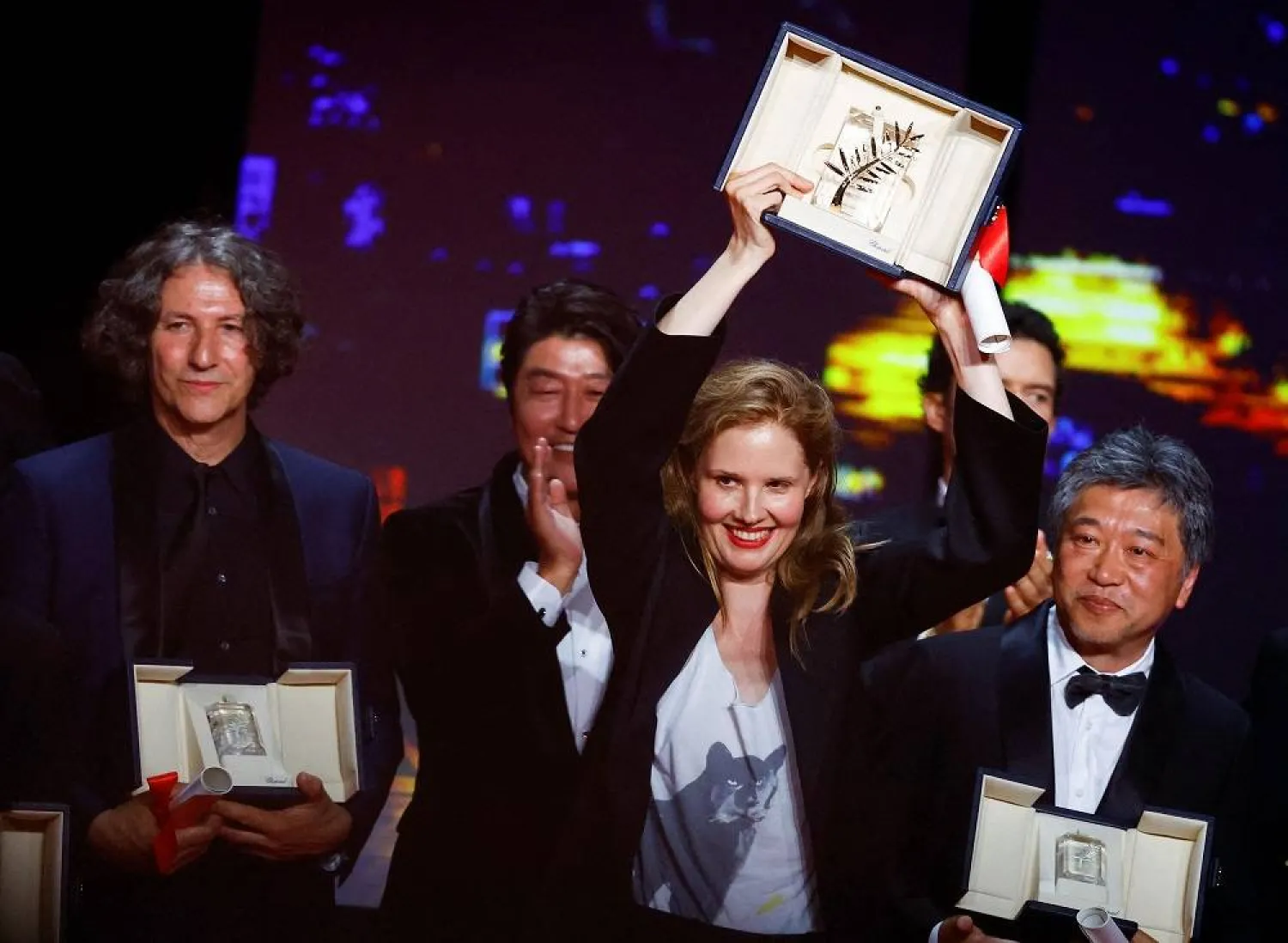

‘Anatomy of a Fall’ Wins Cannes Film Festival’s Palme d’Or; 3rd Time Female Director Wins Top Honor

Director Justine Triet, Palme d'Or award winner for the film "Anatomie d'une chute" (Anatomy of a Fall), Director Hirokazu Kore-eda, the receiver of the Best Screenplay award for the film "Kaibutsu" (Monster) on behalf of screenwriter Yuji Sakamoto, and Director Jonathan Glazer, Grand Prix award winner for the film "The Zone of Interest", stand with their awards as they pose for a photo during the closing ceremony of the 76th Cannes Film Festival in Cannes, France, May 27, 2023. (Reuters)
TT

‘Anatomy of a Fall’ Wins Cannes Film Festival’s Palme d’Or; 3rd Time Female Director Wins Top Honor

Director Justine Triet, Palme d'Or award winner for the film "Anatomie d'une chute" (Anatomy of a Fall), Director Hirokazu Kore-eda, the receiver of the Best Screenplay award for the film "Kaibutsu" (Monster) on behalf of screenwriter Yuji Sakamoto, and Director Jonathan Glazer, Grand Prix award winner for the film "The Zone of Interest", stand with their awards as they pose for a photo during the closing ceremony of the 76th Cannes Film Festival in Cannes, France, May 27, 2023. (Reuters)

Justine Triet's "Anatomy of a Fall" won the Palme d'Or at the 76th Cannes Film Festival in a ceremony Saturday that bestowed the festival's prestigious top prize on an engrossing, rigorously plotted French courtroom drama that puts a marriage on trial.

"Anatomy of a Fall," which stars Sandra Hüller as a writer trying to prove her innocence in her husband’s death, is only the third film directed by a woman to win the Palme d'Or. One of the two previous winners, Julia Ducournau, was on this year's jury.

Cannes' Grand Prix, its second prize, went to Jonathan Glazer’s "The Zone of Interest," a chilling Martin Amis adaptation about a German family living next door to Auschwitz. Hüller also stars in that film.

The awards were decided by a jury presided over by two-time Palme winner Ruben Östlund, the Swedish director who won the prize last year for "Triangle of Sadness." The ceremony preceded the festival's closing night film, the Pixar animation "Elemental."

Remarkably, the award for "Anatomy of a Fall" gives the indie distributor Neon its fourth straight Palme winners. Neon, which acquired the film after its premiere in Cannes, also backed "Triangle of Sadness," Ducournau's "Titane" and Bong Joon Ho's "Parasite," which it steered to a best picture win at the Academy Awards.

Triet was presented the Palme by Jane Fonda, who recalled coming to Cannes in 1963 when, she said, there were no female filmmakers competing "and it never even occurred to us that there was something wrong with that." This year, a record seven out of the 21 films in competition at Cannes were directed by women.

After a rousing standing ovation, Triet, the 44-year-old French filmmaker, spoke passionately about the protests that have roiled France this year over reforms to pension plans and the retirement age. Several protests were held during Cannes this year, but demonstrations were — as they have been in many high-profile locations throughout France — banned from the area around the Palais des Festivals. Protesters were largely relegated to the outskirts of Cannes.

"The protests were denied and repressed in a shocking way," said Triet, who linked that governmental influence to that in cinema. "The merchandizing of culture, defended by a liberal government, is breaking the French cultural exception."

"This award is dedicated to all the young women directors and all the young male directors and all those who cannot manage to shoot films today," she added. "We must give them the space I occupied 15 years ago in a less hostile world where it was still possible to make mistakes and start again."

After the ceremony, Triet reflected on being the third female director to win the Palme, following Ducournau and Jane Campion ("The Piano").

"Things are truly changing," she said.

Speaking to reporters, Triet was joined by her star, Hüller, whose performance was arguably the most acclaimed of the festival. (The festival encourages juries not to give films more than one award.) But "Anatomy of a Fall" did pocket one other sought-after prize: the Palme Dog. The honor given to the best canine in the festival's films went to the film's border collie, Snoop.

The jury prize went to Finnish director Aki Kaurismäki’s "Fallen Leaves," a deadpan love story about a romance that blooms in a loveless workaday Helsinki where dispatches from the war in Ukraine regularly play on the radio.

Best actor went to veteran Japanese star Koji Yakusho, who plays a reflective, middle-aged Tokyo man who cleans toilets in Wim Wenders' "Perfect Days," a gentle, quotidian character study.

The Turkish actor Merve Dizdar took best actress for the Nuri Bilge Ceylan's "About Dry Grasses." Ceylan's expansive tale is set in snowy eastern Anatolia about a teacher, Samet (Deniz Celiloğlu), accused of misconduct by a young female student. Dizdar plays a friend both attracted and repelled by Samet.

"I understand what it's like to be a woman in this area of the country," said Dizdar. "I would like to dedicate this prize to all the women who are fighting to exist and overcome difficulties in this world and to retrain hope."

Vietnamese-French director Tràn Anh Hùng took best director for "Pot-au-Feu," a lush, foodie love story starring Juliette Binoche and Benoît Magimel and set in a 19th century French gourmet château.

Quentin Tarantino, who won Cannes' top award for "Pulp Fiction," attended the ceremony to present a tribute to filmmaker Roger Corman. Tarantino praised Corman for filling him and countless moviegoers with "unadulterated cinema pleasure."

"My cinema is uninhibited, full of excess and fun," said Corman, the independent film maverick. "I feel like this what Cannes is about."

Saturday’s ceremony drew to close a Cannes edition that hasn't lacked spectacle, stars or controversy.

The biggest wattage premieres came out of competition. Martin Scorsese debuted his Osage murders epic "Killers of the Flower Moon," a sprawling vision of American exploitation with Leonardo DiCaprio and Lily Gladstone. "Indiana Jones and the Dial of Destiny," Harrison Ford’s Indy farewell, launched with a tribute to Ford. Wes Anderson premiered "Asteroid City."

The festival opened on a note of controversy. "Jeanne du Barry," a period drama co-starring Johnny Depp as Louis XV, played as the opening night film. The premiere marked Depp's highest profile appearance since the conclusion of his explosive trial last year with ex-wife Amber Heard.



Perry Bamonte, Keyboardist and Guitarist for The Cure, Dies at 65

Perry Bamonte of The Cure performs at North Island Credit Union Amphitheater on May 20, 2023 in Chula Vista, California. (Getty Images/AFP)
TT

Perry Bamonte, Keyboardist and Guitarist for The Cure, Dies at 65

Perry Bamonte of The Cure performs at North Island Credit Union Amphitheater on May 20, 2023 in Chula Vista, California. (Getty Images/AFP)

Perry Bamonte, keyboardist and guitarist in The Cure, has died at 65, the English indie rock band confirmed through their official website on Friday.

In a statement, the band wrote that Bamonte died "after a short illness at home" on Christmas Day.

"It is with enormous sadness that ‌we confirm ‌the death of our ‌great ⁠friend and ‌bandmate Perry Bamonte who passed away after a short illness at home over Christmas," the statement said, adding he was a "vital part of The Cure story."

The statement said Bamonte was ⁠a full-time member of The Cure since 1990, ‌playing guitar, six-string bass, ‍and keyboards, and ‍performed in more than 400 shows.

Bamonte, ‍born in London, England, in 1960, joined the band's road crew in 1984, working alongside his younger brother Daryl, who worked as tour manager for The Cure.

Bamonte first worked as ⁠an assistant to co-founder and lead vocalist, Robert Smith, before becoming a full member after keyboardist Roger O'Donnell left the band in 1990.

Bamonte's first album with The Cure was "Wish" in 1992. He continued to work with them on the next three albums.

He also had various acting ‌roles in movies: "Judge Dredd,About Time" and "The Crow."


First Bond Game in a Decade Hit by Two-month Delay

'007 First Light' depicts a younger Bond earning his license to kill. Ina FASSBENDER / AFP
TT

First Bond Game in a Decade Hit by Two-month Delay

'007 First Light' depicts a younger Bond earning his license to kill. Ina FASSBENDER / AFP

A Danish video game studio said it was delaying the release of the first James Bond video game in over a decade by two months to "refine the experience".

Fans will now have to wait until May 27 to play "007 First Light" featuring Ian Fleming's world-famous spy, after IO Interactive said on Tuesday it was postponing the launch to add some final touches.

"007 First Light is our most ambitious project to date, and the team has been fully focused on delivering an unforgettable James Bond experience," the Danish studio wrote on X.

Describing the game as "fully playable", IO Interactive said the two additional months would allow their team "to further polish and refine the experience", giving players "the strongest possible version at launch".

The game, which depicts a younger Bond earning his license to kill, is set to feature "globe-trotting, spycraft, gadgets, car chases, and more", IO Interactive added.

It has been more than a decade since a video game inspired by Bond was released. The initial release date was scheduled for March 27.


Movie Review: An Electric Timothee Chalamet Is the Consummate Striver in Propulsive ‘Marty Supreme’

 Timothee Chalamet attends the premiere of "Marty Supreme" at Regal Times Square on Tuesday, Dec. 16, 2025, in New York. (AP)
Timothee Chalamet attends the premiere of "Marty Supreme" at Regal Times Square on Tuesday, Dec. 16, 2025, in New York. (AP)
TT

Movie Review: An Electric Timothee Chalamet Is the Consummate Striver in Propulsive ‘Marty Supreme’

 Timothee Chalamet attends the premiere of "Marty Supreme" at Regal Times Square on Tuesday, Dec. 16, 2025, in New York. (AP)
Timothee Chalamet attends the premiere of "Marty Supreme" at Regal Times Square on Tuesday, Dec. 16, 2025, in New York. (AP)

“Everybody wants to rule the world,” goes the Tears for Fears song we hear at a key point in “Marty Supreme,” Josh Safdie’s nerve-busting adrenaline jolt of a movie starring a never-better Timothee Chalamet.

But here’s the thing: everybody may want to rule the world, but not everybody truly believes they CAN. This, one could argue, is what separates the true strivers from the rest of us.

And Marty — played by Chalamet in a delicious synergy of actor, role and whatever fairy dust makes a performance feel both preordained and magically fresh — is a striver. With every fiber of his restless, wiry body. They should add him to the dictionary definition.

Needless to say, Marty is a New Yorker.

Also needless to say, Chalamet is a New Yorker.

And so is Safdie, a writer-director Chalamet has called “the street poet of New York.” So, where else could this story be set?

It’s 1952, on Manhattan’s Lower East Side. Marty Mauser is a salesman in his uncle’s shoe store, escaping to the storeroom for a hot tryst with his (married) girlfriend. This witty opening sequence won’t be the only thing recalling “Uncut Gems,” co-directed by Safdie with his brother Benny before the two split for solo projects. That film, which feels much like the precursor to “Marty Supreme,” began as a trip through the shiny innards of a rare opal, only to wind up inside Adam Sandler’s colon, mid-colonoscopy.

Sandler’s Howard Ratner was a New York striver, too, but sadder, and more troubled. Marty is young, determined, brash — with an eye always to the future. He’s a great salesman: “I could sell shoes to an amputee,” he boasts, crassly. But what he’s plotting to unveil to the world has nothing to do with shoes. It’s about table tennis.

How likely is it that this Jewish kid from the Lower East Side can become the very face of a sport in America, soon to be “staring at you from the cover of a Wheaties box?”

To Marty, perfectly likely. Still, he knows nobody in the US cares about table tennis. He’s so determined to prove everyone wrong, starting at the British Open in London, that when there’s a snag obtaining cash for his trip, he brandishes a gun at a colleague to get it.

Shaking off that sorta-armed robbery thing, Marty arrives in London, where he fast-talks his way into a suite at the Ritz. Here, he spies fellow guest Kay Stone (Gwyneth Paltrow, in a wise, stylish return to the screen), a former movie star married to an insufferable tycoon (“Shark Tank” personality Kevin O’Leary, one of many nonactors here.)

Kay’s skeptical, but Marty finds a way to woo her. Really, all he has to say is: “Come watch me.” Once she sees him play, she’s sneaking into his room in a lace corselet.

This would be a good time to stop and consider Chalamet’s subtly transformed appearance. He is stick-thin — duh, he never stops moving. His mustache is skimpy. His skin is acne-scarred — just enough to erase any movie-star sheen. Most strikingly, his eyes, behind the round spectacles, are beady — and smaller. Definitely not those movie-star eyes.

But then, nearly all the faces in “Marty Supreme” are extraordinary. In a movie with more than 100 characters, we have known actors (Fran Drescher, Abel Ferrara); nonacting personalities (O’Leary, and an excellent Tyler Okonma (Tyler, The Creator) as Marty’s friend Wally); and exciting newcomers like Odessa A’Zion as Marty’s feisty girlfriend Rachel.

There are also a slew of nonactors in small parts, plus cameos from the likes of David Mamet and even high wire artist Philippe Petit. The dizzying array makes one curious how it all came together — is casting director Jennifer Venditti taking interns? Production notes tell us that for one hustling scene at a bowling alley, young men were recruited from a sports trading-card convention.

Elsewhere on the creative team, composer Daniel Lopatin succeeds in channeling both Marty’s beating heart and the ricochet of pingpong balls in his propulsive score. The script by Safdie and cowriter Ronald Bronstein, loosely based on real-life table tennis hustler Marty Reisman, beats with its own, never-stopping pulse. The same breakneck aesthetic applies to camera work by Darius Khondji.

Back now to London, where Marty makes the finals against Japanese player Koto Endo (Koto Kawaguchi, like his character a deaf table tennis champion). “I’ll be dropping a third atom bomb on them,” he brags — not his only questionable World War II quip. But Endo, with his unorthodox paddle and grip, prevails.

After a stint as a side act with the Harlem Globetrotters, including pingpong games with a seal — you’ll have to take our word for this, folks, we’re running low on space — Marty returns home, determined to make the imminent world championships in Tokyo.

But he's in trouble — remember he took cash at gunpoint? Worse, he has no money.

So Marty’s on the run. And he’ll do anything, however messy or dangerous, to get to Japan. Even if he has to totally debase himself (mark our words), or endanger friends — or abandon loyal and brave Rachel.

Is there something else for Marty, besides his obsessive goal? If so, he doesn’t know it yet. But the lyrics of another song used in the film are instructive here: “Everybody’s got to learn sometime.”

So can a single-minded striver ultimately learn something new about his own life?

We'll have to see. As Marty might say: “Come watch me.”