

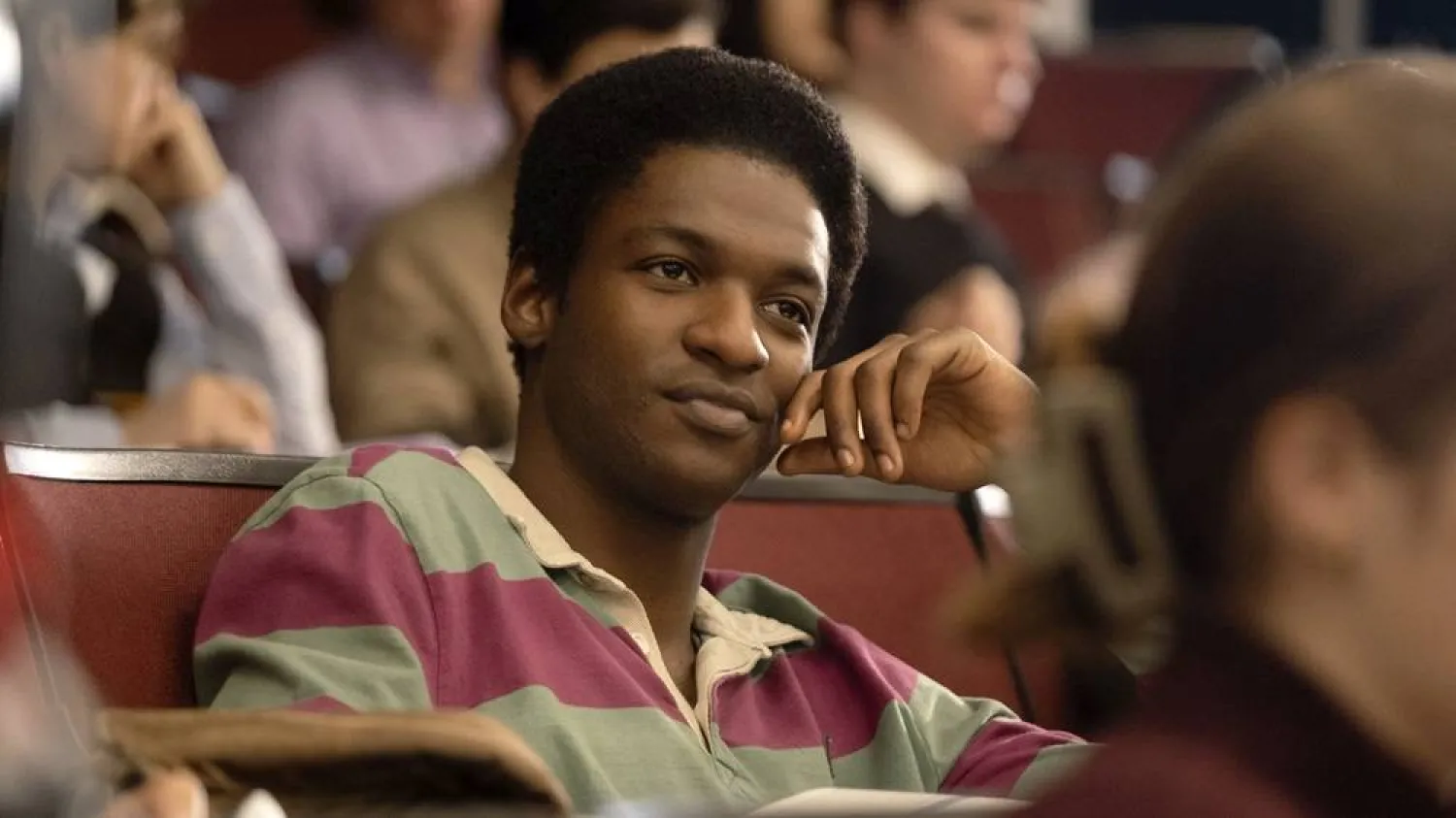

In the Biographical Drama ‘Rob Peace,’ Chiwetel Ejiofor Reframes a Life

 This image released by Sundance Institute shows Jay Will in a scene from "Rob Peace" by Chiwetel Ejiofor, an official selection of the Premieres Program at the 2024 Sundance Film Festival. (Sundance Institute via AP)
This image released by Sundance Institute shows Jay Will in a scene from "Rob Peace" by Chiwetel Ejiofor, an official selection of the Premieres Program at the 2024 Sundance Film Festival. (Sundance Institute via AP)
TT

In the Biographical Drama ‘Rob Peace,’ Chiwetel Ejiofor Reframes a Life

 This image released by Sundance Institute shows Jay Will in a scene from "Rob Peace" by Chiwetel Ejiofor, an official selection of the Premieres Program at the 2024 Sundance Film Festival. (Sundance Institute via AP)
This image released by Sundance Institute shows Jay Will in a scene from "Rob Peace" by Chiwetel Ejiofor, an official selection of the Premieres Program at the 2024 Sundance Film Festival. (Sundance Institute via AP)

Chiwetel Ejiofor had read Jeff Hobbs’ “The Short and Tragic Life of Robert Peace” years before Antoine Fuqua asked if he might consider writing and directing an adaptation.

The book, which explores the complex life of a brilliant boy who grew up in the crime ridden and blighted Orange, New Jersey, was written by Peace’s old Yale roommate. His story did not fit neatly into familiar tropes about rough beginnings, incarcerated fathers or overly simplistic ideas about success and “getting out.” This was a person who wanted to remain tied to his community, to his father, and also to succeed in his schooling and athletics (water polo) first at St. Benedict’s Preparatory School in Newark and then at Yale where he studied molecular biochemistry and biophysics.

Nine years after he graduated from university, in which he spent time teaching at his old prep school, traveled extensively, considered grad school and made money selling marijuana, Peace was killed. Some of the narratives chalked it up to the fact that he went back to where he came from. Ejiofor said Peace’s mother told them that in the aftermath of his death, television crews came and filmed the garbage on the streets instead of the community.

But Hobbs and, subsequently, Ejiofor saw something more complicated and nuanced about the flawed idea of “social mobility” and about the “confluence of race, housing, education and the criminal justice system.” And, most importantly, he felt like he hadn’t seen these ideas engaged with in film.

“I thought it was very special and very powerful,” Ejiofor told The Associated Press in a recent interview. “It was sort of coincidental that I had had this big response to the book, but I hadn’t pursued it in any way. I jumped at the opportunity.”

Fuqua, who had teamed up with Hobbs’ wife, Rebecca, to adapt the film, thought Ejiofor would be the right person after seeing his feature debut, “The Boy Who Harnessed the Wind,” about a 13-year-old boy in Malawi who gets inventive after his family can no longer afford school.

“I knew it was meant to be a film,” Antoine Fuqua wrote in an email. “It was clear that (Chiwetel’s) humanistic approach to storytelling was a perfect fit to bring Rob’s life to screen.”

“Rob Peace” is having its world premiere at the Sundance Film Festival on Monday, where it hopes to find a distributor to get it out to the world.

“Movies like this need to be loved into existence, and that takes a village,” said producer Alex Kurtzman, who got close to Ejiofor while directing him in “The Man Who Fell to Earth” series. “You don’t make movies like this for money. You don’t make movies like this for any reason other than this is an important story to tell. And some reason, we are lucky enough to be able to tell it.”

To play Rob, who would have to carry the film and live in the very different worlds he traversed in his life, Ejiofor and his casting director found Jay Will, a recent Juilliard graduate.

“I never felt that it was a story about somebody who was able to play a role in different places,” Ejiofor said. “It was a story about somebody who very naturally and consistently was all of these things at once. You really had to invest and believe that about him. Jay very naturally did that because that’s part of his experience as well. He’s also just a fabulous actor and has this great charisma and real charm.”

The performance is a meaty showcase for a fresh face who had done some television, including “The Marvelous Mrs. Maisel” and Taylor Sheridan’s “Tulsa King,” which had not yet come out.

Mary J. Blige was already on board to play his mother, Jackie, and Camila Cabello plays an on and off girlfriend Naya. Ejiofor cast himself in the role of the father, Skeet, self-aware enough to know that because it was in his wheelhouse, he’d just be directing another actor to play him as he would.

“He’s kind of a of mercurial character in a way,” Ejiofor said. “There has to be a sequence of question marks about him, but you also have to be very compelled by him. And Rob’s journey is pulled by that sort of magnetic link he has to this to his father.”

As with “The Boy Who Harnessed the Wind,” the director-actor, father-son dynamic actually ended up helping the film, too.

Kurtzman marveled at Ejiofor’s ability to elegantly and calmly navigate three very different roles — writer, director and actor — under the high pressure environment of making a low-budget indie in just 28 days with no money for overtime.

“I never saw him crack, break, get stressed ever,” Kurtzman said. “That he was able to hold space for all of those three things at the same time and know how to put them in a box while the clock was ticking, that’s a true artist.”

Equally important to Ejiofor was to make the film look beautiful. He’d been appalled by the story of the TV crews and the garbage and sought out “Beanpole” and “The Last of Us” cinematographer Ksenia Sereda to realize this vision.

“What she’s done here is elevated this with a real elegance and beauty and a style of telling the story, which doesn’t necessarily feel like we’ve seen before within this kind of cinematic experience,” he said.

All of these facets work together to upend stereotypes and expectations. Ejiofor wants audiences to have a sense of hope in Rob’s story as well as to feel enriched by knowing him.

“By the end of the film, you’re not just left with this bleakness. It’s obviously a tragic story, but it’s much, much richer than that,” he said. “Understanding his journey, I think, is profoundly important and enriching and enlightening. It has been for me.”



‘Godzilla Minus Zero’ Stomps to a Record-Setting $31.6 Debut

 This image released by GKIDS shows Min Tanaka in a scene from "Godzilla Minus Zero." (GKIDS via AP)
This image released by GKIDS shows Min Tanaka in a scene from "Godzilla Minus Zero." (GKIDS via AP)
TT

‘Godzilla Minus Zero’ Stomps to a Record-Setting $31.6 Debut

 This image released by GKIDS shows Min Tanaka in a scene from "Godzilla Minus Zero." (GKIDS via AP)
This image released by GKIDS shows Min Tanaka in a scene from "Godzilla Minus Zero." (GKIDS via AP)

“Godzilla Minus Zero” stomped into movie theaters with a chart-topping $31.6 million over the weekend, scoring a record debut for a foreign-language film at the North American box office.

Takashi Yamazaki‘s sequel to 2023’s Oscar-winning “Godzilla Minus One” easily thrashed Warner Bros.' animated “The Cat in the Hat” movie. That film, featuring the voice of Bill Hader, opened with $20.5 million, according to studio estimates Sunday, plus $10 million overseas.

While Godzilla recently celebrated his 72nd birthday, Yamazaki has revived one of the longest running franchises in movies by bringing the series back to its Japanese roots. The film, produced by Toho and distributed in North America by GKids, is set in post-WWII Japan.

No live-action foreign language film has had a bigger opening weekend, unless you count 2004’s “Passion of the Christ,” which opened with $83.8 million despite its largely Aramaic dialogue. Last year, the anime “Demon Slayer: Infinity Castle” debuted with $70.6 million.

But “Godzilla Minus Zero” bested the mark for live-action previously held by 2004’s “Hero” (a $17.9 million launch) and added to the trend of international, non-English productions drawing American audiences to cinemas.

Japanese and Indian films score in North America

The weekend also saw the widest North American release for an Indian film. “Ramayana: Rise of a Legend, is a Hindi-language epic of Indian mythology that, as part one of two, is the most expensive Indian film ever made. Distributed by Sony Pictures in North America, it launched with $8.7 million domestically and $32 million in India.

“Godzilla Minus Zero” and “Ramayana” were both given global releases, debuting in their home countries at the same time as they reached American audiences. In Japan, “Godzilla Minus Zero” grossed about $17 million over the weekend.

“This historic opening shows how deeply audiences around the world connect with Godzilla and with Takashi Yamazaki’s vision,” said Koji Ueda, president of Toho Global, in a statement. “Our first near-simultaneous global release was built on that belief.”

“Godzilla Minus One,” which won the Oscar for best visual effects, was the highest-grossing Japanese live-action film ever in US and Canada despite a modest budget under $15 million.

“Godzilla Minus Zero,” carrying a budget of less than $20 million, is sure to blow past its predecessor’s record haul of $57.1 million. Since first premiering last month at the New York Film Festival, the film has scored well with critics (90% fresh on Rotten Tomatoes) and audiences (an “A” CinemaScore).

“Godzilla” and “Ramayana” were each filmed for IMAX, with Yamazaki’s film receiving an early IMAX-only release on Tuesday. Both benefited greatly from large-format screens. “Godzilla Minus Zero” generated $21.3 million globally, or 34% of its box-office take, from IMAX.

The big result for “Godzilla Minus Zero” will either whet audiences' appetites or pose an awkward comparison for the next Hollywood, English-language Godzilla movie. In March, Warner Bros. and Legendary will release “Godzilla x Kong: Supernova.”

‘The Cat in the Hat’ disappoints, ‘Drummer Boy’ overperforms

“The Cat in the Hat” was the latest attempt to revive the Dr. Seuss classic on the big screen, following the Mike Myers-led 2003 live-action film. But the animated “Cat in the Hat,” made for $86 million, drummed up only modest interest from moviegoers. Reviews (44% fresh on Rotten Tomatoes) were bad.

Not helping “The Cat in the Hat”: Laika’s acclaimed stop motion animated fantasy “Wildwood” has held well with audiences, even briefly leading all films at the box office early in the week.

“Wildwood” dipped just 22% in its third weekend, with $7 million. With a cumulative total of $39.8 million domestically, it’s fared well, even if Travis Knight’s pricey passion project, with a budget of at least $100 million, is all but certain to lose tens of millions.

Third place went to Angel Studios’ “Drummer Boy,” with $9.3 million on its opening weekend. The Revolutionary War-set musical also saw its music top the iTunes chart.


Eurovision Brings Pop and Politics to Asia

A woman walks past a monitor displaying an advert for the inaugural Eurovision Song Contest Asia 2026, outside the One Bangkok Forum venue in Bangkok on November 7, 2026. (AFP)
TT

Eurovision Brings Pop and Politics to Asia

A woman walks past a monitor displaying an advert for the inaugural Eurovision Song Contest Asia 2026, outside the One Bangkok Forum venue in Bangkok on November 7, 2026. (AFP)

Boasting K-pop and Bangladeshi beatboxing, Eurovision stages its first Asia edition this Saturday, bringing the European song contest's unique brand of kitsch and geopolitics to the world's most populous region.

From Laos to Mongolia and the Philippines, 11 countries are competing in the inaugural Eurovision Song Contest Asia in Bangkok on November 14.

It will be broadcast live on television in participating countries and on YouTube -- but a question remains over whether anyone will be watching.

Eurovision is the world's biggest televised live music event, drawing 131 million viewers in 2026, and over the past 70 years has launched the careers of artists such as ABBA and Celine Dion.

The Asia edition is its first multinational expansion, although a US version was held in 2022 -- and was not repeated.

India, Japan and China are absent from the Bangkok event, while ticket sales have been sluggish.

"Eurovision is very big in Europe and it's very new in Asia," acknowledged executive producer Assaf Blecher.

But he said three years of preparations had fostered a public appetite for the show.

"Suddenly they understood the spirit of Eurovision," he said of those involved, hailing "the music, the extravagance".

"It's a window to other countries, to music, to people, to costumes," he told AFP, adding that he hoped it would be the first of many.

- Some provocation -

The finalists have been chosen through national competitions, some of them established stars such as Vietnam's Toc Tien, a favorite to win with her pop-dance track.

South Korea will be represented by K-pop star Junhee, Bangladesh is sending an all-male a cappella beatbox collective, Beatmosphere, while Pratik Himal Rai is rocking it out for Nepal.

The Asia edition comes as Eurovision marks its 70th birthday under a cloud, 2026 viewing figures down 35 million on the year after a boycott by five countries over Israel's participation.

But the contest has always been marked by controversy, from protests in the 1960s over the participation of Franco-ruled Spain to Russia's exclusion over the 2022 invasion of Ukraine.

The show was first held in 1956 as an experiment by national public broadcasters and became a cultural phenomenon, known for its over-the-top staging and kitsch and eclectic music.

It grew as Europe became more integrated -- although its reach exceeds the continent's borders, with Canada joining next year -- and became as much about the politics as the music.

Votes are gathered by participating country, half from a jury and half from viewers, and no nation can vote for itself -- meaning ballots are often cast based on national relationships.

In the Asia contest, this could see viewers from Cambodia and Thailand, who clashed over their border last year, voting against each other, Blecher noted.

But the entries to Eurovision Asia -- which unlike the original is organized by commercial broadcasters -- are mostly love songs, lamented Dean Vuletic, an author and expert on Eurovision.

He noted as an exception Philippines pop singer Carmelle, whose "Sobra-Sobra" (Too Much) is an upbeat call to female empowerment.

The show is "lacking some provocation or some meaningful messaging that can resonate with international audiences", Vuletic told AFP.

"This is what makes Eurovision in Europe special from other song contests."

- Budget cuts -

The show has been hit by production issues, including a reported budget cut of one million dollars, forcing organizers to issue a statement last month insisting it was going ahead.

"There are always issues with budgets," Blecher insisted.

"This is the first year and we're working with some limitations," he said, adding that it would be a "beautiful production".

The performers were due to arrive this weekend in Bangkok ahead of rehearsals for the final show.

Some will sing in their native language, others in English, a choice made by Malaysian star Aina Abdul to reach a wider audience.

For Bhutan's Nyendra, who is performing his folk-pop love song in traditional dress, the show offers a platform well beyond his country of 800,000 inhabitants.

And he could do well, as Eurovision viewers have a habit of supporting the smallest countries, the underdogs.

Blecher says he already has 16 or 17 places interested in a 2027 edition, if all goes well this week.

He cites China, Hong Kong and Taiwan among those interested -- a selection that would certainly put the contest on the geopolitical map.


Film ‘One in a Million’ Follows Young Syrian Refugee’s Journey Over 10 Years

(L-R) Israa, Itab Azzam and Jack MacInnes attend the "One In A Million" Premiere during the 2026 Sundance Film Festival at the Yarrow Theater in Park City, Utah, US, Jan. 23, 2026. (AFP)
TT

Film ‘One in a Million’ Follows Young Syrian Refugee’s Journey Over 10 Years

(L-R) Israa, Itab Azzam and Jack MacInnes attend the "One In A Million" Premiere during the 2026 Sundance Film Festival at the Yarrow Theater in Park City, Utah, US, Jan. 23, 2026. (AFP)

Israa was 11 years ‌old and selling cigarettes with her father on a street corner in Türkiye when filmmakers Jack MacInnes and Itab Azzam met the Syrian refugee in 2015.

They were charmed by the bubbly young girl and wanted to tell her story as her family, who had fled war-ravaged Aleppo, journeyed across eight countries to settle in Germany.

"We were with them the whole time ... we slept with them ... in the street, in the rain. We were, like, in freezing conditions in Serbia and Croatia ... And ‌by the time ‌we arrived in Germany, it was like ‌we ⁠became like a ⁠family and we really bonded," Azzam told Reuters.

That was when the idea came about for "One in a Million," the couple's documentary filmed over 10 years following Israa to adulthood.

The intimate coming-of-age story shows Israa and her family crossing borders and adapting in Germany, where new-found freedoms jar with old traditions.

Viewers follow Israa ⁠into adolescence, marriage and motherhood as she seeks ‌to find herself amid fracturing ‌shifts at home. A married Israa eventually returns to visit Syria with her ‌husband after the 2024 overthrow of Bashar al-Assad.

“Migration ...(has) become ‌such a sort of political football that has so much to do with the way we feel about each other and the way we feel about our own country and has so little ‌to do with what it's actually like to be a refugee," MacInnes said.

"And what we ⁠hope is ⁠that you can watch this film and walk for an hour and a half in a refugee's shoes and understand the complexity of it."

"One in a Million", which opens in UK cinemas on Friday, premiered at January's Sundance Film Festival where it won the Audience Award.

“We... brought Israa out as a surprise, and the place just went wild," MacInnes said.

"It was so emotional for us to see this girl... who we'd met 11 years previously ... selling cigarettes on a street corner, being beaten up by police, no one gave a damn about her. And ... suddenly here she is getting her moment."