

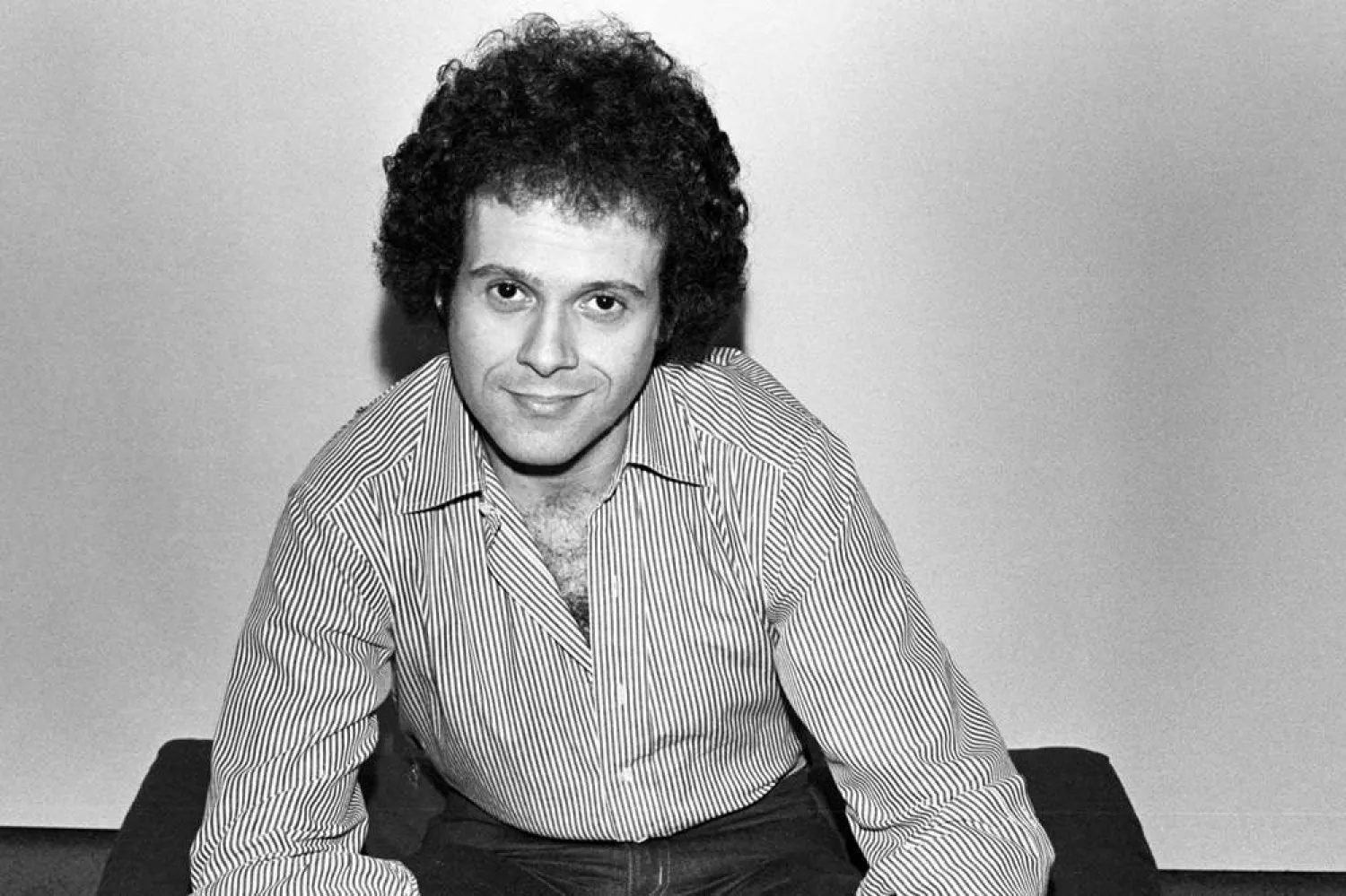

Richard Simmons, a Fitness Guru Who Mixed Laughs and Sweat, Dies at 76

Richard Simmons. (Getty Images)
TT

Richard Simmons, a Fitness Guru Who Mixed Laughs and Sweat, Dies at 76

Richard Simmons. (Getty Images)

Richard Simmons, television's hyperactive court jester of physical fitness who built a mini-empire in his trademark tank tops and short shorts by urging the overweight to exercise and eat better, died Saturday. He turned 76 on Friday.

Simmons died at his home in Los Angeles, his publicist Tom Estey said in an email to The Associated Press. He gave no further details.

Los Angeles police and fire departments say they responded to a house — whose address the AP has matched with Simmons through public records — where a man was declared dead from natural causes.

Simmons, who had revealed a skin diagnosis in March 2024, had lately dropped out of sight, sparking speculation about his health and well-being. His death was first reported by TMZ.

Simmons was a former 268-pound teen who became a master of many media forms, sharing his hard-won weight-loss tips as host of the Emmy-winning daytime "Richard Simmons Show" and author of best-selling books and the diet plan Deal-A-Meal. He also opened exercise studios and starred exercise videos, including the wildly successful "Sweatin' to the Oldies" line, which became a cultural phenomenon.

"My food plan and diet are just two words — common sense. With a dash of good humor," he told The Associated Press in 1982. "I want to help people and make the world a healthier, happy place."

Simmons embraced mass communication to get his message out, even as he eventually became the butt of jokes for his outfits and flamboyant flair. He was a sought-after guest on TV shows led by Merv Griffin, Mike Douglas and Phil Donahue. But David Letterman would prank him and Howard Stern would tease him until he cried. He was mocked in Neil Simon’s "The Goodbye Girl" on Broadway in 1993, and Eddie Murphy put on white makeup and dressed like him in "The Nutty Professor," screaming "I’m a pony!"

Asked if he thought he could motivate people by being silly, Simmons answered, "I think there's a time to be serious and a time to be silly. It's knowing when to do it. I try to have a nice combination. Being silly cures depression. It catches people off guard and makes them think. But in between that silliness is a lot of seriousness that makes sense. It's a different kind of training."

Simmons’ daytime show was seen on 200 stations in America, as well as in Australia, New Zealand, the Philippines, Japan and South America. His first book, "Never Say Diet," was a smash best-seller.

He was known to counsel the severely obese, including Rosalie Bradford, who held records for being the world's heaviest woman, and Michael Hebranko, who credited Simmons for helping him lose 700 pounds. Simmons put real people — chubby, balding or non-telegenic — in his exercise videos to make the fitness goals seem reachable.

Throughout his career, Simmons was a reliable critic of fad diets, always emphasizing healthy eating and exercise plans. "There'll always be some weird thing about eating four grapes before you go to bed, or drinking a special tea, or buying this little bean from El Salvador," he told the AP in 2005 as the Atkins diet craze swept the country. "If you watch your portions and you have a good attitude and you work out every day you'll live longer, feel better and look terrific."

Simmons was a native of New Orleans, a chubby boy named Milton by his parents. (He renamed himself "Richard" around the age of 10 to improve his self-image). He would tell people he ate to excess because he believed his parents liked his older brother more. He was teased by schoolmates and ballooned to almost 200 pounds.

Simmons told the AP his mother watched exercise guru Jack LaLanne's TV show religiously when he was growing up, but he wasn't crazy about the fitness fanatic. "I hated him," Simmons said. "I wasn't ready for his message because he was fit and he was healthy and he had such a positive attitude, and I was none of those things."

Simmons went to Italy as a foreign exchange student and ended up doing peanut butter commercials and bacchanalian eating scenes for director Federico Fellini in his film "Fellini Satyricon." He told the AP: "I was fat, had curly hair. The Italians thought I was hysterical. I was the life of the party."

His life changed after getting an anonymous letter. "One dark, rainy day I went to my car and found a note. It said, 'Dear Richard, you're very funny, but fat people die young. Please don't die." He was so stunned that he went on the starvation diet that left him thin but very ill.

After the crash diet he gained back 65 pounds. Eventually, he was able to devise a sensible plan to take off the pounds and keep them off. "I went into the business because I couldn't find anything I liked," he said.

When Simmons hadn’t been seen in public for several years, some news outlets speculated that he was being held hostage in his own house. In telephone interviews with "Entertainment Tonight" and the "Today" show, Simmons refuted the claims and told his fans he was enjoying the time by himself. Filmmaker-writer Dan Taberski, one of his regular students, launched a podcast in 2017 called "Missing Richard Simmons."

In 2022, Simmons broke his six-year silence, with his spokesperson telling the New York Post that the beloved fitness icon was "living the life he has chosen."

One of the online tributes after Simmons’ passing was from actor-comedian Pauly Shore, who previously developed an unauthorized biopic of Simmons, which Simmons objected to at the time.

"I just got word like everyone else that the beautiful Richard Simmons has passed," he began in an Instagram post. "You’re one of a kind, Richard. An amazing life. An amazing story."


Perry Bamonte, Keyboardist and Guitarist for The Cure, Dies at 65

Perry Bamonte of The Cure performs at North Island Credit Union Amphitheater on May 20, 2023 in Chula Vista, California. (Getty Images/AFP)
TT

Perry Bamonte, Keyboardist and Guitarist for The Cure, Dies at 65

Perry Bamonte of The Cure performs at North Island Credit Union Amphitheater on May 20, 2023 in Chula Vista, California. (Getty Images/AFP)

Perry Bamonte, keyboardist and guitarist in The Cure, has died at 65, the English indie rock band confirmed through their official website on Friday.

In a statement, the band wrote that Bamonte died "after a short illness at home" on Christmas Day.

"It is with enormous sadness that ‌we confirm ‌the death of our ‌great ⁠friend and ‌bandmate Perry Bamonte who passed away after a short illness at home over Christmas," the statement said, adding he was a "vital part of The Cure story."

The statement said Bamonte was ⁠a full-time member of The Cure since 1990, ‌playing guitar, six-string bass, ‍and keyboards, and ‍performed in more than 400 shows.

Bamonte, ‍born in London, England, in 1960, joined the band's road crew in 1984, working alongside his younger brother Daryl, who worked as tour manager for The Cure.

Bamonte first worked as ⁠an assistant to co-founder and lead vocalist, Robert Smith, before becoming a full member after keyboardist Roger O'Donnell left the band in 1990.

Bamonte's first album with The Cure was "Wish" in 1992. He continued to work with them on the next three albums.

He also had various acting ‌roles in movies: "Judge Dredd,About Time" and "The Crow."


First Bond Game in a Decade Hit by Two-month Delay

'007 First Light' depicts a younger Bond earning his license to kill. Ina FASSBENDER / AFP
TT

First Bond Game in a Decade Hit by Two-month Delay

'007 First Light' depicts a younger Bond earning his license to kill. Ina FASSBENDER / AFP

A Danish video game studio said it was delaying the release of the first James Bond video game in over a decade by two months to "refine the experience".

Fans will now have to wait until May 27 to play "007 First Light" featuring Ian Fleming's world-famous spy, after IO Interactive said on Tuesday it was postponing the launch to add some final touches.

"007 First Light is our most ambitious project to date, and the team has been fully focused on delivering an unforgettable James Bond experience," the Danish studio wrote on X.

Describing the game as "fully playable", IO Interactive said the two additional months would allow their team "to further polish and refine the experience", giving players "the strongest possible version at launch".

The game, which depicts a younger Bond earning his license to kill, is set to feature "globe-trotting, spycraft, gadgets, car chases, and more", IO Interactive added.

It has been more than a decade since a video game inspired by Bond was released. The initial release date was scheduled for March 27.


Movie Review: An Electric Timothee Chalamet Is the Consummate Striver in Propulsive ‘Marty Supreme’

 Timothee Chalamet attends the premiere of "Marty Supreme" at Regal Times Square on Tuesday, Dec. 16, 2025, in New York. (AP)
Timothee Chalamet attends the premiere of "Marty Supreme" at Regal Times Square on Tuesday, Dec. 16, 2025, in New York. (AP)
TT

Movie Review: An Electric Timothee Chalamet Is the Consummate Striver in Propulsive ‘Marty Supreme’

 Timothee Chalamet attends the premiere of "Marty Supreme" at Regal Times Square on Tuesday, Dec. 16, 2025, in New York. (AP)
Timothee Chalamet attends the premiere of "Marty Supreme" at Regal Times Square on Tuesday, Dec. 16, 2025, in New York. (AP)

“Everybody wants to rule the world,” goes the Tears for Fears song we hear at a key point in “Marty Supreme,” Josh Safdie’s nerve-busting adrenaline jolt of a movie starring a never-better Timothee Chalamet.

But here’s the thing: everybody may want to rule the world, but not everybody truly believes they CAN. This, one could argue, is what separates the true strivers from the rest of us.

And Marty — played by Chalamet in a delicious synergy of actor, role and whatever fairy dust makes a performance feel both preordained and magically fresh — is a striver. With every fiber of his restless, wiry body. They should add him to the dictionary definition.

Needless to say, Marty is a New Yorker.

Also needless to say, Chalamet is a New Yorker.

And so is Safdie, a writer-director Chalamet has called “the street poet of New York.” So, where else could this story be set?

It’s 1952, on Manhattan’s Lower East Side. Marty Mauser is a salesman in his uncle’s shoe store, escaping to the storeroom for a hot tryst with his (married) girlfriend. This witty opening sequence won’t be the only thing recalling “Uncut Gems,” co-directed by Safdie with his brother Benny before the two split for solo projects. That film, which feels much like the precursor to “Marty Supreme,” began as a trip through the shiny innards of a rare opal, only to wind up inside Adam Sandler’s colon, mid-colonoscopy.

Sandler’s Howard Ratner was a New York striver, too, but sadder, and more troubled. Marty is young, determined, brash — with an eye always to the future. He’s a great salesman: “I could sell shoes to an amputee,” he boasts, crassly. But what he’s plotting to unveil to the world has nothing to do with shoes. It’s about table tennis.

How likely is it that this Jewish kid from the Lower East Side can become the very face of a sport in America, soon to be “staring at you from the cover of a Wheaties box?”

To Marty, perfectly likely. Still, he knows nobody in the US cares about table tennis. He’s so determined to prove everyone wrong, starting at the British Open in London, that when there’s a snag obtaining cash for his trip, he brandishes a gun at a colleague to get it.

Shaking off that sorta-armed robbery thing, Marty arrives in London, where he fast-talks his way into a suite at the Ritz. Here, he spies fellow guest Kay Stone (Gwyneth Paltrow, in a wise, stylish return to the screen), a former movie star married to an insufferable tycoon (“Shark Tank” personality Kevin O’Leary, one of many nonactors here.)

Kay’s skeptical, but Marty finds a way to woo her. Really, all he has to say is: “Come watch me.” Once she sees him play, she’s sneaking into his room in a lace corselet.

This would be a good time to stop and consider Chalamet’s subtly transformed appearance. He is stick-thin — duh, he never stops moving. His mustache is skimpy. His skin is acne-scarred — just enough to erase any movie-star sheen. Most strikingly, his eyes, behind the round spectacles, are beady — and smaller. Definitely not those movie-star eyes.

But then, nearly all the faces in “Marty Supreme” are extraordinary. In a movie with more than 100 characters, we have known actors (Fran Drescher, Abel Ferrara); nonacting personalities (O’Leary, and an excellent Tyler Okonma (Tyler, The Creator) as Marty’s friend Wally); and exciting newcomers like Odessa A’Zion as Marty’s feisty girlfriend Rachel.

There are also a slew of nonactors in small parts, plus cameos from the likes of David Mamet and even high wire artist Philippe Petit. The dizzying array makes one curious how it all came together — is casting director Jennifer Venditti taking interns? Production notes tell us that for one hustling scene at a bowling alley, young men were recruited from a sports trading-card convention.

Elsewhere on the creative team, composer Daniel Lopatin succeeds in channeling both Marty’s beating heart and the ricochet of pingpong balls in his propulsive score. The script by Safdie and cowriter Ronald Bronstein, loosely based on real-life table tennis hustler Marty Reisman, beats with its own, never-stopping pulse. The same breakneck aesthetic applies to camera work by Darius Khondji.

Back now to London, where Marty makes the finals against Japanese player Koto Endo (Koto Kawaguchi, like his character a deaf table tennis champion). “I’ll be dropping a third atom bomb on them,” he brags — not his only questionable World War II quip. But Endo, with his unorthodox paddle and grip, prevails.

After a stint as a side act with the Harlem Globetrotters, including pingpong games with a seal — you’ll have to take our word for this, folks, we’re running low on space — Marty returns home, determined to make the imminent world championships in Tokyo.

But he's in trouble — remember he took cash at gunpoint? Worse, he has no money.

So Marty’s on the run. And he’ll do anything, however messy or dangerous, to get to Japan. Even if he has to totally debase himself (mark our words), or endanger friends — or abandon loyal and brave Rachel.

Is there something else for Marty, besides his obsessive goal? If so, he doesn’t know it yet. But the lyrics of another song used in the film are instructive here: “Everybody’s got to learn sometime.”

So can a single-minded striver ultimately learn something new about his own life?

We'll have to see. As Marty might say: “Come watch me.”