


‘ER’ Creator Michael Crichton’s Estate Sues Warner Bros. Over Upcoming Hospital Drama ‘The Pitt’ 

Author Michael Crichton poses for a portrait at The Peninsula Hotel in New York on Dec. 7, 2004. (AP)
TT

‘ER’ Creator Michael Crichton’s Estate Sues Warner Bros. Over Upcoming Hospital Drama ‘The Pitt’ 

Author Michael Crichton poses for a portrait at The Peninsula Hotel in New York on Dec. 7, 2004. (AP)

The estate of Michael Crichton, who wrote the screenplay for what became the pilot episode of “ER,” has sued Warner Bros. Television over a dispute about an upcoming medical drama it says is a rebranded version of an unauthorized reboot.

After Crichton’s estate, led by his widow, Sherri, could not reach an agreement with the television studio to produce a reboot of the famed medical procedural, the lawsuit alleges Warner Bros. proceeded to develop and produce a series based on the same premise without consent.

The upcoming series, titled “The Pitt,” will be a medical drama set in Pittsburgh, as opposed to “ER’s” Chicago setting, and will feature Noah Wyle in a starring role. Wyle is best known for playing John Carter on “ER” in over 250 episodes.

“The Pitt” is also set to include several “ER” alums behind-the-scenes, including John Wells as the executive producer and R. Scott Gemmill as the showrunner. Wyle, Wells and Gemmill are each named defendants in the suit.

“The lawsuit filed by the Crichton Estate is baseless, as ‘The Pitt’ is a new and original show. Any suggestion otherwise is false, and Warner Bros. Television intends to vigorously defend against these meritless claims,” the studio said in a statement.

Because of Crichton’s success with projects including “Jurassic Park” and “Westworld” before “ER” was developed, he secured a coveted “frozen rights” provision in his contract for the series. The provision prohibits Warner Bros. from proceeding with any sequels, remakes, spinoffs or other productions derived from “ER” without Crichton’s consent, or his estate’s consent after his death from cancer in 2008.

“If Warner Bros. can do this to Michael Crichton, one of the industry’s most successful and prolific creators who made the studio billions over the course of their partnership, no creator is safe,” a spokesperson for Sherri Crichton said in a statement to The Associated Press. “While litigation is never the preferred course of action, contracts must be enforced, and Michael Crichton’s legacy must be protected.”

The estate, which filed the lawsuit Tuesday in Los Angeles Superior Court, is asking the judge to issue an injunction that would force the studio to stop production on the new series, and they are also seeking punitive and compensatory damages.

Warner Bros. began developing a reboot of “ER” for HBO’s streaming service, Max, in 2020 without Sherri’s knowledge, according to the lawsuit.

In 2022, when Sherri Crichton was informed of the developing project, she and the estate engaged in negotiations with the studio, through which she says she was promised that Crichton would get a “created by” credit, backed by a $5 million guarantee for the estate in the event the credit was not given. Ultimately, the term was revoked and negotiations stopped, which the lawsuit states should have ceased all development of the series.

Development continued on, and “The Pitt” was announced in March. A release date has yet to be announced.

“The Pitt is ER. It’s not like ER, it’s not kind of ER, it’s not sort of ER. It is ER complete with the same executive producer, writer, star, production companies, studio, and network as the planned ER reboot,” lawyers representing Crichton’s estate wrote in the lawsuit.

The lawsuit also alleges that Warner Bros. had previously tried to “erase” Crichton from derivatives for his work by downgrading his credit in the 2016 series based off his movie, “Westworld,” from “created by” to “based on,” which they say started “a disturbing pattern.”



A New Generation of Elvis Tribute Artists Compete in the King’s Hometown

Elvis Presley in 1975. (Getty Images)
TT

A New Generation of Elvis Tribute Artists Compete in the King’s Hometown

Elvis Presley in 1975. (Getty Images)

Nearly 50 years after Elvis Presley's death, a gaggle of exuberant young boys and men shook up his hometown, intent on keeping the king's legacy alive for a new generation.

Ranging in age from seven to 17, some donning jeweled jumpsuits, they took the stage at the Tupelo Elvis Festival's youth tribute artist competition last week.

In contrast to their peers, some of whom may have never heard of Elvis, the competitors have dedicated an enormous amount of time and energy studying the king's voice, mannerisms and style.

They are careful to specify they are Elvis tribute artists. Unlike impersonators, who pretend to be Elvis and sometimes present a characterized version of the king, tribute artists strive for authenticity. Some wore costumes created by B&K Enterprises Costume Co., a company licensed to recreate Elvis' outfits and provide costumes for Elvis movies, musicals and TV shows.

“We're not trying to be him,” said Tucker Gladden, 17, from Madison, Mississippi. “We want to recreate the experience as much as we can for people that maybe didn't get to see Elvis in their lifetime.”

As for their fascination with a long-dead musician, several of the tribute artists credited the 2022 “Elvis” movie with sparking their interest. A couple said their admiration began after discovering they were distantly related to Elvis. Others said it was Elvis' faith and charity that inspired them. Some said they had been performing Elvis songs since they were 3 years old.

For 16-year-old Ayden Maloy from Logansport, Indiana, it was the way Elvis' music helped him during a difficult time in his life that helped motivate him to begin performing as an Elvis tribute artist three years ago.

In an afternoon of dazzling outfits and daring dance moves, the performers paid their tributes, getting the audience clapping, singing and swaying along to their Elvis covers. Ultimately, RJ Hursey, a 14-year-old from Bloomington, Illinois, won the competition.

“It means the world to me,” Hursey said.

Before the competition, the tribute artists toured the Elvis Presley Birthplace, a sprawling complex that includes the home where Elvis was born and the church where he was first exposed to Southern gospel music.

“It feels so surreal to pay tribute to Elvis in his hometown,” said 15-year-old Charles Session from Morrilton, Arkansas. “I hope that he’s looking down and smiling at all these young performers.”


‘Scary Movie’ Tops Box Office, Slaying ‘Masters of the Universe’ and Adding to Low-Budget Streak

 (L-R) US actor/producer/writer Shawn Wayans, US actor Anthony Anderson and US actor/producer/writer Marlon Wayans attend Paramount's "Scary Movie" premiere at the Paramount theater in Los Angeles on June 3, 2026. (AFP)
(L-R) US actor/producer/writer Shawn Wayans, US actor Anthony Anderson and US actor/producer/writer Marlon Wayans attend Paramount's "Scary Movie" premiere at the Paramount theater in Los Angeles on June 3, 2026. (AFP)
TT

‘Scary Movie’ Tops Box Office, Slaying ‘Masters of the Universe’ and Adding to Low-Budget Streak

 (L-R) US actor/producer/writer Shawn Wayans, US actor Anthony Anderson and US actor/producer/writer Marlon Wayans attend Paramount's "Scary Movie" premiere at the Paramount theater in Los Angeles on June 3, 2026. (AFP)
(L-R) US actor/producer/writer Shawn Wayans, US actor Anthony Anderson and US actor/producer/writer Marlon Wayans attend Paramount's "Scary Movie" premiere at the Paramount theater in Los Angeles on June 3, 2026. (AFP)

The summer box office is booming — but not because of the usual suspects.

After three weeks of indie horror dominance at the box office, the slasher spoof “Scary Movie” topped ticket sales with $55 million over the weekend, according to studio estimates Sunday, easily besting the far-from-mighty “Masters of the Universe.”

A new order has lately come to movie theaters, which have seen Gen Z ticket buyers flock to the horror hits “Obsession” and “Backrooms,” both made by YouTubers-turned-filmmakers. Those movies have even outshone The Walt Disney Co.’s “Star Wars: The Mandalorian and Grogu.”

This weekend, comedy was the underdog champ. Though the genre has been all but left for dead in theaters, the sixth “Scary Movie” notched a franchise-best $105.5 million global launch. The Wayans brother comedy even outdid its primary satirical target, the “Scream” franchise. Earlier this year, “Scream 7” debuted with $97 million worldwide.

Both franchises are distributed by Paramount Pictures, though Miramax produced the new “Scary Movie.” Co-written by Marlon, Shawn, Keenan and Craig Wayans, the sequel marks the Wayans’ return to the franchise after their departure over creative differences following 2001’s “Scary Movie 2.”

“This is an outstanding opening for a comedy sequel this far into the series,” said David A. Gross, who runs the movie consulting firm FranchiseRe. "It’s a huge bounceback after the last episode crashed in 2013 when Anna Faris and Regina Hall were excluded. The weekend figure is triple the average for the genre.”

Reviews weren’t good (26% fresh on Rotten Tomatoes) and audience scores (a “B” CinemaScore) were so-so. But that didn’t stop the $30-million “Scary Movie” from dominating its much bigger budget competition.

“Masters of the Universe,” a sword and sorcery action adventure based on the 1980s animated series and Mattel toys, failed to revive the dormant franchise. The Amazon MGM release, the second “Masters of the Universe” film following a 1987 movie of the same title, opened with $29.3 million domestically.

“Masters of the Universe,” starring Nicholas Galitzine as He-Man, added $25 million overseas. But for a film that cost nearly $200 million to produce, a much higher launch was needed to make profitability likely.

It’s Mattel Studios’ first release since 2023’s “Barbie.” But after the extraordinary $1.45 billion success of that film, “Masters of the Universe” will be closer to a flop for the toy company.

A24’s “Backrooms,” last weekend’s top release, slid steeply on its second weekend, dropping 68% with $25.9 million. But “Backrooms,” a $10 million movie based on 20-year-old Kane Parson’s YouTube series remains a record-breaking phenomenon. It's now A24’s highest grossing film ever with $212 million worldwide, moving ahead of “Marty Supreme."

In a near tie for third place, Focus Features’ “Obsession” grossed $25.6 million in its fourth weekend. That marked a paltry 7% drop from the previous weekend for 26-year-old Curry Barker’s horror sensation. Not accounting for inflation, no horror movie has ever had a better fourth weekend.

“Obsession,” about a man who wishes his crush returned his affections, was made for less than $1 million. It’s now grossed $152.1 million domestically and $224.8 million worldwide — a record for Focus.

In its third weekend, “The Mandalorian and Grogu” fell all the way to sixth place with $10 million. It was even bested by Fathom Entertainment’s “The Amazing Digital Circus: The Last Act,” a combination of the last two episodes of the animated series. It collected $12.7 million.

A few other movies hit milestones.

Lionsgate’s Michael Jackson biopic “Michael” became the studio’s highest grossing film ever with $898 million globally. That puts it ahead, not accounting for inflation, both the highest grossing entries in the studio’s “Twilight” and “Hunger Games” franchises.

And 2026 got its first billion-dollar movie. “The Super Mario Galaxy Movie” crossed $1 billion worldwide for Universal.

The weekend overall was up a remarkable 63% from the same weekend last year, according to Comscore. Ticket sales on the year are up more than 13%. Next weekend, Steven Spielberg’s “Disclosure Day” debuts.


US Gamers Getting Older as Industry Reports Growth

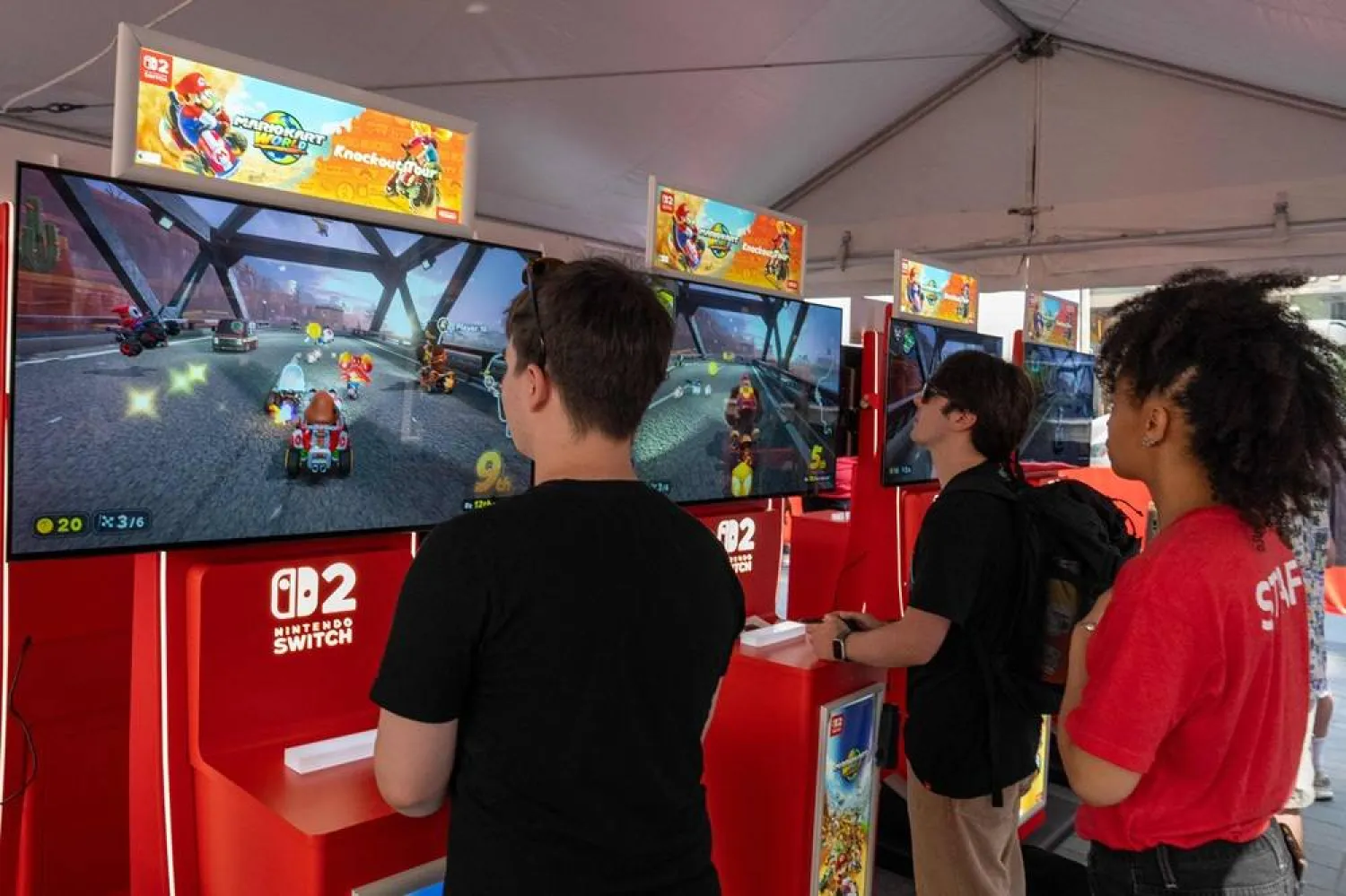
People play Mario Kart World during a launch event ahead of the midnight release of the Nintendo Switch 2 at the Nintendo New York store on June 4, 2025. (AFP)
TT

US Gamers Getting Older as Industry Reports Growth

People play Mario Kart World during a launch event ahead of the midnight release of the Nintendo Switch 2 at the Nintendo New York store on June 4, 2025. (AFP)

Video games are having a moment in the United States -- but the players are getting older.
The average American video game player is now 37 years old -- up from 29 about two decades ago -- as the industry reports activity climbing back to their highest levels since the pandemic-era boom, a new report reveals.
The findings, from the Entertainment Software Association's annual Essential Facts report, challenge enduring stereotypes about who plays games while underscoring the industry's recovery from a post-pandemic slowdown.
"It mirrors in large part the demographics of the nation," ESA president and chief executive Stanley Pierre-Louis told AFP, noting that more than half of all players in the United States are now 35 or older.
The steadily rising average player age reflects both the aging of a generation that grew up with consoles and a wave of older adults who have since picked up the hobby.
The gender split also defies the stereotypical image of the young male gamer.
Men account for 53 percent of players and women 46 percent, with women actually outnumbering men among Baby Boomers, the ESA said.
Overall, 67 percent of Americans play video games for at least an hour a week -- a figure broad enough to encompass everything from blockbuster console titles to casual mobile games like Wordle.
Revenues -- totaling $60.7 billion in 2025 -- have rebounded to their highest point since 2021, when pandemic lockdowns drove an outsized surge in both players and spending.
After a pullback as restrictions lifted, the industry has returned to growth, Pierre-Louis said.
- Self-regulation -
As lawmakers in the United States and Europe weigh tougher regulations on screen time, age verification and in-game spending, Pierre-Louis argued the US gaming industry's track record of voluntary self-regulation sets it apart.
That voluntary framework, he said, has given the industry credibility with US lawmakers that social media platforms lack.
Those platforms, he noted, "traditionally didn't have the same level of parental tools that video games had" -- a gap that has fueled the regulatory backlash now engulfing companies such as Meta and TikTok.
"Safety is not a competitive issue in our industry -- it's one of collaboration," Pierre-Louis said.
"Being on the ecosystem and staying on the ecosystem means you feel like you're in a trusted environment."
- 'Satisfaction' -
The ESA was founded in 1994 partly in response to congressional concern over violent content in games, and almost immediately established the Entertainment Software Rating Board, which assigns age ratings from E for Everyone to M for Mature for titles sold in North America.
The system also flags details about online interactions and in-game purchases.
Major console platforms including Xbox, PlayStation and Nintendo Switch now offer parental control tools that allow families to restrict what games children can access, cap spending and limit screen time -- capabilities Pierre-Louis said have been refined over decades in direct response to parent and policymaker feedback.
The argument, however, faces increasing pushback in the United States.
The gaming industry is facing growing scrutiny as platforms expand into social media-like features, with ESA member Roblox especially under pressure over child safety issues with regulators and in courts.
Legislative proposals range from mandatory age verification for games with chat features to bills that would impose national safety standards.
For the industry, such legislation should not be necessary.
"It's a matter of how do we get everyone up to speed on what the video game industry has been doing, so that there's satisfaction around the practices and trust and safety mechanisms we have in place," Pierre-Louis said.