


'Avatar: Fire and Ash' Launches With $88Mn Domestically, $345Mn Worldwide

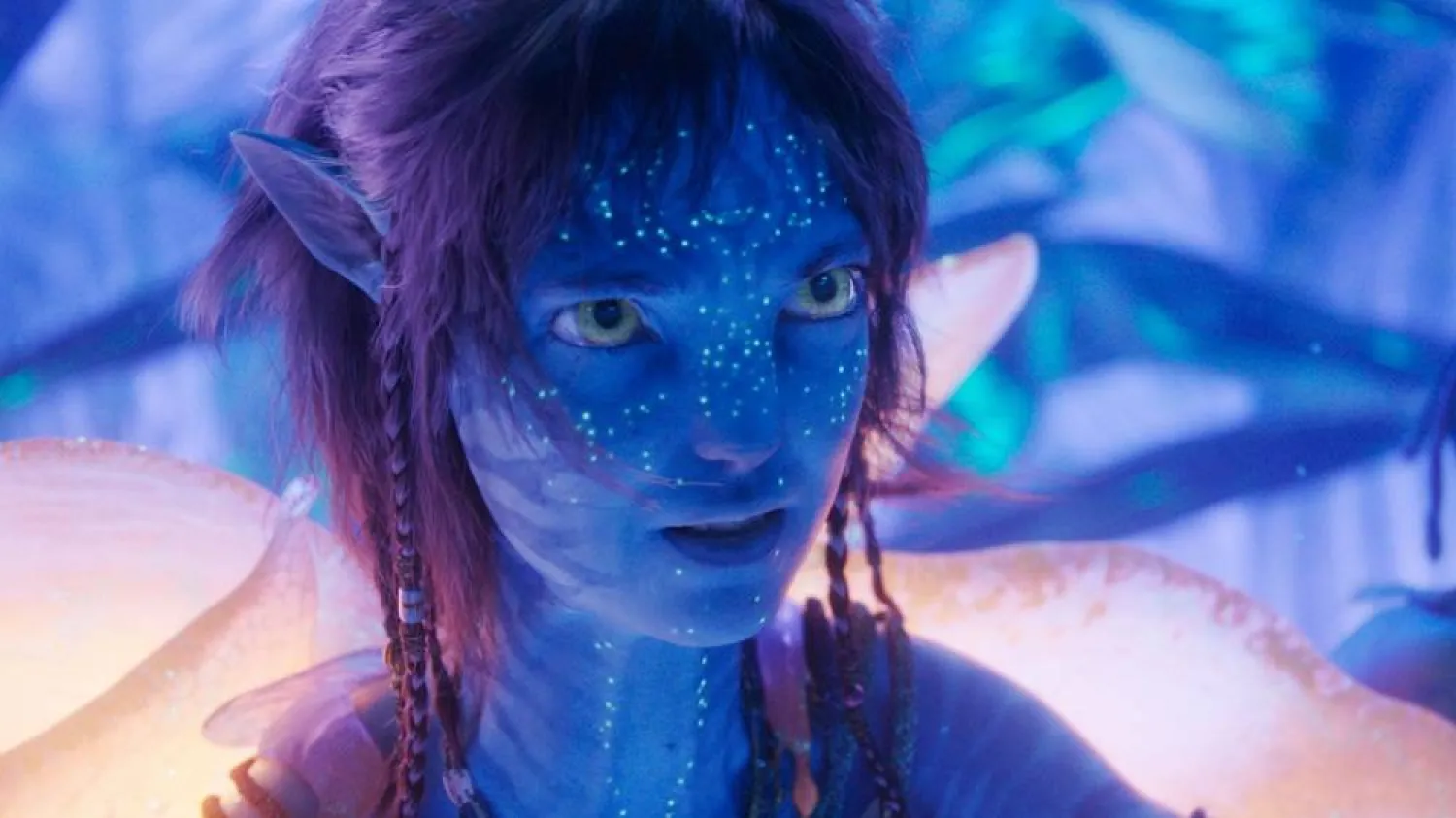
 This image released by 20th Century Studios shows Kiri, performed by Sigourney Weaver, in a scene from "Avatar: Fire and Ash." (20th Century Studios via AP)
This image released by 20th Century Studios shows Kiri, performed by Sigourney Weaver, in a scene from "Avatar: Fire and Ash." (20th Century Studios via AP)
TT

'Avatar: Fire and Ash' Launches With $88Mn Domestically, $345Mn Worldwide

 This image released by 20th Century Studios shows Kiri, performed by Sigourney Weaver, in a scene from "Avatar: Fire and Ash." (20th Century Studios via AP)
This image released by 20th Century Studios shows Kiri, performed by Sigourney Weaver, in a scene from "Avatar: Fire and Ash." (20th Century Studios via AP)

“Avatar: Fire and Ash” opened with $345 million in worldwide sales, according to studio estimates Sunday, notching the second-best global debut of the year and potentially putting James Cameron on course to set yet more blockbuster records.

Sixteen years into the “Avatar” saga, Pandora is still abundant in box-office riches. “Fire and Ash,” the third film in Cameron’s science-fiction franchise, launched with $88 million domestically and $257 million internationally. The only film to open bigger in 2025 was “Zootopia 2” ($497.2 million over three days). In the coming weeks, “Fire and Ash” will have the significant benefit of the highly lucrative holiday moviegoing corridor.

But there was a tad less fanfare to this “Avatar” film, coming three years after “Avatar: The Way of Water.” That film launched in 2022 with a massive $435 million globally and $134 million in North America. Domestically, “Fire and Ash” fell a hefty 35% from the previous installment. Reviews for “Fire and Ash” were also more mixed, scoring a series-low 68% “fresh” score on Rotten Tomatoes.

Yet those quibbles are only a product of the lofty standards of “Avatar.” The first two films rank as two of the three biggest box-office films of all time. To reach those heights, the “Avatar” films have depended on legs more than huge openings.

“Avatar” (2009), opened with $77 million domestically but held the top spot for seven weeks. It ultimately grossed $2.92 billion worldwide. “The Way of Water” also held strong to eventually tally $2.3 billion globally.

“The openings are not what the ‘Avatar’ movies are about,” said David A. Gross, a film consultant who publishes a newsletter on box office numbers. “It’s what they do after they open that made them the #2 and #3 biggest films of all time.”

Should “Fire and Ash” follow in those footsteps, “Avatar” would become the only movie franchise with three $2 billion installments. Working in its favor so far: strong word-of-mouth. Audiences gave it an “A” CinemaScore.

In interviews, Cameron has repeatedly said “Fire and Ash” needs to perform well for there to be subsequent “Avatar” films. (Four and five are already written but not greenlit.) These are exceptionally expensive movies to make. With a production budget of at least $400 million, “Fire and Ash” is one of the costliest films ever made.

“Fire and Ash” was especially boosted by premium format showings, which accounted for 66% of its opening weekend. A narrow majority of moviegoers (56%) chose to watch it in 3D.

The “Avatar” films have always been especially popular overseas. “Fire and Ash” was strongest in China, where its $57.6 million opening weekend surpassed the two previous movies.

“Fire and Ash” didn’t have the weekend entirely to itself. A trio of other new wide releases made it into theaters in hopes of offering some counterprogramming: Lionsgate’s “The Housemaid,” Angel Studios’ “David” and Paramount Pictures’ “The SpongeBob Movie: Search for SquarePants.”

In the race for second place, “David” came out on top. The animated tale of David and Goliath collected $22 million from 3,118 theaters, notching the best opening weekend for Angel Studios.

“The Housemaid,” Paul Feig’s twisty psychological thriller starring Sydney Sweeney and Amanda Seyfried, opened with $19 million 3,015 theaters. The Lionsgate release, which cost about $35 million to make, is set up well to be one of the top R-rated options in theaters over the holidays. Based on Freida McFadden’s bestselling novel, it stars Sweeney as a woman with a troubled past who becomes a live-in maid for a wealthy family.

Trailing the pack was “The SpongeBob Movie: Search for SquarePants,” which collected $16 million from 3,557 theaters. The G-rated film, based on the Nickelodeon TV series, is the first “SpongeBob” theatrical movie since 2015’s “The SpongeBob Movie: Sponge Out of Water.”

All of this weekend’s new films will hope the ticket sales keep rolling in over the upcoming Christmas break. Starting Dec. 25, they’ll need to contend with some new wide releases, including A24’s “Marty Supreme,” with Timothée Chalamet; Focus Features’ “Song Sung Blue,” with Hugh Jackman and Kate Hudson; and Sony’s “Anaconda,” with Jack Black and Paul Rudd.

Before expanding on Christmas, “Marty Supreme” opened in six theaters over the weekend, grossing $875,000 or $145,000 per theater. That was good enough for not only the best per-theater average of the year, but the best since 2016 and a new high mark for A24. The film, directed by Josh Safdie and starring Chalamet as an aspiring table tennis player in 1950s New York, is the most expensive ever for A24.



Hollywood Stars Gather for an All-Winners Celebration at the American Film Institute Awards

Leonardo DiCaprio takes the stage to accept the award for Outstanding Performance by a Male Actor in a Leading Role for his role in "The Revenant" at the 22nd Screen Actors Guild Awards in Los Angeles, California January 30, 2016.(Reuters)
TT

Hollywood Stars Gather for an All-Winners Celebration at the American Film Institute Awards

Leonardo DiCaprio takes the stage to accept the award for Outstanding Performance by a Male Actor in a Leading Role for his role in "The Revenant" at the 22nd Screen Actors Guild Awards in Los Angeles, California January 30, 2016.(Reuters)

If the American Film Institute Awards stands for anything, it's that everyone in the room - from Leonardo DiCaprio and Ryan Coogler to Timothée Chalamet and Ariana Grande - leaves feeling like a winner.

That spirit was on full display Friday as the AFI Awards gathered its 2026 honorees for an invitation-only luncheon in Beverly Hills, where the institute once again celebrated the collaborative nature of film and television by honoring creative teams - in front of and behind the camera.

Inside the ballroom, there were no acceptance speeches in the traditional sense and no suspense over envelopes. Instead, AFI's ceremony unfolded as a series of thoughtfully written tributes: eloquent rationales for each honored film and television program, followed by brief clips designed to place the year's work within a broader cultural and artistic context.

AFI President Bob Gazzale spoke in front of star-filled room, ensuring there were no losers with only shared recognition.

The room reflected that mood. Filmmaker Steven Spielberg was spotted chatting with Coogler, whose wife and "Sinners" producer, Zinzi Coogler, stood beside him. Meanwhile, Michael B. Jordan worked the room, trading hugs and handshakes with fellow honorees and guests including "Bugonia" star Jesse Plemons and "Task" actor Mark Ruffalo. Filmmakers James Cameron and Guillermo del Toro greeted each other.

Nearby, DiCaprio stood side by side with Netflix co-CEO Ted Sarandos and actors Benicio del Toro and Edward James Olmos. Chase Infiniti looked on from her table, gazing toward her "One Battle After Another" co-stars before the program kicked off.

On the red carpet, with "Death by Lightning" actor Nick Offerman beside him, George Clooney shared laughs with a photographer, adding to the easygoing tone that carried throughout the afternoon. After the event, Infiniti and Jordan reunited for a hug and a brief catch-up, a quiet moment that underscored the camaraderie in the room.

Films honored include "Avatar: Fire and Ash,Bugonia,Frankenstein,Hamnet,Jay Kelly,Marty Supreme,One Battle After Another,Sinners,Train Dreams" and "Wicked: For Good."

Television shows recognized were "Adolescence,Andor,Death by Lightning,The Diplomat,The Lowdown,The Pitt,Severance,The Studio" and "Task."

Closing the ceremony was Carol Burnett, who delivered AFI's annual benediction, celebrating the honorees' achievements while reflecting on her own lifelong love of cinema and television.

"I've never lost the deep respect and love that I have for all the stories we tell through cinema and television and by all of those behind and in front of the camera," Burnett said. "Creative collaboration has always remained at the heart of our work, and AFI brings us all together. The world is a better place for having heard your voices."

The luncheon also featured AFI's signature March of Time video montage, a sweeping look at cinematic and television milestones from decades past, situating this year's honorees within the evolving history of the medium.


K-Pop Might Win at the Grammys for the First Time

Grammy Awards are displayed at the Grammy Museum Experience at Prudential Center in Newark, N.J. on Oct. 10, 2017. (AP)
TT

K-Pop Might Win at the Grammys for the First Time

Grammy Awards are displayed at the Grammy Museum Experience at Prudential Center in Newark, N.J. on Oct. 10, 2017. (AP)

Two things can be true at once. K-pop is an inextricable force in global pop culture, and it has long been undercelebrated at institutions like the Grammys — where K-pop artists have performed but have never taken home a trophy.

That could change at next month's 2026 Grammy Awards ceremony. Songs released by K-pop artists — or K-pop-adjacent artists, more on that later — have received nominations in the big four categories for the first time. Rosé, perhaps best known as one-fourth of the juggernaut girl group Blackpink, is the first K-pop artist to ever receive a nomination in the record of the year field for “APT.,” her megahit with Grammys' favorite Bruno Mars.

The song of the year category also features K-pop nominees for the first time. “APT.” will go head-to-head with the fictional girl group HUNTR/X's “Golden,” performed by Ejae, Audrey Nuna and Rei Ami from the “KPop Demon Hunters” soundtrack.

And the girl group Katseye, the brain child of HYBE — the entertainment company behind K-pop sensation BTS and countless other international acts — fashioned in the image of the K-pop idol system, has been nominated for best new artist.

Is this a historic moment for K-pop? It depends on who you ask.

Areum Jeong, assistant professor of Korean Studies at Arizona State University and author of “K-pop Fandom: Performing Deokhu from the 1990s to Today” says the majority of these nominations strike her more as “a de-territorialized, hybrid idea of K-pop,” instead of a recognition of K-pop.

While Rosé “was recruited and trained under the K-pop system, and while ‘APT.’ does contain some motifs from the Korean drinking game,” Jeong says, “the song does not feel like a localized K-pop production. ... Same with Katseye, who was trained and produced under HYBE but marketed more toward Western fans and listeners.”

Jeong says that both “APT.” and Katseye's “Gabriela” — both of which will go head-to-head with “Golden” in the pop duo/group performance category — “seem less K-pop than other K-pop songs that could have been nominated over the years.”

She argues the same is true for the music of “Kpop Demon Hunters.” “It is very similar to ‘APT.’ in that it takes inspiration and motif from Korean culture,” where “K-pop serves as an idea, a jumping-off point, or a motif, creating alternatives or new possibilities.”

Mathieu Berbiguier, a visiting assistant professor in Korean Studies at Carnegie Mellon University, points out that these nominations differ from past K-pop Grammy nominations because “Golden,” “APT.” and Katseye all feature “a mainstream popular music factor.”

That's the connection of a massive popular Netflix film (“Kpop Demon Hunters”), a collaboration with Bruno Mars (“APT.”), and Katseye's international membership and Netflix series (“Pop Star Academy: Katseye”), respectively.

“It tells you that K-pop is not considered as something niche anymore,” he says. “Now, when we think about pop music in general, we also think of K-pop as part of it.”

Bernie Cho, industry expert and president of the South Korean agency, the DFSB Kollective, agrees that there is an international, mainstream appeal to the nominees.

“All the nominees represent a sort of post-idol K-pop, in the sense that Rosé, the three ladies of HUNTR/X and Katseye represent the globalized version of K-pop, where the ‘K’ is very much there, but some people might argue it’s silent. The songs are not necessarily for Korea, by Korea, from Korea, just kind of beyond Korea,” he says. “It’s a celebration and testament to how diverse and dynamic K-pop has become.”

Why are these acts being recognized now? “For years, the Recording Academy has snubbed K-pop acts that have set record-breaking standards, such as BTS, Seventeen and Stray Kids,” argues Jeong. “I think one of the main reasons is that the Western world is still so resistant to non-English lyrics.”

“It does not surprise me that ‘APT.’ and Katseye’s music, which mainly contain English lyrics and seem less K-pop, were nominated,” she continues.

Berbiguier adds that “is a reflection of K-pop nowadays, like, trends: the fact that there’s less and less Korean and more and more English.”

There may be an additional factor at play. Tamar Herman, a music journalist and author of the “Notes on K-pop” newsletter, says many critics and industry voices found 2025 to be a lackluster year for new pop music in the US — a fact that was all but confirmed in Luminate's 2025 Mid-Year Report, which found that streams of new music had slowed compared to the year prior, potentially due to a dearth of megahits dominating the charts.

“Yes, it's a big moment for K-pop, but it is so overdue, these recognitions are more of a sign of how poorly the music industry in the US did this year that we're looking externally,” she says.

She argues that acknowledgment of Korean entertainment from US entertainment industries is more symbolic of US cultural dominance slipping than “K-pop being really good, because K-pop has been really good for a really long time,” she says. “This is all recognition of just global storytelling improvement, global taste-making improvement.”

“I don't want to diminish it,” she adds. “These are all universally friendly, accessible, good pop songs.”

And if they weren't, they wouldn't connect.

“It's very obvious that they’re not just performers. They're artists. They're singers. They're songwriters,” says Cho.

Will a K-pop artist win a Grammy for the first time this year? The jury is still out.

“I think it’s not even a matter of if or when. It’s going to be who and how many,” says Cho.

Others are less committal. “It's hard to predict,” says Berbiguier. “For me, it's more possible that ‘Golden’ gets one.”

“Yes and no,” offers Herman. For her, it depends on an evolving and fluid definition of K-pop. After all, HUNTR/X is a fictional girl group from an animated film that did not debut through the K-pop music industry system. Would a victory for their song “Golden” mean a victory of K-pop? That's a matter of opinion.


Warner Bros Rejects Revised Paramount Bid as Risky Leveraged Buyout

A drone view shows the Warner Bros. studio lot in Burbank, California, US, December 8, 2025. (Reuters)
TT

Warner Bros Rejects Revised Paramount Bid as Risky Leveraged Buyout

A drone view shows the Warner Bros. studio lot in Burbank, California, US, December 8, 2025. (Reuters)

Warner Bros Discovery's board has unanimously turned down Paramount Skydance's latest attempt to acquire the studio, saying its revised $108.4 billion hostile bid amounted to a risky leveraged buyout that investors should reject.

In a letter to shareholders on Wednesday, Warner ​Bros' board said Paramount's offer hinges on "an extraordinary amount of debt financing" that heightens the risk of closing. It reaffirmed its commitment to streaming giant Netflix's $82.7 billion deal for the film and television studio and other assets.

Paramount and Netflix have been vying to win control of Warner Bros, and with it, its prized film and television studios and its extensive content library. Its lucrative entertainment franchises include "Harry Potter", "Game of Thrones", "Friends" and the DC Comics universe, as well as coveted classic films such as "Casablanca" and "Citizen Kane."

Paramount's financing plan would saddle the smaller Hollywood studio with $87 billion in debt once the acquisition closed, making it the largest leveraged buyout in history, the Warner Bros board told shareholders after voting against the $30-per-share cash offer on Tuesday.

The letter accompanied a 67-page amended merger filing where it laid out its case for rejecting Paramount's offer.

The ‌revised Paramount offer "remains inadequate particularly ‌given the insufficient value it would provide, the lack of certainty in PSKY’s ability ‌to ⁠complete ​the offer, ‌and the risks and costs borne by WBD shareholders should PSKY fail to complete the offer," the Warner Bros board wrote.

Paramount, which has a market value of about around $14 billion, proposed to use $40 billion in equity personally guaranteed by Oracle's billionaire co-founder Larry Ellison and $54 billion in debt to finance the deal.

Its financing plan would further weaken its credit rating, which S&P Global already rates at junk levels, and strain its cash flow – heightening the risk that the deal will not close, the Warner Bros board said.

Netflix, which has offered $27.75 a share in cash and stock, has a $400 billion market value and investment-grade credit rating.

The decision keeps Warner Bros on track to pursue the deal with Netflix, even after Paramount amended its bid on ⁠December 22 to address the earlier concerns about the lack of a personal guarantee from Ellison, who is Paramount's controlling shareholder and the father of its CEO David Ellison.

Warner Bros shares ‌closed at $28.47 on Tuesday.

HIGH BREAK-UP FEES

Wednesday's filing said Warner Bros' board met on ‍December 23 to review Paramount's amended offer and noted some improvements, including ‍Ellison's personal guarantee and a higher reverse termination fee of $5.8 billion, but found "significant costs" associated with Paramount's bid compared with a Netflix ‍deal.

Warner Bros would be obligated to pay the streaming service a $2.8 billion termination fee for abandoning its merger agreement with Netflix, $1.5 billion in fees to its lenders and about $350 million in additional financing costs.

Altogether, Warner Bros said it would incur about $4.7 billion in additional costs to terminate its deal with Netflix, or $1.79 per share.

The board repeated some concerns it had laid out on December 17, such as that Paramount would impose operating restrictions on the studio ​that would harm its business and competitive position, including barring the planned spin-out of the company's cable television networks into a separate public company, Discovery Global.

Paramount offered "insufficient compensation" for the damage done to the studio's business, if the Paramount ⁠deal failed to close, Warner Bros said.

Paramount "repeatedly failed to submit the best proposal" to Warner Bros shareholders, the board wrote, "despite clear direction" on the deficiencies in its bid and potential solutions.

TILTING THE POWER BALANCE IN HOLLYWOOD

The jockeying for Warner Bros has become Hollywood's most closely watched takeover battle, as studios race to scale up amid intensifying competition from streaming platforms and volatile theatrical revenues.

While Netflix's offer has a lower headline value, analysts have said it presents a clearer financing structure and fewer execution risks than Paramount's bid for the entire company, including its cable TV business.

Harris Oakmark, Warner Bros' fifth-largest investor, previously told Reuters that Paramount's revised offer was not "sufficient," noting it was not enough to cover the breakup fee.

Paramount has argued its bid would face fewer regulatory obstacles, but a combined Paramount-Warner Bros entity would create a formidable competitor to industry leader Disney and merge two major television operators and two streaming services.

The valuation of Warner Bros' planned Discovery Global spin-off, which includes cable television networks CNN, TNT Sports and the Discovery+ streaming service, is seen as a major sticking point.

Analysts peg the cable channels' value at up to $4 per share, while Paramount has suggested just $1.

Lawmakers ‌from both parties have raised concerns about further consolidation in the media industry, and US President Donald Trump has said he plans to weigh in on the landmark acquisition.