

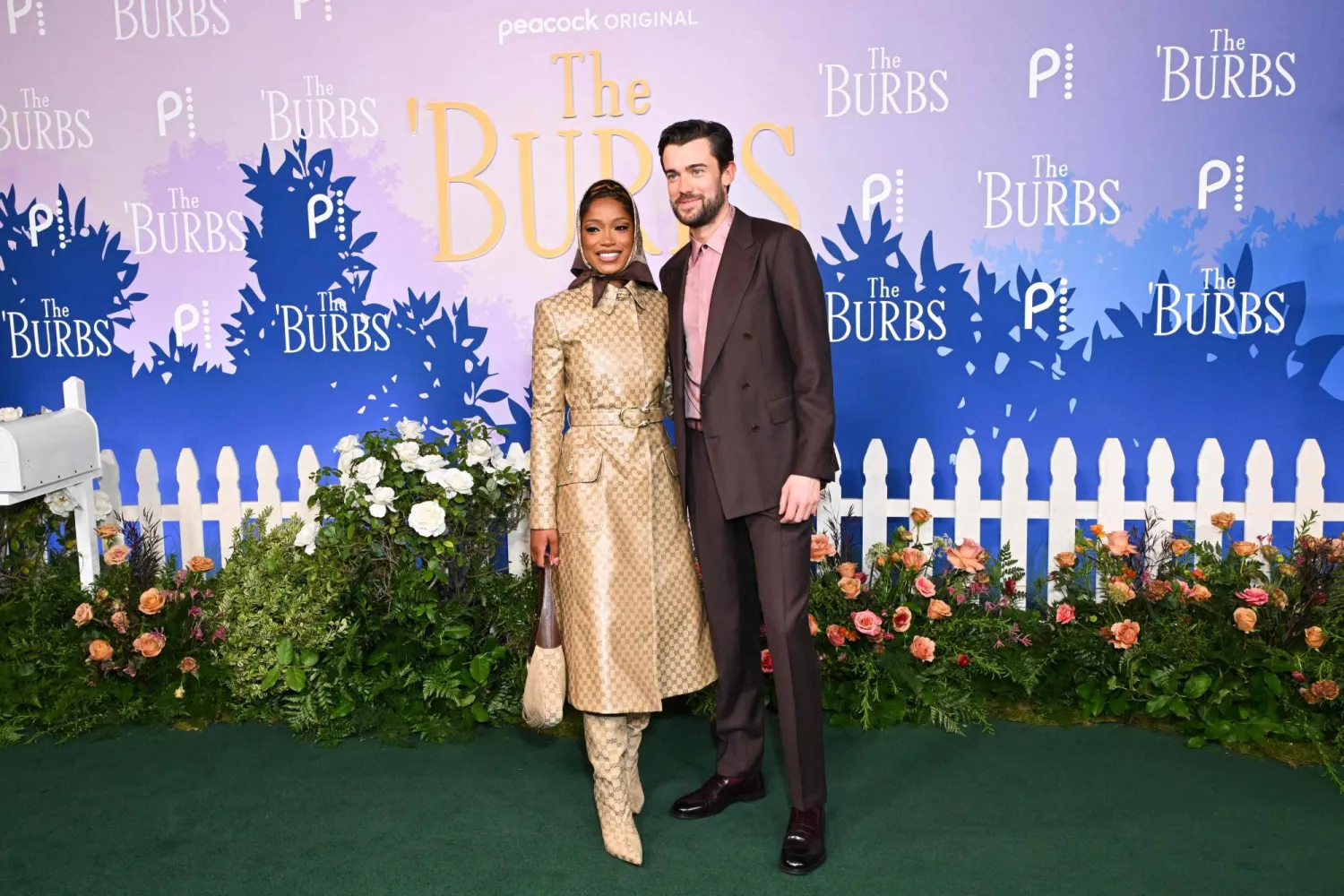

Keke Palmer Is a Fish Out of Water in Horror-Comedy Series Based on Cult Movie ‘The ’Burbs’

Keke Palmer and Jack Whitehall attend Premiere Event Of Peacock's "The 'Burbs" at Universal Studios Backlot on February 05, 2026 in Universal City, California. (Getty Images/AFP)
TT

Keke Palmer Is a Fish Out of Water in Horror-Comedy Series Based on Cult Movie ‘The ’Burbs’

Keke Palmer and Jack Whitehall attend Premiere Event Of Peacock's "The 'Burbs" at Universal Studios Backlot on February 05, 2026 in Universal City, California. (Getty Images/AFP)

The suburbs are anything but bland in the new Peacock series “The 'Burbs,” where strange things are going on. Like how jokes mix with the dread.

Inspired by the 1989 Tom Hanks-led movie of the same name, “The 'Burbs” follows a new mom as she navigates a foreign world of white picket fences and manicured lawns while also investigating a possible murder.

“It’s got the comedy, it has the drama, it's got the mystery, it's got the horror, the thrills, the suspense — all of it,” says Celeste Hughey, the creator, writer and executive producer. All eight episodes drop Friday.

Hanks is replaced by Keke Palmer, who plays a newlywed and new mom who moves into her husband's family home in fictional Hinkley Hills, where everyone is in everybody else's business. “Suburbia is a spectator sport,” she is told.

Across the street is an abandoned home, where a local teen disappeared decades ago. Palmer's Samira soon joins forces with a band of off-beat suburbanites to help solve the case, even if her own husband had some sort of role.

“I really wanted to focus on that fish-out-of-water feeling, centering Samira as a Black woman in a white suburb who is a new mom, a new wife — new everything — and trying to figure out where she belongs in the environment,” says Hughey.

The cast includes Jack Whitehall as Samira's husband and the trio of Julia Duffy, Mark Proksch and Paula Pell as her wine-swilling, investigating neighbors who form a sort of found family.

“The movie came out when I was quite young, but I remember seeing it as a kid and it being like this terrifying movie to me,” says Hughey. “But revisiting it as an adult, it's just like the most timely movie.”

The scripts crackle with witty humor, from references to Marie Kondo to “Baby Reindeer,” and jokes often improvised by the actors. Chocolate brownies are described as “the Beyoncé of desserts” and there’s a joke about how white ladies love salad.

“The ’Burbs” also touches on more serious issues over its eight episodes — microaggressions, racial profiling, bullying and childhood trauma — but takes a kooky, off-beat approach.

“I always look at things with a sense of humor,” says Hughey. “I think comedy is a way to be able to examine all these pretty heavy subjects, but in a way that’s accessible, in a way that is clarifying.”

Palmer says she grew up watching Norman Lear shows and admired his ability to both entertain and address social tensions — something she found in “The 'Burbs.”

“When I read this script for the first time, then as we started doing the show, it started to become clear that we had an opportunity to do the same thing,” Palmer says. “We can expose cliches, we can lean into things, which is one of the greatest tools of satire and comedy in itself, and horror as well, because horror can play as a good allegory for the issues in our life.”

Whitehall, who grew up in the London suburb of Putney, says he appreciates that the social commentary never feels that heavy handed between the comedy and horror: “It was great to sort of be able to play in both genres.”

There are multiple nods to the original movie, like picking the last name Fisher after the late actor Carrie Fisher, who appeared in the Hanks-led version, and naming a dog Darla after the name of the pup who starred in the 1989 version. Hanks, himself, appears in a blink-or-you’ll-miss-it image.

There’s a scene where Samira steps onto her neighbor’s grass and leaves suddenly swirl around her feet menacingly, an echo to the original. And there’s a moment when sardines and pretzels are served, a riff off a classic moment in the movie. The creators even asked original actor Wendy Schaal to return to play the town librarian.

“I really wanted to honor the original fans of the movie and make sure that they see that someone who respects the original material and loves the movie had it in their hands,” says Hughey. “I see the fans.”

Hughey said she wrote the series with Palmer's voice in mind, a piece of manifesting that turned out to actually work when she first met Palmer over a year later.

The music ranges from Bill Withers' “Lovely Day” to Steve Lacy's “Dark Red” to Doechii’s “Anxiety” and Big Pun's “I'm Not a Player.”

“Music is very much a part of my creative process and something that I wanted to stand out in the show as well,” says Hughey. “I got to pull in so many of my inspiration songs.”



Sci-fi Without AI: Oscar Nominated 'Arco' Director Prefers Human Touch

French animation director Ugo Bienvenu says AI has no place in the process of artistic creation. Valerie MACON / AFP/File
TT

Sci-fi Without AI: Oscar Nominated 'Arco' Director Prefers Human Touch

French animation director Ugo Bienvenu says AI has no place in the process of artistic creation. Valerie MACON / AFP/File

Oscar-nominated animated film "Arco" tells the story of a young boy in a future where humanity lives in harmony with nature, far from the robots and artificial intelligence shaping our present.

For first-time director Ugo Bienvenu, who drew the whole film by hand, there was never any chance he would resort to using AI.

"That's why I make science fiction," the French director told AFP. "It was to say to this generation: 'Maybe there are other paths, maybe there are other things to imagine.'"

The graphic novel illustrator, 38, says he is alarmed by society's increasing dependence on artificial intelligence, which he insists is inferior to the things it is being used to replace.

"It's like wanting to saw off your own leg just because you have a great crutch," he said.

The Academy of Motion Picture Arts and Sciences, the body that will hand out the Oscars in Hollywood on March 15, last year updated its rules to say it was neutral on the technology.

"Generative Artificial Intelligence and other digital tools... neither help nor harm the chances of achieving a nomination," it said in April.

"The Academy and each branch will judge the achievement, taking into account the degree to which a human was at the heart of the creative authorship."

'Nobody really wants to use it'

The move came after a furor over the use of AI in best picture contenders "The Brutalist" -- where Adrien Brody's Hungarian accent was artificially smoothed out -- and "Dune: Part Two," in which certain characters had their eye color changed.

This season, two Oscar-eligible animated shorts openly acknowledged their use of AI, but did not get a nomination.

For Bienvenu, the reliance on AI in the creative process is dangerous because it risks allowing the imagination to wither.

"If we tell ourselves that the machine will do it for us, we never make the mistakes that allow us to access our subconscious" where true creativity lies, he said.

Bienvenu, who spoke to AFP on the sidelines of the Oscars nominees luncheon in Beverly Hills last month, said many conversations at the gathering had touched on the use of AI in filmmaking -- a key sticking point in the writers' and actors' strikes that crippled Hollywood in 2023.

"Everyone is more or less on the same page," he said. "Nobody really wants to use it."

'Human'

In January, more than 800 creatives, including actresses Scarlett Johansson and Cate Blanchett, as well as director Guillermo Del Toro, published an open letter accusing AI giants of "theft."

The Mexican filmmaker, whose "Frankenstein" is competing this year for the best picture Oscar, in 2022 said animation created by AI is an "insult to life itself."

Bienvenu shares that alarm.

"The real danger is that we... become weaker intellectually," he says.

"It's not about protecting our jobs, it's about what makes us human."

"Fiction is about sharing experiences," he says -- a process that helps us to be "emotionally prepared when something serious happens to us in life, so we don't fall apart."

Too much of modern life is dominated by machines that can only regurgitate what has come before, says Bienvenu.

"Today, there are people who wear clothes made by robots, and eat food made by robots — basically, they're the poor," he said.

"And now, this same group will be consuming fiction made by robots."

The massive companies that make AI do not pay the true cost of their product, Bienvenu says, and something must be done to level the playing field.

He suggests levying a tax on the huge volumes of water used by companies to cool their server farms, an amount one study published in December found exceeded the volume of bottled water consumed around the planet every year.

"AI isn't free," says Bienvenu.

"It has physical repercussions and impacts on our subconscious."


Berlin Film Festival Director to Stay in Role After Gaza Tensions

Berlinale director Tricia Tuttle speaks during the Award Ceremony of the 76th Berlinale, Europe's first major film festival of the year, in Berlin on February 21, 2026. (AFP)
TT

Berlin Film Festival Director to Stay in Role After Gaza Tensions

Berlinale director Tricia Tuttle speaks during the Award Ceremony of the 76th Berlinale, Europe's first major film festival of the year, in Berlin on February 21, 2026. (AFP)

Berlin Film Festival director Tricia ‌Tuttle will remain in her role but has been given a set of new guidelines, a statement said on Wednesday, after tensions over Gaza overshadowed the event in February.

Tuttle's future as head of the festival, known as the Berlinale, was in the spotlight last week, with Germany's government convening an emergency meeting to discuss the matter.

German media reports suggesting that Tuttle could be ousted prompted a number of directors, writers and producers to rally around her.

It capped a politically ‌charged festival that ‌pitted anger over Israel's actions in Gaza ‌and ⁠concerns over free ⁠speech against historical sensitivities in Germany, which remains one of Israel's staunchest supporters due to guilt over the Nazi Holocaust.

The supervisory board of the federal body responsible for the 'Berlinale' recommended creating an advisory forum for the event and a new code of conduct for all federal cultural events.

Tuttle said in the ⁠statement she would carefully consider the recommendations.

In the ‌same statement, the government's ‌Commissioner for Culture and Media, Wolfram Weimer, said the new guidelines would boost ‌public acceptance of the festival, adding: "Art and artists should ‌once again be at the heart of the Berlinale."

TENSIONS AT THE FESTIVAL

Germany is particularly sensitive to discussion about Israel and what constitutes antisemitism, which has become more acute following the October 7, ‌2023, attack by Hamas.

During the festival, Tuttle issued a statement defending artists' right not ⁠to comment ⁠on politics after actors and directors - including jury president Wim Wenders - were perceived to avoid such questions at press conferences.

An open letter to organizers signed by over 80 former participants that the festival should take a clear stance on Gaza amplified previous criticism by pro-Palestinian activists.

Tensions culminated during the closing ceremony with a speech by Palestinian-Syrian film director Abdallah Al-Khatib accusing Germany of being "partners in the genocide in Gaza by Israel", prompting a German minister to walk out.

Israel has strongly denied that its actions in Gaza amount to genocide and says they are justified as self-defense.


An Oscar Race That Looked Like a Runaway May Be a Close Call, After All

Timothée Chalamet attends the 32nd Annual Actor Awards at Shrine Auditorium and Expo Hall on March 01, 2026 in Los Angeles, California. (Getty Images/AFP)
TT

An Oscar Race That Looked Like a Runaway May Be a Close Call, After All

Timothée Chalamet attends the 32nd Annual Actor Awards at Shrine Auditorium and Expo Hall on March 01, 2026 in Los Angeles, California. (Getty Images/AFP)

Who says to beware the Ides of March?

A March 15 Academy Awards may feel late. By then, it will be almost a year since “Sinners” sunk its teeth into moviegoers last April. Some nominees have been on the campaign trail since the Cannes Film Festival in May.

But the upside of a prolonged Oscar race has meant some unexpected late drama. Think about the same movies long enough, and minds can change. For months, Paul Thomas Anderson's “One Battle After Another” sailed through awards season, picking up prize after prize. But the wins for “Sinners” and Michael B. Jordan at Sunday's Actor Awards — along with some other recent developments — have given the Oscar race what Smoke or Stack might call fresh blood.

An Academy Awards that had looked like a runaway might be a close call, after all. With Oscar voting ending Thursday, let's survey the top categories

Best Picture

WHERE THINGS STAND

“One Battle After Another” has won at the Golden Globes, the BAFTAs, the Producers Guild and the Directors Guild. But its nearly unblemished record was shaken up at Sunday's Actor Awards (formerly the SAG Awards), where “Sinners” took the top prize. You'd have to have quite a few rounds at the “Sinners” juke joint to convince yourself that anything else has much of a chance.

WHAT HAS THE EDGE

The tea leaves are strongest for Anderson's “One Battle After Another.” The Producers Guild, which uses a preferential ballot like the Academy of Motion Picture Arts and Sciences does, is among the most predictive of bellwethers. Their winners have matched the last five years and in eight of the last 10 years.

The actors guild best ensemble prize, on the other hand, has a shaky track record. In the last 31 years, the SAG winner has matched the Oscar champ only 15 times. The win for “Sinners,” though, came right in the midst of Oscar voting. It was a good time to show out. So this race feels close to a coin flip, with a Warner Bros. movie on both sides. The awards season resume makes “One Battle After Another” the front-runner. But “Sinners,” even with a record-setting 16 Oscar nominations, gets to play the underdog.

Best Actor

WHERE THINGS STAND

This has been one of the most competitive and hard-to-call races of the season. Look at Leonardo DiCaprio. He gives one of the best performances of his career, in the best picture favorite, and he's still a long shot. Instead, Timothée Chalamet was widely perceived as in the lead after early wins at the Globes and the Critics Choice Awards for his frenetic performance in “Marty Supreme.” But the BAFTAs muddied the waters (Robert Aramayo, not in the Oscar mix, was the unexpected winner). And “Sinners” star Michael B. Jordan, much to his surprise, won at the Actor Awards.

WHO HAS THE EDGE

Chalamet's maybe meta campaign, full of swagger and braggadocio, rubbed some voters the wrong way. At the same time, many in the academy felt the 30-year-old should have won last year, for his Bob Dylan in “A Complete Unknown” — a year when he won with the actors guild but lost to Adrien Brody (“The Brutalist”) at the Oscars. Chalamet will hope the reverse happens this year. But the academy is notoriously resistant to rewarding young stars. Jordan, 39, isn't much older. But it now suddenly feels like his moment.

Best Actress

WHERE THINGS STAND

Since the fall festival launch of “Hamnet,” Jessie Buckley has been the favorite. She's won at the Globes, the BAFTAs and the Actor Awards. Her closest competition is probably Rose Byrne, who won at the Globes in the comedy/musical category for “If I Had Legs I'd Kick You.”

WHO HAS THE EDGE

This one’s easy. Fortunes have fluctuated in most of the top categories, but Buckley has been entrenched as the front-runner for months.

Best Supporting Actor

WHERE THINGS STAND

Sean Penn, a two-time Oscar winner, has done nearly no campaigning, yet he finds himself the favorite after winning at the Actor Awards and the BAFTAs. But several other nominees remain in the mix. Stellan Skarsgård (“Sentimental Value”) won at the Globes and is the kind of widely-liked veteran actor the academy likes to reward. But so is Delroy Lindo (“Sinners”), who was a surprise Oscar nominee. In the eyes of many, Lindo has quickly joined the contenders.

WHO HAS THE EDGE

Penn's recent wins put him clearly in the lead, and he might stay there. But this remains a category rife with possibilities. The academy's strong international leanings should help Skarsgård. And it wasn't an accident that when “Sinners” won best ensemble at the Actor Awards, Lindo gave the acceptance speech.

Best Supporting Actress

WHERE THINGS STAND

This category has been all over the map. Teyana Taylor (“One Battle After Another”) won at the Globes. Wunmi Mosaku (“Sinners”) won at the BAFTAs. And Amy Madigan (“Weapons”) won at both the Actor Awards and the Critics Choice Awards.

WHO HAS THE EDGE

Any of those three could win. Two of them — Taylor and Mosaku — have the benefit of co-starring in films the academy obviously loves. “Sinners” and “One Battle After Another” have 29 nominations between them, while “Weapons” has only the one. Yet the 75-year-old Madigan, another celebrated character actor who's been great for decades, has the momentum thanks to her charming Actors Award speech.