


In ‘Pressure,’ the Story of the Meteorologist Who Helped Save D-Day

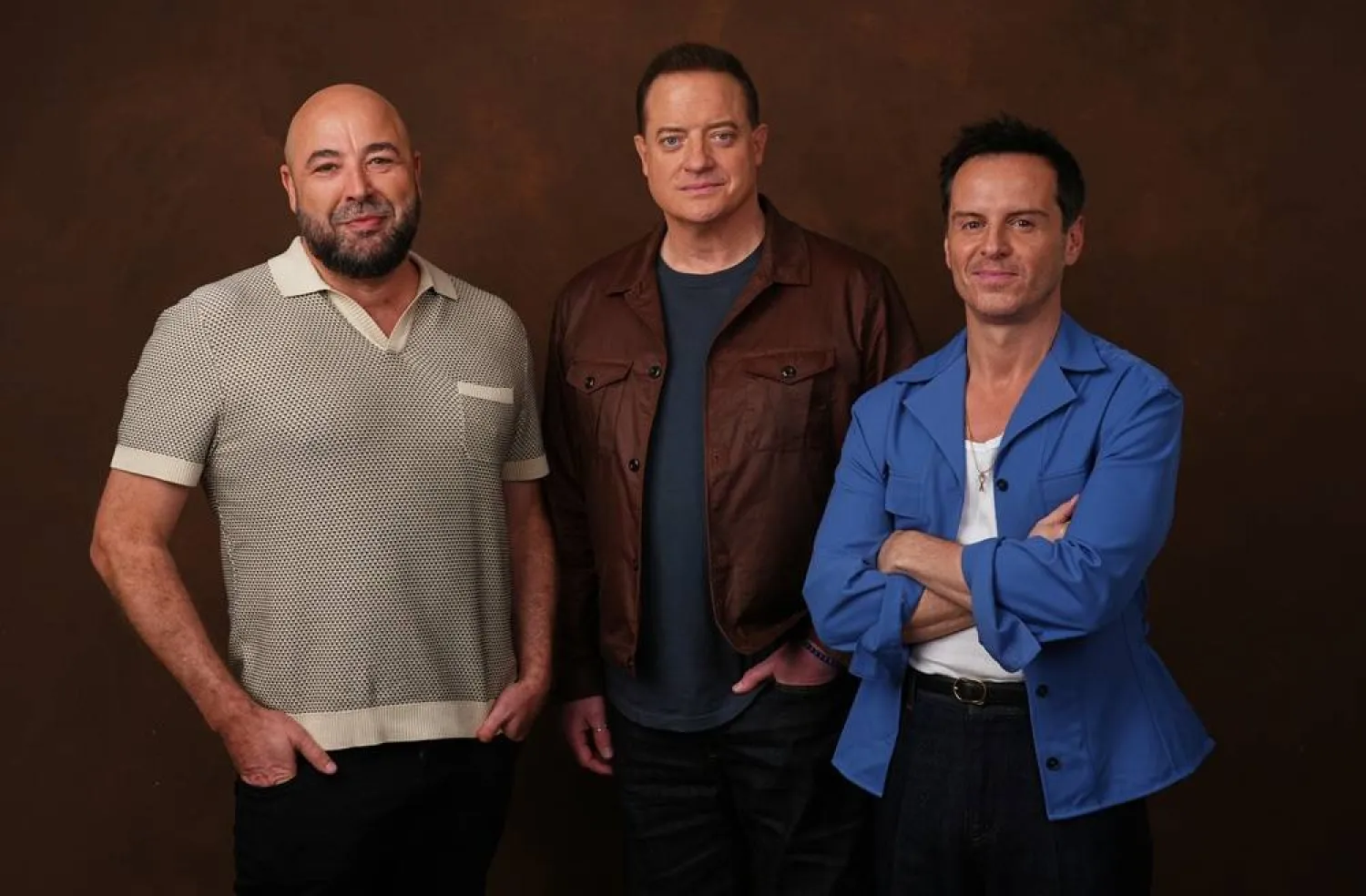
 Anthony Maras, left, director/co-writer of the film "Pressure," poses with cast members Brendan Fraser, center, and Andrew Scott on Tuesday, May 12, 2026, in Los Angeles. (AP Photo/Chris Pizzello)
Anthony Maras, left, director/co-writer of the film "Pressure," poses with cast members Brendan Fraser, center, and Andrew Scott on Tuesday, May 12, 2026, in Los Angeles. (AP Photo/Chris Pizzello)
TT

In ‘Pressure,’ the Story of the Meteorologist Who Helped Save D-Day

 Anthony Maras, left, director/co-writer of the film "Pressure," poses with cast members Brendan Fraser, center, and Andrew Scott on Tuesday, May 12, 2026, in Los Angeles. (AP Photo/Chris Pizzello)
Anthony Maras, left, director/co-writer of the film "Pressure," poses with cast members Brendan Fraser, center, and Andrew Scott on Tuesday, May 12, 2026, in Los Angeles. (AP Photo/Chris Pizzello)

D-Day was supposed to happen on June 5, 1944. The story of why it ultimately took place on June 6 is one that has been a bit lost to history, consumed by the larger events surrounding it.

One day might not seem like much in the grand scheme, but it was a seismic delay in plans for the unprecedented and daring invasion, which would deploy nearly 160,000 Allied troops in Normandy.

Ultimately it came down to a recommendation from a shrewd Scottish meteorologist, Group Capt. James Stagg, who had to tell everyone, including Gen. Dwight D. Eisenhower and the Allied leadership, something they didn’t want to hear: The weather was going to be catastrophically bad. And no, he wasn’t certain about it.

The tense 72 hours before the invasion are brought to life in "Pressure," in theaters May 29, on the eve of the operation’s 82nd anniversary. An adaptation of David Haig’s acclaimed stage play, the film sheds light on this bit of history that would effectively change the course of the second World War.

Filmmaker Anthony Maras assembled a unique group of actors for the task at hand, calling on Brendan Fraser to play Eisenhower and Andrew Scott to play Stagg.

"I didn’t think I was an Ike Eisenhower when Anthony Maras sent me the script," Fraser said. "I got on a Zoom call and he said, ‘You gotta do this man.’ Me? Why? ‘It’s because he’s you, he’s like you. He’s just a regular guy.’ Really? I mean, I thought Eisenhower was this, you know, stern, staunch, something on coin."

Fraser went deep in his preparation, reading and listening to everything he could get his hands on to help him understand the man who would ultimately have to make the decision. The research even continued on set. Maras laughed that right before they shot Eisenhower’s famous "soldiers, sailors and airmen" speech, something that they’d rehearsed many, many times, he looked up and saw Fraser reading yet another biography. But he appreciated that the Oscar-winner was passionate about knowing everything he possibly could to get it right.

"He cared intensely for his troops," Fraser said. "It was my responsibility to honor their memory and to comport myself in a way that puts a human face on the seemingly academic decisions that go into an operation as massive as this."

Scott was the opposite in terms of how he approached his role. Yes, he read Stagg’s book and wanted to have a working understanding of the metrological jargon he’d have to be spouting. While history was important, for him, character was king. And he liked that Stagg is not the most immediately likable person, but he has integrity.

"The thing with Stagg is that he’s just not interested in charm ... or being liked at all," Scott said. "I think that’s to be admired actually, because he’s just there to do a job. So I like the fact that at the beginning of the movie, you’re like, whoa, this guy is not pleasant."

Maras said that for Scott, it was all about the inner, emotional life of the character, which was essential for a part that would require so much internal conflict.

"With Andrew, he has a quality to him where he can seemingly be doing very little — he’s sitting down, rearranging his tie, he can be reading a phone book — and you can’t look away," Maras said.

In the shadow of ‘Saving Private Ryan’

The actors weren’t the only ones feeling pressure of the assignment: Maras also had a behemoth looming in attempting to stage, however briefly, the D-Day invasion.

"You’ve kind of got to be crazy maybe to attempt it, given that Spielberg did it so masterfully," Maras said.

But unlike "Saving Private Ryan," which focused on the men storming the beach, "Pressure" is about the ones making the decisions. It’s a different perspective. Still, once they make the call to go, there would have to be at least some of the operation shown to juxtapose with the "bloody tense, wire-type atmosphere of the control room," Maras said.

Inspired by Peter Jackson’s World War I documentary "They Shall Not Grow Old," and the existence of dozens of hours of pristine 35 mm black and white film from the event, Maras decided that perhaps archival footage, colorized, would be the way to go. It was a different way to present D-Day that gave it immediacy, he said, as opposed to looking like history.

Ultimately, "Pressure" isn’t just a history lesson, or even a character drama with big personalities and even bigger stakes: It’s a portrait of leadership and ego clashing with facts and science. And its relevance to the present day is the reason Maras wanted to make the film in the first place.

"How do you bring your best self to the table to make the decision? How do you have the humility to acknowledge when you don’t know something? And how do you have the wisdom to determine who to trust? ... Eisenhower in the end showed that he was a maestro at that," Maras said.

"What I love about the Stagg character is he’s someone who feels compelled to tell someone something that they don’t want to hear, that they violently don’t want to but they need to hear. The world needs more of that."

Years later, John F. Kennedy, on the way to his own inauguration, asked Eisenhower what gave them the edge on D-Day. His response? "We had better meteorologists than the Germans."

"When life or death depends on you understanding the facts, it probably has a way of like cutting up the BS and getting to it," Maras said. "It’s a very clear example of a time where the Allied worlds’ future was at stake and they listened to someone who knew what he was talking about and they did all right."



Movie Review: In Christopher Nolan’s ‘The Odyssey,’ an Ancient Epic Is Reborn

 US actor Matt Damon (L), British-US director Christopher Nolan (C) and US actress Anne Hathaway (R) attend "The Odyssey" premiere at the AMC Lincoln Square in New York on July 14, 2026. (AFP)
US actor Matt Damon (L), British-US director Christopher Nolan (C) and US actress Anne Hathaway (R) attend "The Odyssey" premiere at the AMC Lincoln Square in New York on July 14, 2026. (AFP)
TT

Movie Review: In Christopher Nolan’s ‘The Odyssey,’ an Ancient Epic Is Reborn

 US actor Matt Damon (L), British-US director Christopher Nolan (C) and US actress Anne Hathaway (R) attend "The Odyssey" premiere at the AMC Lincoln Square in New York on July 14, 2026. (AFP)
US actor Matt Damon (L), British-US director Christopher Nolan (C) and US actress Anne Hathaway (R) attend "The Odyssey" premiere at the AMC Lincoln Square in New York on July 14, 2026. (AFP)

Getting home, and turning back the clock, has long been at the root of Christopher Nolan’s films. The astronauts of “Interstellar” painstakingly lose 23 years in space travel, almost the same length of time Odysseus is away from home in “The Odyssey”: a decade fighting the Trojan War, a decade trying to return to Ithaca.

So, to a remarkable degree, Nolan’s “The Odyssey” — faithful as it is to Homer’s epic poem — feels, down to its nonlinear DNA, like a Nolan movie. The authorship of the epic poem, dated to the 7th or 8th century BC, is complex. But no one could question the maker of this “Odyssey,” an earthy, existential epic that ravishingly melds the storytelling of antiquity with contemporary IMAX-sized bravado.

As a story about a man whose cunning offends the gods, “The Odyssey” feels very much like a companion piece, if not a downright sequel, to “Oppenheimer.” Odysseus (Matt Damon, in the role of his life) is increasingly racked with guilt for the violence and death he’s wrought after his ingenuity led to the sacking of Troy.

The arrival of any new Nolan spectacle inevitably leads to its own kind of assault, and avalanches of “masterpiece” proclamations. (I’m not innocent.) But while “The Odyssey,” Nolan’s first film shot entirely with IMAX cameras, doesn’t skimp on grandiosity, it works surprisingly well as a simpler, human-sized tale.

The journey — you may have heard, it’s about the journey — is sometimes a little clunky, and the sheer Nolan-ness of the production, not to mention the historic nature of the tale, inevitably saps it of some freshness. You could make a credible case that Nolan has already made a movie about a guy trying to reach his family through strata of mind-warping illusion, and it’s called “Inception.” Such is the trouble with urtexts.

But “The Odyssey” is rarely not transfixing, and it’s a ripping adventure story, besides. At the least, it’s the definitive big-screen adaptation of one of literature's oldest tales — a not-too-shabby accomplishment for a filmmaker of restless ambition.

It’s not until Book 5 that Odysseus enters Homer’s poem, and Nolan, who also wrote the screenplay, likewise begins in Ithaca. There, Odysseus’ home is overrun by feasting suitors in pursuit of his wife, Penelope (Anne Hathaway). Foremost among them is Antinous, who’s played with sleazy perfection by Robert Pattinson. For an actor often (pleasingly) at odds with the movies around him, Pattinson has never slid more seamlessly into a part.

Telemachus (Tom Holland, also well-cast), the youthful son of Penelope and Odysseus, resolves to go in search of his father. Meanwhile, we catch up with Odysseus, weathered and white-bearded, following the fall of Troy. His forced conscription, by Agamemnon, is shown in flashbacks. Agamemnon is depicted with an imposing Darth Vader-like presence and played by Benny Safdie, but the real star is his hulking, mohawked helmet.

Such vivid details abound in Nolan’s richly textured film. The simple rocking of Odysseus’ longship, off the Mediterranean coast, is glorious. Some of Nolan’s and cinematographer Hoyte van Hoytema’s most impressive work has come when they’re faced with the elements (as in “Dunkirk”). And “The Odyssey” is flooded with stormy seas and enchanted isles. If anything, the movie could have gone further; I was promised rosy-fingered dawns.

The first line of Homer’s poem, as translated by Emily Wilson (the version Nolan leaned on), refers to Odysseus as “a complicated man.” James Joyce, whose “Ulysses” was based on “The Odyssey,” once noted that while Hamlet is merely a son, Ulysses, or Odysseus, is a father, a husband, a lover and a warrior. In short, he’s an Everyman, albeit an especially smart one. And Damon, the most amiable of Everymen, proves especially attuned to the multifaceted nature of the archetypal hero.

We meet him first as a soldier, leading a small group of ships away from Agamemnon’s fleet, setting a southerly course with his second-in-command Eurylochus (an excellent Himesh Patel). Their route takes them on a series of episodic quests: a cave encounter with Polyphemus, the Cyclops; a pine forest attack by the man-eating giants, the Laestrygonians; a meal with the witch Circe (Samantha Morton); and Odysseus’ seven-year interlude with the sea nymph Calypso (a beguilingly sincere Charlize Theron).

You could argue that the movie can feel like a series of sketched-together set pieces, but what set pieces! That includes the tale of the Trojan horse, a fleeting mention in the poem but here a centerpiece. You can tell that Nolan, who nearly made “Troy” more than two decades ago, has had the sequence — beginning with the Trojan horse sunk in the sand and leading to the burning of Troy — on his mind for years.

Each stop on Odysseus' journey gives Nolan a mythic playground to explore imagery that verges on the stuff of horror. I was most intoxicated by “The Odyssey” in its most surreal moments: the sight of a giant hand emerging out of the shadows, the meeting with the “shades” of Odysseus’ dead army, risen from the black soil of Hades.

“A time of apparent magic” is how the movie is introduced. Nolan has wisely opted to keep the gods sidelined. Their powers are real, but with the exception of Zendaya’s Athena, who appears like a confidant to Odysseus, the gods, themselves, remain off-screen.

That choice draws Nolan’s “Odyssey,” and its themes of sacrifice, fidelity and honor, closer to reality. And it makes Nolan’s decision to cast his film widely all the more essential. This is a story, passed down for centuries by singers and storytellers, that belongs to all of humankind.

Casting the movie with a wide spectrum of actors, including Lupita Nyong’o as Helen of Troy, is not only fair game for a purely mythic tale, but it gives the movie a present-day vitality. Seeing actors like Elliot Page (indelible as a fallen soldier), John Leguizamo (as the loyal servant Eumaeus) and Damon in this ancient context is a very big reason to see “The Odyssey,” and why Homer’s told and retold tale is worth revisiting, at all. If today has no role, what's the point? They didn't have cameras in 700 B.C., either.

Nolan’s “Odyssey” is nearly three hours long but never slow going. And it's the friction between past and present that propels the movie as much as Odysseus' wayward path. The ending of the poem, a tricky thing since it features mass murder, is given a more palatable action-movie melee. But the essence of “The Odyssey” is here, and Odysseus' quest to live down his mistakes and uphold his convictions feels vibrant again. Nolan, you might say, is at home.


Will Ferrell Reunites with Longtime Collaborators for Netflix Golf Comedy ‘The Hawk’

US actor Will Ferrell attends the premiere of Netflix's "The Hawk" at the Directors Village in Los Angeles, on July 9, 2026. (AFP)
TT

Will Ferrell Reunites with Longtime Collaborators for Netflix Golf Comedy ‘The Hawk’

US actor Will Ferrell attends the premiere of Netflix's "The Hawk" at the Directors Village in Los Angeles, on July 9, 2026. (AFP)

For ‌actor Will Ferrell, assembling a cast filled with familiar faces for the Netflix golf comedy series, "The Hawk," added a special chemistry that elevated the show.

The "Step Brothers" actor recalled many shared laughs that went beyond the humor of the series.

"Some of the more fun parts were just sitting around the monitor, and Molly and Chris Parnell and I reading 'SNL' ('Saturday Night Live') stories," Ferrell said.

The "Anchorman" actor added that there was a unique energy and rapport on set compared with other projects because ‌the series was created ‌alongside longtime friends.

"The Hawk" was created ‌by ⁠Ferrell, who also ⁠stars as the lead character, Lonnie Hawkins, alongside his real-life close friends: former "SNL" writer Harper Steele and "The Other Guys" director Chris Henchy.

The cast also includes Molly Shannon as Lonnie's estranged wife, Stacy; Jimmy Tatro as Lonnie's resentful son and fellow golfer, Lance; and Fortune Feimster as Sam, Lonnie's caddie.

The show follows Lonnie, ⁠a golfer whose career peaked in 2004, as ‌he attempts to recapture his ‌former success later in life. Despite tensions within his family, he ‌is determined to make a comeback.

Shannon, who has collaborated with ‌Ferrell for decades, dating back to their time as "SNL" cast members in 1995, said it was difficult to scream at him while playing Stacy.

"It was hard because I'm so close to Will," she ‌said.

Meanwhile, Tatro said he was amused while portraying a character who harbors resentment toward his ⁠father, whom ⁠Ferrell portrays.

"It was funny to hate someone so much in a show that I admire so much in real life," he said.

Ferrell, who has starred in many sports comedies, said he was drawn to creating a series centered on people whose lives revolve around golf.

"I've always been fascinated with the world of golf," he said.

"It's like such a tortured existence for these men and women who just stand over a ball six hours a day taking shots and have to be perfect. And I thought, 'Oh, that must drive you crazy,'" he added.

"The Hawk" begins streaming on Netflix on Thursday.


Co-Star Says Sam Neill Battled Pneumonia Before Death

Sam Neill arrives for a gala presentation of Blackbird at the Toronto International Film Festival (TIFF) in Toronto, Ontario, Canada September 6, 2019. (Reuters)
TT

Co-Star Says Sam Neill Battled Pneumonia Before Death

Sam Neill arrives for a gala presentation of Blackbird at the Toronto International Film Festival (TIFF) in Toronto, Ontario, Canada September 6, 2019. (Reuters)

Actor Sam Neill battled pneumonia before his unexpected death aged 78, a former co-star said Tuesday as some of Hollywood's biggest names mourned the "Jurassic Park" leading man.

Neill died in Australia on Monday, his family said in a statement that described the loss as "sudden and unexpected".

The New Zealander had undergone treatment for lymphoma in recent years but was cancer free, his family added without elaborating on the cause of his death.

New Zealand actor Rima Te Wiata, who starred opposite Neill in the widely acclaimed local comedy "Hunt for the Wilderpeople", said her friend was not scared of dying but he would be "annoyed".

"It really sucks, actually," she told the New Zealand Herald.

"I think he would be like: 'For goodness sake, I got over my cancer. And now look, now I get pneumonia. What next?'"

Te Wiata did not offer any more detail and it was unclear how recently Neill may have been sick with pneumonia.

Neill revealed in a 2023 memoir he was "possibly dying" with stage-three non-Hodgkin lymphoma.

But he declared himself cancer-free earlier this year, thanks to a genetic therapy that modified his immune system.

Director Steven Spielberg led Hollywood's tributes to Neill, who endeared himself to fans with a modest style that belied his fame.

"I adored making all the 'Jurassic' movies with him," said the "Jurassic Park" filmmaker.

"Along with Laura Dern and Jeff Goldblum, we will always have our 'Jurassic' family and Sam will never be forgotten by us or his many millions of fans around the world."

- 'True and noble' -

"Jurassic Park" co-star Laura Dern said Neill was a "true and noble gentleman", while Jeff Goldblum said Neill's "next great adventure begins".

Nicole Kidman, who acted alongside Neill in Australian thriller "Dead Calm", said "Sam was one of the greats".

And Cillian Murphy, who worked with Neill on "Peaky Blinders", said he "admired him and adored him in equal measure".

"He was one of the kindest, funniest and gentlest people, and one of the finest actors... RIP."

Neill was born in Northern Ireland in 1947 but moved to the rugged South Island of New Zealand as a child.

He was christened "Nigel John Dermot" but ditched the name in favor of "Sam" because he feared it was too "effete" for New Zealand.

Neill started acting in New Zealand films in the early 1970s before moving into larger roles in Australia.

His breakthrough came in 1993 when he played Dr. Alan Grant in blockbuster "Jurassic Park", which for a period was the highest-grossing film ever made.

At one point he was even touted to replace Roger Moore in the iconic "James Bond" franchise.

When he was not acting, Neill also ran vineyards in the picturesque Central Otago region of New Zealand's South Island.