Detective in Tupac Case Says He Could Not Verify That Defendant Participated in Rapper’s Shooting

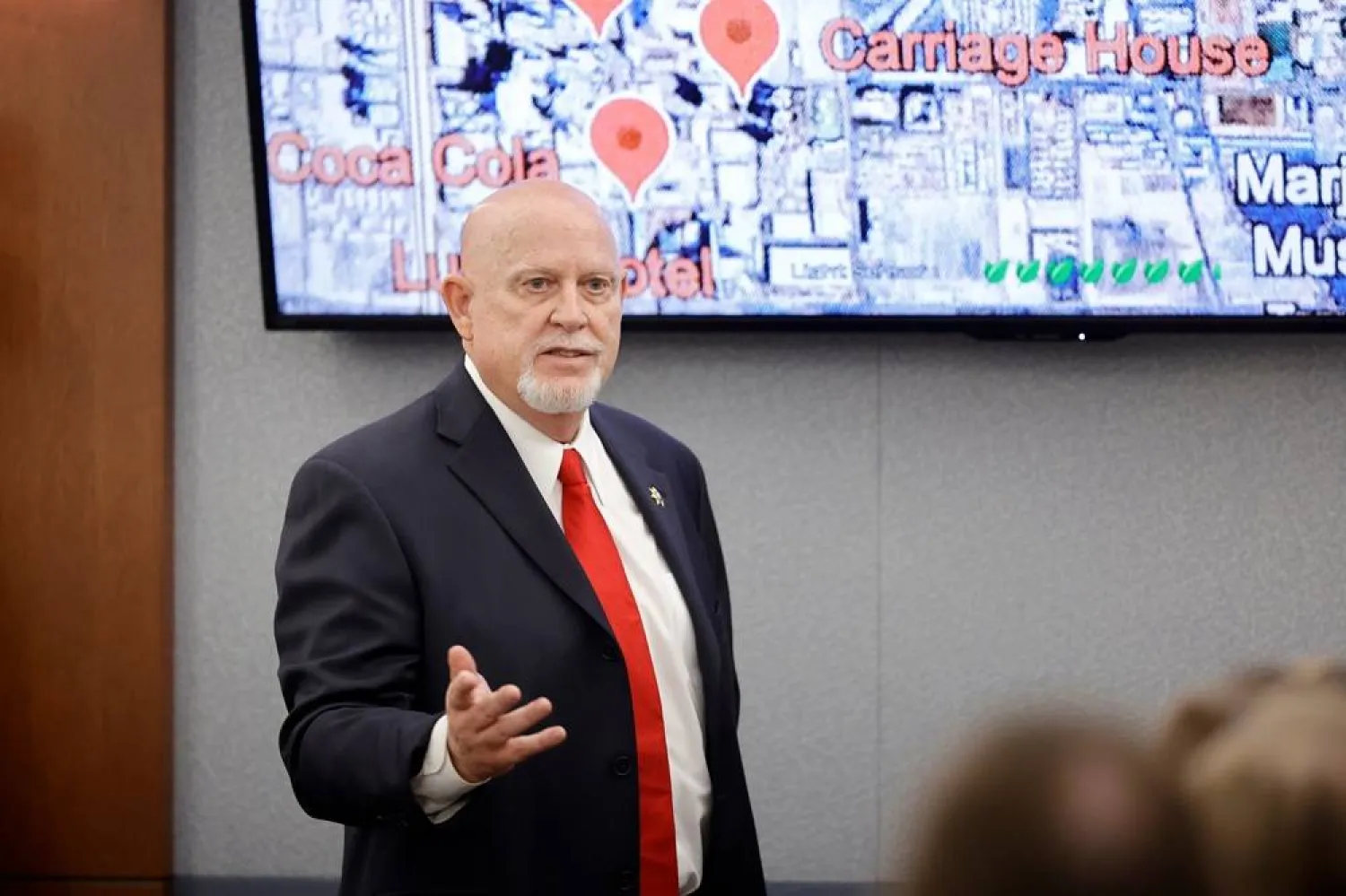
 Former Las Vegas Metro Police detective Dan Long testifies in court during the Duane Davis trial, related to the 1996 killing of rapper Tupac Shakur, in Clark County District Court at the Regional Justice Center in Las Vegas on Thursday, Aug. 27, 2026. (Steve Marcus/Las Vegas Sun via AP, Pool)
Former Las Vegas Metro Police detective Dan Long testifies in court during the Duane Davis trial, related to the 1996 killing of rapper Tupac Shakur, in Clark County District Court at the Regional Justice Center in Las Vegas on Thursday, Aug. 27, 2026. (Steve Marcus/Las Vegas Sun via AP, Pool)
TT

Detective in Tupac Case Says He Could Not Verify That Defendant Participated in Rapper’s Shooting

 Former Las Vegas Metro Police detective Dan Long testifies in court during the Duane Davis trial, related to the 1996 killing of rapper Tupac Shakur, in Clark County District Court at the Regional Justice Center in Las Vegas on Thursday, Aug. 27, 2026. (Steve Marcus/Las Vegas Sun via AP, Pool)
Former Las Vegas Metro Police detective Dan Long testifies in court during the Duane Davis trial, related to the 1996 killing of rapper Tupac Shakur, in Clark County District Court at the Regional Justice Center in Las Vegas on Thursday, Aug. 27, 2026. (Steve Marcus/Las Vegas Sun via AP, Pool)

A former Las Vegas police detective told jurors on Thursday he could not corroborate the story of an ex-gang leader who said he was involved in the drive-by killing of Tupac Shakur but now denies being responsible for the shooting.

Duane "Keffe D" Davis, 63, is charged in Nevada's Clark County with a single count of murder using a deadly weapon. He has pleaded not guilty. Davis is accused of leading a group of men to kill Shakur, 25, who was one of rap's most commercially successful and influential artists, in ‌a drive-by shooting ‌near the Las Vegas Strip.

The case rests almost entirely on ‌Davis' ⁠public and private statements ⁠that he was in the car with Shakur's killer and passed him the gun. Davis' lawyer, Michael Sanft, told jurors during opening statements these statements were mere bravado and could not be backed up with evidence.

On Thursday, Sanft called to the stand a former Las Vegas Metropolitan Police Department homicide detective who interviewed Davis in 2009. Dan Long said he believed what Davis said but conceded he could not verify his statements.

"I ⁠wasn't able to verify any of that," Long said.

Sanft rested ‌his case on Thursday and Davis did ‌not testify. Closing arguments are set for Monday.

The defense’s strategy rests on impugning Davis’ credibility while ‌convincing jurors that his stories were mere bravado. It is a risky strategy, ‌but Davis’ self-incrimination leaves him little choice.

Over the past two weeks, prosecutors from the Clark County District Attorney’s Office played hours of recordings for jurors, including public interviews and secret meetings with investigators, where Davis said he was enraged after Shakur and his entourage beat up Davis’ nephew ‌at a Las Vegas casino on September 7, 1996.

Davis and three other men including his nephew went looking for Shakur and ⁠his record producer ⁠Marion “Suge” Knight in a white Cadillac on the night of the beating, he said. Davis said he passed a gun to the backseat, and when they found Knight and Shakur’s car, one of the two men in the back opened fire.

Prosecutors have not named the shooter, and the three other men in the car have since died. Under Nevada law, Davis can be charged with murder even though he did not pull the trigger.

Davis was a leader of the Southside Compton Crips, a Los Angeles-area street gang that feuded with rival gang Mob Piru, which was associated with Shakur and his record label Death Row Records.

Shakur's killing in 1996 became a seminal moment in rap history and heightened hip-hop culture's violent image during “gangsta” rap’s heyday, an era defined by feuding between East and West Coast artists.


‘End of an Era’: Players Lament Decline of the Disc at Gamescom

Trade fair visitors are seen at the Gamescom gaming convention in Cologne, Germany, 27 August 2026. (EPA)
TT

‘End of an Era’: Players Lament Decline of the Disc at Gamescom

Trade fair visitors are seen at the Gamescom gaming convention in Cologne, Germany, 27 August 2026. (EPA)

Some video game fans are flabbergasted at Sony's decision to discontinue disc sales from 2028 at Germany's Gamescom trade show -- leading to calls for a boycott.

"It's a bad decision," British developer Chris Bastin, 34, told AFP. "It's the end of an era. I wish it wasn't."

While Sony's announcement in early July to stop releasing games on discs came as a bombshell for gamers, the economics of the industry meant the decision was long in the making, Joost van Dreunen, a professor at New York University's Stern School of Business, told AFP.

"Digital distribution has been a replacement very much of physical carriers for the last 10 years," he said, with online stores replacing the discs once associated with the Xbox and PlayStation or the cartridges for some of Nintendo's consoles.

"Retail usually historically costs 20 to 30 percent of total margin on the sale of a single disc," Dreunen said, as stores take a cut of any sale. "By distributing it digitally through their own network and their own servers, they save a huge amount of margin."

Digital downloads accounted for nearly 82 percent of game sales on the PS4 and PS5 at the start of 2026, Sony said in late July.

The Japanese giant helped popularize console discs in the 1990s after launching its first PlayStation.

- 'Sentimental value' -

The shift has caused uproar among some who fear that losing access to a physical copy makes gamers dependent on the goodwill of service providers, who may or may not maintain players' digital accounts into the future.

"They don't go digital to pass on savings to the consumer," Clemens Istel, a spokesman calling for the boycott, told AFP.

"They go digital to make more profit. And there is zero indication that the customer will benefit from this."

In its 2025 report, French industry gaming group SELL found that while physical sales had fallen to 11 percent of the country's market, big titles like "EA Sports FC 26" and "Assassin's Creed Shadows" nevertheless sold hundreds of thousands of physical copies.

Thomas Bachellerie, who used to manage a games shop in Lyon, warned that second-hand sales sometimes made up almost a third of stores' turnover -- a problem since digital games "cannot be resold or lent".

For some, simple nostalgia plays a role.

"I have the 'Oblivion Collector's Edition' that I bought when I was a teenager, early teenager," Australian civil servant Scott Whiting told AFP at the fair, referring to the critically acclaimed fourth instalment in the best-selling "The Elder Scrolls" role-playing franchise.

"I still, I've moved 10 times since I bought it and I still carry that case around," he said.

"It still means something to me," he added. "There's emotional value in it, sentimental value, and I still look at games that I bought 20 years ago."

- Monopoly? -

Due for release on November 19, the highly anticipated "Grand Theft Auto VI" has also drawn criticism because its physical game box contains only a download code.

"That's a very bad sign," Bachellerie said. "GTA is a game that is supposed to keep us going for 10 years. For a shop, there is almost no point in selling it anymore."

But whatever some gamers might think, Geoffray Brunaux, a lawyer specializing in digital law, told AFP that holders of a physical game did not own it any more than those with a digital copy.

"Whether it is physical or digital, you never actually own the game," he said.

Gamers buy licenses to play the game -- licenses that can be withdrawn.

Consumer movements have sought to stop publishers pulling the plug on games they decide are no longer worth keeping online.

In January, the European Commission took receipt of the "Stop Destroying Videogames" petition, signed by almost 1.3 million people, after high-profile instances of games being switched off.

But anti-trust law can come in handy for gamers, Brunaux said.

The Dutch Stichting Massaschade & Consument consumer group is suing Sony for forcing PlayStation owners to buy from the PlayStation Store, alleging monopolistic practices that drive up the price of digital goods.


A Lasting Dolly Parton Legacy: Childhood Literacy

Fans of Dolly Parton visit a mural featuring her likeness in the city's North Side on August 26, 2026 in Chicago, Illinois. (Getty Images/AFP)
TT

A Lasting Dolly Parton Legacy: Childhood Literacy

Fans of Dolly Parton visit a mural featuring her likeness in the city's North Side on August 26, 2026 in Chicago, Illinois. (Getty Images/AFP)

To nine-year-old Zenaida, it wasn't Dolly Parton's storied country music career that made her so great.

It's the entertainment icon's beloved Imagination Library book donation program that has had the biggest impact on the young girl's life.

"These are the first books I learned how to read," Zenaida told AFP late Wednesday, flipping through Parton's "Coat of Many Colors" children's book at a makeshift memorial in the singer-songwriter's hometown at the foot of the Great Smoky Mountains.

Parton's extraordinarily successful book project was borne of personal anguish: her own father grew up illiterate in rural Tennessee.

But thanks to the Imagination Library, millions of children like Zenaida in the United States and around the world have received a literacy boost from Parton herself: books that arrive by mail, for free, from birth until age five.

For Kendal Manning's two young boys, the program has been a godsend.

"We've been receiving their books since they were born. We have them all," the 41-year-old theater performer told AFP at the memorial, where several Imagination Library books were left among the flowers.

When Manning's boys were born, "immediately we were sent something in the mail to sign up," she said.

"It says mountains about the person that she is, the heart that she had for people," Manning said.

Parton, who died this week at 80, is globally renowned for her music. But locals remembered her more for her charitable giving and care for younger generations in blue-collar regions of her native east Tennessee.

Her non-profit foundation is committed to keeping the popular program going.

What began in 1995 as Parton's modest giveaway of 6,000 books to needy children has mushroomed into an operation involving hundreds of local groups and multiple publishers.

"Now we give away 3.4 million books a month to kids" up to age five, Dollywood Foundation's treasurer Eugene Naughton told AFP.

The foundation funds the program, along with several other donors.

- The Book Lady -

Literacy was a critical focus for Parton, who has said she set up the Imagination Library because of her own father's inability to read, which "probably kept him from seeing all his dreams come true."

"I'm the Book Lady to lots of kids, and I take great pride in that," she once said in an interview with NBC's Boston affiliate.

The books have reached countless families in east Tennessee, where hospitals often invite new parents into the program.

"I signed up all five of my grandchildren on the day they were born," Susan Williams recalled in Sevierville.

"My children had the books too, and now their children have them. Two generations," she said, holding back tears.

Imagination Library claims 300 million books gifted since its inception. The program has extended to Australia, Britain, Canada and Ireland.

In the United States, Parton's books have reached as far as Bethel, Alaska, a small town accessible only by plane or boat that serves as a hub for Indigenous villages.

Zenaida's mother Katy Allis had brought her four children to the Parton memorial to honor the woman who changed their lives.

Her son Victor, 11, plopped onto the sidewalk to read his Imagination Library edition of "Llama Llama Red Pajama," a family favorite.

"I see her program as a part of our collective culture," said Allis.

"I don't know there are even words to express how important that is."

Local teacher Tabitha Thomas, 34, was also at the memorial with her three children who are growing up with the books, including her seven-month-old who has already received a few in the mail.

Impoverished kids in the region "often don't have the money to buy those books, so it helps a lot of the community," she said of Parton's generosity.

"She's touched so many lives."


Tim Curry, Actor Famed for ‘Rocky Horror Picture Show,’ Dead at 80

Tim Curry attends the Museum of the Moving Image salute to Alec Baldwin in New York on Feb. 28, 2011. (AP)
TT

Tim Curry, Actor Famed for ‘Rocky Horror Picture Show,’ Dead at 80

Tim Curry attends the Museum of the Moving Image salute to Alec Baldwin in New York on Feb. 28, 2011. (AP)

Tim Curry, the baritone-voiced British actor who pranced to movie fame in the 1975 cult classic "The Rocky Horror Picture Show," has died at the age of 80, Variety and other outlets reported.

A cause of death was not immediately given, but Curry had been in ill health for some time.

Curry appeared in numerous movies, often as a hammy villain, was nominated three times for a Tony Award for Broadway roles, and performed voice work in many animated films and TV shows.

But his best-known role was Dr. Frank N. Furter, which came in his debut film, the outrageous, crowd-pleasing horror-comedy-musical "The Rocky Horror Picture Show," co-starring Susan Sarandon and Barry Bostwick.

In a 1975 television interview, Curry ‌noted the risk ‌of having his career defined by such an outlandish role - a prescient worry, as it ‌turned ⁠out. "When I read ⁠it, I just thought it was very, very witty and funny," Curry said, although he confessed to some initial reluctance.

"I mean, I was hesitant in that, if it worked, it might be a difficult thing to shake off. But, really, I've always thought that it (a part) wasn't worth doing unless you took a risk," Curry said.

Among his other films were "Charlie's Angels" (2000), "Muppet Treasure Island" (1996), "The Shadow" (1994), "The Three Musketeers" (1993), "Home Alone 2: Lost in New York" (1992), "Clue" (1985), "Legend" (1985) and "Annie" (1982).

OVER-THE-TOP VILLAINS

Curry did much of his best work on stage. He was nominated for a Tony, Broadway's top honor, in 1981 for his role as Mozart in "Amadeus," a tale of the ⁠great composer's interaction with jealous rival Salieri. Curry was also nominated for a Tony ‌in 1993 for "My Favorite Year" and in 2005 for his role as ‌King Arthur in the zany "Monty Python's Spamalot."

Possessing a rich baritone voice, he was in demand as a voice actor for animated films ‌and TV shows. He won a Daytime Emmy Award in 1991 for his voice work on the animated "Peter ‌Pan & the Pirates."

With his sinister grin and menacing laugh, Curry was frequently cast in Hollywood films as a villain - sometimes with comic overtones, which let him deliver the type of over-the-top performances for which he was famed.

"I do love those roles – they're always the best written," Curry told interviewer Andrew Kay in 2011.

He conceded that some of his movies were mediocre, singling out 1995's "Congo," a ‌tale of diamond mines and killer gorillas.

"I was really very bad in it," Curry said. "I won a Razzy award for one of the worst performances of the ⁠year – and I richly deserved ⁠it, too."

A CULT FOLLOWING

Curry was born in the English village of Grappenhall, Cheshire, on April 19, 1946. His father, a Royal Navy chaplain, died when he was 12. His mother was a school secretary.

Curry studied drama at Birmingham University.

In 1973, he landed the part of Dr. Frank N. Furter in the original London stage version of "The Rocky Horror Show." He performed the play in New York and Los Angeles before it was made into a film, renamed as "The Rocky Horror Picture Show."

The movie was not an instant hit, but won a cult following in midnight screenings in New York City and elsewhere, with audience members often dressing up as "Rocky Horror" characters.

Curry withdrew from a British stage production in 2011 due to ill health. In 2013, his agent said that he had suffered a stroke, but was recovering "in great humor."

From then on he used a wheelchair and reduced his workload. In 2024, he did, however, return to the big screen, appearing in the horror film "Stream."

Curry, who lived in Los Angeles, never married and had no children. A composer and a singer, Curry also performed with his own rock band and released a handful of albums.